

Industry News

Cal/OSHA Issues Electronic Filing Requirement For 2017 OSHA 300A Form
Author, Alyssa Burley, Client Services Coordinator, Rancho Mesa Insurance Services, Inc.
In April 2018, federal OSHA announced all affected employers are required to submit injury and illness data (i.e., Form 300A data) via the Injury Tracking Application (ITA) online portal by July 1, 2018, even if the employer is covered by a state plan like those in California, Maryland, Minnesota, South Carolina, Utah, Washington or Wyoming.
Author, Alyssa Burley, Client Services Coordinator, Rancho Mesa Insurance Services, Inc.

In April 2018, federal OSHA announced all affected employers are required to submit injury and illness data (i.e., Form 300A data) via the Injury Tracking Application (ITA) online portal by July 1, 2018, even if the employer is covered by a state plan like those in California, Maryland, Minnesota, South Carolina, Utah, Washington or Wyoming.
Cal/OSHA then issued a statement in May 2018, advising affected employers “to comply with federal OSHA’s directive to provide Form 300A data covering calendar year 2017," even though it was not a Cal/OSHA requirement.
“On November 1, 2018,” according to the Cal/OSHA website, “the Office of Administrative Law approved the emergency action. This means that the employers in California described below are now required to submit Form 300A data covering calendar year 2017 by December 31, 2018. These employers should follow the instructions posted at federal OSHA's ITA website:
Check Appendix H for your industry. It includes industries like: Construction; Community/Nursing/Residential Care facilities; Community Food/Housing Relief Services; and many more.
All employers with 250 or more employees, unless specifically exempted by section 14300.2 of title 8 of the California Code of Regulations
Employers with 20 to 249 employees in the specific industries listed in Appendix H of the emergency regulations.”
This emergency action by the Office of Administrative Law brings Cal/OSHA’s requirements up to the federal OSHA’s minimum standards, with one difference. Federal OSHA required affected employers covered by state plans to submit the 2017 Form 300A data electronically by July 1, 2018, while this new action requires affected California employers to submit the data by December 31, 2018.
Since the Federal OSHA deadline has already passed, it is recommended that all affected employers in California who have not already submitted the 2017 Form 300A data via the ITA, submit it as soon as possible, but no later than December 31, 2018.
Next year, the deadline for electronically submitting 2018 Form 300A data will be March 2, 2019.
Rancho Mesa has put together a 9-minute tutorial video on how to generate the electronic Form 300A data file from the Risk Management Center, that can be uploaded to the ITA website for reporting the data.
For questions about how to track the injury and illness data in the Risk Management Center, contact Alyssa Burley at (619) 438-6869.
Benefits of using GPS Tracking Devices for Automobile Fleets
Author, Chase Hixson, Account Executive, Human Services Group, Rancho Mesa Insurance Services, Inc.
Global Positioning System (GPS) tracking devices have become a popular topic with employers who maintain vehicle fleets. The companies want to know what the advantages are of having these devices installed on their fleet vehicles and will it reduce their insurance costs.

Global Positioning System (GPS) tracking devices have become a popular topic with employers who maintain vehicle fleets. The companies want to know what the advantages are of having these devices installed on their fleet vehicles and will it reduce their insurance costs.
The short answer is yes. Some insurance carriers provide a credit for having GPS systems installed on vehicles. Others may include a discount in their overall assessment of the company’s risk profile. Taking a proactive stance will be noticed by a carrier and taken into account.
The most important element of having GPS tracking is what the company does with the information received. It’s not enough to just install the device. The information generated should be used to promote corrective and preventative action within the organization. Rancho Mesa suggests organizations provide trainings, periodic ride-a-longs by a supervisor, and implement some kind of corrective behavior should the GPS show unfavorable driving behavior such as speeding or taking a less favorable route.
Other Benefits
Rancho Mesa clients have experienced indirect, sometimes unexpected, benefits from implementing a GPS System. These benefits include decreased fuel and labor costs, and ultimately more efficiency. Knowing the routes are being tracked can lead to a greater sense of accountability from employees as to what routes they are taking and how long they are spending on each trip. It can also allow decision makers to properly direct service calls to the right technician knowing who is in the vicinity.
For more information about the benefits of using a GPS system to lower insurance costs, contact Rancho Mesa Insurance Services at (619) 937-0164.
2019 Expected Loss Rates Published in California’s Updated Regulatory Filing – X-MOD Impact Inevitable for 0042 Class Code
Author, Drew Garcia, Vice President, Landscape Group, Rancho Mesa Insurance Services, Inc.
The 2019 Expected Loss Rate (ELR) for Landscaping class code 0042 was recently published at a 15% decrease or $2.97.
The ELR is the factor used to anticipate a class code’s claim cost per $100 for the experience rating period. It is not to be confused with the Pure Premium Rate (PPR). The ELR differs from the PPR in that the ELR simply measures the basic claim cost for a class code without including loss adjustment expense, excess loss load (capped at $175,000 for X-MOD purposes), and loss development.
Author, Drew Garcia, Vice President, Landscape Group, Rancho Mesa Insurance Services, Inc.
The 2019 Expected Loss Rate (ELR) for Landscaping class code 0042 was recently published at a 15% decrease or $2.97.
The ELR is the factor used to anticipate a class code’s claim cost per $100 for the experience rating period. It is not to be confused with the Pure Premium Rate (PPR). The ELR differs from the PPR in that the ELR simply measures the basic claim cost for a class code without including loss adjustment expense, excess loss load (capped at $175,000 for X-MOD purposes), and loss development. The PPR includes all of the mentioned above factors and is the rate for which a carrier can expect to pay for all of the cost associated with claims in a specific industry. The PPR does not account for the carrier’s overhead, profit, tax, and commissions.

Under most circumstances, when you hear the word decrease as associated with insurance its a good thing, but in the case of the ELR, a decrease will have a negative impact on your Experience MOD (X-MOD). In simple terms, if your losses stay the same and the ELR for your industry is down 15%, your X-MOD is going to go up.
At 15%, the landscape class code accounts for one of the largest swings in the 2019 regulatory filing for all industries. This only reinforces the importance of mitigating claim frequency, superior carrier claims handling, internal claims advocacy, claim cost consolidation efforts, and a proven system to keep all of these aspects running constantly. Fortunately, Rancho Mesa has a system in place today and it is a proven success.
Don’t be caught off guard in 2019; have a plan and always anticipate for the future. Let Rancho Mesa help manage your landscape insurance needs. For more information, call (619) 937-0164.
Distracted Driving, Not Just an Automobile Insurance Issue, Bad News for Workers Compensation Too
Author, David J Garcia, A.A.I, CRIS, President, Rancho Mesa Insurance Services, Inc.
I’ve written at length on the negative effects distracted driving is having on the automobile insurance industry and its impact on the rise in accidents, claim costs, and increases to your automobile premiums. But, have you considered its effects on your Experience Modification Rate (EMR) and ultimately workers’ compensation cost?
Author, David J Garcia, A.A.I, CRIS, President, Rancho Mesa Insurance Services, Inc.
I’ve written at length on the negative effects distracted driving is having on the automobile insurance industry and its impact on the rise in accidents, claim costs, and increases to your automobile premiums. But, have you considered its effects on your Experience Modification Rate (EMR) and ultimately workers’ compensation cost?
When one of your employees is injured in an automobile accident while working on your behalf, Arising out of Employment (AOE) / Course of Employment(COE) their sustained injury will be covered by your workers’ compensation policy, regardless of fault.

“Regardless of fault?!”
When a third party is deemed at fault and the injuries to your employee(s) have been settled, your workers’ compensation insurance carrier may “subrogate” their costs to the carrier representing the at fault driver. Now, here is the realty – studies have shown that 14.7% (4.1 million) of all California drivers are uninsured, while another large percentage of drivers hold the California minimum limits of $15,000/$30,000. What this means is that even if subrogation is a possibility, the likelihood of a “full” recovery is not probable. Thus, all the costs of the injury to your employee(s) will likely be the sole responsibility of your workers’ compensation carrier and this claim cost negatively affects your EMR and loss ratios for years to come.
What can you do?
You can implement a strong fleet safety program that includes a policy pertaining to distracted driving. When your employee is involved in a motor vehicle accident, adherence to your company’s accident investigation protocol is crucial. Documentation will prove pivotal for your carrier if subrogation becomes a possibility.
For our clients, through RM365 Advantage, we have a number of resources: fleet safety programs that can be customized, fleet safety training topics, fillable and printable accident investigation forms, archived fleet safety workshop videos, and more, in both English and Spanish. You can access this through our RM365 Advantage Risk Management Center or contact our Client Services Coordinator Alyssa Burley at aburley@ranchomesa.com.
If you are not a current client of Rancho Mesa, we encourage you to reach out to your broker for assistance or email Alyssa Burley to get additional information or to ask any questions.
Fleet Safety: Four Steps to Effective-Driver Selection
Author, Sam Clayton, Vice President Construction Group, Rancho Mesa Insurance Services, Inc.
Driver selection guidelines are one of the most important things a company can implement to prevent vehicle accidents. A company should manage a written Motor Vehicle Records (MVR’s) program to assure that they are selecting the right employees to drive for the company and annually qualify each driver for desirable driving records. The following are some “best practices” guidelines that will help businesses implement and improve the driver selection process.

Author, Sam Clayton, Vice President Construction Group, Rancho Mesa Insurance Services, Inc.
Driver selection guidelines are one of the most important things a company can implement to prevent vehicle accidents. A company should manage a written Motor Vehicle Records (MVR’s) program to assure that they are selecting the right employees to drive for the company and annually qualify each driver for desirable driving records. The following are some “best practices” guidelines that will help businesses implement and improve the driver selection process.
Step 1: Determine who drives for the company.
The first thing a business must do to control driver selections is knowing who is driving on behalf of the company. Most companies have drivers that fall into several categories:
Non-employees operating company vehicles
Drivers of vehicles owned or leased by the company
Drivers with a Commercial Drivers License (CDL)
Employees driving their own vehicle for company business
Step 2: Establish specific requirements depending on whose is driving.
For all employees, regardless if they are operating a company owned or leased vehicle, the company must:
Verify the person has a valid Driver License.
Determine that the license is appropriate for the type of vehicle they will be operating.
Request a copy of their Motor Vehicle Record (MVR) and compare it to the acceptable criteria before they drive for the company, and again on an annual basis.
For drivers of vehicles owned or leased by the company, it is wise to ask for a:
Completed written application that includes a section that lists all driving violations and/or accidents within the last 3 years.
Substance abuse test (optional).
For drivers with a Commercial Driver License:
Conduct a Department of Transportation (DOT) physical examination.
Create a driver qualification file for each driver that complies with DOT.
Conduct a drug test for each driver, following DOT regulations (pre-hire, random, post-accident and suspension).
For employees using their own vehicles for company business:
Require proof of insurance.
Establish minimum personal limits of insurance. Rancho Mesa recommends a minimum of $100,000/$300,000/$100,000.
Step 3: Establish MVR Qualification Process
Managing the driver selection and ongoing qualification process is the employer’s responsibility. There is a broad range of driving violations that can be classified into two major categories “A” and “B.”
Category “A” would include driving under the influence of drugs, refusing to take a substance test, reckless/careless driving, speeding in excess of 14mph over the posted speed limit, texting, hit and run, speeding in a school zone, racing, driving with a suspended or revoked license, vehicular assault etc.
Category “B” would include, speeding 1-14 mph over posted speed limit, improper lane change, failure to yield, failure to obey traffic signal or sign, accidents, having a license suspended in the past for moving violations, etc.
Best practices for MVR qualifications include:
Anyone with a type “A” driving violation in the last five years is undesirable for a driving position.
Anyone with three or more type “B” violations, or two or more at fault accidents in a three-year period, is undesirable for a driving position.
Anyone with two type “B” moving violations, or one driving accident in the last three-year period, should be put on warning and MVR’s reviewed semi-annually.
In addition to the initial MVR check upon hire, all employees who routinely drive their personal vehicle on company business should have their MVR screened at least once every 12 months to ensure their driving record remains acceptable.
Step 4. Enroll all employees in the DMV Pull Notice Program.
For a nominal annual fee, employers can enroll in the Department of Motor Vehicles' Pull Notice Program. This service provides employers with a notice of any moving violations within 24 hours. So, an employer will know right away if one of their drivers' records has changed. Not participating in the program makes the company vulnerable to going months with an unqualified driver before an annual MVR review is completed.
Following these best practices for effective driver selection takes the guest-work out of determining who should drive for a company. Following these four steps can help ensure the company has qualified drivers at all times.
For questions about driver selection, contact Rancho Mesa Insurance Services, Inc. at (619) 937-0164.
Focus on preventing Back Injuries: Introducing Rancho Mesa’s A.B.L.E Lift Protocol and the “Field” Mobility & Stretch Program
Author, Drew Garcia, Vice President, Landscape Group, Rancho Mesa Insurance Services.
Physical work is demanding on our bodies. As the employer, what are you doing to help your employees prepare for the day’s work? Collectively, the most severe injuries come from the lower back by way of strain or sprain as a result of lifting. It’s not always the heavier objects causing the injuries. In many cases, early morning “light” lifts or movements can quickly cause a strain or sprain.
Author, Drew Garcia, Vice President, Landscape Group, Rancho Mesa Insurance Services.
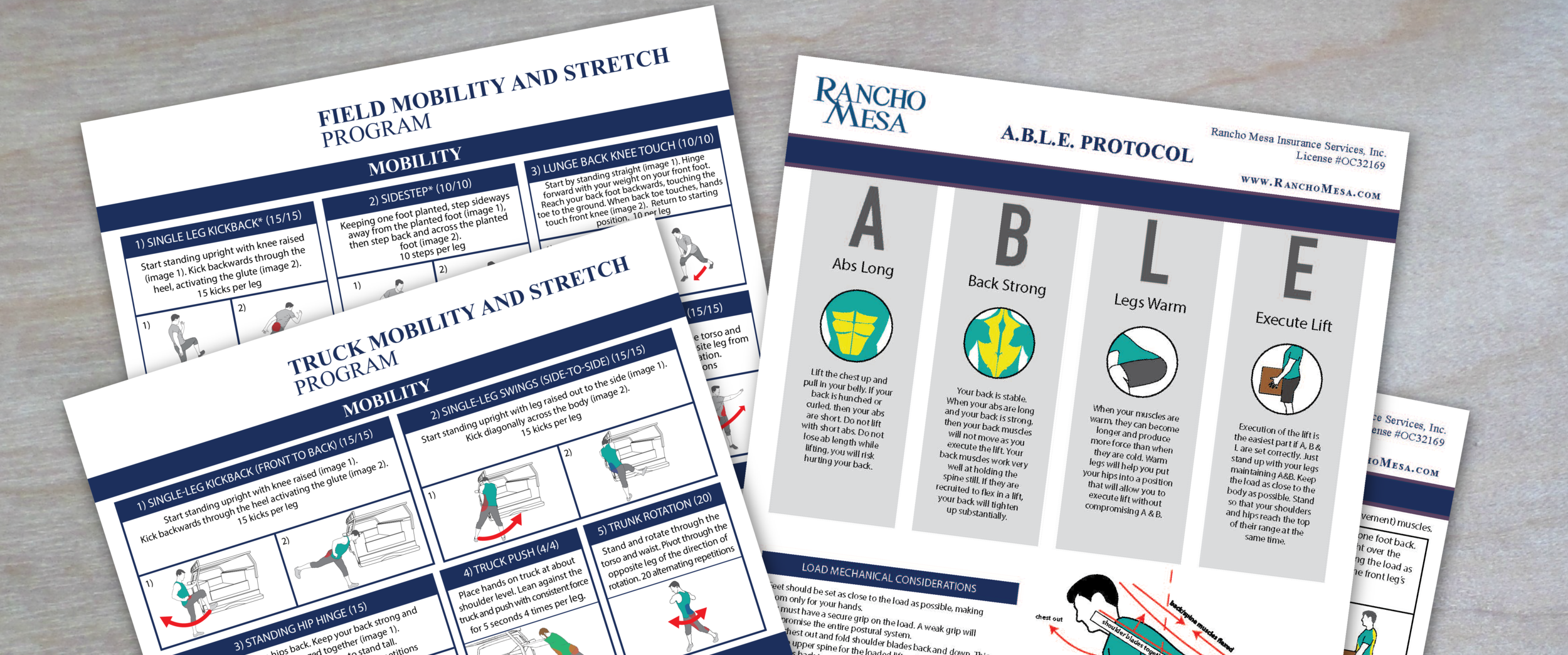
Mobility & Stretch Program and ABLE Lift Protocol flyers.
Physical work is demanding on our bodies. As the employer, what are you doing to help your employees prepare for the day’s work? Collectively, the most severe injuries come from the lower back by way of strain or sprain as a result of lifting. It’s not always the heavier objects causing the injuries. In many cases, early morning “light” lifts or movements can quickly cause a strain or sprain. Eliminating lifting exposures is the ultimate solution to limiting back strains; however, it is not always possible. Interactively training your employees to accurately lift material with proper technique is a preventive approach you can implement today to limit your businesses lifting exposure.
Following the success of our “Truck” Mobility and Stretch Program, Rancho Mesa is excited to announce, in conjunction with Collin Dawson CPT., A.B.L.E. “Lift” Protocol to help physically train your employees to execute proper lift decision making and establish the correct physical eliminates it takes to perform a lift. Not all lifts are the same, each one contains different variables, but the same simple body positioning and lift techniques are relevant no matter the exposure.
Our “Truck” Mobility and Stretch Program was highly received and ultimately implemented by many of our clients. Over the past nine months we have worked to address the need for a Mobility and Stretch Program to be lower back specific, but with the ability to perform the exercises without the support of a truck or wall.
We knew the Mobility and Stretch Program would be beneficial. We were surprised to see the amount of clients willing to incorporate this program and ultimately are very pleased with the results, almost one year in. We challenged Collin to create another program that could be performed in a group setting without sacrificing the main purpose of the routine, which is to flex and strengthen the core muscles surrounding the back while providing total body activation. Our “Field” Mobility and Stretch Program does just that, but also provides some opportunity for participants to slowly begin to establish a better center of balance and body awareness, which can be practically applied to the work day and life. We hope this program will be just as well received.
Register for October 25, 2018 webinar where we will detail A.B.L.E. Lift and the recently developed “Field” Mobility and Stretch Program. Only those who attend the webinar will receive the following:
A PDF Mobility and Stretch Program branded to your company (upon request, 10-15 business days to process) “Truck” and “Field” Series
PDF version of A.B.L.E. Lift (8.5x11 and Poster Size)
Recognition on Rancho Mesa website for your participation in the workshop
30-minute complimentary phone assessment with Collin Dawson about these programs and further implementation strategies.
And remember, “Only lift if you are A.B.L.E.”!
Changes in the 2019 Experience Modification Formula – Are You Ready? (Part 2)
Author, David J. Garcia, A.A.I, CRIS, President, Rancho Mesa Insurance Services, Inc.
As we approach 2019, there will be several changes in the experience modification formula that directly affects the calculation of an employer's 2019 Experience Modification Rate (EMR).
Part 1 of this article describes the Primary Threshold and Expected Loss Rate. Read Part 1 of this article. Part 2 provides an overview of the changes to the EMR calculation.
Author, David J. Garcia, A.A.I, CRIS, President, Rancho Mesa Insurance Services, Inc.

As we approach 2019, there will be several changes in the experience modification formula that directly affects the calculation of an employer's 2019 Experience Modification Rate (EMR).
Part 1 of this article describes the Primary Threshold and Expected Loss Rate. Read Part 1 of this article. Part 2 provides an overview of the changes to the EMR calculation.
The Simplified Formula
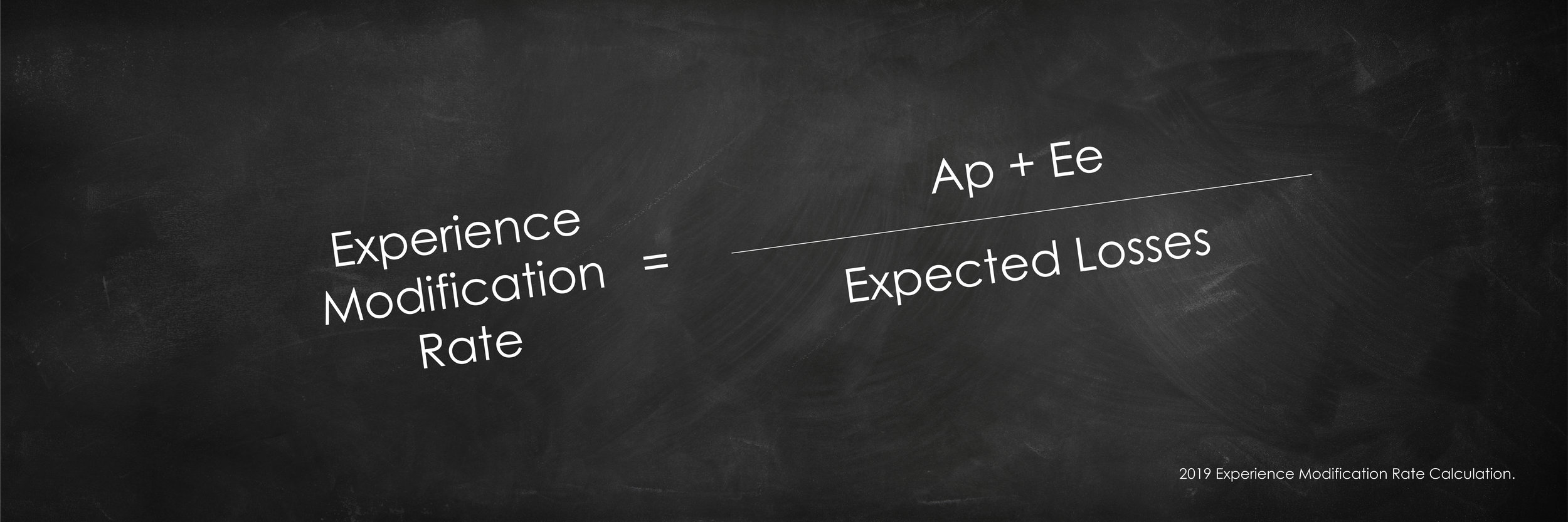
Individual claim cost (i.e., both paid and reserved) will go into the calculation up to the primary threshold limit are considered the actual primary losses. Any claim cost that exceeds your primary threshold is considered the actual excess loss. In past experience mod formulas, the actual excess loss was used in the factoring of your EMR; in 2019, it will have no effect. However, under the new calculation, the industry expected excess losses will be considered in the 2019 simplified formula.
Actual Primary Losses + Expected Excess Losses / Expected Losses
The expected excess losses are calculated by multiplying your class code’s payroll per $100 by the expected loss rate for that same class code. This number is then discounted by the “D Ratio” to determine expected primary losses and expected excess losses. There are 90 different D-Ratios for each classification based on the primary threshold. The D-Ratio is different for each classification and is determined by the severity of injuries that occur within that particular class code.
The first $250 of all claims will no longer be used in the calculation of your EMR.
This is a major change and one that was initiated in part to encourage all employers to report all claims, including those deemed first aid, without having a negative impact on the companys’ EMR. This change will affect all claims within the 2019 calculation; so yes, it will include years previously completed and reported. This will have a positive impact on EMRs in that claim dollars will be removed from the EMR calculation.
Confused – Want more details?
Help is on the way. We are going to hold a statewide webinar on Thursday, October 4th at 9:00am in order to dig deeper into this subject and answer specific questions. You may register for the webinar by contacting Alyssa Burley at (619) 438-6869 or aburley@ranchomesa.com.
Contractor Strategies to Maximize Your Bank Line of Credit
Author, Matt Gaynor, Director of Surety, Rancho Mesa Insurance Services, Inc.
Some of my most successful bond clients opened their construction business with a good amount of working experience on their resume, but only a minimal amount of cash and capital. Unfortunately, bond companies like to see a strong amount of cash and capital. Therefore, my goal, as their bond agent, is to work with what they have at the present time to explain why they are a “good risk” now for bid, performance, and payment bonds - along with ideas on how to overcome the initial cash and capital constraints.
Author, Matt Gaynor, Director of Surety, Rancho Mesa Insurance Services, Inc.

Some of my most successful bond clients opened their construction business with a good amount of working experience on their resume, but only a minimal amount of cash and capital. Unfortunately, bond companies like to see a strong amount of cash and capital. Therefore, my goal, as their bond agent, is to work with what they have at the present time to explain why they are a “good risk” now for bid, performance, and payment bonds - along with ideas on how to overcome the initial cash and capital constraints.
As a contractor grows and is looking at larger single and aggregate bond programs, I make it a point to work with the contractor on upgrading their financial presentation along with the goal to qualify for a Bank Line of Credit. It can sometimes be difficult to qualify for that “first” bank line of credit.
We want to help! On Friday, September, 28th, we will be inviting a local bank professional to cover "Contractor Strategies to Maximize their Bank Line of Credit." Our goal is to answer some of the following questions to prepare the contractor for a favorable submission process with the banker:
a) What is the typical information needed from the Contractor to apply for a Bank Line?
b) How do I determine what size Line of Credit I should ask for?
c) What are the “key” underwriting areas you will concentrate on?
d) How long after we provide you the information should we expect an answer?
e) To qualify for a line of credit – do we need to move our checking account to your Bank?
The seminar will allow us to pull back the curtain with the banker to make this process as seamless and painless as possible. The seminar will provide the contractor an opportunity to ask the questions you might have avoided because you assumed you did not qualify.
If interested, please register online or contact Rancho Mesa Insurance at (619) 937-0164.
Changes in the 2019 Experience Modification Formula – Are You Ready? (Part 1)
Author, David J. Garcia, A.A.I, CRIS, President, Rancho Mesa Insurance Services, Inc.
As we approach 2019, there will be several changes in the experience modification formula that directly affects the calculation of an employer's 2019 Experience Modification Rate (EMR). Sadly, most businesses are both unaware and unprepared.
Author, David J. Garcia, A.A.I, CRIS, President, Rancho Mesa Insurance Services, Inc.
As we approach 2019, there will be several changes in the experience modification formula that directly affects the calculation of an employer's 2019 Experience Modification Rate (EMR). Sadly, most businesses are both unaware and unprepared.
Before we breakdown the changes to the 2019 EMR formula, we must first have a strong understanding of the two critical components that directly affect the outcome of the EMR. This article will be broken out into 2 parts. Part 1 will describe the Primary Threshold and Expected Loss Rate. In Part 2, I will provide an overview of the changes to the EMR calculation.
The single most important number to my EMR is not my final rating?
Primary Threshold
Rancho Mesa has long taken a stance on the importance of a business owner knowing their primary threshold as it relates to the EMR. Proactive business owners should monitor their primary threshold annually as it is subject to change due to payroll fluctuations, operations, and the annual regulatory filing of the expected loss rate. In general terms, the more payroll associated with your governing class (the class code with the preponderance of your payroll) the higher your primary threshold will be. The primary threshold is unique to every business. The 2019 EMR formula is heavily weighted by the company's actual primary losses, the claim cost (both paid and reserved) that goes into the calculation up the primary threshold amount. Controlling claim cost and knowing your company's primary threshold is the first step to understanding the EMR.
Expected Loss Rates
The expected loss rate is the factor used to anticipate a class code's claim cost per $100 for the experience rating period. The expected loss rate (ELR) is not to be confused with the pure premium rate (PPR). The ELR differs from the PPR in that the ELR simply measures the basic claim cost for a class code without including loss adjustment expense, excess loss load (capped at $175,000 for X-MOD purposes), and loss development. The PPR includes all of the mentioned above factors and is the rate for which a carrier can expect to pay all of the cost associated with claims in a specific industry. The PPR does not account for the carrier’s overhead, profit, tax, and commissions.
The ELR changes, annually. It’s important to monitor the change; if your expected loss rates go down (from our analysis this is the direction most are going) and if nothing else changes, your EMR will go up. Why is this? Again, without going too deep, in simple terms, your EMR is a ratio of actual losses to expected losses. If your expected losses go down, but your actual losses remain the same, then your EMR will go up.
To illustrate this, consider the following. Actual losses are $25,000 and your expected losses are $25,000 your EMR would be 100. Now, if your actual losses stay the same at $25,000, but your expected losses drop to $20,000, your EMR would now be 125%. (There are other factors that would go into the actual calculation, so your actual EMR would be different – this was just to illustrate the expected losses impact to the EMR.)
In Part 2 of this article, will cover the actual changes to the EMR calculation.
For more information about the EMR, contact Rancho Mesa Insurance Services at (619) 937-0164.
Understanding Waivers of Subrogation for Contractors
Author, Casey Craig, Account Executive, Rancho Mesa Insurance Services, Inc.
In an era where general contractors commonly require a Waiver of Subrogation from its sub-contractors before they are allowed to step foot on the jobsite, it is important to understand how a Waiver of Subrogation functions. Most companies simply tell their agent they need the waiver added to their contract, but what does this mean? How does it affect the policy?
Author, Casey Craig, Account Executive, Rancho Mesa Insurance Services, Inc.
In an era where general contractors commonly require a Waiver of Subrogation from its sub-contractors before they are allowed to step foot on the jobsite, it is important to understand how a Waiver of Subrogation functions. Most companies simply tell their agent they need the waiver added to their policy, but what does this mean? How does it affect the policy?
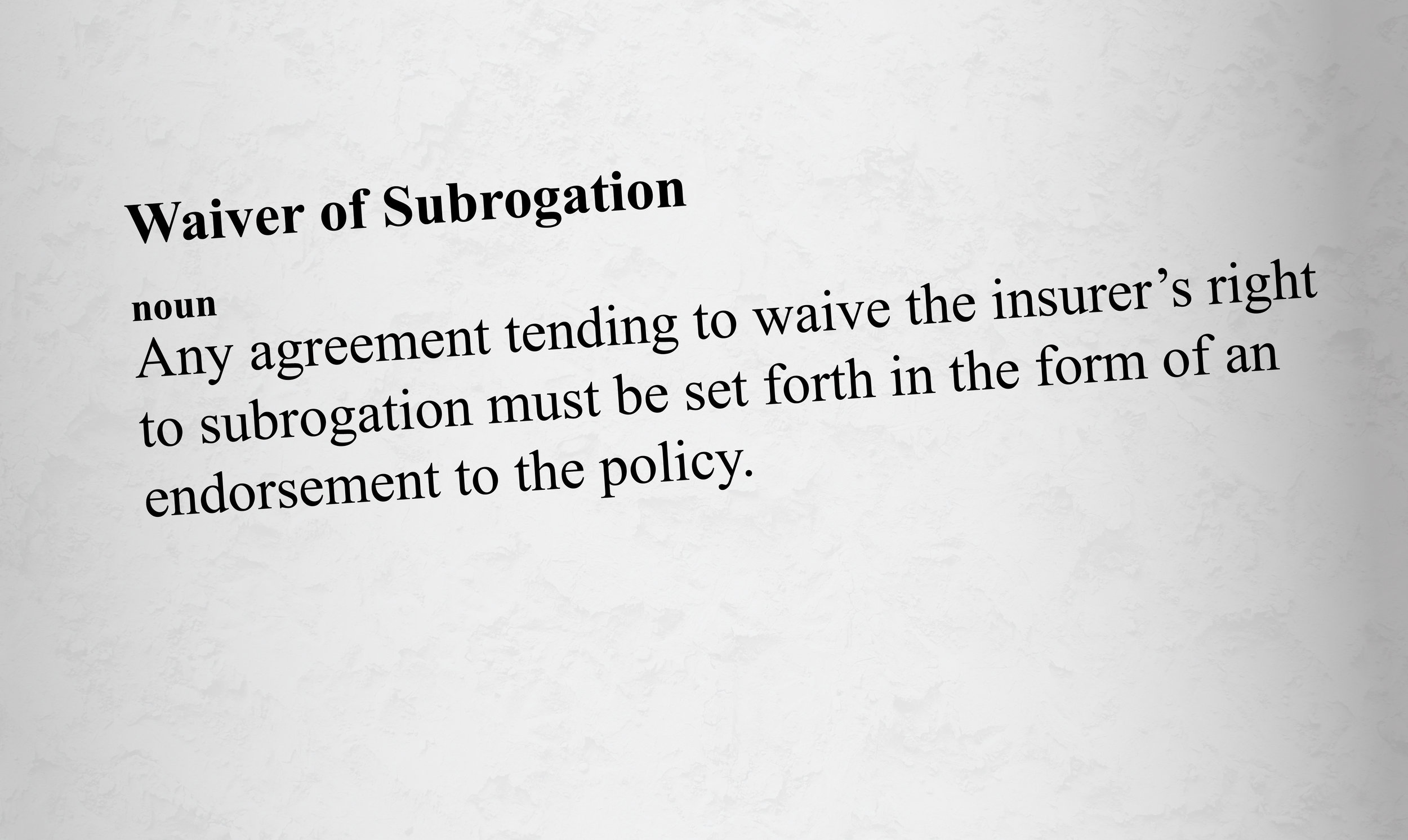
Subrogration is "the legal process by which an insurance company, after paying for a loss, seeks to recover all or a portion of the loss from another party who is legally wholly or partially liable for that loss," according to the Workers' Compensation Insurance Rating Bureau of California (WCIRB). So, a Waiver of Subrogration prevents your insurance carrier from recovering funds paid on a claim from the named party requesting the waiver.
When subrogating, three things must be established:
1) The defendant was negligent (or that a product was defective),
2) Negligence proximately caused the damages for which the carrier paid, and
3) The amount and nature of the damages.
If you cannot establish any one of these three, there will be no subrogation.
Subrogation is used throughout various lines of insurance. It is very common in dealing with auto insurance claims. If you are in an accident and the other driver is deemed to be at fault, your insurance company will respond first by paying to have your vehicle fixed. Then, the carrier will collect from the at fault driver’s insurance company to recover the amount they had to pay to fix your car. The insured’s carrier jumps on the claim immediately so that the insured will not have to wait for the claim to be disputed and resolved before their car is repaired. Claims are handled the same for every line of insurance, unless there is a Waiver of Subrogation in place.
When a sub-contractor is hired and has signed a Waiver of Subrogation for the project owner or general contractor, they are essentially waiving their carrier's ability to recover the money that was paid out on a claim that was caused by a third party's negligence. Waivers of subrogation often come in two formats. Either, the waiver specifically names an entity that the carrier waives its’ right to subrogate against, or a Blanket Waiver of Subrogation. If a Blanket Waiver of Subrogation is provided, the carrier must obtain permission from the named insured to subrogate against a third party.
When adding a Blanket Waiver of Subrogation to a policy, there is an additional fee to offset the carrier’s ability to reclaim money from any losses that were caused by a third party's negligence. These fees can change from carrier to carrier and it is a good move to review each policy to know exactly what you are paying for waivers. Adding a blanket waiver of insurance does not increase coverage or limits, it simply absolves an owner/general contractor of their liability.
With Waivers of Subrogation becoming more prevalent, it is easy to see how important it is as a business owner to know exactly what is covered and what you are waiving.
If you have any questions or would like to understand subrogation further, please contact Rancho Mesa at (619) 937-0164.
Three Reasons to Read Subcontractor Warranty Endorsements
Author, Sam Clayton, Vice President, Construction Group, Rancho Mesa Insurance Services, Inc.
Contractors General Liability Policies provide coverage for bodily injury and property damage for which the Named Insured is legally liable. This legal liability can result from the company’s direct operations or from other subcontractors hired by the Named Insured.
Author, Sam Clayton, Vice President, Construction Group, Rancho Mesa Insurance Services, Inc.

Contractors General Liability Policies provide coverage for bodily injury and property damage for which the named insured is legally liable. This legal liability can result from the company’s direct operations or from other subcontractors hired by the named insured.
Many general liability carriers will include some form of subcontractor warranty endorsement which establishes minimum requirements for subcontractors relative to insurance and other risk management benchmarks. At a minimum, these forms require written indemnification in favor of the named insured, certificates of insurance with additional insured wording, and specific insurance limits required by subcontractors.
These endorsements can vary widely from carrier to carrier; so, contractors may be faced with serious consequences in the event that requirements are not met. Below are three types of penalties policyholders may encounter:
- Coverage is DENIED relative to any loss resulting from the work of the subcontractors.
- Coverage is not altered, but a higher deductible or retained limit applies to any loss resulting from the work of the subcontractor. For example, should you fail to comply with the warranty, the deductible on the policy is amended from $5K to $25K.
- Coverage is not altered, but failure to comply will result in an additional premium charged at the final audit.
It is critical to have a strong contractual written transfer program in place with proper certificates of insurance from your subcontractors, regardless of the contract amount. Lean on your broker to interpret these endorsements and help negotiate the most favorable terms as you head into your renewal. Understanding these nuances can be the difference between a covered loss and an unexpected large capital expense.
For more information about subcontractor warranty endorsements, contact Rancho Mesa Insurance Services, Inc. at (619) 937-0164.
Six Reasons a Company’s Experience Modification Could be Recalculated
Author, Jeremy Hoolihan, Account Executive, Rancho Mesa Insurance Services, Inc.
Workers’ Compensation costs continue to be one of the most costly expenses for business owners in California. With recent reform, California has maintained steady rate decreases in the workers’ compensation marketplace. Unfortunately California still maintains some of the highest rates in the country, often times two to three times the nations average.
Author, Jeremy Hoolihan, Account Executive, Rancho Mesa Insurance Services, Inc.

Workers’ Compensation costs continue to be one of the most costly expenses for business owners in California. With recent reform, California has maintained steady rate decreases in the workers’ compensation marketplace. Unfortunately, California still maintains some of the highest rates in the country, often times two to three times the nations average.
Controlling insurance costs is vital to staying profitable and often times, staying in business. An important way business owners can control their insurance costs is by controlling their Experience Modification or X-MOD. An X-MOD is a benchmark of an individual employer against others in its industry, based on that employer's historical claim experience. This comparison is expressed as a percentage which is applied to an employer's workers' compensation premium.
The premium impact of a credit X-MOD (less than 1) vs a debit X-MOD (more than 1) can be significant. Business owners budget around their insurance costs. When there are unforeseen changes to their insurance costs it can have a dramatic effect. While it is rare, there are situations when an X-MOD can change in the middle of a policy term. Below are six circumstances when this could happen:
- If a claim that has been used in an X-MOD calculation is subsequently reported as closed mid policy term AND closed for less than 60% of the aggregate of the highest value, then the X-MOD is eligible for recalculation.
- In cases where loss values are included or excluded through mistake other than error of judgement. Basically, this rule takes into consideration the element of human error.
- Where a claim is determined non-compensable. Meaning the injury was determined to be non-work related.
- Where the insurance company has received a subrogation recovery or a portion of the claim cost is declared fraudulent.
- Where a closed death claim has been compromised over the sole issue of applicability of the workers’ compensation laws of California. Basically, if a person passes away at work but it was determined that the person had a pre-existing condition which caused the death, not work itself.
- Where a claim has been determined to be a joint coverage claim. This occurs mainly with cumulative trauma claims where there was no specific incident that caused an injury, but an injury that developed over time (i.e., wear and tear).
If any of the circumstances above have occurred, than a revised reporting shall be filed with the Workers’ Compensation Insurance Rating Bureau (WCIRB) and it shall be used to adjust the current and two immediately preceding experience ratings.
If you would like to discuss this topic in further detail, and learn how Rancho Mesa Insurance can audit your X-MOD worksheet for potential recalculations, please contact us at (619) 937-0164.
Seven Tactics to Reduce Slips and Falls when Landscaping a Slope
Author, Drew Garcia, Landscape Division Leader, Rancho Mesa Insurance Services, Inc.
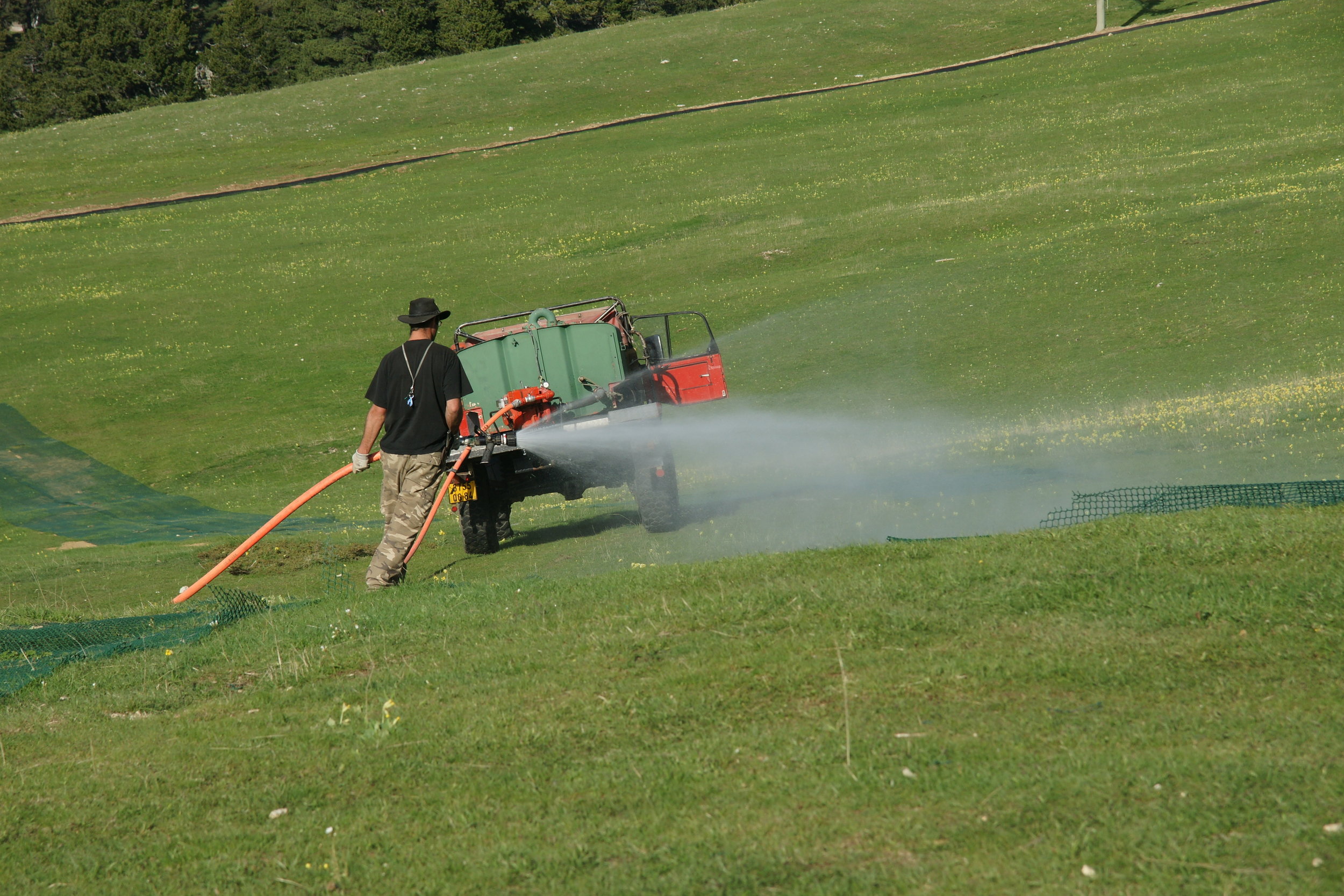
Is your company taking the necessary precautions to avoid serious and costly slips and falls from slope work? Many maintenance jobs will require employees to mow, weed abate, or plant on hillside locations as a part of the properties serviceable needs. The injury exposures that come with slope related work typically result in severe injuries. Any injury of this magnitude can result in lost time away from work by that employee and possibly permanent disability.
Author, Drew Garcia, Landscape Division Leader, Rancho Mesa Insurance Services, Inc.
Is your company taking the necessary precautions to avoid serious and costly slips and falls from slope work? Many maintenance jobs will require employees to mow, weed abate, or plant on hillside locations as a part of the properties serviceable needs. The injury exposures that come with slope related work typically result in severe injuries. Any injury of this magnitude can result in lost time away from work by that employee and possibly permanent disability.
Take your slope work safety to the next level. Evaluate what percentage of your operations includes this exposure and then proactively manage the risk through tactical solutions. Perhaps when you consolidate your work, you will realize the percentage of the properties in your portfolio that require hillside management is a small representation of your total body of work. Here are a few examples of tactics taken to lower this exposure that we have seen in the past:
- Eliminate the exposure all together by avoiding contracts that require slope work to be performed.
- Consider creating an experienced “slope crew” and train these employees on slope related protocol to ensure they are properly educated. By having a specialized slope crew you’re ensuring this work will be done by properly trained employees.
- Evaluate the time of day slope work is performed. Morning dew can cause slick surfaces and result in an employee losing balance.
- Make sure employees are wearing proper footwear.
- Strategically plan your route up the slope or through the slope prior to engaging in the operation.
- Always complete a pre-job hazard assessment and communicate the information to the crew onsite. Identify loose soil and rock conditions before accessing dangerous areas of the slope.
- Work in horizontal lines across the slope. Dislodged materials can fall on workers below. Remain vigilant for rolling boulders and loose rocks.
Are you doing anything extra special with your slope work to prevent injury? We would enjoy hearing your strategies; please share!
Please contact Rancho Mesa Insurance Services, Inc, at (619) 937-0200 if you have questions about managing risk for the landscape industry.
Six Proactive Steps to Prevent Heat Illness During a Scorching Summer
Author, Dave Garcia, President, Rancho Mesa Insurance Services, Inc.
The National Weather Service has issued heat warnings for many parts of California starting today, and excessive heat warnings for some other areas. Temperatures are expected to rise to 110ºF in some parts of the Sacramento Valley, for instance. In the desert areas of Imperial and San Diego counties, they will soar as high as 114ºF.
Author, Dave Garcia, President, Rancho Mesa Insurance Services, Inc.

The National Weather Service has issued heat warnings for many parts of California starting today, and excessive heat warnings for some other areas. Temperatures are expected to rise to 110ºF in some parts of the Sacramento Valley, for instance. In the desert areas of Imperial and San Diego counties, they will soar as high as 114ºF.
Recommendation
If you have employees working outdoors, you should have an effective heat illness prevention plan in place and train your workers on it's content. Elements of the plan include:
- Making sure those toiling outside have plenty of fresh, cool water – workers need to drink at least a quart an hour. Just providing it isn’t enough, according to the heat illness prevention standard (General Industry Safety Orders section 3395). You must encourage employees to drink water.
- Providing shade when the temperature reaches 80ºF, or when employees request it.
- If an employee is in danger of developing heat illness, they must be allowed to take a rest in the shade until their symptoms disappear.
- Having emergency procedures, including effective communication with workers in remote areas.
- Designating employees at each work site to call emergency medical services if someone starts to develop heat illness.
- Keeping a close eye on workers who have been on the job for two weeks or less. They may not have the prior training to be aware of the early signs of heat illness.
In order to prepare our clients, Rancho Mesa recently conducted a Heat Illness Prevention Workshop. For those of you who were not able to attend, the training videos are available in the Risk Management Center or via the Workshop Video Request Form.
Should you have any questions or need further assistance, please contact a member of your Rancho Mesa team. Please be safe!!
Independent Contractor Classification Changes Expected to Impact Construction Industry
Author, David J. Garcia, AAI, CRIS, President, Rancho Mesa Insurance Services, Inc.
With the recent ruling by the California Supreme Court concerning how 1099 employees (independent contractors) are defined, the construction industry's approach to utilizing these workers has changed significantly. The Court adopted a new test to determine whether the worker should be classified as an employee or independent contractor. The previous test to determine if a worker was an employee or independent contractor was whether the employer had the right to direct the manner and means by which the worker performed the services.
Author, David J. Garcia, AAI, CRIS, President, Rancho Mesa Insurance Services, Inc.

With the recent ruling by the California Supreme Court concerning how 1099 employees (independent contractors) are defined, the construction industry's approach to utilizing these workers has changed significantly. The Court adopted a new test to determine whether the worker should be classified as an employee or independent contractor. The previous test to determine if a worker was an employee or independent contractor was whether the employer had the right to direct the manner and means by which the worker performed the services. Under the new test, a worker is considered to be an independent contractor only if all three of the following factors are present:
- The worker must be free from the control and direction of the hiring entity in connection with the performance of the work, both under the contract for the performance of the work and in fact;
- The worker must perform work that is outside the usual course of the hiring entities business;
- The worker must be customarily engaged in an independently established trade, occupation, or business of the same nature as that involved in the work performed.
These new factors have major implications for contractors, or any business for that matter, where previously they had classified a worker as an independent contractor and now have to classify them as an employee. This will impact several lines of insurance, but most critically workers' compensation, general liability and employee benefits.
Workers' Compensation
Currently, if an employee is classified as an independent contractor, they would not be subject to any workers' compensation premium nor workers' compensation benefits. If their status should change to employee, they now would be entitled to workers' compensation benefits and would have their payroll accounted for in the employer’s premium. In addition, based on the work being performed, this may change the employer’s risk profile, creating negative underwriting consequences in the workers' compensation carrier marketplace, resulting in coverage not being offered or higher premiums.
General Liability
The impact to general liability insurance is very similar to that of workers' compensation. Additional payroll or sales will need to be accounted for as the employer will become directly responsible for the work being performed without the benefit of any hold harmless agreement or other risk transfer methods. This could potentially change the risk profile of the employer’s operations, which could result in the employer needing to provide additional underwriting information.
Employee Benefits
Since 1099 contract workers are not employees and are considered self-employed, they do not show on the Quarterly Wage and Withholding Report (DE9 and DE9C) to the State of California. Because of this status, they typically cannot enroll in a group health insurance plan. Many workers who are now classified as independent contractors will be considered employees in the eyes of the state and will be eligible for group benefit offerings from their employer.
Employers may need to reevaluate their group size to ensure that they remain compliant with the Affordable Care Act (ACA). Employers with 50 or more full-time employees working a minimum of 30 hours per week, and/or full-time equivalents (FTEs) must offer health insurance that is affordable and provides minimum value to 95% of their full-time employees and their children up to age 26, or be subject to penalties.
While these changes are new and just beginning to take affect, we believe your best strategy moving forward is to consult with your trusted advisors in legal, accounting and risk management. This will have a significant impact to the construction industry throughout California and we intend to take a leadership role in helping those companies with concerns and questions. So, please reach out to our Rancho Mesa Team to help you navigate these changes. Contact Alyssa Burley at aburley@ranchomesa.com for assistance.
Key Steps to Take Before, During, and After an OSHA Inspection
Author, Sam Clayton, Vice President, Construction Group, Rancho Mesa Insurance Services, Inc.
An OSHA officer can show up to your facility or worksite for any number of reasons: employee complaints, accidents, programmed inspections, sweeps, follow-up or a drive-by observation. In order to ensure a smooth inspection, we suggest you prepare before OSHA appears at your door. Here are some key steps to take before, during and after an OSHA inspection.
Author, Sam Clayton, Vice President, Construction Group, Rancho Mesa Insurance Services, Inc.

An OSHA officer can show up to your facility or worksite for any number of reasons: employee complaints, accidents, programmed inspections, sweeps, follow-up or a drive-by observation. In order to ensure a smooth inspection, we suggest you prepare before OSHA appears at your door. Here are some key steps to take before, during and after an OSHA inspection.
Before the Inspection
Every company should have a formal plan in place detailing what should be done before, during and after an OSHA inspection. This procedure should be site specific and available to all supervisors. Site specific information should include company contacts for the project if OSHA arrives, location of documents like OSHA 300 logs and the Injury and Illness Prevention Program (IIPP).
Upon arrival of the OSHA inspection officer, the company should verify the officer’s credentials and try to determine why they are at the site. Before the opening conference begins, the employer should assign specific individuals to be the note taker and the photographer. It is also extremely important to remind everyone involved to be professional and treat the compliance officer with respect.
During the Inspection
Opening Conference: During the opening conference, you will want to establish the scope of the inspection, the reason for the inspection, and the protocol for any employee interviews or production of documents. If the inspection is triggered by an employee complaint, the employer may request a copy.
Physical Inspection: During the inspection, the OSHA compliance officer will conduct a tour of the worksite or facility in question to inspect for safety hazards. It is likely pictures will be taken by the compliance officer. Instruct your photographer to also take the same pictures and possibly additional pictures from different angels while the note taker should take detailed notes of the findings.
Closing Conference: At the closing conference, the OSHA compliance officer typically will explain any citations, the applicable OSHA standards and potential abatement actions and deadlines. It is important that during this process the company representative takes detailed notes and asks for explanations regarding any violations. If any of the alleged violations have been corrected, you will want to inform the OSHA compliance officer.
After the Inspection
If you are told no citations will be issued, contact the compliance officer and obtain a Notice of No Violation after Inspection (Cal/OSHA 1 AX). If you receive a citation, it is important to take immediate action because a company only has 15 working days after the inspection to notify the Appeals Board, if they choose to appeal the citation. Citations can be issued up to six months after the inspection, so it is important to watch your mail closely during this time.
For a proactive approach to OSHA inspections, contact the Consultation Services Branch for your state (i.e. Cal/OSHA) or Federal OSHA Consultation. They will be able to provide consultative assistance to you through on-site visits, phone support, educational materials and outreach, and partnership programs.
Register for the "How to Survive an OSHA Visit" webinar hosted by KPA on Monday, June 25, 2018 from 11:00 am - 12:00 pm PST to learn about what OSHA looks for during an inspection.
For additional information, please contact Rancho Mesa Insurance Services, Inc. at (619) 937-0164.
CIGA is “Back in Black” - Employers will receive 2% savings on 2019 workers' comp premium
Author, Sam Clayton, Vice President, Construction Group, Rancho Mesa Insurance Services, Inc.
For the first time in 20 years, the California Insurance Guarantee Association (CIGA) will not collect its annual assessment. As a result, California employers in the guaranteed cost workers' compensation insurance market will save 2% on their premium in 2019.
Author, Sam Clayton, Vice President, Construction Group, Rancho Mesa Insurance Services, Inc.
For the first time in 20 years, the California Insurance Guarantee Association (CIGA) will not collect its annual assessment. As a result, California employers in the guaranteed cost workers' compensation insurance market will save 2% on their premium in 2019.

The CIGA board of directors approved a zero assessment for 2019, as it moved into the black after collecting last year’s 2% assessment on workers' compensation premiums. At one point, CIGA had a workers, compensation deficit of $4 Billion. The 20 years of employer assessments, ranging from 1% to 2.6% of premium, paid off workers' compensation debt and in some years the debt payments on special bonds issued to pay claims from insurance company insolvencies.
Similar to the rest of the Industry, CIGA’s improved fortune results from positive reforms provided in SB 863, as well as the efforts of Department of Industrial Relations Director Christine Baker.
Three Question to Ask Before Enrolling in an OCIP/CCIP or Wrap Program
Author, Daniel Frazee, Executive Vice President, Rancho Mesa Insurance Services, Inc.
Subcontractors in California regularly enroll in OCIP/CCIP or wrap programs. These programs are insurance policies that cover many of the participants in a construction project, including the owner/developer, general contractor and subcontractors. As many contractors learn the hard way, they do not control the program or the coverage terms, leaving the possibility of significant gaps that can impact the contractor in the future.
Author, Daniel Frazee, Executive Vice President, Rancho Mesa Insurance Services, Inc.

Subcontractors in California regularly enroll in OCIP/CCIP or wrap programs. These programs are insurance policies that cover many of the participants in a construction project, including the owner/developer, general contractor and subcontractors. As many contractors learn the hard way, they do not control the program or the coverage terms, leaving the possibility of significant gaps that can impact the contractor in the future.
Prior to enrolling in a wrap insurance program, consider developing a list of key questions to regularly ask the plan sponsor. Before you begin that process, subcontractors need to know what information the plan sponsor is obligated to share about the project. And, that obligation varies greatly, depending on whether the project is public, private, or residential. Additionally, the statutory disclosure requirements are inconsistent in how they appear in the contract and bid documents. The following are a summary of those disclosures.
Residential Project Contract Documents
For residential projects, the contract documents must disclose, if and to the extent known, (Civil Code section 2782.95(a)):
- Policy limits
- Scope of policy coverage
- Policy term
- The basis upon which the deductible or occurrence is triggered by the insurance carrier
- Number of units, if the policy covers more than one work improvement indicated on the application for the insurance policy
- A good faith estimate of the amount of available limits remaining under the policy as of a date indicated in the disclosure obtained from the insurer.
Public and Commercial Project Contract Documents
For public and commercial projects, subcontractors are entitled to even less information, under (Civil Code section 2782.96):
- The policy limits
- Known exclusions
- The length of time the policy is intended to remain in effect.
In both cases above, the information that the plan sponsor is required to provide is far less than subcontractors need to truly make an informed decision on the coverage terms. Knowing now that enrollees have the right to ask for these insurance requirements before bidding the job, we will prioritize three important questions to begin the framework for your due diligence.
What are the Limits of Coverage?
Work inside OCIP/CCIP or wrap programs is commonly excluded on all contractor’s general liability policies. As a result, coverage is found almost entirely within the policy limits in place for the wrap program. That leaves key questions for your team to explore before stepping foot on a jobsite. What are the total costs of construction relative to policy limits? Are there any other projects being covered under the Wrap policy? Are the limits of insurance reinstated after a large loss? Do defense costs reduce the policy limits? While there are certainly more questions inside this vertical, knowing these initial answers and being familiar with what impact they may have on your business are a solid first step in your process.
What is Covered and What is Excluded?
Wrap programs, as many subcontractors know, can provide coverage for both general liability and workers' compensation. In the last few years, Wrap policies have focused more on general liability. Many can also include builder’s risk, professional and/or pollution liability. Each project, and therefore each wrap policy, is very unique. Be prepared to negotiate the removal of certain exclusions that often relate to some, but not all, subcontractors:
- Subsidence (earth movement)
- Professional Liability (also referred to as errors & omissions - typically a separate policy)
- Pollution Liability (typically a separate policy)
- Offsite work
What Deductible or Self-Insured Retention (SIR) is Required?
There are limited protections for wrap participants regarding the amount of self-insured retentions and/or deductibles, particularly with public or commercial projects. Subcontractors must identify, for example, the size of the deductible and whether that contribution is shared or individual. Deductibles within wrap policies can be as high as $25,000 - $50,000 per claim, which can represent significant impacts to a subcontractor’s balance sheet when unprepared.
Whenever you are considering a project that requires you to enroll within a OCIP/CCIP or wrap program, your due diligence in understanding the full scope of the insurance being offered is of the utmost importance. Discuss this in detail with your broker or reach out to one of us in our constructions group to help you navigate your way through the process.
Case Study: First-Time Bonding for Landscape Professional
Author, Matt Gaynor, Director of Surety, Rancho Mesa Insurance Services, Inc.
I recently had the opportunity to work with a new client who is a landscape professional. He wanted to bid on a maintenance project for a local municipality and wasn’t sure if he would qualify for the required performance bond.
Author, Matt Gaynor, Director of Surety, Rancho Mesa Insurance Services, Inc.

I recently had the opportunity to work with a new client who is a landscape professional. He wanted to bid on a maintenance project for a local municipality and wasn’t sure if he would qualify for the required performance bond.
After a brief discussion of how bonding differs from insurance, we decided to collect some basic information to determine if he would “pre-qualify” for the bond before putting together a full submission. The bond company ran the personal credit of the owner and determined that they would support single bonded projects up to $500,000.
After a careful review of the project specifications, the client decided not to bid on the project. We mutually decided he should provide additional information to the bond company in the event he wanted to bid on a larger project that was going to be released in the following month. The information requested by the bond company included:
a.) Completed contractor questionnaire
b.) Two year-end financial statements or tax returns for the company
c.) A personal financial statement for the owner(s)
Based on the additional information provided, we were able to negotiate a $1,000,000 single project / $3,000,000 aggregate bonding program for this particular landscape professional. The client executed the bond company general indemnity agreement and was off and running to bid the larger projects.
Make sure you work with a professional surety agent who can help assist with the bonding process if you are considering bidding on public works projects. It can save you a lot of time and effort.
Contact Rancho Mesa at (619) 937-0165 if you have any bonding questions.
Employers Beware! Ten Red Flags You May Have a Fraudulent Workers’ Comp Claim
Author, Jeremy Hoolihan, Account Executive, Rancho Mesa Insurance Services, Inc.
Workers’ Compensation is a form of insurance providing wage replacement and medical benefits to employees injured in the course of employment in exchange for mandatory relinquishment of the employee's right to sue their employer for the tort of negligence.
Author, Jeremy Hoolihan, Account Executive, Rancho Mesa Insurance Services, Inc.

Workers’ Compensation is a form of insurance providing wage replacement and medical benefits to employees injured in the course of employment in exchange for mandatory relinquishment of the employee's right to sue their employer for the tort of negligence.
While most people would agree with the idea of a workers' compensation system, unfortunately, there are people who try to defraud it in an effort to earn an extra buck. These individuals include both employers and employees. For this article, I will focus solely on the most common workers’ compensation fraud, claimant fraud (i.e., when an employee commits the fraud).
Claimant fraud includes false claims and exaggerated claims. These claims typically involve soft-tissue symptoms, such as headaches, whiplash, or muscle strain, which are all very difficult to disprove. In order to increase the value of the claim, claimants will also include multiple body parts. The most common types of claimant fraud includes reporting fake claims, injuries not received on the job, exaggerated injuries, and claimants working for another employer while collecting benefits from an injury claim.
Claimant fraud causes extreme frustration, animosity, and can lead business owners to question all claims, including those that are legitimate. Employers can feel helpless, especially when the system gives the benefit of the doubt to fraudsters. There are, however, red flags that both employers and insurance companies can pick up on to fight against these individuals seeking easy money.
Ten Red Flags
The top ten red flags employers can look for on a possible fraudulent claims are: When the claimant;
Hires an attorney the day of the alleged injury.
Has several other family members also receiving workers’ compensation benefits.
Exhibits a strong familiarity with the workers’ comp system.
Has been disciplined several times or is disgruntled and fears termination.
Was engaged in seasonal work that is about to end.
Continues to cancel or fails to keep medical appointments or refuses a diagnostic procedure to confirm an injury.
Changes doctors when the original suggests they return to work.
Is seen working at another job while collecting total temporary disability.
Is reluctant to return to work and shows very little improvement.
Has problems with workplace relationships.
Contact me to learn strategies for combating fraudulent claims before and after it is reported.