

Industry News

Top 5 Risk Exposures for Janitorial Service Providers
Author, Jeremy Hoolihan, Partner, Rancho Mesa Insurance Services, Inc.
Running a successful janitorial company means more than delivering spotless facilities. Every day, your employees work around customers, expensive property, cleaning chemicals, and equipment creating exposures that can lead to costly liability claims.
Author, Jeremy Hoolihan, Partner, Rancho Mesa Insurance Services, Inc.
Running a successful janitorial company means more than delivering spotless facilities. Every day, your employees work around customers, expensive property, cleaning chemicals, and equipment creating exposures that can lead to costly liability claims.
However, knowing the most common liability risks facing janitorial companies and understanding ways to mitigate your exposure can reduce your overall risk.
Slip and Fall Accidents Remain a Leading Risk
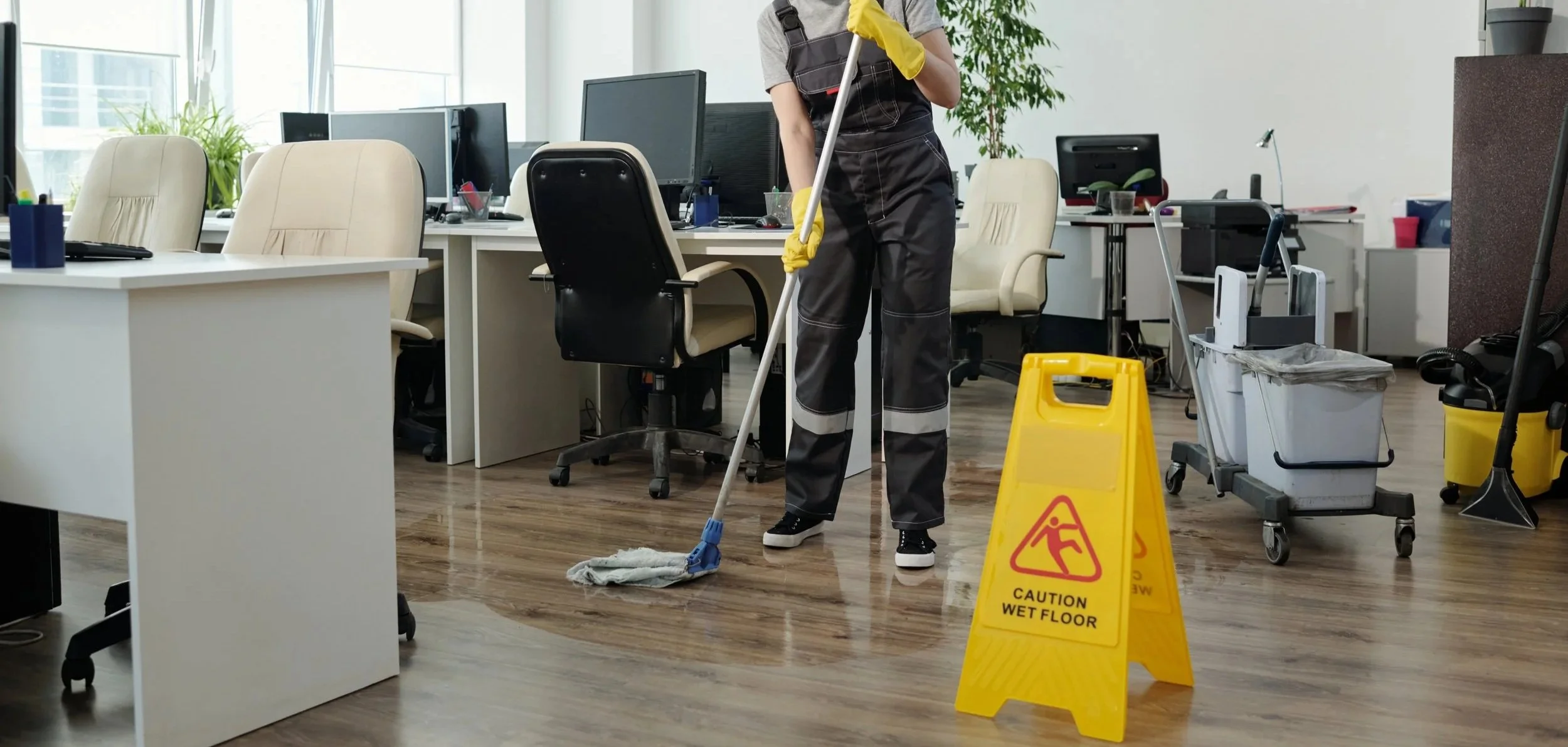
One of the leading causes of liability claims in the cleaning industry is slip and fall injuries.
Whether it is a recently mopped floor, a misplaced caution sign, or excess cleaning solution left behind, a single incident can result in significant medical and legal costs.
When someone is hurt, the costs can extend far beyond medical expenses. Legal fees, settlements, and damage to client relationships can make even a single incident extremely costly. That’s why consistent safety practices are so important. Ensuring wet floor signs are always visible, following documented cleaning procedures, and providing regular employee safety training can significantly reduce the likelihood of an accident.
Rancho Mesa’s SafetyOne™ platform offers multiple slip, trip and fall online training courses and toolbox talks to ensure employees are properly trained for a variety of workplace settings.
Property Damage Can Happen in Seconds
Janitorial companies often work around valuable assets, from office furniture and flooring to electronics and fixtures. Even when employees exercise care, accidents can happen. A floor cleaning machine may cause water damage, a cleaning solution may discolor a specialty surface, or equipment could accidentally damage furniture or fixtures.
Because these incidents can be costly, proper employee training and equipment maintenance are essential. Making sure staff understand the correct cleaning methods for different surfaces and regularly inspecting equipment can help prevent costly mistakes.
Chemical Handling Requires Ongoing Attention
Cleaning chemicals are a necessary part of the job, but they also pose a significant liability when used improperly. Exposure incidents can lead to respiratory irritation, skin burns, allergic reactions, or other injuries. In some cases, mixing chemicals incorrectly can create serious health hazards.
Reducing this exposure starts with proper education. Ongoing training, clear labeling practices, and easy access to Safety Data Sheets (SDS) help employees understand how to safely handle and use cleaning products. A well-trained team is often the first line of defense against chemical related claims.
Not only does the SafetyOne platform offer online training on both chemical hazards and GHS Safety Data Sheets, but the mobile app also allows employees to access your company’s SDS from their mobile device through the app or via QR code.
Protecting Client Equipment Is Critical
Many businesses today rely heavily on technology and specialized equipment. Computers, security equipment, medical devices, and manufacturing machinery can all be damaged during routine cleaning operations.
Unfortunately, even a minor accident can have major consequences. A spilled cleaner or an improperly moved piece of equipment may result in expensive repairs, business interruption, and strained client relationships. Establishing clear procedures for working around sensitive equipment and maintaining open communication with clients about restricted or high-risk areas can help minimize these exposures.
Theft Allegations Can Damage Reputations
Not every liability exposure involves physical damage. In the janitorial industry, theft allegations can be just as damaging as the actual loss. If cash, electronics, inventory, or personal belongings go missing, janitors are often the first people questioned.
Even when no wrongdoing has occurred, accusations can harm a company’s reputation and client relationships. Conducting thorough background checks and implementing a crime policy that includes theft of client’s property can help protect both your employees and your business.
Liability claims are an unfortunate reality for many janitorial businesses, but risk management can significantly reduce both the frequency and severity of incidents. Rancho Mesa Insurance provides its clients with access to its proprietary SafetyOne platform, RM365 HRAdvantage™ portal, monthly workshops and webinars, and RM365 Advantage Safety Star Program™ . These services offer a way for employers to implement employee training, maintain strong operational procedures, and foster a culture of safety and accountability. This allows janitorial companies to better protect their employees, their clients, and their bottom line.
If you would like to discuss how Rancho Mesa can assist your companies risk profile, please reach out to me at (619) 937-0174 or jhoolihan@ranchomesa.com.
CA Workers’ Compensation Market Faces Increased Pressure Beneath Stable Surface
Author, Jeremy Hoolihan, Partner, Rancho Mesa Insurance Services, Inc.
Recently, the Workers’ Compensation Insurance Rating Bureau (WCIRB) of California released its Quarterly Experience Report that offers insight into the state of the California workers’ compensation market. While at a glance, the market may seem stable; however, there are evolving claim patterns that are creating challenges for insurers and employers alike.
Author, Jeremy Hoolihan, Partner, Rancho Mesa Insurance Services, Inc.

Recently, the Workers’ Compensation Insurance Rating Bureau (WCIRB) of California released its Quarterly Experience Report that offers insight into the state of the California workers’ compensation market. While at a glance, the market may seem stable, there are evolving claim patterns that are creating challenges for insurers and employers alike.
Premiums Hold Steady as Rates Bottom Out
Since the pandemic, written premium in California has remained steady while average rates have reached historically low levels. However, recent data suggests this decline may be slowing. Modest rate changes over the past two years and the upcoming proposed increases signal that pricing may have reached a breaking point and insurers will be responding with higher rates.
Profitability Under Strain
Combined ratios, which are a key measure of underwriting performance, rose again in 2025, hitting its highest level in over 20 years at 129%. For the fifth consecutive year, combined ratios have exceeded 110%, indicating that insurers are paying out significantly more in claims and expenses than they are collecting in premium.
Cumulative Trauma Claims Reshape the Landscape
A major driver behind many of these trends is the rise in cumulative trauma (CT) claims. Since 2021, CT indemnity claim frequency has increased from 15.7% to 23.7%, clearly making these claims a significant threat to the health of the industry. CT claims typically involve repeated stress or wear and tear injuries rather than single incidents. They are often more complex, slower to resolve, and more likely to involve litigation. As a result, they contribute to longer claim durations and increased administrative and legal costs.
Looking Ahead
The WCIRB report highlights a workers’ compensation system at a critical juncture. On the surface, stable premiums and low rates may suggest a healthy market. But beneath that stability, rising claim frequency, increasing litigation, and escalating medical and legal costs are putting sustained pressure on the system.
As we look to the future, we should expect insurance companies to focus on rate adequacy, cost containment, and claims management strategies. We should also expect legislative changes relating to the increased frequency and costs associated with CT claims. Rancho Mesa has taken a leadership position in pushing for legislative reform from our state representatives to help prevent the growing abuse of the system.
Without pricing and legislative changes, the California workers’ compensation market is a ticking time bomb. If you would like to know how you can get involved to push CT claim reform, please feel free to reach out to me at (619) 937-0174 or jhoolihan@ranchomesa.com.
WCIRB Approves Dual Wage Threshold Increases for 2026: What California Contractors Need to Know
Author, Jeremy Hoolihan, Partner, Rancho Mesa Insurance Services, Inc.
The Workers’ Compensation Insurance Rating Bureau (WCIRB) has reviewed and approved a proposal to increase the hourly wage threshold for 13 out of the 16 dual wage classifications by $2 to $5 per hour that would go into effective September 1, 2026, once Insurance Commissioner Ricardo Lara agrees.
Author, Jeremy Hoolihan, Partner, Rancho Mesa Insurance Services, Inc.

The Workers’ Compensation Insurance Rating Bureau (WCIRB) has reviewed and approved a proposal to increase the hourly wage threshold for 13 out of the 16 dual wage classifications by $2 to $5 per hour that would go into effect September 1, 2026, once Insurance Commissioner Ricardo Lara agrees.
This upcoming change could have a direct impact on your workers’ compensation premium, if you employ workers in any trade subject to the dual wage classifications.
There are 16 dual wage classifications that will affect California Contractors:
| Dual Wage Classifications | Curent Threshold Effective 2024 |
Recommended Threshold Change |
Recommended Threshold |
| 5027/5028 Masonry | $35 | +$2 | $37 |
| 5190/5140 Electrical | $36 | +$4 | $40 |
| 5183/5187 Plumbing/HVAC | $32 | +$3 | $35 |
| 5185/5186 Automatic Sprinkler Install | $33 | +$3 | $36 |
| 5201/5205 Concrete or Cement Work | $33 | +$3 | $36 |
| 5403/5432 Carpentry | $41 | +$5 | $46 |
| 5446/5447 Wallboard Install | $41 | +$4 | $45 |
| 5467/5470 Glaziers | $39 | +$4 | $43 |
| 5474/5482 Painting/Waterproofing | $32 | +$4 | $36 |
| 5484/5485 Plastering or Stucco Work | $38 | +$4 | $42 |
| 5538/5542 Sheet Metal | $33 | +$4 | $37 |
| 5552/5553 Roofing | $31 | +$2 | $33 |
| 5632/5633 Steel Framing | $41 | +$5 | $46 |
| 6218/6220 Excavation/Grading | $40 | TBD | TBD |
| 6307/6308 Sewer Construction | $40 | TBD | TBD |
| 6315/6316 Water/Gas Mains | $40 | TBD | TBD |
Data from the WCIRB’s Classification and Rating Committee Meeting on November 11, 2025.
https://www.wcirb.com/sites/default/files/2025-11/20251111_cr_presentation.pdf
In California, certain construction class codes use a dual wage system to separate employees into two tiers:
Higher Wage – Workers earning at or above a set hourly threshold qualify for lower workers’ compensation rates because statistically these workers have lower claim frequency and severity.
Lower Wage – Workers earning below the threshold qualify for in the higher workers’ compensation rates because they tend to be less experienced and have a higher frequency and severity of claims.
The WCIRB periodically adjusts these thresholds to reflect rising wages, inflation, and updated claims data. When wages increase across the industry but thresholds stay static, more employees drift into the higher wage threshold which creates an imbalance. Therefore, the WCIRB now reviews and adjusts the thresholds every two years.
In preparation for proposed wage threshold changes, business owners may want to consider implementing the following strategies:
Review your payroll and identify employees earning near the current dual wage threshold.
Model the impact and estimate how a $2 to $5 per hour increase could affect your premium classification mix.
Evaluate wage adjustments by comparing the cost of modest raises against the savings from qualifying for lower workers’ compensation rates.
Keep accurate records! Maintain clean timecards and payroll documentation for upcoming audits.
Talk with your broker now to help you analyze potential exposure and prepare for your 2026 renewal.
The WCIRB’s Classification and Rating Committee reviewed these proposed increases in a meeting on November 11, 2025 and has approved them as part of the Bureau’s regulatory filing next spring for Lara’s consideration. If accepted, the updated thresholds would apply to policies incepting on or after September 1, 2026.
For any questions relating to how the dual wage threshold increase will affect your workers’ compensation premiums, reach out to me at (619) 937-0174 or jhoolihan@ranchomesa.com.
Doubling Down on Safety in California’s Janitorial Industry
Author, Jeremy Hoolihan, Partner, Rancho Mesa Insurance Services, Inc.
For those that run janitorial businesses in California, you have probably heard the news that workers’ compensation rates are on the rise. Insurance Commissioner Lara recently approved a recommended rate increase of 8.7% on average across all classification codes effective September 1st 2025. For the janitorial industry specifically, the pure premium increase was 11%. These increases will result in higher costs for employers across the board.
Author, Jeremy Hoolihan, Partner, Rancho Mesa Insurance Services, Inc.

For those that run janitorial businesses in California, you have probably heard the news that workers’ compensation rates are on the rise. Insurance Commissioner Lara recently approved a recommended rate increase of 8.7% on average across all classification codes effective September 1st 2025. For the janitorial industry specifically, the pure premium increase was 11%. These increases will result in higher costs for employers across the board.
In the janitorial industry, where the work is physically demanding and full of potential hazards, these rate increases hit especially hard. But the good news is, with a strong focus on workplace safety, you can help keep your claims down and your premiums more manageable.
The Most Common Claims
The janitorial industry has a unique set of risks that contribute to its workers’ compensation claims, including:
Slips, Trips, and Falls: Wet floors, cluttered hallways, and stairs can lead to sprains, fractures, and plenty of lost days.
Lifting and Overexertion: Heavy and improper lifting can cause painful back, shoulder, or knee injuries.
Repetitive Motion Injuries: Tasks such as mopping, vacuuming, or scrubbing can result in repetitive strain injuries over time. Common injuries include carpal tunnel syndrome, tendonitis, and chronic back pain.
Chemical Exposure: Regular use of cleaning agents like bleach, ammonia, and disinfectants can lead to rashes, eye irritation, or respiratory issues if workers are not properly protected.
Cuts and Punctures: Broken glass and sharp edges can cause injuries. While often less severe, these incidents occur frequently and can result in infections.
The Most Severe Claims
Some injuries may be less frequent but carry a much higher price tag. For example:
Fall From Heights: Janitors who use ladders are at a higher risk of serious injuries such as fractures, head trauma, or spinal damage.
Severe Back Injuries: Herniated discs or spinal injuries can sideline an employee for months or even end their career.
Severe Chemical Exposure: Accidents with strong cleaning agents can cause permanent lung or eye damage.
These types of injuries not only impact your employee’s health, they also drive up insurance costs and are a big factor in the rate increases we are seeing.
Mitigating Common and Severe Claims
Maintaining a safe workplace is not just about compliance, it is also a financial strategy. Fewer claims and losses over time will help you control your premiums even in a rising rate environment.
A few key risk mitigation strategies include:
Prevent Slips and Falls: Place “wet floor” signs immediately when mopping. Use slip resistant shoes and ensure adequate floor mats are in place.
Teach Smart Lifting: Provide training on proper body mechanics and lifting methods. Use carts or dollies instead of manual lifting whenever possible. Encourage team lifting for heavy or bulky objects.
Reduce Repetitive Strain: Rotate tasks to reduce strains. Provide ergonomic tools such as lightweight mops, backpack vacuums, and adjustable handles.
Protect Against Chemicals: Train employees on safe handling, storage, and mixing of cleaning agents. Make PPE (i.e., gloves, safety glasses, and masks) non-negotiable. And maintain clear Safety Data Sheets (SDS) for all products.
Stay Sharp About Sharps: Provide puncture resistant gloves and safe disposal containers for broken glass or needles. Also train employees on safe handling procedures.
Develop a workplace safety program. Rancho Mesa’s SafetyOne™ platform is designed to administer an effective workplace safety program to ensure employees are getting the proper safety training, identifying hazards before an incident occurs, and investigating incidents to ensure they don’t happen in the future.
Final Takeaway
The reality is that workers’ compensation rates are firming in California. Your employees are your most valuable assets. By paying close attention to the most common risks and putting preventive measures in place, you will not only keep those employees safe but will also help minimize your frequency and severity of claims. The result will be fewer disruptions, lower expenses, and a more efficient business.
A Proactive Approach to Insuring Your Commercial Property
Author, Jeremy Hoolihan, Partner, Rancho Mesa Insurance Services, Inc.
Wildfires in California over the last several years have had a dramatic effect on the insurance marketplace. With expected losses of the recent Los Angeles fires alone to exceed $30 Billion, insurance companies have been taking action to stop the bleeding. These actions include non-renewing policy holders in high hazard zones as well as pulling out of California all together.
Author, Jeremy Hoolihan, Partner, Rancho Mesa Insurance Services, Inc.

Wildfires in California over the last several years have had a dramatic effect on the insurance marketplace. With expected losses of the recent Los Angeles fires alone to exceed $30 Billion, insurance companies have been taking action to stop the bleeding. These actions include non-renewing policy holders in high hazard zones as well as pulling out of California all together.
It is critical that property owners now take a proactive approach to prepare for their upcoming insurance renewals. Insurance companies have tightened up underwriting guidelines and are much more selective with the buildings they are willing to insure. Knowing what insurance companies are looking for and addressing these concerns in advance can be the difference between being insured in the standard marketplace or having to resort to the California FAIR Plan.
Some of the top insurance concerns underwriters are currently facing include the following:
Brush Clearing – It is commonplace for insurance companies to require a pre-inspection before offering an insurance quote. General maintenance such as weed abatement and brush clearing are two important tasks that can determine whether an insurance company is interested in insuring a building.
Fire Zones in California, fire zones continue to grow as a result of climate change, urban expansion, and new technology such as AI modeling that provides a more accurate prediction of where high hazard zones exist.
Building construction type also has a huge impact on an Underwriter’s appetite. A concrete building will obviously be more appealing than a wood framed building, especially in a mid to high level fire zone.
Building Updates – Insurance companies now expect building owners to keep their buildings well maintained and up to date. Underwriters will inquire about the age of a building’s roofing, plumbing, electrical, HVAC and fire sprinkler systems. If a building is over 20 years old, replacement of any one of these systems is a common risk control requirement.
Knowing some of these challenges in advance, building owners can take proactive steps to make their building more attractive to underwriters. Here are a few of those examples:
Property Maintenance
Roof – Regular inspections and timely replacement is key, especially if the roofing material is fire-resistant.
Electrical Systems – Upgrade outdated wiring and panels, especially if you have a Zinsco Panel. They have been known to spontaneously combust and will almost certainly cause carriers to decline offering a quote.
Plumbing – Updating the plumbing system can prevent water damage claims. PEX or copper is preferred over galvanized steel or polybutylene.
HVAC – Upgrading and/or regularly maintaining heating and cooling systems can help avoid fire and mold risks as well as creating a more efficient system.
Fire Suppression System – Installing or upgrading sprinklers can often times determine if an insurance company is willing to insure a building.
Risk Mitigation Features
Fire Alarms – Fire alarms, extinguishers, sprinkler systems, smoke detectors are critical features.
Flood Protection – The installation of sump pumps and proper drainage systems are important, especially in flood zones.
Security Systems – Monitored alarms, cameras, and controlled access points will help reduce theft.
Documentation and Compliance
Inspection reports – Keep updated reports (i.e., roof, HVAC, electrical, fire) ready and available to show underwriters.
Maintenance logs – Document routine maintenance. This helps to show that you are a responsible owner.
Permits and certificates – Make sure upgrades are properly permitted and compliant so that you are able to provide evidence to the insurance underwriter.
While there is reform in the making to California’s property insurance marketplace, it continues to be very difficult to navigate. By implementing many of these recommendations and being proactive as you approach your property insurance renewal window, you will improve your chances of securing the most competitive terms and pricing.
If you have any questions, I can be reached at (619) 937-0174 or jhoolihan@ranchomesa.com.
Non-Owned Auto Can Be A Janitorial Company’s Hidden Nightmare
Author, Jeremy Hoolihan, Partner, Rancho Mesa Insurance Services, Inc.
It is common for employees of janitorial companies to drive their own vehicles, whether that is driving to various jobsites, transporting cleaning supplies, or simply running errands. For the janitorial company, this creates what is referred to as a non-owned auto exposure.
Author, Jeremy Hoolihan, Partner, Rancho Mesa Insurance Services, Inc.

It is common for employees of janitorial companies to drive their own vehicles, whether that is driving to various jobsites, transporting cleaning supplies, or simply running errands. For the janitorial company, this creates what is referred to as a non-owned auto exposure.
Often overlooked, non-owned auto liability arises when a business is held responsible for accidents caused by employees driving their personal vehicles while performing duties in the course of employment.
As inflation and nuclear verdicts drive up costs of individual auto liability claims, employers must be concerned not only with company-owned vehicles, but their employees’ vehicles being used on company time. If an employee causes an accident while driving their personal vehicle while on the clock, the injured parties may file claims against both the employee’s personal auto insurance and their employer.
To protect your company from non-owned auto liability, it is recommended that companies have an updated fleet safety program that includes the following:
Employees using their personal vehicles on company time should be required to provide a copy of their MVR. It is critical that the employee’s MVR meets the same parameters as those driving company-owned vehicles.
Employees who drive company and/or personal vehicles should be required to participate in the DMV Pull Program. This way, if an employee received a major moving violation (e.g., reckless driving, DUI, etc.), the company will be alerted.
Require all company drivers who drive non-owned vehicles to purchase personal liability coverage. That way, damages of a claim are less likely to exceed the personal auto liability limit and fall on to the employer’s commercial auto liability policy. It is also recommended that employers require their drivers to purchase minimum limits of $300,000.
Make sure the employee completes routine maintenance as per the car’s manufacturer on their personal vehicle, such as oil changes, tire checks, windshield wiper replacements, etc. This is just as critical as a maintenance program for company-owned vehicles.
Provide regular fleet safety training to all employees driving company and personal vehicles during business hours.
Finally, business owners may want to encourage employees to use safety features such as apps that prevent the driver from using their phone while the vehicle is in motion.
Janitorial businesses, in general, have a large non-owned auto exposure that can often be overlooked and leave a business vulnerable to high dollar auto claims, which can result in policy non-renewal and/or increased premiums.
Now is the time to review your current program’s policies and procedures with your insurance broker and make any adjustments necessary.
If you need any assistance reviewing your current program or have any questions, please feel free to contact me at (619) 937-0174 or jhoolihan@ranchomesa.com.
Best Practices Approach to Insuring Janitorial Companies
Author, Jeremy Hoolihan, Partner, Rancho Mesa Insurance Services, Inc.
Running a successful janitorial company in California can often be cut throat. With low profit margins, janitorial companies continue to face daily challenges like increased wages and material costs, as well as aggressive competition that continues to under bid contracts. It is natural for business owners to explore ways of cutting costs to help their bottom line, but insurance should not be one of them. In fact, they should be looking to add coverages that are unique to janitorial operations and protect the long term health and viability of the company.
Author, Jeremy Hoolihan, Partner, Rancho Mesa Insurance Services, Inc.

Running a successful janitorial company in California can often be cut throat. With low profit margins, janitorial companies continue to face daily challenges like increased wages and material costs, as well as aggressive competition that continues to under bid contracts. It is natural for business owners to explore ways of cutting costs to help their bottom line, but insurance should not be one of them. In fact, they should be looking to add coverages that are unique to janitorial operations and protect the long term health and viability of the company.
Following are a few key coverages and endorsements to consider that could help insulate a janitorial business from serious losses.
Crime Coverage (First and Third-Party)
A commercial crime policy can insure a janitorial company from an employee stealing from them (i.e., a first-party crime). These types of claims include, but are not limited to, forgery or alteration, funds transfer fraud, credit card fraud, and computer fraud.
Third-party crime includes theft of a client’s property. Many janitorial companies have employees cleaning after hours. If property on the client’s premises goes missing, it’s often the janitor that gets accused. This is when 3rd party crime coverage comes into place.
Lost Key Coverage
If you are operating a janitorial company and your employee misplaced or lost a master key for one of your client’s properties, are you prepared to replace all the keys and locks? Depending on the number of locks to replace, your business could be out tens of thousands of dollars. Lost key coverage is typically an endorsement that can be added to a general liability policy. Limits and deductibles often vary, depending on the customer’s request.
Limited Pollution Liability
With most janitors using chemicals, cleaning products, and power washers, it is highly recommended that the company has the limited pollution liability endorsement added to their policy (or better yet, a standalone pollution policy). Coverage for accidental job site pollution that may arise from chemical spills and accidental water runoff could prove extremely valuable.
Cyber Liability
Janitorial companies often store clients’ information and process payments online for their customers. This can be very enticing for hackers. Which is why business owners should consider carrying a cyber liability policy that can insure the company for data breaches, cyber-attacks, cyber extortion, business interruption, computer fraud, and much more.
Cyber-attacks can debilitate a business and bring it to a screeching halt. Cyber liability coverage can assist with keeping a business afloat during these very trying times.
Employment Practices Liability Insurance (EPLI)
EPLI insures a business when a current or former employee sues the employer for such things as wrongful termination, sexual harassment, retaliation, etc. An EPLI policy can also insure a business if a non-employee sues the business for other similar harassments. With defense costs and settlements commonly reaching well over six figures, these claims can easily put a company out of business. And to top it off, even if a company is proven innocent, the cost of defense alone could jeopardize its financial stability.
At the end of the day, insurance is simply risk transfer. Businesses elect to either transfer the risk to an insurance company or self-insure it. The key is knowing what risk transfer options are out there and what they cost. It starts with partnering with an insurance broker that has expertise in your industry.
I’ve been specializing in insurance for the janitorial and construction industries for over 20 years. If you have any insurance related questions, I am here to help! Contact me at jhoolihan@ranchomesa.com or (619) 937-0174.