

Industry News

Navigating the Future of Workers’ Compensation with Todd Lewis: Litigation Trends, AI, and Claims Management
Rancho Mesa President and CEO Dave Garcia sits down with Todd Lewis, Vice President of Claims at Republic Indemnity, to discuss the growing challenges facing California’s workers’ compensation system, including rising litigation and cumulative trauma (CT) claims. They explore how AI is helping claims organizations investigate and manage claims more effectively, along with practical strategies employers can use to reduce claim disputes, support employees, and foster a stronger workplace culture.

Rancho Mesa President and CEO Dave Garcia sits down with Todd Lewis, Vice President of Claims at Republic Indemnity, to discuss the growing challenges facing California’s workers’ compensation system, including rising litigation and cumulative trauma (CT) claims. They explore how AI is helping claims organizations investigate and manage claims more effectively, along with practical strategies employers can use to reduce claim disputes, support employees, and foster a stronger workplace culture.
Dave Garcia: Hi, everyone. This is Dave Garcia, and you're listening to Rancho Mesa's StudioOne™ podcast, where each week we break down complex insurance and safety topics to help your businesses thrive. I'm your host, Dave Garcia, president of Rancho Mesa, and I'm joined today by Todd Lewis, Vice President of Claims with Republic Indemnity, one of the leading workers' compensation carriers here in California.
Todd, welcome to the show.
Todd Lewis: Hey, thank you for having me, Dave.
DG: Great. So Todd let’s jump in to some of the general industry, state of the union types of things. So, what do you see—from your position, what do you see as the biggest challenges facing workers' compensation claims organizations today?
TL: Well, I think it's, you know, I think the obvious answer to that and what we're all seeing is the increase in litigation, you know, primarily CT. I mean, that's the buzz phrase these days in workers' compensation. But, you know, when we, and also too, I think we hate to just kind of blame all the changes in the world on COVID. But you can really see a change in workers' compensation that took place. And, you know, a lot of claim professionals such as myself, we tend to scratch our head because there's nothing that really changed primarily in the law. There's nothing that changed in work comp. But yet we've seen dramatic differences. You know, some of the primary differences that we see now is that the amount of new claims that come into our shops that are litigated from day one.
DG: Really?
TL: That's increased dramatically.
DG: What do you attribute that to?
TL: You know, I think when we look back at how the world changed when COVID hit is that you had a lot of non-essential workers go home. We all thought it would be days or weeks. It turned into months. And I think even applicant attorneys sat back and all of a sudden they looked at their clients dry up and they had to look for ways to keep their businesses going. So I think that they started to lean into an area that was always there and the opportunity was there. But I think that they had to figure out a way to do what they needed to do to keep their business going and then also to be able to do so in a world where we weren't going to be in person. And so, CT really lent itself to that.
And we started to see a lot of these workers that were at home and they started to file CT claims. And we started to see a very, very large spike in that. It's odd because a lot of folks think that litigation rose at the same rate that CT did, but it really didn't. I mean, if you look at most claim operations, you'll see that litigation over the last six years rose primarily about 10%, yet CT has gone up 20%, 25%. You know, as an industry, it's up 21% in the last five years. And so, it's just really odd to see things shift in that direction.
DG: Yeah. When you look at some of the fixes that might be out there, and everybody talks about AI. It's on every street corner, every conversation you have. How do you see technologies like AI maybe helping defending against some of the CT claims that you're seeing?
TL: One of the primary ways that we try to use AI is how we dive into medical records. And I don't want to get too far in the weeds, but from a technical aspect. But CTs, they come in the door with no medical. The employer likely, if they're still employed, many employers don't even know that the CT claim has been filed. Some of these people are even still at work, which is very strange. But most of it's post-term, post-layoff. Obviously, we saw a spike in layoffs after COVID. Many businesses struggled.
And so, there's nothing to support the claim at all. So, one of the things that we have to do as a carrier is to be able to differentiate between the CTs that come in your door. Some of them, even if they're post-term, these are 10, 15-year laborers that quite frankly, could have an injury. And maybe they didn't report something for one reason or another, whatever the case is. You have to handle those a little bit differently. But the way we use AI for these other set of claims that come in the door with no support at all, there really is nothing in there to validate the claim that's being alleged. And there's a laundry list of allegations being made.
We dive into the medical records, the personal medical records, where someone treats for and has been treating. Maybe it's Blue Shield or UnitedHealth. And we get those records and we use AI to dive in and identify prior diagnosis and injuries that have occurred over their lifetime that focus on those body parts. And it's enabled us to shine a light on that and say, hey, this is something that's been with you for quite some time. And we identify fraud that way. We identify other body parts where maybe we're going to get apportionment at the end.
There's many ways to use AI to be able to help you do that because the human being can't go through thousands of pages of records. AI can very quickly, and it can basically outline those facts for you.
DG: So, do you think that's one of the variables that separates a high-performing claims operation from just the average claims operation, amongst carriers?
TL: It does. It really does. I think that you have to be creative. You can't do things by route. And I think many of the, I don't want to say poor claim operations but claim operations that really haven't changed with the times, they're handling things very in a standard way that we've done so for years. The claim comes in, they delay it, they send them their MPN link. They allow the claimant and the attorney to create the claim from scratch on their dime. In California, we pay the first $10,000 if the claim is delayed. So they allow and they basically, they initiate the claim for them, and they allow themselves to be put in a lesser spot from a defense perspective.
DG: Oh, I see.
TL: Yeah, but it's also too, it's as a claim leader, I have to be very careful too, because my message is not, let's deny them all and let's be, that's not what I'm saying. You have to be able to differentiate at the desk level when claims come in. And you have to be able to make first contact, initiate a good investigation, have discussions, and to be able to identify and separate the CT claims that lack merit from those that actually have some substance. And these are good people. We need to take care of them.
DG: Yeah, it's interesting. As you're talking, I'm thinking, you know, AI is such a great tool for lots of different businesses. But there's still a human element to it. And so in your view, you know, what kinds of claims decisions, you maybe have alluded to it a little bit, should remain human decisions?
TL: You know, there's a lot. I mean, there's a few different things that go on in California workers' compensation, such as the way we do utilization review, which is like a doctor makes a request for a specific treatment. It goes through utilization review. We don't want adjusters making medical decisions. Sometimes there's things, though, that may not be approved by utilization review. You have to look at the bigger picture. You have some people that have very complex injuries, very significant injuries. You have to take a look at it and ask yourself what this person needs to get to MMI, which is basically where we're all trying to get. It's financially to our benefit to get this person to the end of treatment. You have to look at it realistically and what's going to benefit this person.
Sometimes there's things that you need to approve at the desk level that before you go to UR and not go to UR and be able to take care of that because it's the right thing to do. It's, it's, it makes sense. And we can't think. We can't be so boxed in in the way our adjuster's mentality works that they're just thinking black and white. They're just thinking process, which is very easy to do when you're at a desk. But you have to be human about it. It doesn't mean that you're giving benefits and things that aren't due, but you're trying to understand where you're trying to go, that you're trying to get this person to be permanent and stationary. How am I going to get there? Because it's going to financially benefit the company, it's going to benefit this person greatly, and it's going to be a win-win.
DG: That's outstanding. So let's shift it to, we get this question asked a lot. from our clients, you know, with CT or just frivolous, fraudulent types of claims, you know, as an employer, what can I do to help me defend against that kind of an onslaught of claim? Are there things employers can do?
TL: Yeah, I think there's things that employers can do overall. to help themselves deal with workers' compensation. And I think CT is definitely obviously part of that. There's the obvious things, where you make it known how to report a claim if you have an injury. You make sure you have good people managers that aren't leveraging people to work the number day sign in the warehouse that says, we've been this many days without an injury. We can't lean into that so much that we're pressuring people not to report claims. We have to do all those things, which are very obvious.
But I think there's a bigger component to it. And much like the way I run claims, much like the way you probably run your business here, I know you well enough to know that you're very conscious of this, is that you want to create an environment where you don't lead and manage by the stick, meaning that people don't fear retribution. They don't fear that they're going to be written up. They're not looking at it that way. They look at you as the president of Rancho Mesa, for example, that I don't want to let Dave down. Dave wants the best for me. He wants the best for this business. He wants to obviously make a profit, but he also wants to advance my career and develop me as an individual because he's smart enough to know that that's going to make his business better. It doesn't matter what you're doing. You could be counting widgets in a corner. And if you have that mentality with your staff and you lead that way, people have a tendency to want to take value in their job and their employer. They're not going to be the type they're going to file a frivolous claim. They're not going to be the type that's looking to litigate or is going to get bitter because something didn't go their way. They're going to understand the greater good, if that makes sense.
DG: Yeah, that's a great point. I think sometimes, you know, we've heard where an injured worker then just feels no longer a part of the company. And so whether it's intentional or unintentional or retaliatory, you know, like, well, fine, if you don't care about me. I don't care about you.
TL: Right.
DG: What is there any advice you could give? You know, post-term claims are a huge issue out there. Sometimes layoffs are necessary and it may be just short term. You know, we just the job completed. We don't need the manpower we currently have. When future jobs come, you know, we want you to come back with us. Is there any advice you can give to an employer how to handle that transition from you're employed to I've got to let you go in a manner that it mitigates, doesn't probably completely remove, it mitigates the opportunity for those post-term claims that are not legitimate claims?
TL: At the point of termination or layoff, you need to be apathetic. You need to have some apathy for the employees who are being let go. If you're able financially, I would highly recommend that you give some sort of consideration. You know, we'll talk to employers that have like a factory environment and they'll lay off 20 people and they gave them their last check. They gave them no notice and they did it on a Friday and that's that. And then they're surprised when they get 10 to 15 claims from the EDD or that were made through the lunch truck or whatever, or the bar where all these gentlemen or women drink after work and they all start to talk. And that surprises them. Why are you surprised? These people, you almost kind of left them with no choice.
If you can have consideration, and by that I mean if it's financial, that's great, you should have an exit interview. You should sit down, try to have an exit interview, have some consideration financially for these folks. If you can, have them sign something that whether or not or have them report something if they have an injury, let's hear about it now. If not, if you could sign this document, I'm going to take care of you. I'm not going to give you consideration to sign the document. That's not the message here. But it's a package. And there's some sort of apathy. I'm doing something for you as it takes place. I think those that go the cold route, they're going to see litigation. That's just the way it's going to work.
DG: Kind of like the golden rule, right? Treat others like you want to be treated. So I know businesses get busy and sometimes they don't have in their mind time to sit down and have that formal conversation letting somebody go. But it sounds like you'd advise, find the time. Find the time to do it because it's probably the right thing to do, but it also is likely to reduce the chances to some degree of those post-termination claims.
Todd, you've got a great reputation in the industry as well as Republic Indemnity. Let's shift gears. I know you've been with Republic now about a year and a half or so. Let's talk about, with that strong reputation kind of already in place, what do you believe that you and Republic do differently than many competitors?
TL: I try to practice what I preach. The way that we lead our claim department is very similar to what I talked about, what I would recommend to an employer. You know, adjusting claims is a difficult job. It's a very hard job. It's something that's hard to do in managing a claim department. My team managers, it's rough. It could be a very challenging job. It's one of these types of jobs that's never done. And people have a hard time adjusting to that. It's not for everybody. So what we try to do is develop organizational skills inwardly.
Also, too, one of the things I do when I come into a claim organization, and I haven't been in a lot of shops, but when I came to Republic was first try to identify what's causing them pain. Here's my claim department. We have three locations. What don't you like? What's causing you pain? Do skip-level interviews and touch points with employees and find out what makes them tick. You're going to hear some of the usual things, but you're also going to hear some things. that means something and things that are changes that can simply be made and bring value, real value to them. But you want to start from day one to create the environment within a claim department that people want to work for.
And it's a very competitive environment. Claim handlers get stolen away by recruiters every day. There's a lot of money to be made as well. It's a good career. And good claim handlers are of great value. And so you have to create an environment that they want to be at. And if someone leaves you, there's a reason why they left you. And you need to understand what that is. You can't just be upset and just be hurt by it and just kind of turn your back on it and go, I don't know why Bob left. You have to understand it. And so what I try to do is create an environment where people want to be at. They want to work for it. They believe in where we're trying to go.
And also, too, you make it very clear to them. You communicate. And if anything, probably if I look at myself critically, I probably overly over communicate. And some like it. Some probably like it's a little much. But I'm a fan of it. I want to know where everyone stands. I want the department to know where we stand, what we're doing, why we're doing it, what our numbers are, and what our goals are. And also, too, to clearly explain expectations.
There's many businesses, especially claim organizations. where people really don't understand clearly what's expected of them. That needs to be black and white and it needs to be forefront. You need to understand what is expected of me daily and what I need to achieve, not only to be successful, but also if I want to move upward, you need to develop me as a leader. You need to understand what my wants are and then also too what my needs are.
DG: Is there anything that you're formally doing? You identify somebody that wants to grow. They'd like to take on more responsibility as their career develops. Is there things within Republic that you're doing to consciously develop those people into a leadership position?
TL: Yeah, definitely. I think mentorship is a great way to do that. We're actually doing that consciously right now with a few individuals. I do require all my people leaders to have monthly touch points, one-on-ones with their staff. Also, too, to be able to have some value brought to that. It's not like, well, my door is always open. Dave knows he could come in and talk to me anytime. That doesn't work. You need to have something on the calendar so Dave can plan on what he wants to talk to me about as his manager. And so that's important. And that's hard for a lot of managers to understand, but that's something that I do require within our organization. And I think it brings a lot of value.
So what we've done is we clearly understand where people want to go as much as we can. And then we try to assign mentors to actually help them get to that next level and explain to them the qualities and what they need to take on from a technical perspective. Because this is a very technical job. You must be a technician first in claim. And you must understand the law. You must understand what you're doing. It's not enough just to say, hey, do A, B, and C. I need you to understand what A, B, and C mean and what you're doing. There's a difference.
DG: So it sounds like the characteristics you're looking for is somebody that utilizes critical thinking, problem solving. All of that is something that your mentors try to work with the people that are mentoring to develop those types of skills. Is that kind of the idea?
TL: Definitely, definitely. I think in a career and in a field where, like I said earlier, like you're never finished, right? There's always something to do. You have to be able to be very organized. You have to be able to prioritize very well. You have to think critically as you commented on. These things are very important. And that's what I look in the interview process as well. And if I'm going to bring someone in and, you know, it's always nice and to bring someone in that's like a known quantity, as I call it.
But I was at a prior job where I actually hired a lot of people out of college and whether they be right out of college or a year or two and trying to differentiate between those that are thinking critically, that are organized. It's not always the smartest person, you know, book smart. You have to find someone that's able to think on their feet and the way they react. And I probably have, I've been told probably a more odd style of interview because it's not about me. asking you what you know about claim or these things. It's me trying to figure out how you think.
DG: Oh, interesting. Is there a claim handling practice at Republic that really challenges the conventional industry thinking?
TL: You know, I think what we're doing right now in litigation is challenging that way of thought. And I mentioned it earlier. I think we have a very aggressive CT litigation strategy, but it's all built around differentiating at the desk level.
To give you an idea of basically in most insurance carriers right now, over half of the claims that they set up daily come in the door, litigated, blind application, no medical, just here's a letter from an attorney and you don't know much else. And that person's never been to a doctor. In some of these cases, unfortunately, within California and primarily LA County, these attorneys in many cases haven't even met these people. And it'll say signature on file. You have to be able to differentiate between these types of claims and the types that are made by individuals that truly you need to handle in a different fashion.
I think what we do is we're very aggressive with those in the first bucket. I'm going to deny your claim. Your claim has no substantial evidence, not only medical evidence, just nothing. There's nothing there at all. You may or may not even still be employed. No one knows that you've had an injury. There's things listed that just don't make sense. There's nothing to validate it at all. So we're very aggressive out of the chute.
And also, too, part of that goes in, and again, not to get too in the weeds, but once we go to medical legals, things of this nature, we're going to provide the doctor with everything. We're going to make sure that we have what we call a perfected medical legal. And that's important. Many carriers today will send out to medical legals QMEs that you hear. And the doctor comes back and they find a compensable injury. It's a trial of fact issue. This is a CT claim. This person hasn't been employed for months. They may have a diagnosis, but how's that link it to work? And this doctor doesn't have that information. Oftentimes, they don't have any medical records. They haven't been given anything. And so you have to object to that medical. You have to hold your ground and get to a perfected medical legal. And you try to settle these claims early. You try to understand what nuisance value really means. And I think that's something that's kind of lost on the industry. But you need to be very aggressive up front. But most importantly, you need to differentiate the claims that you're going to take that strategy on from those that actually have probably some merit. And you need to actually handle them in a different fashion.
DG: So no one size fits all.
TL: No, no. And the thing I fear most in sitting down with you today is walking away and having people listen to this and think, well, it's just another claim guy that's beating everybody up with a stick. That's not the mentality at all. This is a claim administration system. We are a benefit administrative system. Our job is to pay benefits that are due. We will pay every dollar due, but my job, I'm not going to pay one more. I'm going to pay everything you have coming. I'm going to take really good care of you and so is my staff. But we are going to draw the line once we feel that there's abuse.
DG: Well, I can hear the passion in your voice, Todd. That's outstanding. OK, we're getting near the end. So I've got a couple of questions for you. I wanted to let you brag a little bit. So what accomplishment are you most proud of at Republican Indemnity?
TL: You know, I think that I'd say I'm only a year and a half in. And I think what I've done with the staff and to turn many of our metrics around the way that we're audited. Republic Indemnity has been a great claim department and great insurance company for a long time. It didn't take Todd Lewis to come in to do that. They administer benefits and they audit at the very top of the state rankings and have for a lot of years. We do that very well. I think what I like to think about what we do well now in the recent past is that the way that we've embraced AI. the way that we've actually embraced the strategy to handle increased litigation.
Everyone's getting beat up in California Work Comp. You know that. I know that. We've all seen the combined ratio go up. It's how do you get beat up less? How do you manage this system to be able to understand the strategy that's needed. So much of what I just talked about, our ability to develop the staff and train them to understand and differentiate between these claims that come in the door, because truly you have to take care of people at the end of the day. That's the job. But to understand where you draw the line. And I think that's the thing I'm most proud of. And I think I see our staff now, our walkaway rate, which is like the rate of people that file litigation and just walk away from their claim because it's just not—you handle it in such a way out of the gate that's like, okay, well, this isn't what I was told. I was told that I don't really need to do much here and we'll just get a check and we'll go away. That's just not the way we do things at Republic.
DG: Yeah, that's great. Okay, last question. I'm going to give you the magic wand. If you could change any one thing about the workers' compensation system here in California, what would it be?
TL: Well, I think it's obvious we need reform, but I don't want to sound like the basic claim VP and say all these things that we feel it's too liberal because it is a benefit administrative system. That's the way it's built. But in California, I've managed every state and I've also managed Defense Base Act and Longshore and just about every kind of comp there is. California is set up to basically hurt the insured. We need to make it tougher, and not tougher from a standpoint where we make it hard to collect benefits, but the burden to prove a compensable claim is just too low. We can't allow litigation to be filed months after someone's employment ends. Other states don't do that, and they're able to provide benefits in a very fair manner.
Also, too, though, there's some other reform that's going to have to take place as well, like our permanent disability. There's different kinds of legislative change out there. that, you know, labor is going to want something and they should get it. And maybe we should look
at the PD rate. There are some changes that make sense there. It's been a long time since they've increased their weekly rate. Maybe there's some give take that needs to happen, but it can't be all give. And we need to figure out how to basically keep employers in California, make them solvent, make them want to be here and make them successful. Because right now it's not set up that way.
DG: Yeah, it's interesting. You know, we're, so we talked last night at dinner. We're, here at Rancho Mesa, we're involved in three different peer groups nationally. So we get to talk to other agency owners from every state in the union. And CT, frankly, they don't even, what's it stand for?
TL: Right.
DG: They don't see it. So we know it's fixable. You know, we just have to get there. And I do agree with you. It is going to be a give or take. And we're all in agreement that the PD rates should go up. No problem there. We want to compensate those injured workers accordingly, but that are really injured workers. What we want to try to get away from is everybody feeding into the system that are not the injured worker or the employer that are driving these costs up and creating all these log jams of litigation and things like that.
Well, Todd, I don't have the ability to say I grant your wish, but I wish I did. But I think you know, the audience that's listening to this are people that understand we've all
got to take an action in arms here. We've got to all do our part, whether it's reaching out to our council members, to our state senators, chairs, anybody in Sacramento to say, hey, we need to take a look at this and we need to take a look at it sooner than later to correct some things.
So, Todd, is there anything else before I wrap up today that you'd like to share?
TL: No, that's about it, Dave. I appreciate your time.
DG: Yeah, thank you so much for joining me today. Really appreciate it.
And to everyone out there, thanks for tuning in to our latest episode produced by StudioOne. If you enjoyed what you heard, please share this episode and subscribe. For more insights like this, visit us at RanchoMesa.com and subscribe to our weekly newsletter. I'll talk to you again soon. Bye.
Top 5 Risk Exposures for Janitorial Service Providers
Author, Jeremy Hoolihan, Partner, Rancho Mesa Insurance Services, Inc.
Running a successful janitorial company means more than delivering spotless facilities. Every day, your employees work around customers, expensive property, cleaning chemicals, and equipment creating exposures that can lead to costly liability claims.
Author, Jeremy Hoolihan, Partner, Rancho Mesa Insurance Services, Inc.
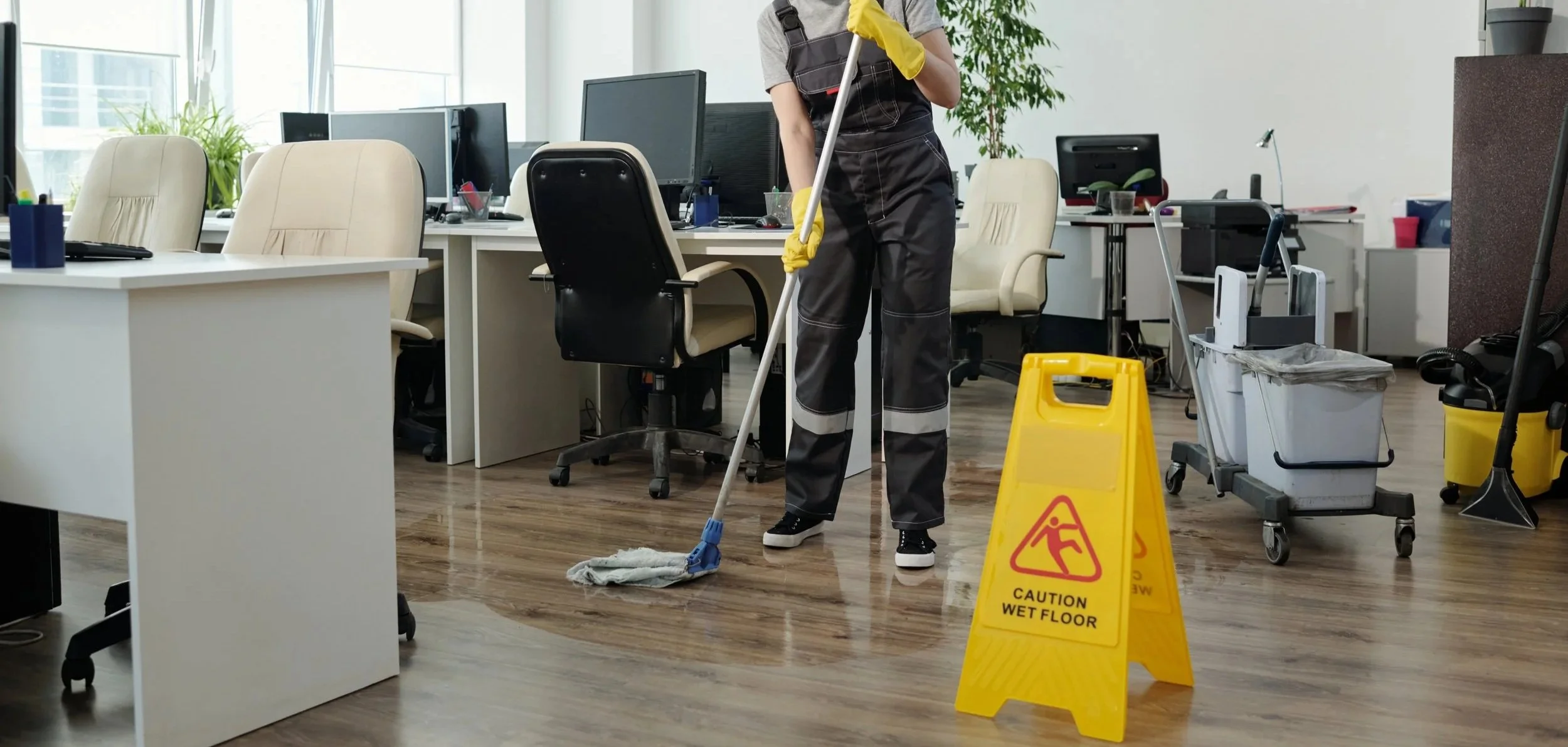
Running a successful janitorial company means more than delivering spotless facilities. Every day, your employees work around customers, expensive property, cleaning chemicals, and equipment creating exposures that can lead to costly liability claims.
However, knowing the most common liability risks facing janitorial companies and understanding ways to mitigate your exposure can reduce your overall risk.
Slip and Fall Accidents Remain a Leading Risk
One of the leading causes of liability claims in the cleaning industry is slip and fall injuries.
Whether it is a recently mopped floor, a misplaced caution sign, or excess cleaning solution left behind, a single incident can result in significant medical and legal costs.
When someone is hurt, the costs can extend far beyond medical expenses. Legal fees, settlements, and damage to client relationships can make even a single incident extremely costly. That’s why consistent safety practices are so important. Ensuring wet floor signs are always visible, following documented cleaning procedures, and providing regular employee safety training can significantly reduce the likelihood of an accident.
Rancho Mesa’s SafetyOne™ platform offers multiple slip, trip and fall online training courses and toolbox talks to ensure employees are properly trained for a variety of workplace settings.
Property Damage Can Happen in Seconds
Janitorial companies often work around valuable assets, from office furniture and flooring to electronics and fixtures. Even when employees exercise care, accidents can happen. A floor cleaning machine may cause water damage, a cleaning solution may discolor a specialty surface, or equipment could accidentally damage furniture or fixtures.
Because these incidents can be costly, proper employee training and equipment maintenance are essential. Making sure staff understand the correct cleaning methods for different surfaces and regularly inspecting equipment can help prevent costly mistakes.
Chemical Handling Requires Ongoing Attention
Cleaning chemicals are a necessary part of the job, but they also pose a significant liability when used improperly. Exposure incidents can lead to respiratory irritation, skin burns, allergic reactions, or other injuries. In some cases, mixing chemicals incorrectly can create serious health hazards.
Reducing this exposure starts with proper education. Ongoing training, clear labeling practices, and easy access to Safety Data Sheets (SDS) help employees understand how to safely handle and use cleaning products. A well-trained team is often the first line of defense against chemical related claims.
Not only does the SafetyOne platform offer online training on both chemical hazards and GHS Safety Data Sheets, but the mobile app also allows employees to access your company’s SDS from their mobile device through the app or via QR code.
Protecting Client Equipment Is Critical
Many businesses today rely heavily on technology and specialized equipment. Computers, security equipment, medical devices, and manufacturing machinery can all be damaged during routine cleaning operations.
Unfortunately, even a minor accident can have major consequences. A spilled cleaner or an improperly moved piece of equipment may result in expensive repairs, business interruption, and strained client relationships. Establishing clear procedures for working around sensitive equipment and maintaining open communication with clients about restricted or high-risk areas can help minimize these exposures.
Theft Allegations Can Damage Reputations
Not every liability exposure involves physical damage. In the janitorial industry, theft allegations can be just as damaging as the actual loss. If cash, electronics, inventory, or personal belongings go missing, janitors are often the first people questioned.
Even when no wrongdoing has occurred, accusations can harm a company’s reputation and client relationships. Conducting thorough background checks and implementing a crime policy that includes theft of client’s property can help protect both your employees and your business.
Liability claims are an unfortunate reality for many janitorial businesses, but risk management can significantly reduce both the frequency and severity of incidents. Rancho Mesa Insurance provides its clients with access to its proprietary SafetyOne platform, RM365 HRAdvantage™ portal, monthly workshops and webinars, and RM365 Advantage Safety Star Program™ . These services offer a way for employers to implement employee training, maintain strong operational procedures, and foster a culture of safety and accountability. This allows janitorial companies to better protect their employees, their clients, and their bottom line.
If you would like to discuss how Rancho Mesa can assist your companies risk profile, please reach out to me at (619) 937-0174 or jhoolihan@ranchomesa.com.
The Evolving Workers’ Compensation Landscape with State Fund CEO Vern Steiner
Rancho Mesa President and CEO Dave Garcia speaks with California State Fund CEO Vern Steiner about the current state of California’s workers’ compensation market. They discuss key industry trends, cost drivers impacting employers, and offer considerations for the future of the workers’ compensation system in California.
Rancho Mesa President and CEO Dave Garcia speaks with California State Fund CEO Vern Steiner about the current state of California’s workers’ compensation market. They discuss key industry trends, cost drivers impacting employers, and offer considerations for the future of the workers’ compensation system in California.
Dave Garcia: Hi everybody, you're listening to Rancho Mesa’s studio and podcast, where each week we break down complex insurance and safety topics to help your businesses thrive. I'm your host, Dave Garcia, and my guest today is Vern Steiner, the CEO of the California State Fund. Vern, welcome to StudioOne™. We're super pleased and excited to have you join us today.
Vern Steiner: Thanks for having me, Dave.
DG: Sure. All right. Let's just jump into it. So, Vern, you've built an impressive career spanning more than 30 years, in workers’ compensation in the insurance industry, starting in claims and now becoming the CEO of the State Fund. Looking back on that journey, what experience has had the biggest impacts on your leadership philosophies and how do you approach the industry today?
VS: Well, Dave, I think it my leadership philosophy probably started being shaped even before I got into insurance. And it's all a set of experiences with people. There's, you put it leadership. Right. And there's leadership and there's management right. And there's technical and there's inspirational things. And I think leadership is more about motivation, alignment, mission, communication, all those kinds of things.
And frankly, I learned a lot from various leaders I had along the way. Some things I learned what to do and some things I learned who I don't ever want to do that. And more than anything else, I reached the conclusion at some point in my journey that the most effective thing you can do is build an environment that people enjoy being a part of, and they feel like they can trust you and that they're trusted, and that that unleashes the best that they have to offer, right?
And so that's my focus has been for the 12 years I've been at State Fund, my focus has been, let's build a culture that really sets us apart, that values the mission of the organization, which is we're a not for profit organization that were created to help make the workers compensation system work in California and draws people into it, that that mission will give them the day to day rewards and positive feeling about what they're doing.
And I think that cultural part of things. I remember years ago studying, you know, strategy, whether you're thinking about corporate strategy or sometimes it was political strategies, five year plans, ten year plans. And today the world moves so fast that a five-year plan is insane. A three-year plan is insane; you know? But you still have to have a strategy.
And I think the strategy then has to be, how do you get really good at change? And that again boils down to culture boils down to trust that enables that change agility. So I won't name names for who was a particularly great influence or who was a particularly negative influence. You may know a few of them, but it's really just about every interaction I've had along the way with people I've worked with, people I worked for, interactions I had as a leader, lessons I learned of what not to do early on.
And I remember thinking at the beginning of my journey, our experience is overrated. And now I think, wow, experience is really valuable. I don't know if I think that just because I have it now and I want to protect my position, or if it's if it's something you can only really understand after having gone through the journey.
DG: I think you're right. Boy, you hit on so many great topics. I mean, we could spend, you know, forget the insurance world for a second. We could just talk about your philosophy and leadership and culture, because I do. I've had similar experience, both good and bad, from different leaders that I've worked for or been around. Just experience with them.
But what I, what really touched me is I'm big on culture as well, is I do believe there's a difference between employee satisfaction and employee engagement. And I think what you're hitting on is really the engagement side. People can be satisfied, you know, they make a good wage. You know, they don't hate their job, that sort of thing. They have nice benefits.
But how do you get them engaged? And I think the engagement piece is what I've watched you build over those 12 years at the State Fund, because I think it cascades out from the top down. If the leaders are engaged, then then they're going to send that message out. And I just want to commend you on that.
I've witnessed that personally with the people that work with us here at the agency level. So bravo to that. And for those of you that listening, really think about that. Think about in your organizations, you know, the difference between just satisfaction and engagement. And it really focuses on the culture that you're providing. So thanks for sharing that piece. That's a great takeaway for me.
VS: Thank you. And I appreciate the feedback and just adding one more thing to it. I think that engagement, if it comes from how you feel emotionally, your emotional connection with the people you work with, with the way the organization treats you, and it is different than satisfaction.
DG: Yeah, there's there, you know, and I learned that from somebody much smarter than me. They sat me down and said, yeah, do you understand the difference between employee satisfaction and employee engagement? And at that point I'm like, they're the same. And then they explain to me through examples and, you know, different things. No they're not. And so the goal here at Rancho Mesa is obviously employee satisfaction.
But more importantly, we should be accomplished that if you're engaged, you will be satisfied, right? If you're satisfied, you may not be engaged. That’s the reality.
Okay, let's shift gears and let's talk about, you know, the current state of workers’ compensation here in California. You know, how would you describe the current state in California's marketplace and what are the biggest challenges you think employers are should be paying attention to right now?
VS: Well, it's an interesting time. Yeah, it is a loaded question. Yeah. And it's an interesting time in kind of the history of California workers’ comp, at least in my 30 plus year career. We're coming off and maybe still in a period where the market has been stable for a very, very long, the longest time I've ever experienced. Prices had generally come down and cost have generally come down.
So pretty much employers, insurers and even injured workers have benefited from this period. I think there is a school of thought that the injured workers benefited from the last reform, which was pushed through, I think in 2013 initially, and now they fallen behind. But I said we're coming off of it, you know, it's gone on for the last dozen years.
And now there are signs that, you know, the patient's running a fever, right? You know, maybe it's a low grade fever. Yeah. But under underlying all that, it's still we still have a very healthy patient because we've had ten years to condition ourselves. And I think what comes next depends on how high this fever gets and how long the fever lasts and what other, you know, comorbidities we have.
You know, if, if the underlying health is what it appears to be, I think the system still has some stability left in it. But if there's been more deterioration than is obvious on the surface in the last couple of years, because for the last 2 or 3 years, combined ratios for California have been over 100, which means from an underwriting basis, insurers are losing money, and yet they haven't really done anything to address that. Prices have stayed pretty stable.
It depends on how far they're dipping into their savings, for how long that can continue. And I don't know what the answer to that is. We know the numbers, the big numbers that the shares. But those are industry wide numbers. Some carriers could be extremely healthy and some maybe not so much healthy, if that's what's going on, you know, the market will continue to be relatively stable, but if it's an increase the board fever, then we could be heading for a little bit of disruption.
And I think that's against a backdrop of we have a new governor. We don't know who the new governor will be, but a new governor next year. And in my career, with the exception of Governor Newsom, every governor has presided over some sort of significant change.
We'll call it reform, although reform sometimes lower costs and sometimes increases costs to the workers’ comp system. And I think that's overdue. And I'm not saying that I think we need it, although I think there are some symptoms now, particularly the CT issue that maybe demands some attention. But I think the system being reformed is kind of the cycle has gone long enough that it's likely to happen again in the next 2 or 3 years.
DG: Yeah, let's get a tune up. Right? Yeah. And I think, you know, well, I think CT is something we're going to touch on here in a couple of minutes. But in the interim, just like hot off the news just last Friday, current commissioner Laura who will also be we will also have a new insurance commissioner. So the WCIRB had recommended a 10.4 average rate increase several months ago.
He finally got his private actuaries and concluded that there should be an increase. But he's recommending or advising a 6.6% increase. So that marks the second year in a row that we've kind of seen mid, you know, between 5 and 10% projected increase need. So where do you see. And this is where CT’s going to come into play.
But in your view what's driving these increases and how do you think this might actually trickle down to the employer. Do you think we'll see, again some people have rate decreases, we know I mean in terms of their premiums? But you think if you were an employer in California would you be budgeting, you know, for decrease, increase or flat in most cases?
How do you see that, Vern, with this recommendation?
VS: All right. So I'll take the last question first. And I think if for years we've seen whatever the commissioner or the WCIRB has recommended, we've seen the average charged rates by carriers go down. But last year it didn't go down. It didn't really go up either. It kind of held flat. I don't know if it'll hold flat next year in spite of these industry trends or if it will start to adjust up.
I do know that over a long enough period of time, if the trends continue the way they are, rates have to go up, right? But whether that's going to happen this year or not, I think that a lot of different factors could enter into individual carriers’ decision making for how they approach this. I think the underlying factors, if I remember the first part of the question, which is really what's driving this increase, that that also is multiple things and some, some odd, unusual type of things that we're still having I think a bit of a reaction to COVID in here, not COVID itself, but the way that the world changed in COVID and remote work started to become more of a factor. And one of the things that happened with that was the courts started operating remotely as well.
DG: Correct.
VS: California is really not one consistent system up and down the state. You know, San Diego is a little bit different than Orange County, different than LA, much different than the Bay area and way different from, you know, the extreme north or the Sierras. And one of the things that's happened, and it relates to the growth of the continuous or cumulative trauma claims is now that the courts have become virtual, law firms, applicant law firms from Los Angeles are able to represent people up and down the state.
And this cumulative trauma behavior was far more prevalent in LA. And now it's being exported to other areas as well. So there is a growth overall in in cumulative traumas in California. And cumulative traumas are more complicated, almost always more expensive. And another factor that I don't think has been fully accounted for by the WCIRB or the commissioners, actuaries, or anyone else who's studying it, is cumulative trauma claims are usually paid later, and the full exposure is recognized later, because there's a lot of investigation that has to go on at the front end of them that are often not accepted, and a claims person has to do their best to estimate what this is going to cost without nearly enough information.
DG: Right.
VS: I suspect that most of the forecasts that we're working with today are understating what the ultimate liabilities are going to be for the growth of the cumulative trauma claims, because they just develop later.
DG: Yeah.
VS: So those are the things the trauma, this remote work.
There's also this period of the post-last reform was, the last reform was so effective in driving down costs that for a number of years it not only erased medical inflation, it created medical deflation. Now that is over. And so medical inflation is going to take hold again. And it is. But that's a pretty severe shift in the trend from cost being naturally or unnaturally lowered by the impact of the reform offsetting other natural increases, inflationary increases in the system.
So now there's no offset. And in fact medical costs are going up and contributing to the inflation in the system. And that's I think that's a pretty significant driver. The last thing that I think is worth talking about is both a change to the way that regulation decided we had to pay for medical legal exams for years and years and years there was no increase in medical legal reimbursement to doctors.
And when the state took a look at that a few years back, the avenue, they chose to address that. And I think it needed to be addressed. I think it was one of the worst avenues they could have chosen. And they decided, well, we're going to pay doctors a dollar per page that they have to review and medical records.
Yeah, well, that's just rife with all kinds of abuse problems and, and so medical legal costs have exploded. And throughout our, throughout my history in this comp system, there have been ways that people that really try to abuse the system find loopholes in, in the regulation that is supposed to make the costs predictable. That had really slowed down for a long time.
But now we're seeing this kind of activity in pain management and I think long-term, kind of severe care, brain trauma, where the actual procedures being provided, provided or not listed in the fee schedule and the providers get to charge pretty much whatever they want. And we're seeing that being used more and more often.
DG: Wow.
VS: Maybe, maybe it's appropriate for a small percentage of claims, but there's a larger and larger percentage of claims where that activity is going on. And so that is also driving some of the cost increase.
DG: Yeah. It's everything you touched on are things that we see daily. You know, when we're doing our claim meetings with our clients and we're looking at the loss information, we see this, you know, put preponderance of cumulative trauma where five years ago we didn't see it. Now we're seeing it regularly. I think I may be misstating it, but I think the total number of average percentage, 27% of indemnity claims California now cumulative trauma obviously that number used to be in the low teens.
So there are some, you know, forces at work that have looked at how to manipulate possibly the system a little bit for their own gain, not necessarily for the injured worker necessarily, but just for their own game. So, you know, that's a that's a cause. And it probably has to do with I've been in the insurance industry about 40 years now, and when I see things like this, I get frustrated because it's just wrong.
You know, it's just, you know, there are, you know, cumulative trauma cases that need to be taken care of. Nobody's arguing that. But two times that number and the cost and the drivers is just too much. So I think you've mentioned several great things that to me, the answer is going to be some form of legislative reform.
Doubtful it's going to happen in 2026. Too much going on. Do you, is there anything that you think is reasonable to believe? Maybe in the ‘27 cycle, maybe we could see some differences here?
And I'm not naive enough to know that if some of these things were to change, you know, that you mentioned like proximity attorneys where they can't do they have to appear, not appear cumulative trauma is 1%, you know, should it be 51?
I mean, some of this stuff is really not complicated, but you're going to have to give something up in order to get that through. So how do you see that balancing out legislation or without, you know, with given your position, I know you'd be sensitive to what you can, you know, share. But do you see that? Is there hope out there that we could see some reform to try to alleviate some of these cost drivers in the next few cycles?
VS: Yeah, I do think there's hope and I don't know anything in particular given my position. We're, you know, we're a quasi-state agency, but I'm not on the inside of any discussions about what's happening from a, you know, potential reform or what any party is going to support. But what I, what I am aware of is there is this pressure building up to it's been years since the last reform, 2013/14, since there's been any kind of increase in the rate that an injured worker’s paid for permanent disability.
And, you know, after 12, 13 years, yeah, there's a belief that what's being paid now is inadequate given the rates of inflation we've all experienced. So that is a, you know, a motivating factor for, I think, labor to start to address that issue. And I, traditionally employers, business has negotiated over that issue. Okay, we're going to raise costs in the system in this way. Where can we recapture some costs?
And cumulative trauma has been an issue that we've all been aware of for many, many years. But it is now exploding. And it just there's no way to say that, okay, it's gone from the teens, as you said, to the mid-20s now and it's over. It could continue to explode. So I think that that is definitely one of the cards to be played to try to offset the increases in benefit rates.
There's also been a long term attempt by, you know, the doctors lobby, the applicants’ attorneys lobby to undo the medical networks, the medical provider networks and/or utilization review and IMR. And I think both are very effective ways to make sure that medical care is appropriate. Particularly UR an IMR. And if these things are attacked or unwound, it's impossible to really estimate what the impact on the system will be.
But my estimate would be without these controls, medical care will go wild and costs will escalate rapidly. So that's, I think, something we have to be very careful about as the next round of discussions take place. And, and these discussions generally take place between key stakeholders, which labor and employers.
DG: Right.
VS: You know, insurers are maybe invited to a third table, but it's this is really a bargain between labor and employers and, and the effectiveness of the people negotiating on both sides of that table in the next year or the year after, I think will determine where we end up.
DG: Yeah, I think that's great. I know that, you know, from a grassroots perspective, you know, we've drafted letters to the committee chairs that would deal with something like this, both the senator and the committee chair, and just trying to raise the level of awareness and try to get we know it's going to come from, as you said, employers.
So we need to raise that like they feel the people that we've spoken with just on the CT issue in particular, they just feel helpless, you know, they don't know how to prevent it. You know, what can you know, they've asked this a hundred times. What can we do as an employer to try to mitigate this exposure? And there are certain things they can do. Their hiring practices, how they treat their employees, if they're going to lay somebody off, have a really good process to do that. All of those things. And many people say, yep, and we're doing all of those things, but we still have a lot of these claims. So they're really looking, I really think the employer is looking for legislative reform to answer some of this question.
It sounds like, you know, you're talking about everybody's talking about it. At some point it's going to be addressed. And I think the giveback everybody's in favor of, You know, raising some of that permanent disability. Think nobody's going to argue that, you know, and that goes actually to who? The injured worker, not to a third party that's kind of feeding off the system.
So sorry, I'm letting my 40 years of, you know, fighting for the advocacy of, you know, clients and business owners. But anyway, so I'll get off that soapbox.
All right. We'll wrap it up here pretty quickly. So, Vern, here you go. This I always like this question at the end. If you had one minute to speak directly to every California employer listening, what message would you want them to hear relative to workers’ compensation for the next year?
VS: Well, I think you've set that up pretty well in that when we're at one of those forks in the road in the workers’ compensation system, the last one was 2013. The one before that was probably 2003. The one before that was around 1995. Where decisions are going to be made that will change the system. And the people making those decisions do not always get it right, and they do, generally do not understand what the total impact of those decisions are going to be, particularly when you start changing the not the amount of benefits, but what determines whether you're eligible for a benefit.
And those things drive behavioral changes that are really hard to quantify when you go to actuaries and say what's, they get it wrong every time. This last time, they wildly understated the impact of things like independent medical review. This next time. Yeah. The more that we tweak that part of the system, the more volatility we're going to introduce to it. Maybe on the upside, maybe on the downside.
But get involved.
DG: Yeah.
VS: This is one of those forks in the road. I mean if you make sure your voice is heard go to your Chamber of Commerce. You figure out how to make sure that your legislator knows where you stand on these issues, because it is likely that in the next year to three years, we're going to take another path, with workers’ compensation.
And it could be another path that isn't so different than the one we've been on, or could be one that is wildly disruptive. And we're already at a stage now where the health of the system, which had been accumulated and been very healthy for a ten-year period, is starting to deteriorate. You know, as I said earlier, the analogy, the patient definitely has a fever now.
Maybe it's just a little cold. Maybe it's going to turn into something else. Well, we don't want to turn into is a whole new disease that we don't understand. And that's why involvement in this political process, the voices that matter most in this, are the voices of California employers and the folks who represent labor.
DG: Perfect. Well, listen, I can't thank you enough for joining me today. Your candid insights, your leadership, and, you know, the impact you've just made throughout your career is second to none. So thank you for spending time with us, sharing your expertise with our audience. Really appreciate you jumping into StudioOne. Love to have you back at some point in the future.
So Vern, thank you for your time today.
VS: My pleasure Dave, it's been fun talking to you.
DG: Great. Everyone, thank you for tuning in to our latest episode produced by StudioOne. If you enjoyed what you heard, please share the episode and subscribe. For more insights like this, visit us at ranch and or subscribe to our weekly newsletter. Until next time, thank you. Goodbye.
CA Workers’ Compensation Market Faces Increased Pressure Beneath Stable Surface
Author, Jeremy Hoolihan, Partner, Rancho Mesa Insurance Services, Inc.
Recently, the Workers’ Compensation Insurance Rating Bureau (WCIRB) of California released its Quarterly Experience Report that offers insight into the state of the California workers’ compensation market. While at a glance, the market may seem stable; however, there are evolving claim patterns that are creating challenges for insurers and employers alike.
Author, Jeremy Hoolihan, Partner, Rancho Mesa Insurance Services, Inc.

Recently, the Workers’ Compensation Insurance Rating Bureau (WCIRB) of California released its Quarterly Experience Report that offers insight into the state of the California workers’ compensation market. While at a glance, the market may seem stable, there are evolving claim patterns that are creating challenges for insurers and employers alike.
Premiums Hold Steady as Rates Bottom Out
Since the pandemic, written premium in California has remained steady while average rates have reached historically low levels. However, recent data suggests this decline may be slowing. Modest rate changes over the past two years and the upcoming proposed increases signal that pricing may have reached a breaking point and insurers will be responding with higher rates.
Profitability Under Strain
Combined ratios, which are a key measure of underwriting performance, rose again in 2025, hitting its highest level in over 20 years at 129%. For the fifth consecutive year, combined ratios have exceeded 110%, indicating that insurers are paying out significantly more in claims and expenses than they are collecting in premium.
Cumulative Trauma Claims Reshape the Landscape
A major driver behind many of these trends is the rise in cumulative trauma (CT) claims. Since 2021, CT indemnity claim frequency has increased from 15.7% to 23.7%, clearly making these claims a significant threat to the health of the industry. CT claims typically involve repeated stress or wear and tear injuries rather than single incidents. They are often more complex, slower to resolve, and more likely to involve litigation. As a result, they contribute to longer claim durations and increased administrative and legal costs.
Looking Ahead
The WCIRB report highlights a workers’ compensation system at a critical juncture. On the surface, stable premiums and low rates may suggest a healthy market. But beneath that stability, rising claim frequency, increasing litigation, and escalating medical and legal costs are putting sustained pressure on the system.
As we look to the future, we should expect insurance companies to focus on rate adequacy, cost containment, and claims management strategies. We should also expect legislative changes relating to the increased frequency and costs associated with CT claims. Rancho Mesa has taken a leadership position in pushing for legislative reform from our state representatives to help prevent the growing abuse of the system.
Without pricing and legislative changes, the California workers’ compensation market is a ticking time bomb. If you would like to know how you can get involved to push CT claim reform, please feel free to reach out to me at (619) 937-0174 or jhoolihan@ranchomesa.com.
Update on California Workers’ Compensation Reform Efforts: APCIA Launches Public Awareness Campaign
As part of Rancho Mesa’s ongoing efforts to support meaningful reform around cumulative trauma claims, I want to share an important update on recent developments within the California workers’ compensation system.
Author, David Garcia, President & CEO, Rancho Mesa Insurance Services, Inc.

As part of Rancho Mesa’s ongoing efforts to support meaningful reform around cumulative trauma claims, I want to share an important update on recent developments within the California workers’ compensation system.
The American Property Casualty Insurance Association (APCIA), in collaboration with a broad coalition of business organizations, has launched a new public awareness campaign: “Fix CA Workers’ Comp Now.” This initiative includes a dedicated website, media outreach, and targeted digital advertising across social media, streaming services, and connected TV platforms.
What this means for California businesses:
The coalition is advocating for practical reforms aimed at improving the stability, fairness, and long-term sustainability of California’s workers’ compensation system.
The current campaign is focused on building awareness and support, and is not yet tied to a specific piece of legislation.
More detailed updates on potential legislative proposals and timelines will be shared as the effort progresses.
You can learn more and share the initiative at the Fix CA Workers' Comp Now website.
We will continue to closely monitor these developments and keep our clients informed as additional details emerge. If you have questions or would like to discuss how this may impact your organization, please reach out to Rancho Mesa at any time.
Rising Impact of Cumulative Trauma Claims in California Workers’ Compensation System
Author, Jadyn Brandt, Client Communications Coordinator, Rancho Mesa Insurance Services, Inc.
Claims involving Cumulative Trauma (CT) injuries are growing significantly, across California. Data collected by the Worker’s Compensation Insurance Rating Bureau (WCIRB) shows growth of these types of claims accelerated in 2022, 2023 and 2024. The WCIRB now estimates that more than 25% of indemnity claims involve CT.
Author, Jadyn Brandt, Client Communications Coordinator, Rancho Mesa Insurance Services, Inc.

Claims involving Cumulative Trauma (CT) injuries are growing significantly, across California.
Data collected by the Worker’s Compensation Insurance Rating Bureau (WCIRB) shows growth of these types of claims accelerated in 2022, 2023 and 2024. The WCIRB now estimates that more than 25% of indemnity claims involve CT.
The Los Angeles area continues to see the largest concentration of CT claims; however, the recent increases have been observed state-wide.
Most CT claims are filed after an employee is terminated. Based on WCIRB claim survey data, approximately 60% of recent CT claims were filed post-termination, that’s an increase from prior studies which indicated only 40% of CT claims were filed post-term.
The rise in claims involving CT is having real effects on costs to employers, and underwriting losses.
The WCIRB reports combined ratios have exceeded 100% for the last six years and have been above 125% for the last two years. In accident year 2025, higher claim frequency, rising average medical costs, and increasing average allocated loss adjustment expenses (ALAE), led to a combined ratio of 129%, marking the highest ratio in over 15 years.
Rancho Mesa is seeking to reform California’s CT claims situation by drafting and sending letters to legislators asking for reform. If you are interested in taking action, templates are available addressed to California Senator Lola Smallwood-Cuevas and California Assembly Member Lisa Calderon at both their regional and capitol offices.
Representing Independent Agents in Washington: Key Legislative Takeaways from the Big “I” Conference
Author, Jeremy Hoolihan, Partner, Rancho Mesa Insurance Services, Inc.
On April 22-24, I had the opportunity to attend the Big “I” Legislative Conference in Washington, D.C. The Big “I” is the national organization affiliated with IIABCal and IIAB San Diego. It represents and supports independent insurance agencies at the federal level and maintains a strong presence in Washington, advocating tirelessly on behalf of independent agents and our carrier partners.
Author, Jeremy Hoolihan, Partner, Rancho Mesa Insurance Services, Inc.
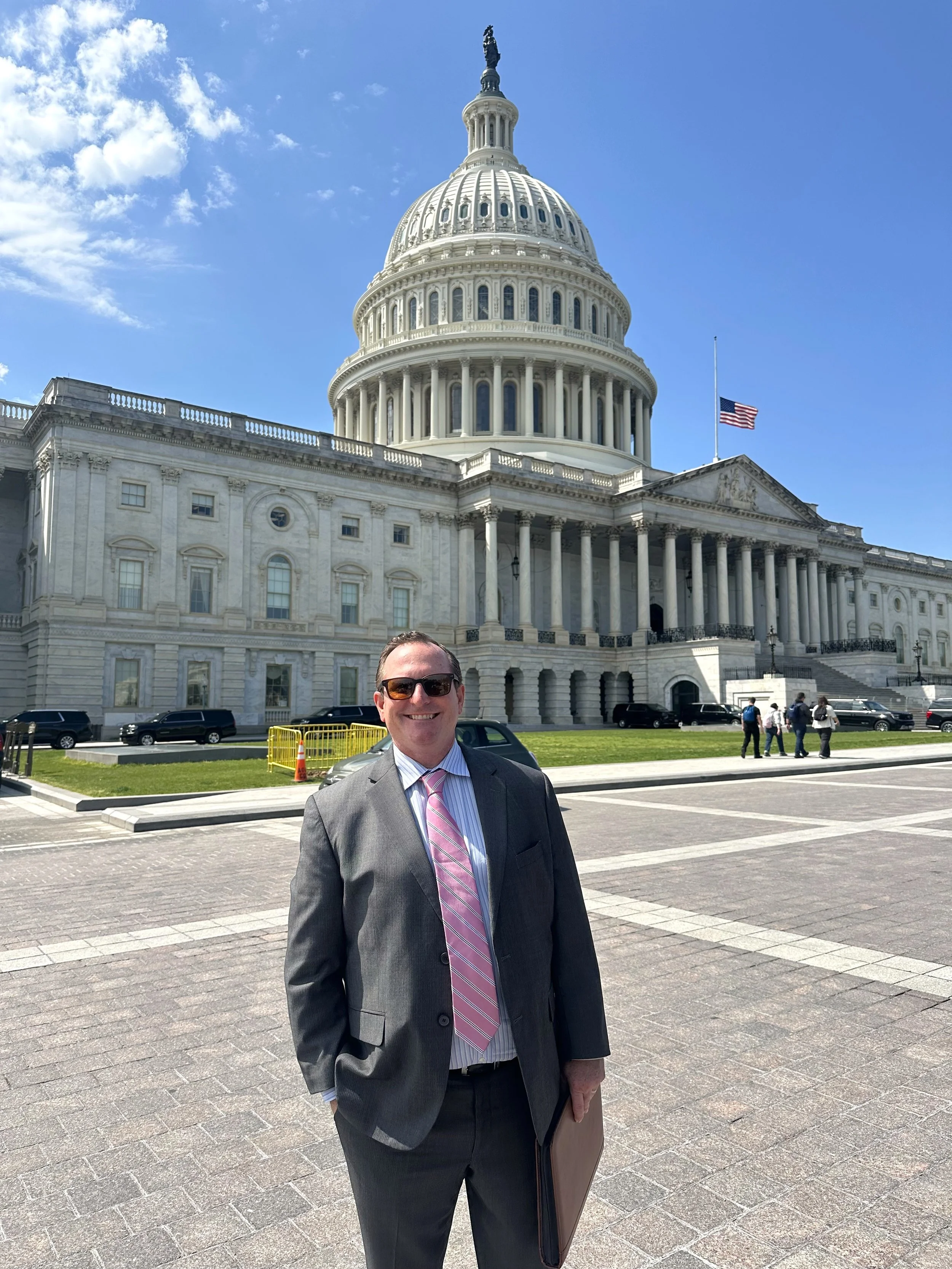
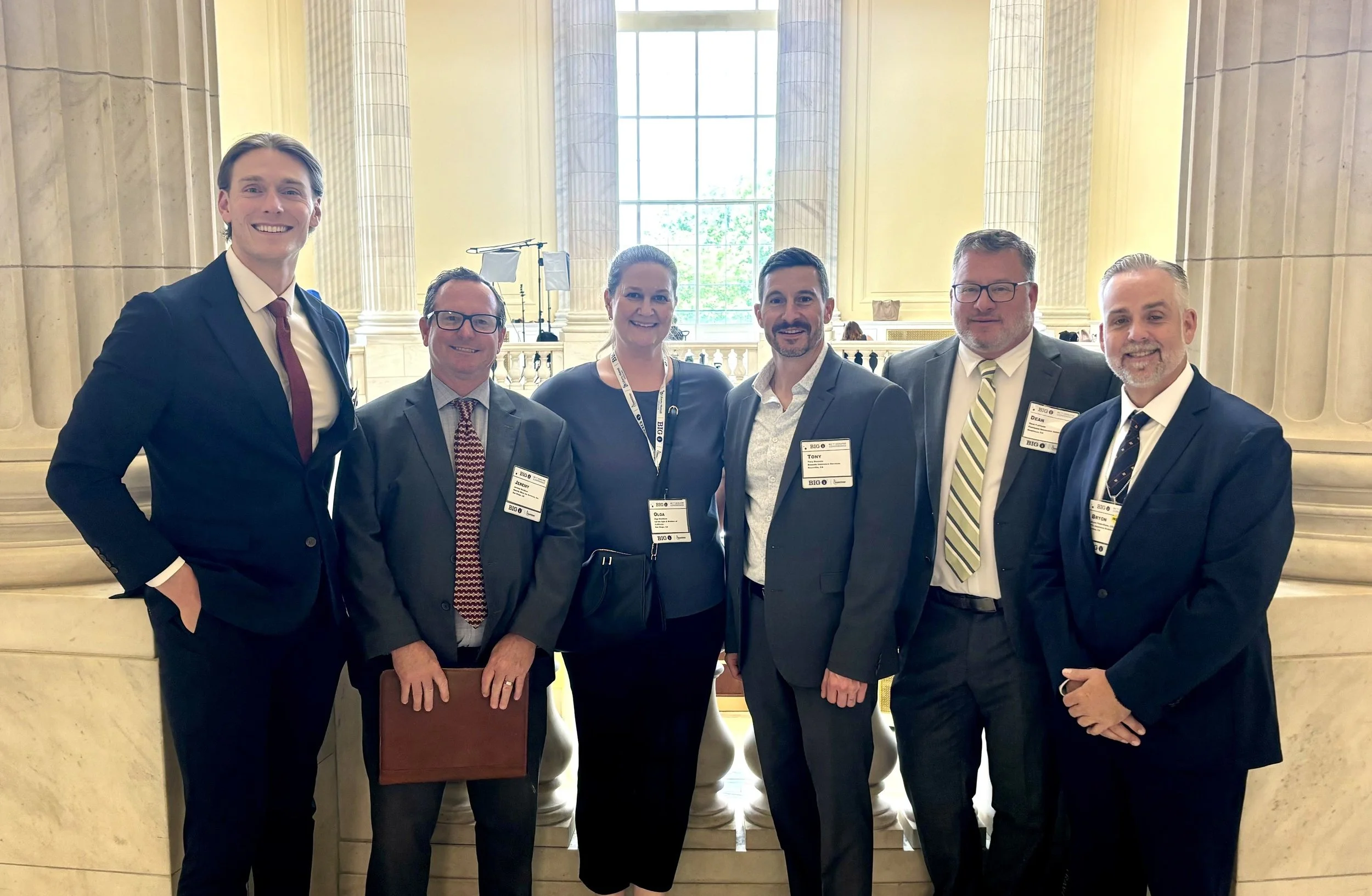
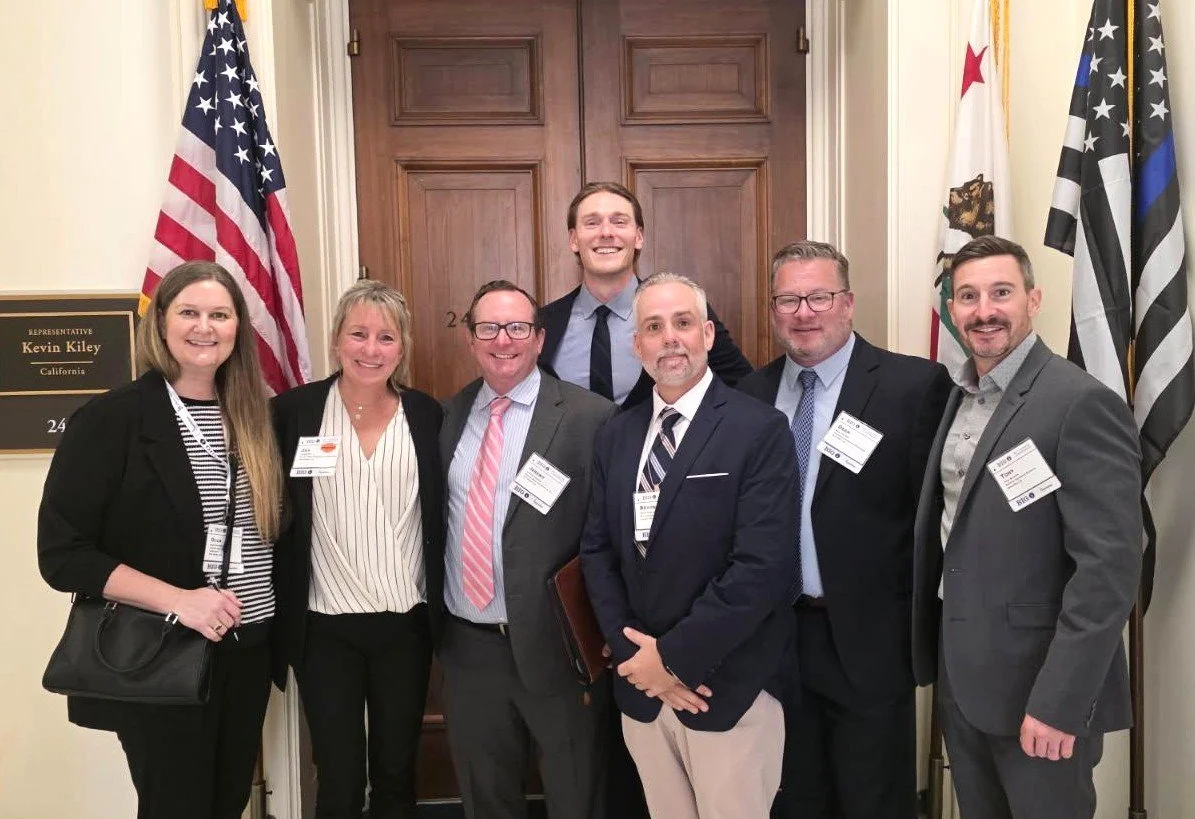
On April 22-24, I had the opportunity to attend the Big “I” Legislative Conference in Washington, D.C. The Big “I” is the national organization affiliated with IIABCal and IIAB San Diego. It represents and supports independent insurance agencies at the federal level and maintains a strong presence in Washington, advocating tirelessly on behalf of independent agents and our carrier partners.
Each year, IIAB San Diego sends the President‑Elect to its national conference. This year, I attended as the President-Elect, alongside IIABCal and leaders from other local California chapters. During the conference, we received detailed briefings on key legislative issues and bills that the Big “I” is actively supporting. In addition, we were asked to engage directly with our representatives to help build awareness and support for legislation that impacts our industry and, ultimately, our clients.
Our California delegation met with representatives and staff from each of our respective districts on Capitol Hill to discuss these bills and explain their real world impact on the insurance marketplace. Below is a summary of the legislation we covered.
Legal Reform
Rising litigation costs are directly increasing insurance premiums and limiting market availability. The rapid growth of third‑party litigation funding (TPLF), particularly by foreign entities, lacks transparency and benefits from unfair tax treatment.
We urge support for:
The Tackling Predatory Litigation Funding Act (H.R.3512 / S.1821) to ensure litigation funders pay fair tax rates and close foreign tax loopholes.
The Protecting Our Courts from Foreign Manipulation Act (H.R.2675 / S.3180) to require disclosure of litigation funding arrangements and prevent foreign exploitation of U.S. courts.
Disaster Mitigation
Increasingly severe natural disasters are disrupting insurance markets, driving premiums higher, and increasing reliance on federal disaster aid. Proactive mitigation reduces losses and long‑term costs.
We encourage Congress to:
Advance the Fix Our Forests Act (H.R.471 / S.1462) to reduce wildfire risks through improved forest management and infrastructure hardening.
Support the Disaster Mitigation and Tax Parity Act of 2025 (H.R.1849 / S.336) so homeowners are not taxed on mitigation grants.
Pass the Fixing Emergency Management for Americans Act (H.R.4669) to modernize FEMA and streamline disaster response.
Flood Insurance
The National Flood Insurance Program (NFIP) remains essential for homeowners and businesses in high‑risk areas. Repeated short‑term extensions have created uncertainty and left consumers vulnerable.
We urge Congress to:
Reauthorize the NFIP on a long‑term basis.
Support the Continuous Coverage for Flood Insurance Act (H.R.6620), allowing consumers to move between private flood insurance and NFIP policies without penalty.
Protect the Write‑Your‑Own program and avoid proposals that weaken or eliminate NFIP.
Terrorism Risk Insurance
The Terrorism Risk Insurance Act (TRIA) provides a proven, cost‑effective federal backstop that allows insurers to offer terrorism coverage for an inherently unpredictable risk.
We strongly support a clean, long‑term extension of TRIA to maintain market stability, protect taxpayers, and ensure coverage availability, especially ahead of major national and international events.
Health Care
Employer‑sponsored health insurance remains the backbone of America’s health care system. Stability, transparency, and affordability are critical.
We encourage Congress to:
Protect the tax exclusion for employer‑provided health insurance.
Pass the Patients Deserve Price Tags Act (H.R.5582 / S.2355) to require clear, standardized disclosure of actual health care prices.
Support expanded access to telehealth and reduced administrative costs.
Please reach out to me at jhoolihan@ranchomesa.co or (619) 973-0174 if you have questions about our efforts in Washington.
A Letter from RMI President to California Clients: Take Action On CT Claims Legislation
Rancho Mesa would like to provide you with an update on our efforts related to the growing cumulative trauma issue impacting the California workers’ compensation marketplace. As many of you have experienced firsthand, cumulative trauma claims continue to rise and are having a significant, negative effect on premiums and experience modification rates (EMRs) across all industries.
Rancho Mesa would like to provide you with an update on our efforts related to the growing cumulative trauma issue impacting the California workers’ compensation marketplace. As many of you have experienced firsthand, cumulative trauma claims continue to rise and are having a significant, negative effect on premiums and experience modification rates (EMRs) across all industries.
Over the past year, we’ve worked to better understand the root causes of this problem. We’ve hosted podcasts with industry experts and recently held a Cumulative Trauma workshop with a leading workers’ compensation carrier. From these conversations, one conclusion is clear, meaningful reform is needed.
To help advance that discussion, I’ve written letters to both the State Senator and Assembly Member who chair the committees responsible for potential legislative changes. While major action is unlikely during an election cycle, it’s important that our representatives understand the real-world impact this issue is having on California businesses.
Our intent is not to limit legitimate cumulative trauma claims, but rather to establish sensible guardrails that help prevent the growing abuse of the system. I’m attaching drafts of the letters I’ve submitted on behalf of Rancho Mesa. If you are inclined to join this effort, please feel free to use or modify them as you see fit.
Your voice matters, and collective engagement is often what drives meaningful change.
I hope you will consider joining me in supporting this much-needed reform.

David J. Garcia
President, Rancho Mesa Insurance Services Inc.
Send Letters to the Following
Senator Lola Smallwood-Cuevas
senator.smallwood-cuevas@senate.ca.gov
Assembly Member Lisa Calderon
assemblymember.calderon@assembly.ca.gov
Protect Your Equipment this Year with the National Equipment Register
Author, Megan Lockhart, Marketing & Media Communications Specialist, Rancho Mesa Insurance Services, Inc.
The National Equipment Register (NER) plays an important role in protecting heavy equipment owners from theft by maintaining a national database of equipment ownership and stolen machinery that is used by both law enforcement and insurance agencies.
Author, Megan Lockhart, Marketing & Media Communications Specialist, Rancho Mesa Insurance Services, Inc.
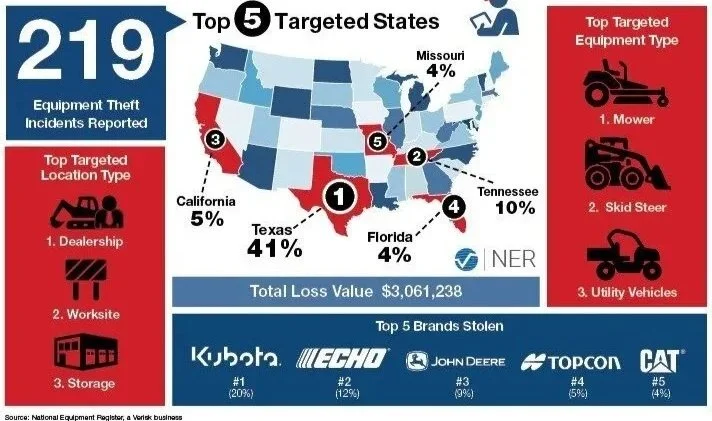
The National Equipment Register (NER) plays an important role in protecting heavy equipment owners from theft by maintaining a national database of equipment ownership and stolen machinery that is used by both law enforcement and insurance agencies. When equipment is registered, it provides clear proof of ownership, making it easier for police to identify stolen equipment and increasing the chances of recovery if a theft occurs.
NER helps deter theft and reduce financial losses. Registered equipment is flagged in systems used by buyers, lenders, and insurers, making stolen machines harder to resell.
Additionally, Rancho Mesa, in partnership with NER, offers premium discounts when utilizing HELPtech for registered equipment, helping clients lower costs while improving their theft prevention.
Register your equipment today, or contact your Rancho Mesa broker to learn more about reducing your heavy equipment exposure.
Insuring the Future: AI Tools for Modern Brokers
Rancho Mesa President David Garcia and Erik Vandermaus, Executive Vice President with BrokerPRO, a data and insight company that’s transforming the insurance industry. Discover how their technology is empowering brokers to streamline workflows, personalize client interactions, and stay competitive in a rapidly evolving market. discuss how to deal with current or former employees who post slanderous videos online, and ways to prevent it from occurring.

Rancho Mesa President David Garcia sits down with Erik Vandermaus, Executive Vice President with BrokerPRO, a data and insight company that’s transforming the insurance industry, to discuss how their technology is empowering brokers to streamline workflows, personalize client interactions, and stay competitive in a rapidly evolving market.
Dave Garcia: Hi everyone, you're listening to Rancho Mesa's Studio One podcast, where each week we break down complex insurance and safety topics to help your businesses thrive. I'm your host Dave Garcia, and today I'm joined by Erik Vandermaus. He's the Executive Vice President with BrokerPRO, and today we're going to discuss this platform and what's on the horizon with it. Erik, welcome to the show.
Erik Vandermaus: Thanks so much, Dave.
DG: So, Eric, let's just jump right into this thing. What led you and your team to start BrokerPRO?
EV: Well, I really appreciate the opportunity here. And it all started with our president, Nezih Hasanoglu's vision back in 2023 to create an insight and automation company that would do just that, bring solutions to brokers that would more effectively harness, leverage, and monetize their data and then share that high quality trusted data with other like-minded brokers to create a national benchmark across P&C, EB, and other areas.
So Nezih is our president of BrokerPRO and then I lead our data product development efforts. And about two years ago, two and a half years ago, I was a managing director at Accenture, which is a global tech consulting firm, and I was creating those same data analytics, digital and CRM solutions for my clients in the insurance industry.
DG: Okay.
EV: And so now I get to bring those same technologies to the broker space.
DG: Awesome.
EV: Yeah, it's been such a blast to work with Nez and others in the space. And the key for me has really been the ability to make an impact and deliver value to those at the trading desk. Those that are producing and need an edge to increase their win rates, go up market, and free up time so they can spend more of it with their clients.
DG: So in working with Nez and looking around and doing your research, what were some of the biggest frustrations or inefficiencies you saw brokers facing in the insurance marketplace today and how do you think BrokerPRO’s going to be solving some of them?
EV: Yeah, great question. BrokerPRO is a data and insight company. And our mission is to digitally enhance the client experience by harnessing and leveraging data for value at the trading desk. And so we start with a phrase by brokers for brokers, meaning that it's in our DNA, our funding, our leadership is from the broker space. And why does that give us an edge? It means we're close to the problems because we see them when we walk down the hall and see someone spending hours creating a benefit guide, or see someone using other generative apps that really aren't tuned to the specific task and are inherently just not going to be as accurate as some of our solutions are. And so what we see for biggest frustrations, inefficiencies at the trading desk, there's so much unnecessary times moving things around, taking data from here to there, spending 10 hours creating a benefit guide, as I mentioned, or comparing two policies or a quote to a policy, or spreadsheeting information. It's time that could be freed up. And so this is why we created one of our products called GenPro, which I'll talk more about.
And second, brokers can no longer rely solely on the strength of their relationship with a prospect or client to win and keep their business. Yes, relationship will always be critical, but not sufficient. And that's really because of the buyer of today. And, you know, that new CFO, that's 35 years old, they went through college during the 2008 financial crisis. And they were trying to find their first job around that time. And that has significantly shifted how brokers need to approach them, more towards a strategic risk-aware partnership mindset. And they value resilience, data-driven insights, and long-term value. And so that's how we need to meet them, where they're at. And that's what BrokerPRO is doing.
EV: So you mentioned a lot of things there. And your customers will be brokers like Rancho Mesa, and other agencies across the country. And then we'll be able to deliver these benefits to our customers and clients and hopefully talk to prospects about the benefits of things as well. So is there, is that, do you have any success stories that I know, you know, what's the genesis of BrokerPRO? How long has it been out in the marketplace? And then maybe you can share a couple of success stories with us today.
EV: Yeah, we just started with our marketing efforts this year and we have six brokers on platform now and we're growing. And back to that CFO, they want a national benchmark and that trading desk wants efficiency. That's what BrokerPRO is solving for. And so I'll give you some numbers, success stories: 31, 106, and 20.
First, riffing off that national benchmark comment, producers that use BrokerPRO's data products see new business win rates 31% higher than those that don't.
What's more, producers that use our data products see their average win amount 106% higher than their peers. And that's because they're using data products within the pro suite benchmark, national benchmarking for P&C as well.
And a producer recently who was doing a P&C renewal, client wanted to change carriers. They weren't happy with the carrier from a work comp. claims perspective. But the producer was able to bring this trusted national benchmarking to show that their rate is lower than their peer. They argued that they shouldn't go to market and that the client immediately agreed. So again, back to that CFO, they want to see data to back up the recommendation.
Even more, brokers need to free up time. And so 20 comes from freeing up 20% of time at the trading desk when our generative AI GenPro is used. Users are saying that it's saving them on average an hour and a half per day. And that adds up over a week, that's 20% of your time for the week.
DG: So I know we're going to discuss some of the products specifically here in a second Erik, but I'm curious you've mentioned a lot about the producers and the impact to them. Do you see this as a tool that the client management staff will use as well? Maybe you can share a little bit about how they're using this in their day to day. I'm sure it's saving them time too.
EV: I love it. Yeah, absolutely. Yes, 100%. So GenPro, our generative AI app is tuned for the work that a client manager is doing all day long. And that's where we see the greatest use. And that that's where we see that hour and a half savings per day.
For an example, I was I was on with one of our subscribers. And the client manager was talking about a benefit guide accuracy check she was doing and she put it through GenPro and she found another claim in the template because the template is often reused. It happens and her manual check wouldn't find it but GenPro found it. Saved her a lot headache.
DG: Oh for sure. Yeah that's great. You mentioned GenPro. What else is contained in the BrokerPRO model?
EV: Yeah we talk about our pro suite starts with GenPro. That's private, secure, generative AI. It's tuned to perform like an insurance broker's assistant, and it's been configured to be accurate. So unlike Copilot or other Gen AI apps, we've turned its creative abilities all the way down. It is focused on accuracy and to sit alongside you, and that's what's driving the time savings. It's so fun to hear the users when they get into it, “It saved me 10 hours here. This is what I was doing.”
So, really fun and exciting to see what they're doing with it.
DG: Erik, you'll quickly recognize I am not a tech leader like you are. So, let me ask a couple of questions at my level of tech understanding. When we talk about GenPro, I'm concerned that you always hear, at least that I hear, is that somehow we're going to let information out of our office, out into wherever that goes, making it accessible to other types of AI products, can GenPro go out of the system to seek information, other than agency information?
EV: Great questions. The answer to the first question, no, it cannot leak data out because we take a copy of the large language model. And so whenever you're interacting with it, it's using a copy that it's talking to.
DG: I see.
EV: So that public model is never able to see anything you upload to it. So that's a really important piece. Users also have self-contained security. They can only see their own documents, et cetera. We don't want it to go out and find data externally. I will caveat that to say, though, although we are and we do have the ability to ask or have GenPro look at files coming from the AMS. So for example, one subscriber has over four million files that they've downloaded from Epic and GenPro is able to look at those and use those, but it's all contained, self-contained within that subscriber.
DG: Okay, so many of us—Epic for the audience is an agency management system that many agencies probably the 75% probably of the agencies in the United States use Epic. So what we're saying then, Erik, is that GenPro and Epic can communicate with one another? So the information that's in Epic is accessible to GenPro?
EV: Correct, it is.
DG: Okay. I'll tell you, as the agency owner here out in Southern California, that is one of our biggest needs is to, we've got these sources of data, whether it's in our agency management systems, on Excel sheets or wherever and finding some kind of a product that can talk with each of those and extract data from it and then put it into some usable, readable tool is huge.
EV: Yeah, so exactly.
DG: And maybe that kind of leads to my next question. How does BrokerPRO kind of stand apart from all these other insure-tech products? I get an email a day, you know, from the next greatest, you know, insure tech product. How does BrokerPRO stand apart from all of those?
EV: Indeed, there's so many options out there and brokers are spending so many hours just evaluating solutions and weeding through it. Here's BrokerPRO's superpower that cuts through all that. We're by brokers for brokers. By brokers for brokers. We were born from a top 50 broker here, M3 insurance. That gives us a tremendous edge over other insure-techs by being close to the problems that brokers face.
That said, we're also independent and we operate separate from the parent. And so we've solved the national benchmark data problem with high quality trusted data and efficiency with GenPro. And now if you start to put those two together, high quality national benchmarking with Generative AI, if you start to mix and match those tools, which you can do on BrokerPRO, that becomes a competitive edge over these other insure-techs that only do one or two or three things separately. We can mix and match those together.
DG: So Erik, as you grow this membership, I think you mentioned currently have six or seven agencies that are now BrokerPRO subscribers. Is there any abilities to use the data within that group as a benchmarking tool for all the members without obviously being account specific or something like that?
EV: Absolutely that's the beauty of our benchmark pro products both for P&C and employee benefits and that's the beauty of the BrokerPRO platform because we're able to share data with like-minded firms. And we de-identify, we anonymize that data so you can't see the actual name of that client, but you can benefit as a broker by calling up what that national benchmark looks like when you are competing for business and you want that broader perspective.
DG: Yeah, that's a big help for agencies like ourselves. As I mentioned, we're in Southern California is where our corporate offices are, but we do business in 22 different states, and you roll into a state that you're not familiar with, you've got an opportunity there, you really don't know the marketplace, what carriers are really active there, and what are not. So it sounds like this tool would be a big asset for us to say, “Hey, we're looking at a plumbing contractor in Missouri, can you give us an idea of which carriers are being active in that marketing space?”
EV: Yeah, and you can trust it because you know where that data came from. You know that that peer firms that aren't competitors with each other, but we're sharing data in order to help each other win against the national firms that just have national benchmarks just based on their size.
DG: Yeah, so, you know, I'm going to be selfish here for a second because this next question probably Fits myself and our agency, you know spot-on but give me a piece of advice that you give to other brokerage agency leaders like myself who are working on their AI strategy within their own firm. Most of us do not have somebody like Erik that we can just say, "Hey, Erik, can you look into this for us?"
What advice can you give me or give us all?
EV: Yeah, absolutely. So if you're evaluating insure-tech and AI, which most of us are, you're in this endless loop of analysis. There's just so many options. So I encourage you to prioritize the platforms that are scalable enough on the number of use cases they can solve for you versus having to evaluate and buy a separate solution for every use case problem you face. And that is one of the major benefits of BrokerPRO because we've got close to the problems, and we're able to see across those areas, P&C and EB then mix benchmarking with AI together. If you focus on those things, that will really accelerate your time to value in your shop, and selfishly, it will also lead you to BrokerPRO.
DG: Yeah, right, sure. Well, you know, I think, you know, I've had a few conversations about this, so you enlighten me to a lot, and I like the idea of kind of reverse engineering the needs basis, like what's the outcomes? What's the output we're looking for? And then is that something BrokerPRO can do? And if so, how does that works?
So--versus, and we've already sat through a number of different meetings with different other vendors and it's overwhelming, you know, they can all do everything, most of it we don't need and you get confused. And then, you know, I don't know if this is a real term when I made up, but I feel like there's AI stacking, you know, where you start laying product on top of product on top of product, and you don't know which one's doing what the best. So, sounds like BrokerPRO’s, I like the idea that it's reverse engineered from the broker standpoint. You know, it's written by our needs, and that's a consensus of needs. And then with the growing group of members, there's probably going to be new needs that are going to apply to all of us to help us. So that makes a lot of sense. So Erik, before we wind down, where's BrokerPRO going next? What are you guys working on? Give us a little tip.
EV: So, you know, even if your agency is growing 10 to 15 percent a year, there's likely friction points all over your agency, slowing you down from even that next level of growth. So think about all of those friction points. One of those that we've heard from our subscribers is benefit guide creation. We all know that it takes so long to create those things, and one client may have 10 different files that a client manager, someone at the desk, needs to look at to create one of those benefit guides. And so, how can you take that 10 hours of manual creation and use AI to bring that down to let's say an hour? We're solving that problem. We're actively in development on that. I can't wait to bring out to our subscribers to show them what we can do.
DG: So a little tease there, a little something coming. Stay tuned for the first episode of next season, sounds like. That's awesome. Anything else in the pipeline that you can mention or feel comfortable mentioning?
EV: Yes, there's so much on our roadmap and so many things that we're working on, but it's really important for us to prioritize based on what our subscribers are asking for. That is one of them, but there's a couple others that are on the burners right now.
DG: Okay, great. Well, listen, Erik, I've really enjoyed the time today. It's been super informative. We're looking forward to you and I and our companies having further discussions for sure, but if listeners that are out there are curious to learn more or to get started with you, what's their best first step? How can they reach out to you?
EV: Yep, go to brokerproai.com, and there's a way to request an invitation, and we would love to talk with you.
DG: Okay, that's is there before we end is there anything else you'd like to talk about or mention before we wrap up today?
EV: It's just, it's been an honor to be able to talk with you and to get this opportunity and we know that now being by brokers for brokers we're talking to those that are in the same boat they're looking for these solutions and it's tough it's tough to read through it so let us show you how we're different and how we're close to the problems that you need to solve.
DG: Great Erik, thanks so much for joining me today in StudioOne. I appreciate it.
EV: Thank you.
DG: And everyone out there, thanks for tuning in to our latest episode produced by StudioOne. If you enjoyed what you heard, please share this episode and consider subscribing. For more insights like this, visit us at RanchoMesa.com and subscribe to our weekly newsletter. Till next time, take care, bye-bye.
CA Insurance Commissioner Lara Approves 8.7% Workers Compensation Increase
Rancho Mesa’s Alyssa Burley and President David Garcia discuss California's approved 8.7% workers' compensation insurance rate increase, its impact on businesses, and practical steps business owners can take to prepare for the changes effective September 1st.
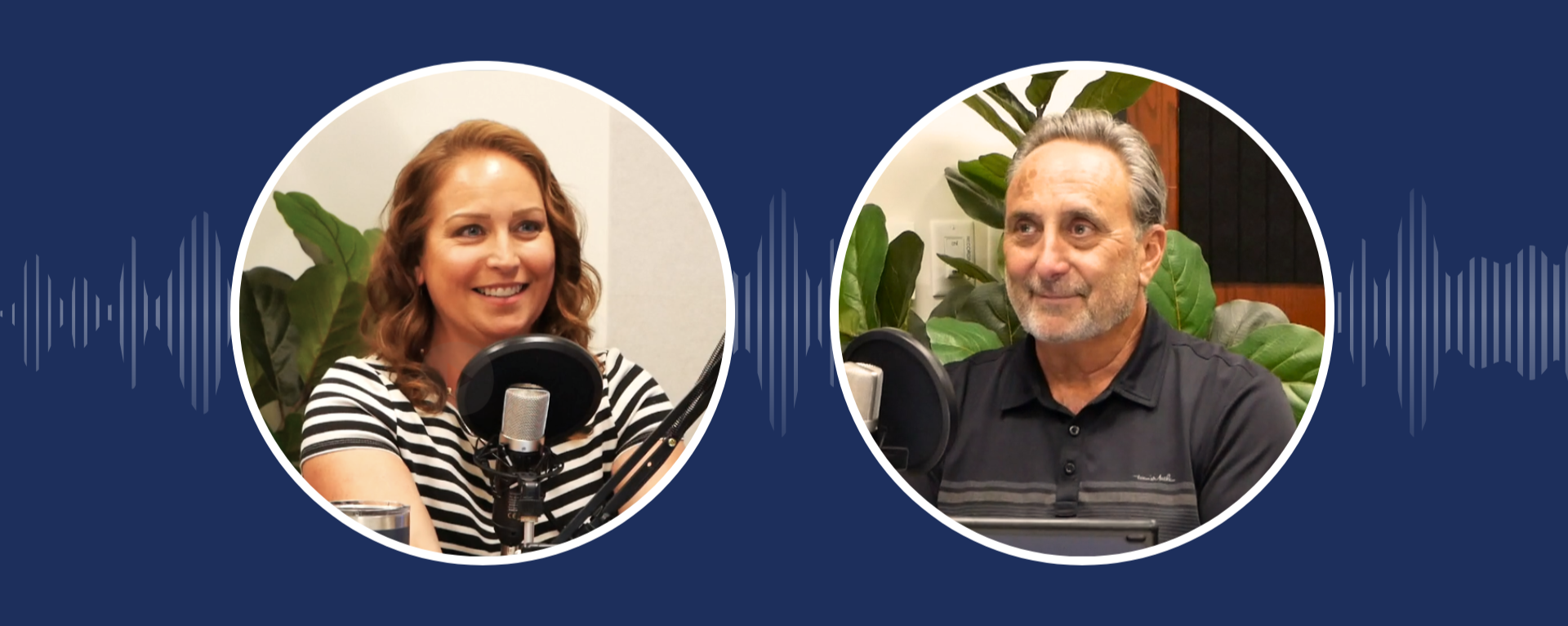
Rancho Mesa’s Alyssa Burley and President David Garcia discuss California's approved 8.7% workers' compensation insurance rate increase, its impact on businesses, and practical steps business owners can take to prepare for the changes effective September 1st.
Alyssa Burley: You're listening to Rancho Mesa’s StudioOne™ podcast, where each week we break down complex insurance and safety topics to help your business thrive. I'm your host, Alyssa Burley, and I'm joined by Dave Garcia, president with Rancho Mesa. And we're going to talk about California's now approved workers' compensation insurance rate increase. Dave, welcome to the show.
Dave Garcia: Thanks, Alyssa, glad to be back here in StudioOne and anxious to get this information out there for everybody.
AB: Yeah. So we've actually been talking about the proposed workers' compensation increase for, I don't know, the last few months. And we've published multiple articles and podcast episodes on the subject, and now it's actually official. California's Insurance Commissioner, Ricardo Lara, has approved an 8.7% average rate increase.
So Dave, in your opinion, what kind of impact will this increase have on California businesses?
DG: Well, you know, this is a deep, deep topic. So I'll try to be brief right now. So in short, you know, we've obviously been talking a lot about this recently, and particularly about what's driving these increases. But rather than go over all those elements again, I'd encourage the audience to listen to the three-part series I did recently with Margaret Hartman. She's the Senior Vice President and Chief Marketing Officer for Berkshire Hathaway Homestate Companies. They're one of the largest specialty work comp carriers in California and Margaret gave just tremendous insightful overviews of what's at the heart of this and the increases range from medical cost inflation, payroll inflation, and cumulative trauma claims just to name a few of the many cost drivers.
So to fix those, we're definitely going to need reform, but as with anything else, to address those bigger problems that are going to require that type of reform, I just don't see that coming until 2027 at the earliest. Maybe election year 2026, puts a little upward pressure there, but I'm not going to bank on anything happening before 2027.
So with Laura's decision, the WCIRB just recently released their new pure premium rates per class code, which we take the opportunity then to download that into our pricing models here at Rancho Mesa. So that gives us an ability to identify the individual impacts these new pure premium rates will have on each class code.
AB: Okay, and we'll include links to those three episodes with Margaret in the episode notes for this episode. And I would encourage our listeners to reach out and see if this increase or how this increase is going to impact your individual class code.
Now, when can California business owners expect to feel the result of this increase?
DG: That's a great question, Alyssa. So this all goes into effect September the first of this year. So these pricing changes will take effect on that day. But the thing that business owners should understand is that those changes will not take effect for them until the actual renewal time of their workers' compensation policy.
AB: All right. So businesses with a renewal date on or after September 1st will feel this change. While someone who renews, let's say in February, won't feel this impact until February 2026, correct?
DG: Yeah, exactly. You’re spot on there. And that's why I think we've tried to kind of be the canary in the mine here by publishing so many articles and podcasts months ago to try to get this message out because, so many of the businesses that--so for those business that renew really close to September they have some opportunity to get prepared the time is short.
AB: All right so there are things business owners can do to prepare even if they renew early September, maybe October?
DG: Yes, there's ways to prepare now and that's whether your renewal is in September or some month after September. But let me just stress this, time is of the essence. There is no time to delay. So the closer you are to September 1st in your renewal, you really have no time to spare.
So along those lines, we've got solutions here that we think will help all businesses. So we're going to be taping an episode here in the next few days that will spell out exactly what businesses can do now to try to mitigate these increases. The good news is we have the answers and on top of that we're more than willing to roll up our sleeves and get to work.
AB: If you're talking to your client today we know the time is over the essence what are you telling them?
DG: You know I'm telling them that the first thing they need to do is understand what the actual individual increase is to them and their pure premium rates. So they need to reach out to the broker, hopefully they're aware of what those changes are, and find out is it a single digit, double digit, high double digit increase, it's going to really make a big difference.
The second thing they really need to do is kind of roll up their sleeves and have somebody audit their safety program.
And then thirdly, I think it's time to really mine into your claims and try to develop solutions to the root causes of those claims. Without those three things, the wave's going to hit you and you're not going to see it coming.
So we all need to just encourage one another, now's the time to be proactive. And this is work that is able to be done. This is not overwhelming work. It's a matter of being proactive, understanding the situation, and then implementing a strategy and moving forward.
So businesses that are out there, reach out to your broker, reach out to us, talk to somebody now, don't wait.
AB: All right, and I look forward to discussing all of those ways California businesses can prepare now for the coming increases. So Dave, thank you for joining me in StudioOne.
DG: Alyssa, thank you so much, an audience out there. Really, time is of the essence. So make those calls.
AB: All right. Well, thanks for tuning in to our latest episode produced by StudioOne. If you enjoyed what you heard, please share this episode and subscribe. For more insights like this, visit us at RanchoMesa.com and subscribe to our weekly newsletter.
Workers' Comp Rate Increases On the Way with Margaret Hartmann: Part 3
In the final episode of a three-part series, President David Garcia and Margaret Hartmann, Sr. VP and Chief Marketing Officer with BHHC, discuss the WCIRB's proposed 11.2% workers’ compensation rate increase in California. They explore how this may impact employers, and actionable steps businesses can take to mitigate rising premiums.

In the final episode of a three-part series, President David Garcia and Margaret Hartmann, Sr. VP and Chief Marketing Officer with BHHC, discuss the WCIRB's proposed 11.2% workers’ compensation rate increase in California. They explore how this may impact employers, and actionable steps businesses can take to mitigate rising premiums.
Dave Garcia: Hi, you're listening to Rancho Mesa's StudioOne™ podcast where each week we break down complex insurance and safety topics to help your businesses thrive. I'm your host, Dave Garcia. Thanks for joining us.
So today with the WCIRB's recent announcement of 11.2% recommended rate increase in workers' compensation, it definitely feels to me like the workers' compensation marketplace in California is about to change, and with that in mind, we've invited Margaret Hartman, the Senior
Vice President/Chief Marketing Officer at Berkshire Hathaway Home State Companies, who's one of the largest specialty workers' compensation carriers in California, to give us some insights as to how this recommendation came about, what are the areas that are driving this increase, and what employers can do to try and mitigate the rate increases.
Hi Margaret, welcome back to StudioOne. Thanks for joining me today.
Margaret Hartman: Thanks for having me.
DG: It seems to me Margaret, given all the data and recent recommendations that many employers have not all are going to experience rate increases on the renewals. You know, we know Commissioner Lara--generally speaking--the Bureau makes their recommendation which they have at 11.2. Commissioner Lara--usually in June so it could be any day now-- will make his recommendation.
MH: I think it's today. There's a hearing today. He may not decide today, but I know there's a hearing today.
DG: Okay, well it could be today and today, so the we're taping this it's June the 10th. You know, I don't have a crystal ball. My crystal ball has snow in it I think he's going to come in with a recommendation of somewhere between four and six percent increase or somewhere in that range, six to seven, I don't know. Regardless, it's going to be a recommended increase, which we have not seen in over a decade in workers' compensation. So while that means it's going to put upward pressure on rate, that doesn't mean every single policyholder in California will see the same rate increase as another.
So your experience modifications come into play, your claims experience is going to come into play, and most importantly too, your safety practices. And this is where we're really auditing that and then allowing your broker to present that to the marketplace and what you're doing to prevent injuries from occurring and then what you do once an injury occurs. I think that is the really, really critical right now and Margaret, what actions would you recommend they try to do, if they see an increase to try to mitigate the increase and in some cases maybe there's still a decrease out there?
MH: Sure. And I mean, we've talked a lot about some specific ways that employers can help themselves out. But really, that experience modification that you're talking about is the best way to manage your insurance premium. So as you mentioned, there's going to be probably some sort of rate increase and probably single-digit, I'd imagine. And I agree with you four to six, three to five, something like that, but you're experiencing it. So that's, the carrier will have a base rate increase, increase likely, but your net rate is not going to be the same as that base rate. And the only way to impact that is to have a low mod. So try to manage your experience mod as much as you can.
And again, that's all the things we talked about, having the safest work environment that you can so you can prevent accidents from happening and then partnering with a carrier that's focused on providing the best possible care, getting claims resolved quickly and efficiently.
DG: Yeah, and we know, as Margaret said, it’s your premiums can be predicated on your payrolls by class code, multiplied by the final rate from the carrier, multiplied by your experience modification. But to get to the final rate of the carrier, there is some subjectivity still available with the carriers. So they can deviate a certain percentage, usually it's plus or minus 50%, off of their base rate. But in order to warrant those credits, it's going to take real items to try to get the carrier to understand why they should apply those credits. So when we talk about that out there, what your broker does is he or she submits to a carrier your information. We call that a submission.
So Margaret, how important is receiving a complete submission early in the process of benefit to the policyholder in getting the best possible rates?
MH: Yeah, I think it's incredibly important. So an underwriter is going to be getting a lot of these
applications, right, they're coming to their desk. And the ones that are complete, where they don't have to call or send an email or ask questions or try to get more information, those are going to rise to the top of the stack and they'll be able to process them quickly and maybe get the quotation out, right?
And then that starts the process of negotiation or tweaking that price. So the earlier that you can do that, the better. I think it definitely helps. And then the more complete the information is, you know, that will help the underwriter better price the risk as well.
DG: Yeah, are there any parts of submission that, you know, they're all important, but does any part of it carry more weight for your underwriting team than another area?
MH: Yeah, I mean, I think we look at the account as a whole, but obviously, loss history. It goes a lot into how we view an account, how we price an account. You know, a lot of times there's a supplemental application and employers out there have checked the box. "Oh, yeah, I have a safety program," blah, blah, blah.
But sometimes it becomes a check the box versus a, you know, "What exactly are you really doing?" But the proofs and the pudding, what does the loss history look like?
We also pay a lot of attention to payroll too. Is the account growing and if there's substantial growth in the payroll versus the expiring year, what's going on is there going to be growth and if there's going to be growth, it's not to say we would dislike the account, but that's one where we may want to keep an eye on them. how are they going to manage hiring practices to bring on all these new people? What kind of projects are they going to be taking on? It just goes into us understanding what that risk is isn't understanding how to price it.
Likewise, if the payroll's dropping substantially, why is that happening? Is there a layoff spending, those kinds of things? And then we look at the risk quality, risk management, safety program. Those are harder to get our arms around because as I said, a lot of people will just kind of check the box. Yeah, we have these things. So a narrative is really important from the broker, kind of putting together the story of the account.
The loss history, none of these things are the only, they're only a little piece of the puzzle, right? So maybe the loss history is such that it looks really bad and then in the last two years, it's improved. If you can substantiate why it's improved, not just send, here's the loss runs and here's the application, but this employer really took some steps to improve their loss profile. You know, they hired a new risk manager, they automated a lot of their procedures. Those are things that are going to play into the price and you're going to go, well, I think that account is going to perform the way it has the last two years, not what happened in the past. And they may still have a really high mod because of past poor losses. So it can help kind of paint the picture of what's going on with the account today.
DG: I think that's great you know what it sounds to me and it's high time it's time for everybody go to work, you know the broker needs to go to work and not just check boxes needs to provide more information. I know we regularly dig deep into those things if payrolls are going up maybe it's just payroll inflation maybe there's no new employees everybody just got pay raises or now they're doing union work versus not. Like you need to know more than just the basic facts. And I love the summaries, you know, we're a big proponent of that. But I think I'm always three dimensional, always seems to be the best. And so I know we've worked in the past Margaret, when we get looking at a new potential client of ours, we put all the all the paperwork together, the summaries, the losses, the payrolls, all those things, but it's still paper.
And what I think I like, you know, how we work with you is we'll say, "Hey, can we go out and do a joint call together so you can actually ask the questions and see the operations?"
Do you think having the carrier go out prior to quoting the business is a benefit to the business?
MH: Yeah, absolutely it is. And we love to go out and see the prospects. There's nothing like meeting somebody face-to-face, looking them in the eye and seeing the operation as well. And on the other hand too, they have an opportunity to meet us and see their service team and what they’re going to get from us. You know, policy, especially in the workers’ comp, you know, they all kind of cover the same thing, there’s not really a lot changes besides maybe a deductible. So it's really the service that's important. And so I think it's good for an employer to actually meet their service team and see who's going to be working with them in the future. Yeah, I mean, absolutely. We love to do that. We're always open to having our folks go out and meet with prospects face to face.
And now with virtual too, a lot of times we will do them virtually. It's easier and you can do them quickly. You can get them set up quickly.
DG: I'm sure you can do more than two or three in a day if you need to.
MH: Right, so either way. We're happy to have those meetings. And it does make an impact.
DG: So employers, I would encourage you, you're working with your broker currently to engage with them early. And when we say early, you're probably talking 120 days outside of your renewal date. So you want to get this process started early, particularly with the changes that are occurring. And then as a team, you guys decide should we involve some carrier interviews where we get an opportunity to talk to the carriers, and you can talk to more than one. You know, if you just want to get a comparison like who did you like better? They both offer great services and things like that. So it is going to, it's time to roll up our sleeves and you know really get to work here. There's some tremendously great work comp carriers--Berkshire Hathaway heading the
List--that are out there. So I would just encourage you to you know to go out and work with your broker partner and make sure that they're doing the job that they're supposed to be doing too.
So Margaret you know I appreciate your time today before we wrap up is there anything else you'd like to share with our audience.
MH: Gosh, no, I mean, I think we've covered a lot today. And again, I think our mission is really to provide, you know, the best possible care for injured workers, because at the end of the day, you know, that's what's going to result in the best claims costs more effective for employers. And it's the right thing to do. And keeping employees safe is the right thing to do, not just for, you know, an employer's business, but just because, you know, we care about people.
DG: Yep. And you've demonstrated that, you know, time and time again. So I think everybody out there, you know, there's been a lot of things that we've discussed today. If you're looking for more information, you know, reach out to myself or to Margaret directly, you know, you can go to our site, RanchoMesa.com.
And we're happy to help, you don't have to be our client, we're in this together. So Margaret, listen, I can't thank you enough for joining me today in StudioOne and kind of sharing your insights to this changing worker compensation marketplace. Last, anything else? How's Notre Dame football going to be this year? What do you think? What's your prediction?
MH: Oh boy, I don't know. Don't throw that curve at me. I have no idea, but I'm still looking forward to the season.
DG: Okay, there you go. All right. Well, listen, thank you all for joining me today in StudioOne. If you found this information useful, you can subscribe to our podcast channel, which is StudioOne, all one word, and it can be found on literally all the podcast applications. So thank you again for your time. Goodbye for now.
Workers' Comp Rate Increases On the Way with Margaret Hartmann: Part 2
In the second episode of a three-part series, President David Garcia continues his discussion with Margaret Hartmann, Sr. VP and Chief Marketing Officer with BHHC, and explains how companies can mitigate cumulative trauma claims in light of the WCIRB’s recent 11.2% recommended rate increase.

In the second episode of a three-part series, President David Garcia continues his discussion with Margaret Hartmann, Sr. VP and Chief Marketing Officer with BHHC, and explains how companies can mitigate cumulative trauma claims in light of the WCIRB’s recent 11.2% recommended rate increase.
David Garcia: Hi, you're listening to Rancho Mesa's Studio One podcast, where each week we break down complex insurance and safety topics to help your businesses thrive. I'm your host, Dave Garcia, thanks for joining us.
So today, with the WCARB's recent announcement of a 11.2% recommended rate increase in workers' compensation, it definitely feels to me like the workers' compensation marketplace in California is about to change and with that in mind, we've invited Margaret Hartman, the Senior Vice President, Chief Marketing Officer at Berkshire, Hathaway Homestate Companies, which's one of the largest specialty workers' compensation carriers in California, to give us some insights as to how this recommendation came about, what are the areas that are driving this increase and what employers can do to try and mitigate the rate increases.
Hi Margaret, welcome back to Studio One. Thanks for joining me today.
Margaret Hartman: Thanks for having me.
DG: I know that Berkshire Hathaway, we've worked with you guys for any number of years. We have a tremendously strong relationship so I'm very familiar with a lot of the services that you're able to provide policy holders, but are you guys looking at taking any targeted steps to help manage this growing impact of CT claims as a company?
MH: Yeah, I'm glad you asked. We are taking this very seriously and we have taken some proactive steps here, including you know we have a task force a little committee that we’ve set up internally within our claims teams to try and manage some of these claims and have strategies for, you know, we want to make sure that we make decisions on these quickly, ones that are legitimate that we’re getting people treated quickly and though the system so that we can get them back to health and back to work as quickly as possible.
DG: You know, that's a really, really smart idea. I know you guys did the same thing during COVID, when you started to see COVID claims, you kind of bunched those into a unit because the repetitiveness of the type of claim led to expertise in managing the claim.
MH: Right.
DG: Yeah. That's a, that's, that's awesome. I'm glad to hear you're doing that.
MH: Yeah, so we've, you know, we've improved our tracking, like our CT tracking approach implemented some analytics on that so we can dig deeper on some of the doctors that we're seeing, some of the players in the CT space. We ramped up our training around the compensability decisions involved, more managers in the process. We've just, we've made a lot of targeted changes, including using data analytics again and identifying the players in that CT space. And then we really kind of launched a collaborative approach on how we're managing these claims. So along with our claims professionals and consolidating cases with specific claims professionals, we also have specialty teams that are pretty unique, including our medical excellence team, which is headed by our medical director, Dr. Lynn, who's an occupational health specialist. So she's developed some strategies for helping us deal with these. We have a roundtable approach that we've now implemented for some of these CT claims.
We also have a contribution team which is kind of unique as well. So, as I mentioned, a lot of these, since they happen over a span of time, it often, you know, somebody may work for multiple employers and we want to make sure that our policyholders are only paying for their fair share of those claims. So we have a contribution teams that helps us manage those third party recoveries and get those dollars back if somebody else is responsible for a portion of those claims. We also have in-house council and a very robust special investigation unit, for when we do start to see some of those like mass layoff type filings of CT claims, we'll get our special investigations unit involved in those as well.
DG: Is that unit also involved with I guess the slang word would be capping you know by attorneys?
MH: Yes.
DG: Can you explain what capping is and maybe how that hurts the system if you're the employer or the insurance carrier?
MH: Right well there's been several really, really high profile cases of capping here in California where people are actually going out and trying to that people to come in and get medical treatment, signing them up, say you have a claim and we'll send you in to see these doctors. I mean, to the point where some of them are really egregious, like people were having surgeries that they didn't need just so that they could get paid and then they're getting paid for that. So our special investigation unit is very involved in those types of cases. Those are, of course, very, very extreme cases, but we want to make sure that they're involved. And so when we start spotting some of these trends and behaviors and things, we will definitely bring them into the loop. And they work with the local district attorney's offices. A lot of them have very good relationships with the DA's offices so that we can move some of these cases forward and make sure that there's no abuse there. And then, you know, all of that is kind of what we're doing after the fact. But probably the most important thing, and I'm going to talk about this again when we talk about what employers can do, is getting loss control involved early on. I think our loss control specialists are very well versed in trying to identify these possible CT exposures that may occur in the workplace. And we may not be able to eliminate them all, but we can reduce the risk often.
DG: Well that's great. So let's switch gears now and start talking about what would you recommend employers do to try to mitigate this risk.
MH: Well prevention starts at the workplace level of course so one of the most effective things employers can do is foster early reporting, open communication, many CT claims stem from issues that were never reported or addressed early If somebody is having problems with their wrists, for example, because they're doing, you know, repetitive typing, we can get an ergonomic eval and get somebody out there to help prevent that injury from progressing because now we're going to have the right equipment in place for them to be able to do the job safer. And often some of these modifications are not expensive to do.
DG: And that ergonomic evaluation is something that your loss control department can assist with?
MH: They can assist with it. We also have a kind of a do -it -yourself app. Okay. You know, there's a lot of them out there. I mean, the nice thing for employers right now is that there are so many safety resources before you had to go through some library and now you can kind of Google YouTube videos and get them from anywhere.
DG: Right.
MH: So I'd say, you know, stay informed, stay engaged in what kind of preventative measures are out there. And then just stay tuned into what's going on with your workforce as well. Strong return to work programs also can help with that as well. I want to highlight another thing that, you know, we have nurse triage that's available for employers. So nurse triage programs where the injury gets reported to a nurse and they help to triage that injury, get them to the right medical provider network doctor and get people in appropriate treatment right away. That can also really help with early reporting.
Also, that these nurses take a pretty detailed medical history. So that can really go a long way to in helping like set the groundwork for the defense of a claim. If say the specific injury you talked about, sometimes a specific injury, then turns into a CT, then turns into multiple body parts, we'll have a detailed and recorded statement from the nurse with a medical history of the injured worker. So a lot of times we can use that to help defend against that spread. Now, you know, it was a risk, but now it's an elbow and a shoulder and a neck.
DG: Yeah, you know, big, big proponent of nurse triage. I just think it's you guys implemented that now I don't know several years ago and in just with our clients that utilize it we've seen a significant decrease in claims kind of growing arms and legs because it's make that phone call at the initial time the injury occurs. This is of course assuming a non -life -threatening type of injury. It's recorded as you said it's a very thorough, you know, evaluation by a nurse on the other end, but it is recorded. And then the nurses then report the claim into your claims department. So there's really hardly any lag time in reporting the claim. And then it gives your claims people an opportunity to get it from the jump. I just think that's a, if you're an employer out there and you're not asking your current carriers, if they have this availability you may consider moving to a carrier, like a Berkshire Hathaway, that does provide this service because it comes to you at no cost. Berkshire absorbs this cost and it's just a way of you know treating your employees better. They feel like you really care because you're getting immediate assistance right away. You know it also eliminates the drive time between wherever the injury occurred and whatever facility you're taking them to be seen. If it's not an urgent situation then they're just sitting in an urgent care waiting room and it's not very productive. So you know we've seen that the claim handled better and we've seen productivity have less of an impact negatively for our clients that use it. So I think nurse triage is really something that everybody should be using regularly.
MH: Yeah, I Agreed.
DG: What other things Margaret?
MH: Again, I'm going to highlight loss control, you know, loss control specialists can help develop a plan to address some of the CT exposures that that may occur in the workplace. Some wellness programs and I know you guys implemented that mobility stretch program for landscapers. That is also very helpful if somebody's already, you know, stretched and they're loose and it can help prevent injuries. And if they're doing that consistently, it can also help prevent a CT claim.
DG: Yeah, yeah, thanks for bringing that up. We did, you know, we worked closely with your team to identify, you know, what is the predominant type of injury a landscaper might have. We found it to be lower back. It looked for the root cause of what it's what were they doing in those situations. Then identified a stretching program that helped mitigate that when they were going to be doing whatever that procedure in the work day entailed. And you know, I think when we do that, whether it's a broker, the carrier, the combination of the broker and the carrier, and then the employer, the worker feels like they matter, that somebody actually cares about them.
And you know, most people, that's all they're really looking for. It's like I want to provide a living for my family. I want to go to a work environment that I feel safe, that I feel valued. And so we're going to switch just a little bit about culture too. Do you find culture, you know, being a part of this that an employer can, you know, I mean, there's so many things, aging workforce.
So let's hold off on culture. Talk to me about aging workforce. I'm in that category. I'm 67 years
old. I was hoping to skip it, but we really need to talk about it. So is there any plan, you know, that you think an employer can do for handling the aging workforce like me?
MH: Well, again, I just think it has to be acknowledged and addressed. So, you know, Bureau of Labor Statistics is saying employees age 65 or older has grown 117 % in the last 20 years. So people are just staying in the workforce-
MH: -A lot longer. And, you know, I think employers just need to be cognizant of that and that there may be work modifications that can and should be done to accommodate some of these workers just to keep them also protected.
DG: Yeah.
MH: Often we will see CT claims and it's kind of the retirement claim after a prolonged, you know, like 10 year of doing heavy lifting, right? If it is some of these workers, you know, they're great employees. And that's why people keep them on and they want to continue to contribute. And I think that there are some ways that you can strategize on keeping them safe. So and I, I'm going to highlight loss control and reaching out to them or some of some guidance on some of those plans. And then, if there is going to be a pending layoff, there's some things that can be done in advance to prepare as well. So again, I think the partnership between employer and carrier, just open communication and knowing what's going on early on, we can help. We can't eliminate all of the exposure, but we can help mitigate some of it.
DG: Yeah, we get asked this question a lot prior to a layoff or even just during the regular work week is it helpful to have anybody acknowledge sign something saying I don't presently have an injury you know so they're going to be laid off and then you say great are you know you're okay yes would you mind acknowledging that is that just a pipe dream or is that something that maybe an employer should think about doing does it help at all if they have that document?
MH: I think it certainly can help and I think that there's you know the other side will argue well then are you putting it in their mind that you know now they've had a claim. I think there's ways to ask those questions that are you know are still legitimate we don't want to certainly be you know sneaky in the way we're asking it but we do want We do want to ask, is there anything we could do to make the workplace safer? How do you feel about the things that we have in place to keep you safe? Maybe having some of those questions. There are some ways that I think it does help if you can set that groundwork early on. Again, you might not be able to completely defend any of these cases, but it can just be one more thing. Look, we do ask how people feel at the end of their shifts, how people feel about our ability to keep them safe, and there was no issues at all until six months post layoff, and now all of a sudden we're getting this litigation. But all along they were saying that everything was okay. So I think it can help, and again, it's about really developing the right strategy and talking to our loss control professionals about how to go about doing that. That kind of tees up culture in a way, you know, the empathy, the care, all of those types of things. So, do you think that the culture of an organization can really impact the number of CT claims a business might have?
MH: I think it's probably the best way to impact the number of CT claims. You know, some of the things you were saying earlier about employees feeling heard and valued and safe, you know, physically and emotionally, you know, culture plays this huge role because those employees are likely to report issues early. And they're also not likely to litigate because they feel angry or disenfranchised or because they've been treated unfairly. So I think it's probably the most impactful thing that you can do is to have that really good culture. And on the other hand, we see environments where morale is very low and the culture's not good. And employees will find a way to retaliate on that. So it's often we'll see like a group of CT claims and they'll all be in one department or one unit or one team or reporting to one supervisor.
So those issues about leadership in your organization, you know, have to be addressed. And so yes, I think culture isn't just like a nice to have, it's actually a risk management tool.
DG: Yeah, and it's, you know, it's not to the point where you have to say, you know, the inmates are running the asylum kind of thing, it's like, no, but you know, it's the golden rule, right? Treat others that you'd like to be treated. So I think if you're, you know, seeing things or observing things that you don't feel are right, you need to do something to correct it. And I think that feedback to ask those questions like, is there anything else we could do or can be doing to make your job better, safer, more productive, things like that. It's an overused term, culture, you know, like what does that really mean? But boy, I'll tell you, I'm sure you've seen this, when you walk into certain businesses, within five minutes, you can see that on the good or bad culture scale, you're like, this is an energy company, these people are engaged, these people are happy to be here, they're working well, and you can walk into a company like, I don't think anybody wants to be here. It seems very punitive or something.
So I think it's a really good measure for us. And maybe another transition point here is to say, hey, do you think it's now time, given the changes that we see coming in the marketplace, that employers should really fully audit their safety plans, their cultures, and be looking for areas to improve it? Do you think that would be step one for a lot of companies out there right now?
MH: 100%. I mean, it's a best practice anyway to be constantly looking and evaluating and enhancing your safety program. But now with what we're seeing in the market and appending rate increase, it's really actually critical. And I think what you said about, you know, culture to wrap that up, you know, you can tell and a company has a really good safety culture. And if you want to help improve it, again, I'm going to make a pitch for loss control and our loss control especially, they do a lot of training on safety culture, train the trainers, training managers and lead people to do that. Because those are the key people within the organization. You know, you might say it at the top, but if it's not happening at the management level, it's probably not happening, and they have a lot of ideas. One of the strategies, as an example, that was mentioned to me was we had an employer that they had one of their lead people that was a very long-term employee that was bilingual. They have Spanish-speaking workforce, and he volunteered as part of his leadership responsibilities to be accountable for the work comp claims. If there was a work comp claim, he was kind of the go-to that they could come and ask questions on what to do, who to go to, how to report. And having that be somebody that was actually out there that was a worker on the floor made a huge impact with that company where they were having a problem with late reporting. So, that's just one little example of what an employer might do.
DG: Yeah, and there's, you know, a company safety program, it's like an octopus. It has a lot of different arms to it. You could be looking for root causes of injuries, what safety trainings are you providing to attend any workshops. If you have a claim or you engage, as you mentioned earlier, with a return to work program, are you reporting the claims timely? How are you investigating the claims you're looking for, hey an injury occurred, we should do an accident investigation and then use that as a training with other employees So that we don't have that reoccurrence of that issue because we've now trained for it benchmarking themselves against industry peers. How am I doing against other landscapers or whoever it happens to be I probably any one of those things you can spend a lot of time on but you need to tackle them You know those are all things and there's the list can kind of go on and on. Are there any one in particular that stands out to you? Or is that just-
MH: Well, you know, I'd say all of the above I mean I think everything you mentioned is really important and helping to manage claims costs and have a good safety culture and you know as I said before safety resources are readily available everywhere yeah and even if you don't you If you're a small employer and you say, "Well, I don't have a loss control consultant that's coming out," I mean, almost all carriers have safety centers, websites, and all sorts of tools and resources that can help keep employees safe.
And we haven't talked yet about return to work programs. And with indemnity payments on the rise, and I recently saw a study by another large multi-line carrier, but they write a lot of work with composition here in California, and they were noticing that disability days are very much on the rise. So it's important to get employees back to work as quickly as possible. And some employers don't have the ability to modify jobs, so there's no modified work available.
We have a transitional work program so we can get people back to work at local nonprofits. It gets employees back to some kind of modified duty, feeling like they're doing something to add value and help get them back on the path to recovery. So I would encourage a return to work program for all employers, especially given that we're seeing those increases and wages are continuing to go up too. So temporary disabilities tied to state average weekly wage, so we've seen some pretty big increases the past couple of years.
DG: Yeah, and you know, we've been big proponents of that and utilized your resources, whether it's, as you mentioned, kind of the re-employability side of your business where you do put them out into nonprofits or your other program, Shakley, which actually sends the work to their house.
MH: Right.
DG: So they don't even have to leave their house if that was the need. And we've just seen tremendous improvement in returning them back to their customary job.
And it also, just for employers out there, if you’re able to continue any of the wage during that period of time, any portion of it, it comes off of that temporary disability benefit so, your wages that you’re going to pay that person this work does not accumulate to go towards your experience modification. So, only the actual temporary disability payment that the carrier is making on behalf of you go into that calculation. So, you know, for our clients, they're very aware of that, they understand, you know, how many dollars of claim value is equal to one point of claim, and they realize, well, if I just pay this person X, I've reduced my experience modification by one, three, five points. So, there's just a lot of benefit to doing it. So I would definitely encourage you to take a look at that. Make sure that your place in your business with a carrier like Berkshire Hathaway that offers those tools.
Margaret, listen, I can't thank you enough for joining me today in StudioOne and kind of sharing your insights to this changing worker compensation marketplace. And thank you all for joining me today in StudioOne. If you found this information useful, you can subscribe to our podcast channel, which is StudioOne, all one word, and it can be found on literally all the podcast applications. So thank you again for your time. Goodbye for now.
Workers' Comp Rate Increases On the Way with Margaret Hartmann: Part 1
President David Garcia sits down with Margaret Hartmann, Sr. VP and Chief Marketing Officer with BHHC, to offer insight on the outcome of WCIRB’s recent 11.2% recommended rate increase, what areas are driving this increase, and what employers can do to mitigate it.

In the first episode of a three-part series, President David Garcia sits down with Margaret Hartmann, Sr. VP and Chief Marketing Officer with BHHC, to explain the outcome of WCIRB’s recent 11.2% recommended rate increase, and offer insight on what areas are driving this increase.
David Garcia: Hi, you're listening to Rancho Mesa's StudioOne™ podcast, where each week we break down complex insurance and safety topics to help your businesses thrive. I'm your host, Dave Garcia. Thanks for joining us.
So today, with the WCIRB's recent announcement of 11.2 % recommended rate increase in workers' compensation, it definitely feels to me like the workers' compensation marketplace in California is about to change. And with that in mind, we've invited Margaret Hartman, the Senior Vice President, Chief Marketing Officer, Berkshire Hathaway Home State Companies, who's one of the largest specialty workers' compensation carriers in California, to give us some insights as to how this recommendation came about, what are the areas that are driving this increase, and what employers can do to try and mitigate the rate increases. Hi, Margaret. Welcome back to Studio One. Thanks for joining me today.
Margaret Hartman: Thanks for having me.
DG: All right. Well, let's just roll up our sleeves and jump into this thing. So starting with the 11.2 rate increase being the recommendation by the Bureau, and the root causes driving it, aside from cumulative trauma claims, which we definitely will talk about today, what are the other areas that are driving this recommended increase?
MH: Okay, well, I think first we have to start with medical cost inflation, which we thought we would see a couple of years ago, and I think really because we've had very good fee schedules here in California, the impact of medical inflation was delayed a little bit. We are now starting to see significant growth in paid medical services per claim in 2024, attributed to a recent growth in the number of medical transactions per claim and a continued increase in paid per transaction.
So one of the other things that happened a couple of years ago is they redid the fee schedule for medical legal services and we've seen increases for medical legal services per claim also with an increase of 15% in 2024. So those numbers are now starting to hit and they're really pretty big numbers.
DG: Yeah, so when you talk about medical cost inflation, that's something I think our audience is probably well aware of just in their own health insurance costs. I mean, what we're talking about here is you go to the doctor for some procedure, it's going to be more expensive today than it was five years ago, simply because of inflation in the medical arena. Is that kind of what we're talking about?
MH: Absolutely.
DG: Yeah. So that eventually is going to trickle into the premium, the losses and all of those things for when we consider workers' compensation, it's going to pull into that arena as well. So that's it. That's a cost driver, an increase that has to be accounted for.
MH: Absolutely.
DG: Yeah.
MH: The fee schedules have now caught up with medical inflation.
DG: Yeah. What else is driving this Margaret?
MH: So we've also seen a slight increase in indemnity payments of about 3%, which is driving indemnity claim and just an indemnity claim is really a lost time claim, a claim that it's not just a need for medical but also disability payments.
DG: Right. So you're going to be away from work.
MH: Right. So the projected severity on indemnity claims for 2024 was 6% higher than in 2023. And the average severity in 2024 is the highest it's been in more than a decade. So we, so we talked a lot about the workers' compensation market and how great the Senate Bill 863 reforms that happened several years ago were on the industry. Well, now we're starting to see that some of those increases creep back in. And so we're seeing indemnity claim frequency also on top of the severity. So it's kind of a double whammy.
DG: Yeah, so more serious claims and more often.
MH: More often.
Yeah, okay.
MH: Now, interestingly, this is what we're going to talk a little bit about, start to talk about CT claims. There was a lot of volatility obviously in frequency during the pandemic years, but then we started to see claims frequency start to tick up and really the sharp increase in the frequency of claims really involves these cumulative trauma or continuous trauma claims that we're going to talk about here in a minute. That started really in 2022 and has continued through the beginning of this year as well. So if you take those claims out of the system, there's a slight actually decline in frequency. So those are really what's driving claims frequency here in California.
DG: Okay. So CT claims is the major driver for this cost increases. So you mentioned it, but before we jump into the topic, just for the audience, how do you define Cumulous Trauma, a CT claim? What is that?
MH: Okay. Yeah, I'm happy to describe what that is.
DG: Give it a shot.
MH: I'm also going to tell you, though, that one last thing on the increases, because these continuous trauma claims are typically litigated, there’s also been a big increase in loss adjustment expenses and we saw a 10 % jump in 2024. So a lot of that 11.2 % increase is driven by these negative trends, including this big impact on continuous trauma. So now I'm going to delve into what is this and you may hear the term cumulative trauma, continuous trauma, RMI, of motion injury, repetitive stress injuries.
The thing that's in comment about these claims is they occur gradually over time. So it's not a specific incident that causes it, but it's a gradual onset. And they result from repetitive stress or continuous exposure or chronic overuse of a body part during work activities. So to give you a couple of examples of repetitive stress injuries is carpal tunnel syndrome, which happens of the risks from repetitive typing. You can have back pain from chronic heavy lifting or bending and stooping.
Hearing loss is another form of continuous trauma from prolonged exposure to loud machinery. You have respiratory claims from prolonged exposure to chemicals.
So those are just some examples of what a continuous trauma claim is.
DG: And that doesn't seem, I mean, obviously some of this could be industry specific. I think about the construction industry, as you know, we focus quite heavily on that. We see a lot of these types of claims from what you were talking about, the lifting, just the year over year over year of doing that manual work. But it's not limited just to construction, right? You're seeing these CT claims across the board, whether it's an office exposure, a manufacturer, hospitality, construction, doesn't really matter, is that?
MH: Absolutely.
DG: Okay. What do you, in your view, what have these CT claims met to the overall performance of workers' compensation claims in California? How big of an impact have they really had?
MH: Well, in talking about the numbers that went into that recommended increase, I mean, CT claims have had a pretty significant impact on our overall system. They're also, interestingly, kind of California -specific. We write workers' compensation, of course, in all states. And we really see this phenomenon here in California. They are typically litigated. 70 % of the continuous trauma claims that we see are litigated, which results in longer claim duration. So they're open longer, they're going to stay on an employer's experience mod longer. So there's a lot of challenges in trying to get these claims resolved. It's typically not a quick resolution. Often there's other carriers involved since they happen a prolonged period of time. They limit it to a year, but there could be two or more different employers that are involved in these claims. So, they can be rather complicated. And then, you know, applicants, attorneys here in California have been very aggressive about using social media and a lot of advertising to kind of get the word out and sometimes even kind of convince workers that the aging process itself is part of their continuous trauma.
And then the other interesting thing that's happened with CT claims recently is they were really, really prevalent in Southern California. So it's kind of started in the LA Basin and expanded throughout Southern Cal. But, you know, there was often talk about there was it was a tale of two states. Southern California had all these issues with CT claims. We didn't see them in the North. Now we're starting to see them. Since 2022, big increases in Northern California and the Central Valley as well.
One of the theories behind why that's happening, which I think makes a lot of sense, is that with the pandemic, a lot of things pivoted, a lot of these legal proceedings now have pivoted to virtual, so they don't have to go to the board to prove the case. The attorneys now can have clients all over the state, it doesn't really matter, and then handle depots and hearings virtually, so it's made it a lot easier for them to get clients that are outside of their area. So we've seen these claims really balloon and expand.
DG: So, that's kind of like you said that's a residual of the COVID years right that's what it had to be enacted and that's just continued.
MH: Right.
DG: Yeah so you know I'm already thinking of some solutions here but let's power forward here a little bit further. So are there any ways potential reform changes in the laws that you can see that might help tune this around?
MH: Well, you know, absolutely, there's opportunities for reform. For one, just tightening the standards around how CT claims are filed and accepted could help. The threshold in California is vague and really leaves the door open for some questionable claims.
Today, really, an introvert only has to prove 1% of work causation cause their disability. So they could have all sorts of pre -existing conditions, but if the work environment contributed even just very slightly like the 1%, that CT claim would be accepted. So you may get some apportionment on permanent disability, but you still, the employer would be responsible for the medical treatment and the temporary disability for that claim. So tightening up some of those thresholds years and years ago in California, we were seeing the same thing. It was just a flurry of mental health psychological claims and with the same threshold and they actually changed the threshold. So now for a pure site claim where there's no other specific incident, post -traumatic stress type situation, that's involved, it's a continuous trauma type of cycling, the work has to be the predominant cause of that. So it's like it's more of a 51% threshold. So maybe doing something like that.
DG: So I mean, that makes total sense to me, of course. What would it take to get something like that done? Why isn't that happening right now?
MH: Yeah, I think the biggest problem is that, you know, it's California right now is having problems with property insurance with a wildfire situation that we have here, auto insurance, there's just not been a focus on workers comp. Workers comp rates have just continued to decline for the past several years, so there hasn't really been any big efforts to make any changes there.
Now that we're seeing rates start increasing, we may see some reform. The California Workers Comp Institute is saying maybe in 2026, I think it's probably going to take a little bit longer than that before, you know, we see any types of changes. I think one of the other things that could be addressed to is really how post termination claims are handled because, you know, we still continue to see these post termination layoff claims where, you know, the insured has a layoff and then we see multiple claims filed often with the same attorney, same types of pleadings.
DG: So, on those post termination claims, is there any timeframe, post termination that they have to file the claim? Is it a year for that as well?
MH: It's not. So, a post term specific injury, there is a statute of limitations of a year, but not for a post-term continuous trauma because if the employee doesn't know that they're injured, they can't report the claim. And since the CT happens over time, the threshold is when you knew or should have known that you had a disability and an injury and so you have to have proof that they went to a doctor and someone told them they were injured and that kind of thing.
DG: So that leaves that door pretty wide open.
MH: Exactly.
DG: And just for the audience, we will get to some solutions that you can do as an employer to maybe try to mitigate some of these things. So what we really are trying to do is let's just get the issues on the table, try to really understand them, and then let's go about trying to put some fixes in place that in your companies that you might be able to do to try to help this situation. We're not going to be able to let it, we're not going to get it to go away until there's more reform. And as Margaret said earlier, that's going to take some time. But I think it's all employer groups, unions, associations, things like that. Now is the time to start to put some focus on, putting some pressure on Sacramento to try to get these things higher on the list and not let it just sit behind the wildfires and the other issues we have in California.
MH: Sure. And I want to add too that we don't want to take legitimate benefits away from somebody who's injured, but we have seen a lot of abuse with these types of claims and that's what we need to get out of the system.
DG: Yeah. I just, I mean, we can talk about the frustration and, you now, the accounts that we manage and work with and, you know, you just see where body parts become separate claims, you know, so it's a CT claim, first it's a shoulder, then a week later it's an ankle, then it becomes a back, an arm, you know, so these are just multiple claims then, which have individual costs, which again really impact the EMR's experience, lots of things like that.
Margaret, listen, I can't thank you enough for joining me today in StudioOne and kind of sharing your insights to this changing worker compensation marketplace.
And thank you all for joining me today in Studio One. If you found this information useful, you can subscribe to our podcast channel, which is StudioOne, all one word, and it can be found on literally all the podcast applications. So thank you again for your time. Goodbye for now.
Steps to Prevent Social Engineering Fraud
Author, Jack Marrs, Associate Account Executive, Rancho Mesa Insurance Services, Inc.
Social engineering fraud is when cybercriminals impersonate a trusted individual to manipulate others into performing actions such as making wire transfers, sharing confidential information, or granting access to their systems. It is often confused with hacking, but the two are fundamentally different. Hacking involves identifying vulnerabilities in software to breach a system, where as social engineering fraud relies on impersonation and manipulation to trick individuals into helping the cybercriminal.
Author, Jack Marrs, Associate Account Executive, Rancho Mesa Insurance Services, Inc.

Social engineering fraud is when cybercriminals impersonate a trusted individual to manipulate others into performing actions such as making wire transfers, sharing confidential information, or granting access to their systems. It is often confused with hacking, but the two are fundamentally different. Hacking involves identifying vulnerabilities in software to breach a system, where as social engineering fraud relies on impersonation and manipulation to trick individuals into helping the cybercriminal.
There are multiple types of social engineering fraud schemes, but the most common one is called phishing. CrowdStrike, a global cybersecurity firm, defines phishing as “a cyberattack that leverages email, phone, SMS, social media or other form of personal communication to entice users to click a malicious link, download infected files or reveal personal information, such as passwords or account numbers.” This form of social engineering fraud has increased in popularity since the start of the pandemic as a result of an increase in the population working remote.
Research highlights that 98% of all cyberattacks come from some type of social engineering fraud. In the U.S., more that 80% of businesses have experienced phishing attacks, and nearly all successful network breaches (95%) involve phishing tactics. These statistics show that social engineering fraud is growing and can be challenging to detect because it is designed to grab the user’s attention through human emotions to manipulate their victims. Given these statistics, it is crucial that organizations adopt trainings and proactive measures to prevent these types of cyberattacks.
Even with an increase in these types of crimes, there are strategies organizations can put into place to mitigate risks.
Trainings
Employees need to know exactly what social engineering fraud looks like and how to identify phishing emails, fraudulent phone calls, and other common tactics. Organizations should implement in-house phishing attempts to their own employees to practice guarding against these attacks. It is important that employees are mindful when receiving a potential fraudulent email and they should be checking the source by confirming with person it came from that it is a legitimate request. This is especially important if the email is requesting personal information like passwords or asking to wire money. Educating your employees will help build awareness and help guard against these kinds of cyberattacks.
Secure Devices
Organizations will need to make sure their anti-malware and antivirus software is always up to date to block malware from phishing emails before it reaches the receiver. Another way to secure your devices is to always use different passwords for your various accounts. If you have multiple passwords and a cybercriminal does get ahold of one of your passwords, they are not able to login into other accounts. Also, implementing a two-factor authentication process will also help guard against these attacks. If a cybercriminal does obtain a password, there is now a second step that is required by requesting a text message with a confirmation code or asking a security question.
Minimize Your Digital Footprint
Cyber criminals use social media to their advantage to gather personal information. Kaspersky, an international cybersecurity company, shares an example of how a common security question many banks ask is ‘what is the name of your first pet.’ However, the security firm points out that if someone innocently shares this information on Facebook or other social media sites, you could be vulnerable to a cybercrime. “In addition, some social engineering attacks will try to gain credibility by referring to recent events you may have shared on social networks,” explains Kaspersky. To protect yourself, make sure all of your social media accounts are set to private so only friends and family are able to see what you post. Also, make sure your social media accounts do not include addresses and phone numbers. These easy precautions will guard against social engineering fraud.
Get Cyber Liability Insurance
While you can implement all the best strategies to protect your organization from social engineering fraud, it is still a best practice to talk to your risk advisor about a cyber-liability policy. They can explain the coverage and help you mitigate the risks.
Social engineering fraud is a growing threat for individuals and organizations of all sizes. By implementing these strategies, organizations can help mitigate this risk. Focus on educating your employees by building awareness of what social engineering fraud is and looks like, securing your devices through anti-virus software and implementing two factor authorizations. Lastly, minimize your digital footprint by making sure your social media accounts are set to private and not sharing personal information. By implementing and practicing these steps, organizations and individuals will be better equipped to defend themselves from social engineering fraud.
For questions about your risk management program, contact me at (619)486-6569 or jmarrs@ranchomesa.com.