

Industry News

Reducing Risk Near Traffic for Landscaping and Tree Care Crews
Author, Jessee Keirstead, Risk Control Consultant, Rancho Mesa Insurance Services, Inc.
Landscaping and tree care companies are already high-risk operations, but few job sites present more risk than roadsides, medians, and highway corridors. When employees work is near moving traffic, the potential for severe injury increases significantly, making effective traffic management a priority.
Author, Jessee Keirstead, Risk Control Consultant, Rancho Mesa Insurance Services, Inc.
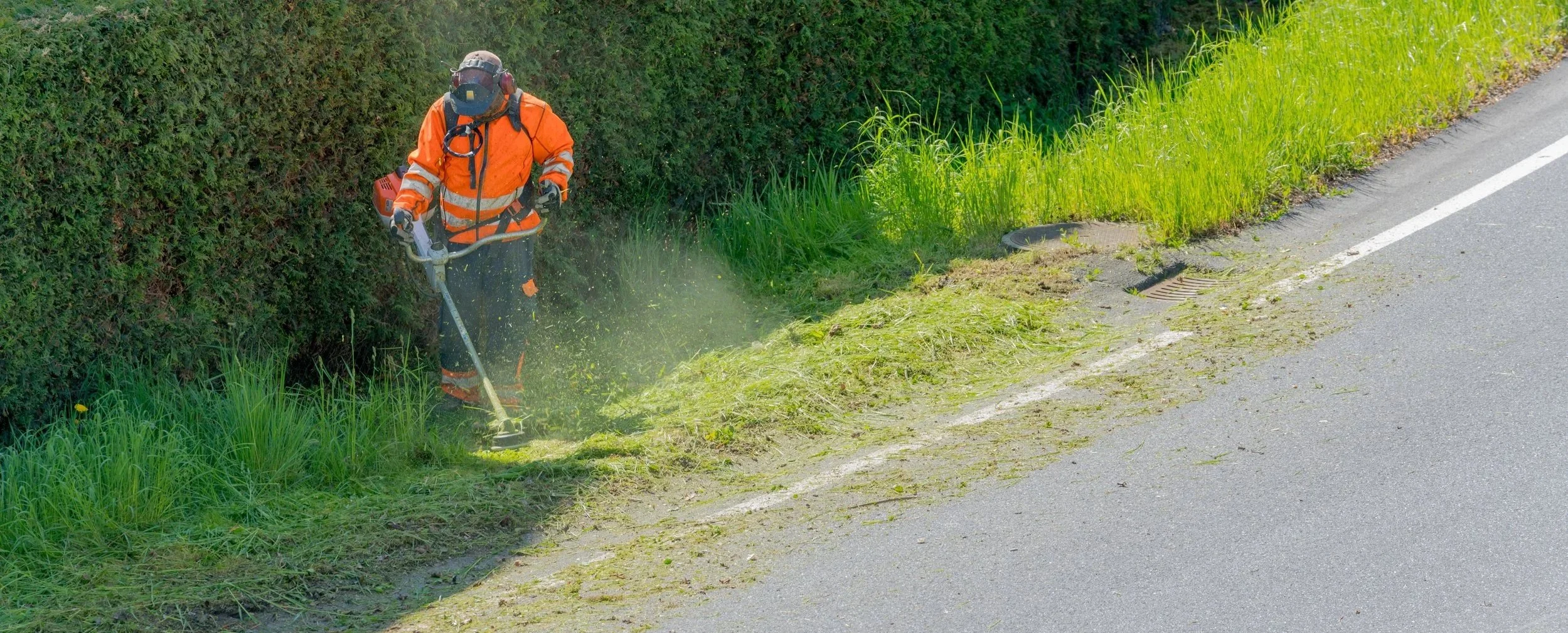
Landscaping and tree care companies are already high-risk operations, but few job sites present more risk than roadsides, medians, and highway corridors. When employees work is near moving traffic, the potential for severe injury increases significantly, making effective traffic management a priority.
Temporary traffic management is a frequent and critical part of the job. And, when crews are exposed to moving traffic, the primary controls are designed to create enough time, space, and visibility for drivers to recognize the work zone and react safely. Even when lane closure is not required, proper planning, vehicle positioning, signs, cones, and escape routes are necessary controls that can prevent serious incidents.
Pre-Planning
Every roadside job should begin with a hazard assessment. Factors such as road speed, traffic volume, sight distance (including curves and hills), proximity of workers to traffic, and available escape routes help determine the level of protection that is needed.
Preparation also includes ensuring the work zone has with all required equipment on-site including signs, cones, communication devices, and high visibility personal protective equipment (PPE). Workers exposed to traffic should wear ANSI Class 2 or Class 3 high visibility reflective vests.
Core Elements of a Safe Roadside Work Zone
Effective temporary traffic control should include five core elements:
Signs provide early warnings to approaching drivers.
Cones create visual separation between traffic and workers.
Buffer zones provide a clear recovery area.
Company vehicles act as a physical protective barrier when positioned between traffic and the work zone.
Escape routes provide a predetermined path to safety and serve as the crew's last line of defense.
Adjust for Roadway Conditions
Traffic control requirements vary depending on roadway type. Urban streets may present challenges like pedestrians, driveways, and intersections, while rural roads often have limited visibility due to hills and curves. Highways present the greatest level of exposure because of higher vehicle speeds and reduced reaction times.
As roadway speeds increase, work zones generally require larger buffer areas and more advanced warning for passing drivers.
Specific Challenges of Median Work
Median operations require special consideration because traffic approaches from both directions.
Effective traffic control typically includes signs in both directions of traffic, cones protecting both sides of the work area, clearly marked access points, and protection that moves with the crew as work progresses.
Workers should never enter the road to conduct work nor should they focus solely on one direction of traffic. They must continuously maintain awareness of vehicles approaching from both sides.
A Proactive Approach to Safety
Although roadside and median work will always involve some exposure to traffic, you can reduce risk through planning and proper work zone setup. The most effective roadside operations provide drivers with early warning signs, create separation between traffic and workers, maintain clear escape routes, and continually adapt to changing conditions. Implementing these best practices can help landscaping and treecare companies conduct roadside work safely while protecting employees.
Rancho Mesa’s proprietary SafetyOne™ mobile app offers both landscape and tree care-specific traffic control toolbox talks designed to streamline training of workers on the hazards of roadside and median work.
Companies that prioritize visibility, communication, traffic control, and worker awareness are better positioned to protect employees while performing essential landscaping and tree care services in high-traffic environments.
Critical Steps That Protect Employees and Your Business Following a Work-Related Injury
Author, Greg Garcia, Account Executive, Rancho Mesa Insurance Services, Inc.
In the landscaping industry, workplace injuries can occur despite the best safety efforts. When an injury does happen, the employer’s next steps can significantly impact the outcome for the injured employee, the employer, and the insurance carrier.
Author, Greg Garcia, Account Executive, Rancho Mesa Insurance Services, Inc.
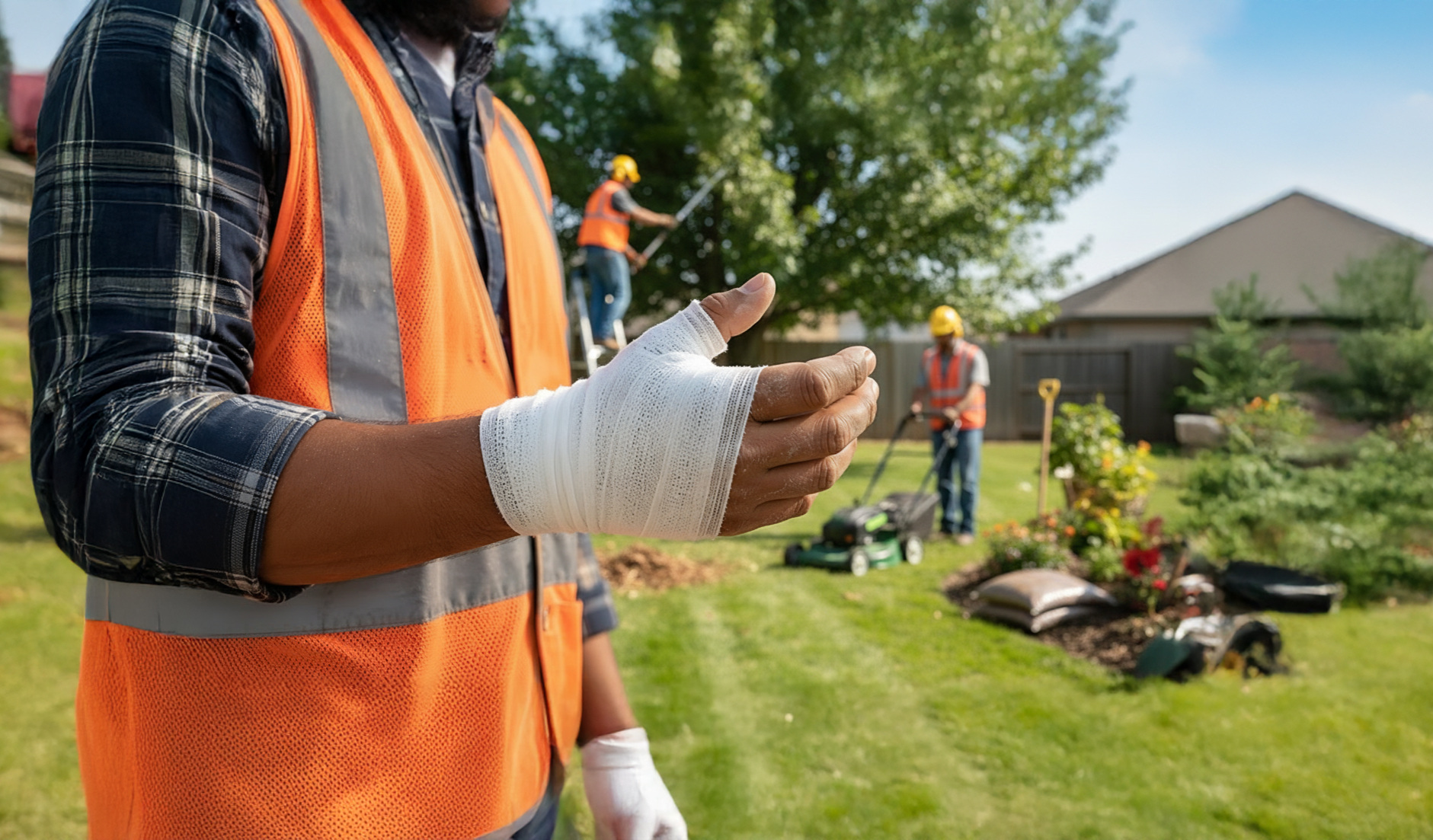
In the landscaping industry, workplace injuries can occur despite the best safety efforts. When an injury does happen, the employer’s next steps can significantly impact the outcome for the injured employee, the employer, and the insurance carrier.
The first step is to report the injury as soon as possible, even if it initially appears to be a minor injury. Prompt reporting allows the insurance carrier to begin managing the claim immediately, which often leads to better outcomes for all parties involved. Early reporting helps ensure the injured employee receives appropriate medical care, logs important details about the incident, and can help prevent a minor injury from developing into a more costly claim.
After the claim has been reported, it is important to let the treating clinic know that modified duty is available. This allows the medical provider to evaluate the employee's ability to return to work and identify any temporary work restrictions.
If the work restrictions can be accommodated, modified duty can be offered to the injured employee. By doing this, it allows for several important benefits:
It allows the injured employee to continue to receive their normal wages. If the injured employee was not offered modified duty, then they would be eligible for temporary disability benefit which is generally less than their normal wages.
By keeping the claim from any temporary disability being paid, the impact to the experience modification rate (XMOD) is minimal. Because normal wages continue to be paid by the employer and not the insurance carrier, the temporary disability portion of the claim is controlled and the actual overall claim costs are reduced, thus having a positive impact on your XMOD. By controlling your XMOD, you are helping your company maintain stable rates for your workers’ compensation insurance premiums.
Offering modified duty also improves employee morale while strengthening company culture. It demonstrates that the company values its employees and is committed to supporting them throughout the recovery process.
Finally, offering modified duty can significantly reduce the likelihood of litigation. When injured employees remain connected to the company, continue earning their regular wages, and feel supported throughout the recovery process, communication tends to remain strong. This often leads to a more positive claim experience while reducing the potential for litigation.
Prompt claim reporting and a strong return to work program are great ways for landscape companies to control workers' compensation costs, reduce likelihood of litigation, and demonstrate their commitment to employee wellness.
Reach out to me at ggarcia@ranchomesa.com if you have any questions or additional interest in this topic.
Hierarchy of Controls Applied to Landscape Maintenance Fleet Safety
Author, Drew Garcia, Vice President, Landscape Group, Rancho Mesa Insurance Services, Inc.
The National Safety Council introduced the Hierarchy of Controls in the 1950s as a safety framework. The framework is organized as an inverse pyramid of risk mitigation practices that can help organizations reduce workplace hazards.
Author, Drew Garcia, Vice President, Landscape Group, Rancho Mesa Insurance Services, Inc.
Hierarchy of Controls
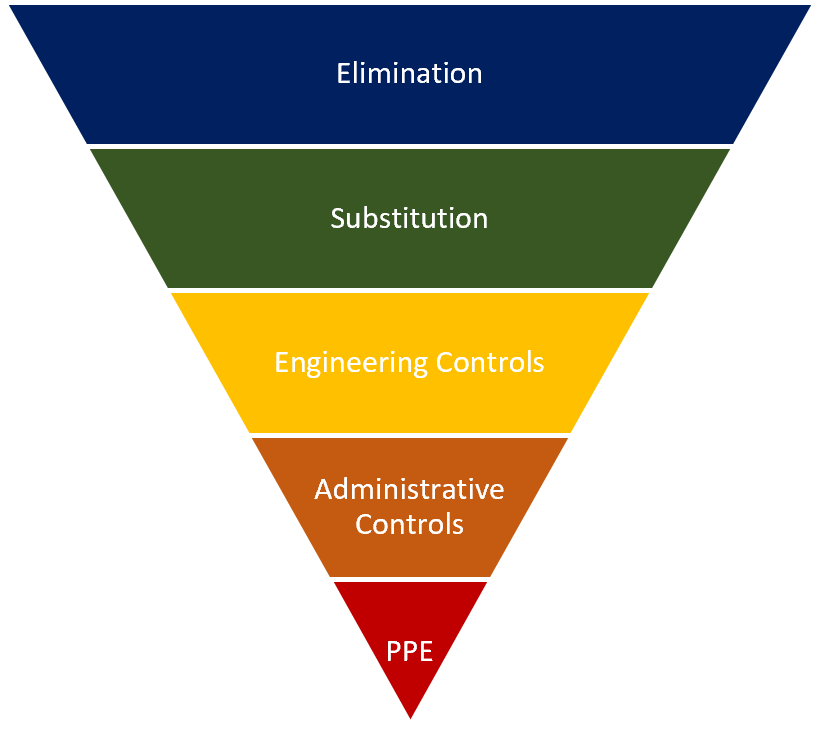
The National Safety Council introduced the Hierarchy of Controls in the 1950s as a safety framework. The framework is organized as an inverse pyramid of risk mitigation practices that can help organizations reduce workplace hazards. The graphic places the most effective methods at the top and the least effective at the bottom starting from elimination, substitution, engineering controls, administrative controls, and personal protective equipment.
Applying the Hierarchy of Controls to fleet safety for a commercial landscape maintenance company is critical. Using the five levels of controls in the order of most effective first to the least effective can reduce overall fleet risks.
Elimination
Although eliminating the over-the-road exposure all together is impossible for landscape companies, there are still ways to critically reduce the risk through other means.
Eliminate unnecessary trips due to route optimization or job consolidation can reduce overall miles driven.
Eliminate hazardous or unsafe vehicles from the fleet immediately.
Eliminate driving in severe weather conditions like rain, wind, fog, and snow.
Eliminate the need for backing up at job sites with pre site planning.
Substitution
If a risk cannot be eliminated, try replacing the hazard with something less risky.
Replace older vehicles that lack updated safety technology with more modern options.
Replace open utility trailers with enclosed options.
Stagger morning rollouts, when appropriate, for a safer start to the day.
Engineering Controls
The third option is deploying engineering controls to isolate people from the hazard.
Utilize safety controls such as backup cameras, 360-degree cameras, blind spot notice, land departure, forward collision warning and automatic emergency braking technology in vehicles.
Organized and fitted trailers help hold equipment and material while in transport to prevent shifting.
Dash cameras and global positioning systems (GPS) are tools help monitor driver behavior and provide more insight if an accident occurs.
Prepare flow maps for the yard to help crews enter and exist safely.
Administrative Controls
Changing the way people work is an administrative control that can reduce fleet risks.
The controls can consist of MVR reviews, driver authorization programs, driver evaluations, and driver training.
Implement cell phone, seatbelt, and drug/alcohol policies.
Perform daily vehicle inspections and telematics safety habit reviews.
Implement a preventive maintenance program that helps keep vehicles operating safely.
Personal Protective Equipment
The last control in the hierarchy is personal protective equipment (PPE).
High visibility safety vest help with existing and entering the vehicles.
Signage and cones when parked near roadsides alert drivers that people are working near by.
Safety blocks for parking and effective tools that can help employees in and out of truck beds or trailers to minimize slip and trip hazards.
When looking for opportunities to improve your fleet safety program, look at your risk through the hierarchy of controls. We tend to see most improvements within engineering space with telematics, GPS and dashcameras alongside strong administrative controls from driver selection to ongoing monitoring and training.
California’s Workers’ Comp Rates Poised to Increase Again: What the 10.4% Proposal Means for Landscape Employers
Author, Greg Garcia, Account Executive, Rancho Mesa Insurance Services, Inc.
The Workers’ Compensation Insurance Rating Bureau of California (WCIRB) recently released a proposed pure premium rate increase of 10.4% across all class codes. As a reminder, the proposed increase does not mean every class code will see a 10.4% increase on their specific class code, rather that is the blended average increase across all class codes. These proposed rate increases will be reviewed by California’s Insurance Commissioner Ricardo Lara sometime in mid-July for the new rates to go into effect September 1, 2026.
Author, Greg Garcia, Account Executive, Rancho Mesa Insurance Services, Inc.
The Workers’ Compensation Insurance Rating Bureau of California (WCIRB) recently released a proposed pure premium rate increase of 10.4% across all class codes. As a reminder, the proposed increase does not mean every class code will see a 10.4% increase on their specific class code, rather that is the blended average increase across all class codes. These proposed rate increases will be reviewed by California’s Insurance Commissioner Ricardo Lara sometime in mid-July for the new rates to go into effect September 1, 2026.
Last year, the WCIRB proposed an 11.2% pure premium increase, but Lara ultimately adopted a lower increase of 8.7% in July. We will learn more about the Commissioner’s decision on this year’s proposal in the coming months.
Looking specifically at the 0042 class code, the proposed pure premium rates are recommended to increase from $5.30 to $5.77, which is a 9% increase. For context, last year, the 0042 class code had an 8% increase on the pure premium rates. If this increase is approved again this year, it will mark the fifth consecutive year that the 0042 class code has seen an increase on the pure premium rates. These trends point toward a continuing hardening workers’ compensation market, which could result in higher annual workers’ compensation premiums for employers.
So, why has the 0042 class code pure premium rates continue to increase? Many factors go into this increase, including surging medical costs, high litigation rates, and a rise in costly cumulative trauma claims to name a few.
To help combat these potential increases, I encourage all landscape companies to really hone in on their current safety program. Invest in technologies, safety certification, trainings, stretch and flex programs, anything that can create a safer environment for your employees and thus lowering the chances of worker’s compensation claims. Additionally, implementing quarterly claim reviews with your broker, claims advocate advisor, and workers’ compensation carrier adjuster is a critical step in managing claim outcomes that helps to control your Experience Modification Rate.
Ultimately, staying proactive through strong safety practices and disciplined claims management will be the most effective way for landscape companies to help mitigate the potential increases to the 0042 pure premium rates.
Reach out to me should you have further questions on the pure premium rate increases and/or an interest in refreshing your approach to safety. I can be reached at ggarcia@ranchomesa.com.
Building a Scalable Safety Program with SafetyOne™ for Landscape Professionals
Author, Drew Garcia, Vice President, Landscape Group, Rancho Mesa Insurance Services, Inc.
Rancho Mesa provides our clients the key components for building the infrastructure of a modern-day safety program through the SafetyOne™ Platform. By fundamentally layering your safety program through SafetyOne, you will build a system that can keep up with your growth, measure your goals, and keep your organization engaged.
Author, Drew Garcia, Vice President, Landscape Group, Rancho Mesa Insurance Services, Inc.
Rancho Mesa provides our clients the key components for building the infrastructure of a modern-day safety program through the SafetyOne™ Platform. By fundamentally layering your safety program through SafetyOne™, you will build a system that can keep up with your growth, measure your goals, and keep your organization engaged.
In a report from Travelers Insurance Company titled, “2025 Travelers Injury Impact Report,” they noted within the last 5 years, more than a third of all injuries stemmed from an employee’s first year on the job.
Establishing an effective safety program can help prevent new-hire injuries. Avid SafetyOne users saw a 27% decrease in claim frequency over a 3-year period by implementing effective onboarding of their safety program, performing ongoing safety activities and maintain compliance:
Onboarding
The ability of an organization to effectively hire and train new employees is critical to maintaining a safe workplace. Safety onboarding ensures that site, equipment, and tool hazards, along with policies, processes, and emergency response protocols, are clearly communicated and understood to meet core safety expectations.
Ongoing
Manage your safety program on a regular basis with near miss reporting, job hazard analysis, tailgate training and more. By accessing your mobile forms and observations within SafetyOne, you are able to manage your team’s ongoing efforts to stay engaged.
Compliance
Pulling reports can be critical to evaluating the program you established and an efficient way to gather critical information when you need it quickly. This allows you to monitor the standards that are in place to help prevent injuries, ensure expectations are clear and change behaviors which ultimately impacts risk predictability.
Build a safety program that works for you today that has the ability to adapt, grow and change with you. Talk to your broker or client technology team to learn more about a SafetyOne-based safety program.
Discussing The Hidden Levers Behind Lower Insurance Premiums with Drew Garcia and Bill Arman
During a recent interview at NALP’s ELEVATE Conference, RMI Landscape Vice President Drew Garcia joined Bill Arman from The Harvest Group to discuss how landscape companies can take greater control of their insurance outcomes. The conversation dives into practical ways businesses can reduce risk, tighten operations, and make everyday decisions that lead to stronger coverage and more favorable premiums. Fewer incidents in the field, better processes, and a proactive mindset can make a measurable difference.
During a recent interview at NALP’s ELEVATE Conference, RMI Landscape Vice President Drew Garcia joined Bill Arman from The Harvest Group to discuss how landscape companies can take greater control of their insurance outcomes. The conversation dove into practical ways businesses can reduce risk, tighten operations, and make everyday decisions that lead to stronger coverage and more favorable premiums. Fewer incidents in the field, better processes, and a proactive mindset can make a measurable difference.
For business owners focused on protecting margins and building stronger companies, this discussion offered valuable insight, proving that better insurance results are within reach.
Connecting Leaders in the Green Industry: Highlights from the 2026 NALP Leaders Forum
Author, Greg Garcia, Account Executive, Rancho Mesa Insurance Services, Inc.
This year’s National Association of Landscape Professionals (NALP) Leaders Forum took place in beautiful Santa Barbara, CA, just up the coast from San Diego. As always, this is one event that my brother Drew Garcia and I really enjoy going to every year. In fact, this marks Rancho Mesa’s 8th consecutive year sponsoring this event.
Author, Greg Garcia, Account Executive, Rancho Mesa Insurance Services, Inc.
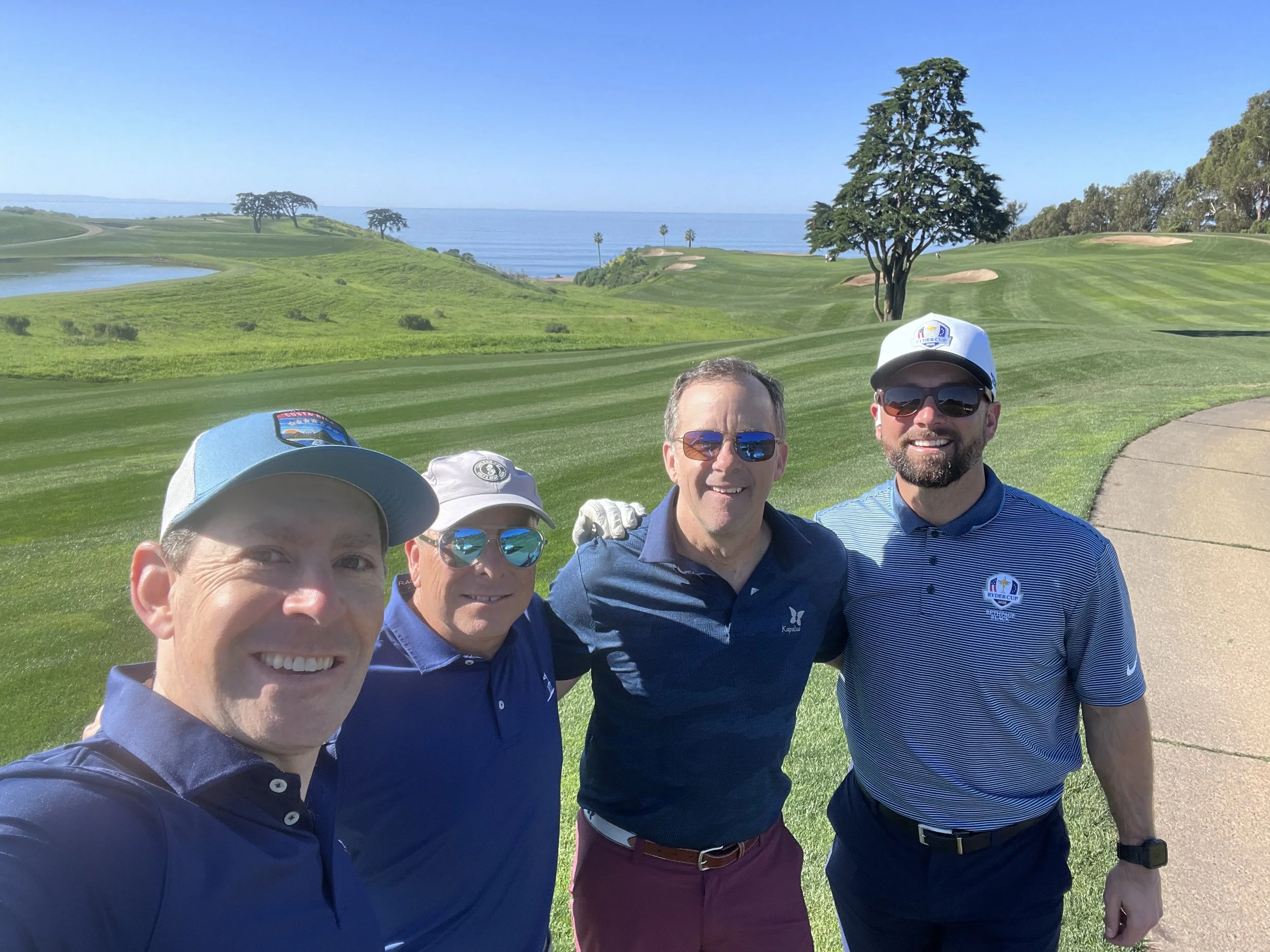
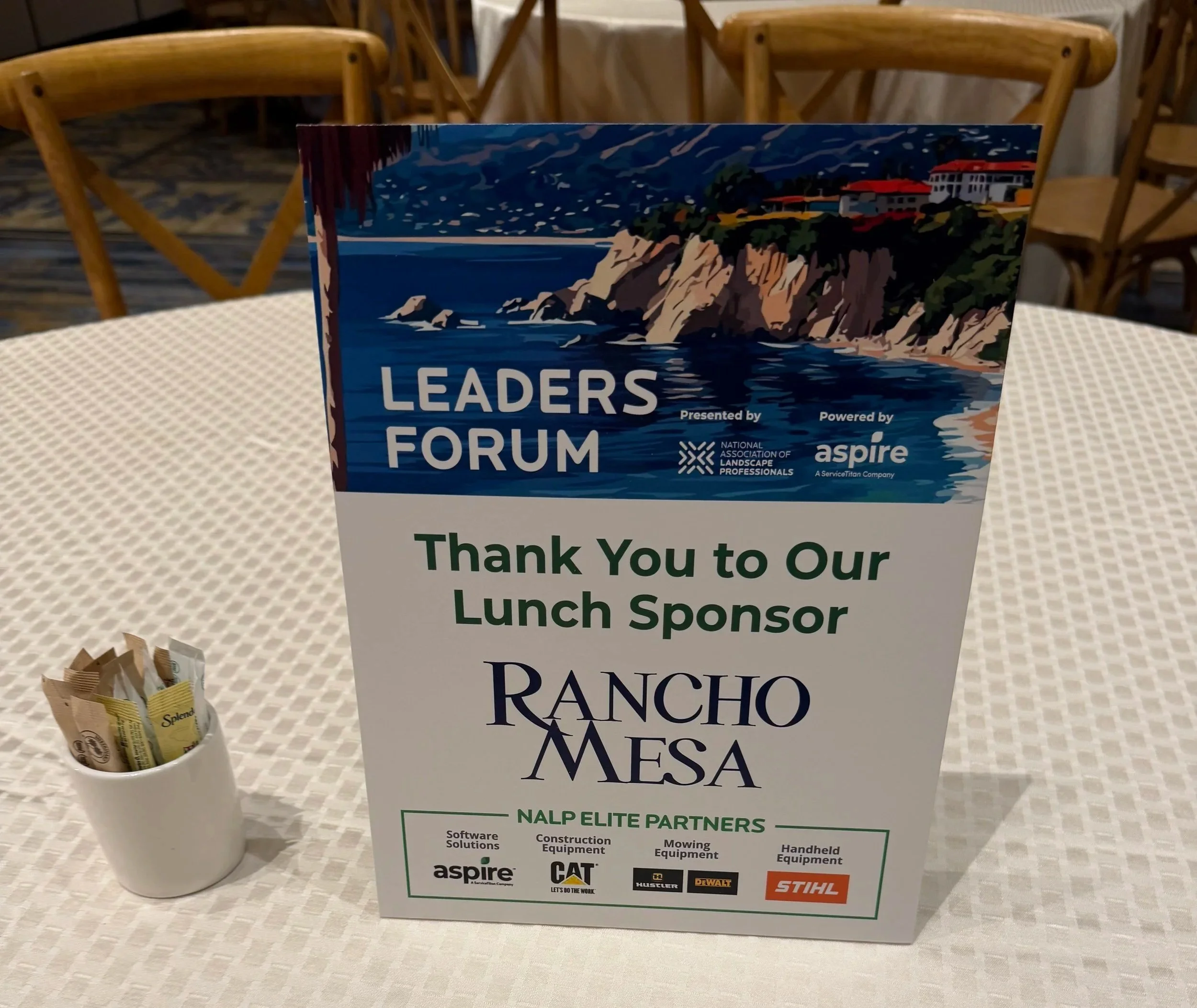
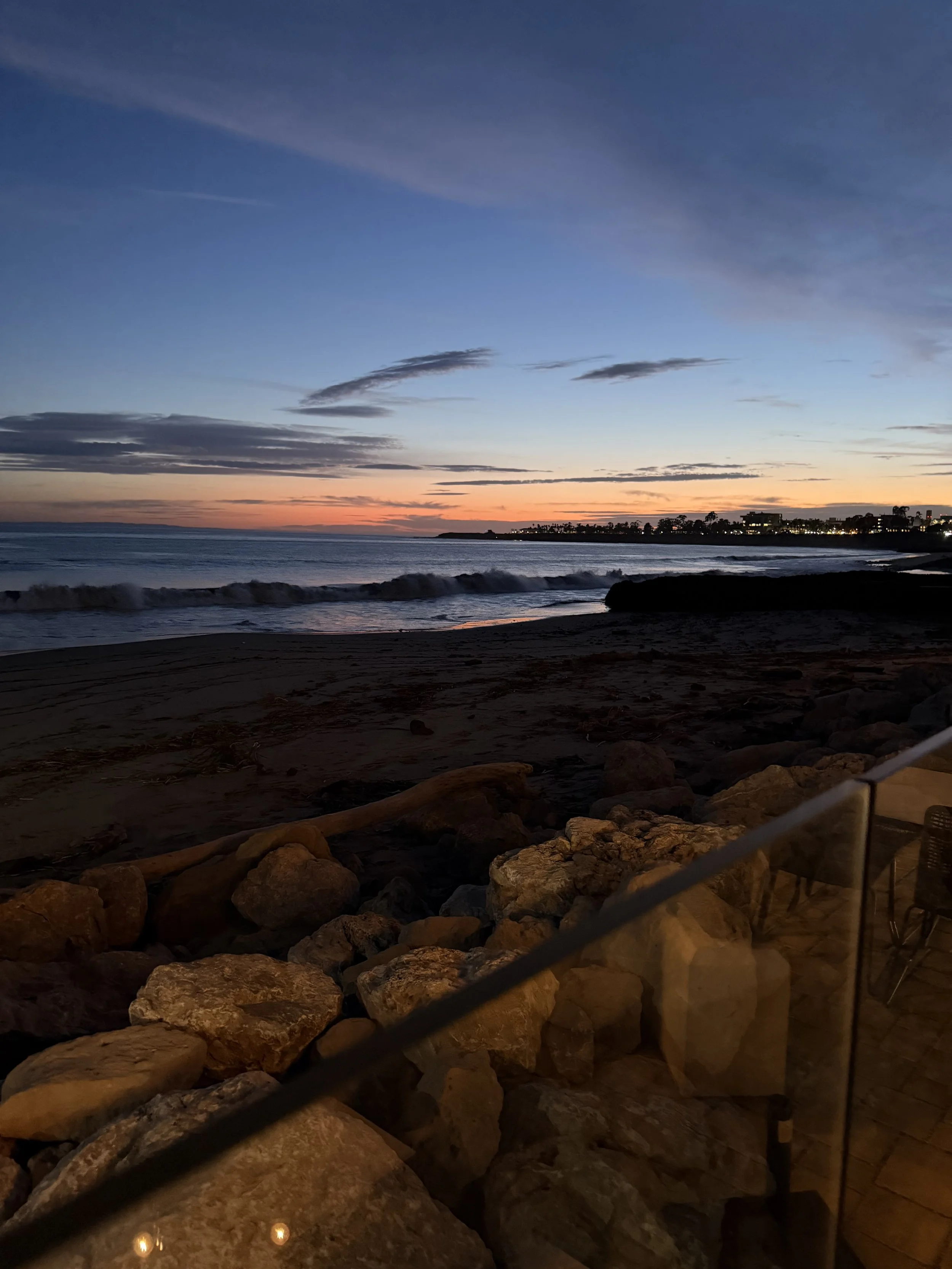
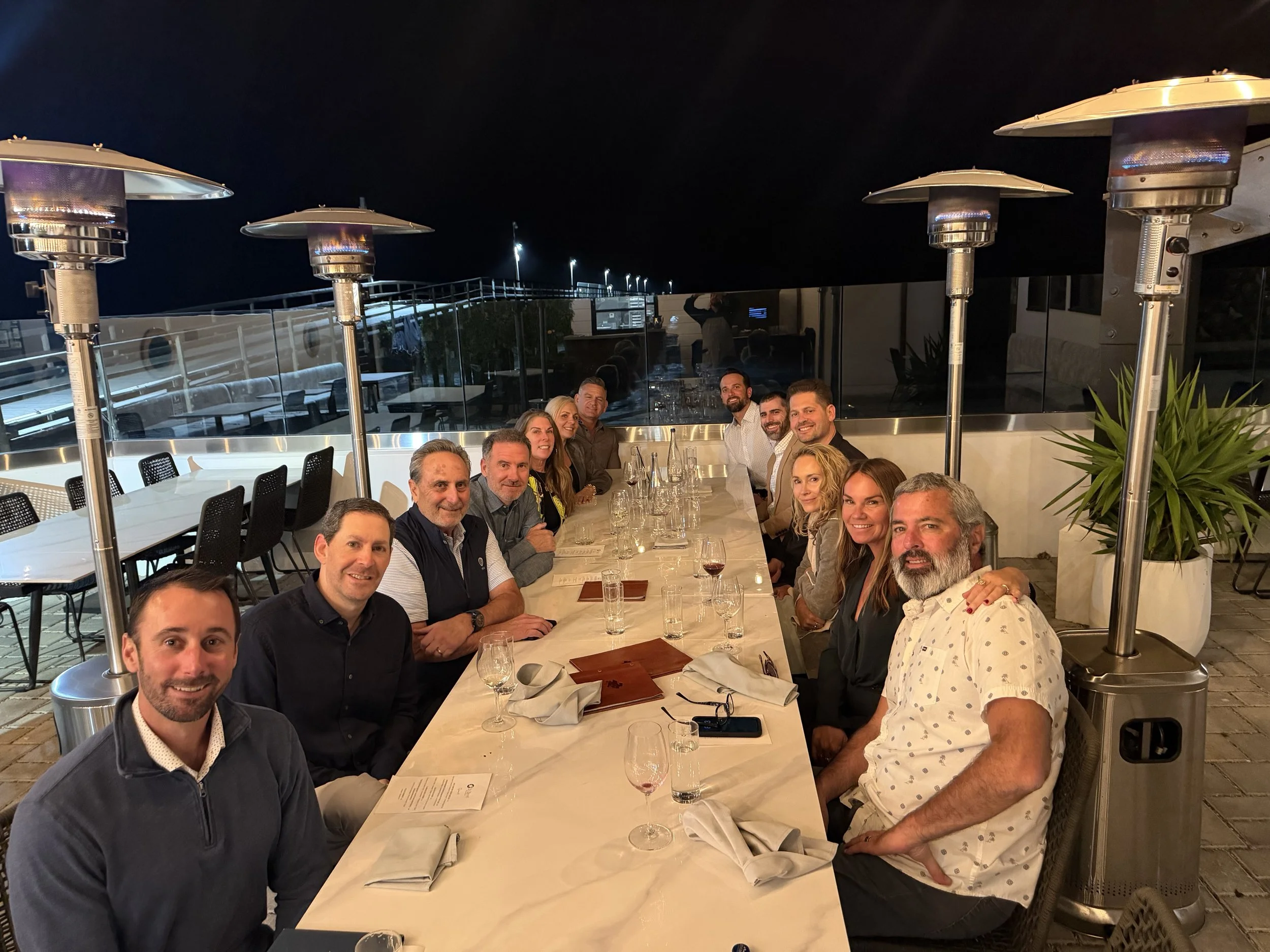
This year’s National Association of Landscape Professionals (NALP) Leaders Forum took place in beautiful Santa Barbara, CA, just up the coast from San Diego. As always, this is one event that my brother Drew Garcia and I really enjoy going to every year. In fact, this marks Rancho Mesa’s 8th consecutive year sponsoring this event.
The forum brings together landscape leaders from across the country, giving them a place to connect, collaborate, and learn. For our Rancho Mesa team, it is an opportunity to not only network with these leaders and stay up to date on what is new and noteworthy in the green industry, but also gives us the opportunity to spend time with some of our clients who attended this year’s forum.
One of the most interesting educational sessions at this year’s event was based around the importance of meetings within an organization. The speaker, Gabrielle (Gabe) Adams, Associate Professor of Public Policy and Business Administration at UVA Darden School of Business, discussed that most organizations may be having too many meetings and the meetings they are having are not as effective as they could be. One of the biggest downfalls that Gabe mentioned is that all too often there is not enough debate and discussion in these meetings, rather most meetings are dominated by one or two voices and most people tend to hold their opinions to themselves even if they don’t agree. Gabe described the best meetings that are the most effective involve everyone participating in the discussion, this is where creative ideas and processes are developed. We found Gabe’s topic to be both educational and thought provoking.
The highlight of the trip was on Thursday night when we hosted both Rancho Mesa clients and other green industry leaders to a dinner at The Elwood, which was just down the road from where the Leaders Forum was taking place. This night was filled with fantastic food and even better conversation. It was a great place to hear strategies and processes that made each of their landscape companies successful.
All in all, NALP Leaders Forum was a huge success, packed with valuable networking and learning opportunities. We are already looking forward to 2027.
If you are interested in discussing this event or your company’s risk management, I can be reached at (619) 438-6905 or ggarcia@ranchomesa.com.
Using Technology to Reduce Risk in the Landscape Industry with Bryan Mours
Rancho Mesa's Vice President of the Landscape and Tree Care Group, Drew Garcia, interviews Bryan Mours, founder of Mours Enterprises, where they explore the technology being used to reduce risk within the landscape industry.

Rancho Mesa's Vice President of the Landscape and Tree Care Group, Drew Garcia, interviews Bryan Mours, founder of Mours Enterprises, where they explore the technology being used to reduce risk within the landscape industry.
Show Notes: https: Subscribe to Rancho Mesa's Newsletter, Mours Enterprises LLC
Host: Drew Garcia
Guest: Bryan Mours
Producer/Editor: Megan Lockhart
Music: "Home" by JHS Pedals, “Breaking News Intro” by nem0production
© Copyright 2026. Rancho Mesa Insurance Services, Inc. All rights reserved.
Transcript
Drew Garcia: Welcome back, everybody. I'm Drew Garcia, Vice President and Landscape Group Leader here at Rancho Mesa, and today we're super excited. We've got an industry veteran in the office today. Someone that, you know, this great industry attracts you to great people. And I got a chance to meet Brian Mours nine years ago now. I've had dinner with him in Costa Rica. We've had laughs in Arizona and Maui. I mean, all the destination spots where the conferences will take us. And each time I'm with Brian, I learn more. And today we brought him in. He's going to talk to us about either emerging technology or capabilities that are available in the industry today, where landscape companies can tap into them and improve their overall risk and safety profile.
So, Brian, could you give a, you know, first of all, welcome, but can you give us a little overview of where you've been in the industry so our audience has an idea of where we're starting?
Brian Mours: Yeah, absolutely. Thanks, Drew. I appreciate you inviting me in. I mean, yeah, we have known each other for a while now. It's hard to believe it's been probably eight, nine, ten, almost ten years that we've known each other, which is fantastic. Again, that's why I love the industry. I get to meet fresh, exciting people, even in the insurance side of things. And so always a lot of fun.
But anyway, I'm from Wisconsin, as you know, and I know that you have a little bit of history in the state of Wisconsin. So maybe that's how we kind of tie together to. But I've been in the landscape industry almost all my life. I broke off, did some restaurant stuff for a while, but I was 16 years old, I was working at a country club. I was down on the grounds working, plus working in the restaurant at night. One of the bar managers there, he was doing some lawn care and maintenance work on the side during the day and bartending at night. He says, “do you want to join me?” I said, “Yeah, Let's do it. I'll come join you. Let's start a business together.” And here I am 16, 17 years old, starting a business in the lawn care industry. And it was really, that was my introduction to the industry. And I've been here all my life. I've done everything from owning at that time. We sold that business. I used to sell landscape products when I worked for Lesco, when it was Lesco, before they sold to John Deere Landscapes, and I worked with a lot of landscapers in the area at that time, and helping them kind of grow their business. I learned that what I really enjoyed was helping people in understanding how to run their businesses better and how to make money at their business. And I learned that at Lesco.
And so I work for another landscape company in in Wisconsin, helped them grow their business to over $10 million. I left there and decided I was going to get into the technology side of the industry. And so I've worked for a couple of different technologies over the past 20 years now, believe it or not. And so that's kind of what brought us together, right? The technology. And I saw the importance because we implemented the technology at one of the companies I was GM at, and I saw the importance of technology and how it could help a business grow, succeed, and also kind of, you know, what we're talking about, how it can help in kind of this risk management and really making the workplace a lot safer at these landscape companies, which, let's face it, right? They have a lot of moving parts going on with equipment and such. And so how can we improve upon or at least recognize when we need to improve to make our workplaces safer?
DG: Yeah, absolutely. You know, you flew through the intro. What's really cool about your experience there is your perspective that you bring, you know, so you actually did get to have the, you know, I've done the work and then I've sold the work and I've sold the equipment and the materials that, you know, they've been used to do the work. And then, like you said, you know, work for somebody, help sell a business. And then ultimately, you were on the technology side. So perspective's huge and you're able to glean from all of that. And that's why I think every time I talk to you, always, you know, I'm picking something up or I'm learning something new. And technology has really made a big impact on the landscape industry. In my short time, you know, I've been doing it 10 years now. I've watched as businesses have been able to scale and build sounder processes, better documentation programs, which all roll down to help a business succeed, but also really manage and minimize overall risk and safety.
And to me, you know, there's a couple key areas. We're talking about how do you keep your people safe, number one, right? Protecting your assets. So trucks, trailers, equipment, how are you managing that, and how can technology maybe help you in those areas? And then the one that I think is most emerging is, and it's been around for a while with snow, but just contract management and documentation, those are key pieces to, you know, maximizing your ability to prove what work was done, when it was done, you know, per some scope of a contract, what does the Endemic Hold Harmless language look like within that contract? And I know technology can help you manage that.
So I guess in your experience, what are some areas that you've seen landscape businesses either start to now grow more into technology to help in those areas? And, you know, do you have any examples of, you know, where someone could take that today or, you know, if I don't know where to start, you know, what would be a good spot?
BM: Yeah. There's all kinds of technology out there, but again, it's really in how you use the technology. You mentioned the documentation, right? I mean, we were all doing it on Word docs and et cetera, but we never really filed those in a good place. They were all over the map in different files on our computer. And so having a centralized location for these documents, and again, let's face it, we should have some legal help with those in order to make sure our documentation is accurate, right? To make sure it covers us in the case of snow, let's say, for example, slip and falls, or even breakage of something, you know, our liability is pretty high out there, right, in this industry. Coming from a snow market, I know that firsthand, I've been out there, been there, done that in the industry. And again, where I saw a lot of technology coming into play, as we were adapting it at the company I was at in Wisconsin, was in looking at different areas of the company in ways to improve how we could make it a more safe, free zone, I guess. Not only at our shop and our office, but also on our job sites.
Surprisingly, and maybe that's, again, why there's a good relationship between us. I was in charge of, when I was at that landscape company, I was in charge of the insurance. I had deal with the setting up the insurance. I would go to insurance classes about safety and safety training and so it's very kind of top of mind to me and it I always took that back to our office one of the things that--obviously time documentation is huge right? But what I’ve found as I train and work with companies that are trying to adopt softwares, they have a hard time understanding the importance of things like logging or tracking safety training. Something as simple as that, right? Insurance agents love it when you're tracking and showing that you're actually doing something to train your people in the area of safety. And So we made a point to have a special task that we would log into, and every week we did our safety trainings, and everyone logged into it, and we knew exactly how much time people were spending in safety training, right? And so that's kind of one area, just a simple area, that we were tracking kind of time that helped us, again, in our risk management.
DG: Yep, and you're so right with that, and we can kind of equate it to the underwriting process when we're working with our carriers is everyone can, you know, if you look at a supplemental application where everybody fills out their operations and this is what I'm doing, you know, you can say, do you do safety meetings, you know, check, yes, we do those. And then, you know, what the underwriter is going to do is they're going to look at that and they're going to ask us the question, you know, based on loss history because they're going to look back at the claims to see if there's any issues. And it might say that they're doing safety training, but if you look at the last five years for work-related injuries, it might show that are they really doing those trainings, you know, because we still see a lot of activity happening in the past.
And that's where what I like about the technology piece, if you're tracking that, you can package it up and then you can use it within the underwriting process and not only show, you know, either, “Hey, we had these issues, but here's what we're doing today, which is different from the past that we feel like is going to help us better manage what you're, you know, what you're looking at.” And that could be, you know, a tool to give the underwriter a better idea as to where the company's headed, as opposed to just looking in the rearview mirror and, you know, what's happened in the past. And I think you said it best. It's kind of the easiest to me entry level way to get into utilizing software within safety, specifically when it comes to those, you know, tailgate style or formalized annual trainings for the, for the crews.
BM:Absolutely. I mean, we did a, we did an initial, like every spring, we did a kickoff because everyone, spring and fall, because everyone would forget how to run their summer equipment, of course being up in Wisconsin, they forgot how to run all their summer equipment through the winter months. So we had retrained. I don't care if the person was there for 20 years at our company. They got trained on all the equipment again, just like the new guys that were just starting that year at our company. They were trained the same way so that we were all kind of learning together and the same happened in the winter, all right? Let's retrain on snowplows and salters to make sure we're injuries.
DG: How about, you know, vehicles before we started talking here, you were mentioning a story just on, you know, when you guys used to manage your fleet, which is probably, to me, probably the biggest exposure, especially for a maintenance company that is very fleet intensive. You know, got to have a lot of trucks to get everybody to all the different job sites. You know, more trucks feels like more exposure, more opportunity for claims to happen. Where are ways where you think or you've seen technology improve maybe somebody's ability to better manage that or maybe isolate opportunity from, you know, turning into an issue?
BM: The fleet side of it was, again, very important to us, right? And again, some of the things that we worked on, and the only way we learned that we needed to work on it, again, was because of data we were collecting through the technology piece, right? And so one of the things that, again, this is probably vehicle and people, right, is this idea of route optimization, right? How do I minimize my windshield time, my drive time, right? Everyone says, well, you're just trying to make more productive time then in a day, and of course I am, right? I'm going to do everything I can as well to make more productive time so that we can have more revenue per day for our crews. However, the other thing that it's doing is less time behind the wheel, three, four guys in a truck, the less, I'm minimizing my risk by not having them on the road, not having them behind the windshield, right?
But we've, we also did, obviously we did We had things like GPS units to make sure we were tracking, you know, with speeding, with harsh breaking. We were very early to jump in on GPS technology. That was huge for us to get a system, and it was so much fun to call somebody. Processes were very important in documenting kind of the things that, you know, like everyone leaves the yard with their seatbelt on. No using your cell phone while you're driving. No, you know, we were doing this 25 years ago. You know, dash cams are yelling at you now when you're, when you're doing that. But we were doing that, you know, 25 years ago. Well, I would, I would get a speeding alert on the GPS unit. And then so I'd call the driver. And, of course, he'd pick up every time. And I'd say, okay, first of all, you were speeding and now you're answering your phone while you're driving. Right. And so I'd get them on two cases.
But my window happened to be like right next to the driveway where all the trucks drove out of. And anytime people saw me looking out the window, you never saw people reach up over their shoulder faster than to grab their seatbelt. “Oh, Brian's watching. Let's put our seatbelt on.” But it was creating good behaviors, right? It was pretty soon it was more and more people that were, were not reaching up or not, right. And that's, that was a part of it, right? But a lot of it was based around what I was seeing and getting from the technology that I was using.
DG: And that's so important to use the technology. Like, you know, like you're saying. So that's something that comes back to us quite often when we're either negotiating a renewal or talking to an emerging underwriter who might be interested in this industry and they're trying to learn more about the exposures. They want to know not only now is the business using GPS or are they using dash cams, but are they managing that information when they get it because it's super important to act on the information you've got, right? So if you're getting constant speeding alerts from an employee and you're getting those messages, but you're not doing anything from a, you know, training standpoint on that, then, you know, what's the point there, right? And getting--it can almost create maybe more liability for you just because you're neglecting the information in that case, right? So those best in class companies are coming up with those systems to manage the data so that they can help the driver behavior to your point. That's what the change, you know, that's what you're trying to do is just create better driver behavior so that they're not, you know, more likely to continue to have, have those bad habits.
And how about, so, you know, the equipment itself, even in my short time, like I mentioned, 10 years doing this, the gas to battery, especially here in California, it's really big, seeing the cost of these batteries and going, oh, my goodness, it's like the cost of a piece of equipment, almost to itself. And so we're navigating ways to, you know, better and more appropriately ensure that. That's thought through. Because in the past for us, you never really thought about, you know, insuring gasoline or something like that because that was the fuel for the piece of equipment. But now the battery is a key component to insurance and insurability, but also just overall minimizing theft because these batteries are expensive. The piece of equipment's expensive. They're powerful. They can, you know, they can do a lot. Are there areas where a business can help improve their, like, theft prevention program? I'm sure there's ways they can, there's usage that you've seen out there. What are some areas there on the equipment side?
BM: Yeah, I think, I think first and foremost, right, making sure that you know what equipment you have. I mean, we've talked about that before. People don't do a good job of keeping their asset inventory to date, right? Because they wouldn't know if a string trimmer was missing or a backpack motor was missing because they don't even know if they have it sometimes. So that's first and foremost, right? Always making sure you're staying up to date with your asset inventory, right? But there's emerging technology out there that is, and I'm a part of one of those groups that is what we're doing is we're putting little like air tags on pieces of equipment. But not only are we using those tags for theft purposes, but we're using them for, again, making sure that the equipment is being utilized every day and utilized on these properties and not just being dragged around in a trailer for all week long.
And again, it was, what it's doing is it's helping people recognize that maybe they don't need to be having as much equipment at their companies. But what, again, from the side of insurance and this theft piece, right, what the, what the devices do is they'll alert the driver that if he showed up at a job site with 10 pieces of equipment. He left the job site with nine, right? It's like, okay, maybe it wasn't him that left one behind, but maybe somebody walked by the trailer and heisted something. I've seen trailer setups, you mentioned electric. I've seen trailer setups where they have the battery racks right along the back door. As you mentioned, those batteries are not cheap. It's very easy for somebody you reach in, grab a battery, and the more we go to electric, the more valuable there's going to be for people to come and just take off the sidewall of a piece of equipment. You just want to try to prevent, in any ways you can, theft. And again, maybe understanding kind of what the utilization is of your equipment, right? Am I using it properly? Am I using it while all of those different things.
DG: And that's where you're getting, you know, both sides of it. Just like you mentioned with GPS, you're getting route efficiency, but you're getting driver behavior. Now on the asset side, you know, side you're getting efficiency and usage of the equipment. And at the same time, it could be a deterrent or a theft prevention measure that's going to play into the insurance side. So building more value, you know, with the software. What am I truly getting, if you're getting two ends of the spectrum there, it's pretty nice. You're kind of doubling down on your overall investment. So very interesting.
Anything else out there? You know, I know I go to the big expos and I walk those floors and I'm amazed at, you know, some of the equipment that's out there, autonomous, you know, mowers and, you know, you've got the hillside mowers on remote control. It just seems like the industry super creative and it's there obviously catering towards the need to become you know more efficient anything else that you're seeing out there that is interesting to you or where you think you know there could be more either dual use or major impact to risk and safety for landscape companies?
BM: Well I think one of the things that and we talked about this a little bit in the beginning is this idea of what I’m presenting to my customer is what I'm delivering on, right? There's software coming out where I can do actually tracking of the people and their movement around the property. For snow, that's huge, right? Because if I get a slip and fall and I can prove that that truck was in that area and that truck did salt that area during this time prior to the slip and fall, right? That's huge when it comes to a liability. The same goes true in the summer months, right? Even if it's something where a client is questioning your behaviors or whether or not you're maintaining their property to the way you set it up as far as the scope of work within your contracts, right? You can have that proof of, yes, we maintained your property, we maintained it fully, we did all the work that we promised you, right? And we're not, you know, we're not trying to kind of short our contract with you, right?
Because I see risk, you know, kind of in two forms. One of them, you know, from an insurance side, the other side is from kind of a churn side, right? If I'm churning work and I'm losing work because I'm not providing what I'm telling people in my contracts, right? That's huge, you know, that's really something that people, again, have to be extremely worried about. And I was always very diligent about making sure that if I told a homeowner or a business that I'm going to provide 28 mows that season, I'm going to provide 28 mows that season. And we're not going to short mow. We're going to maintain the entire property for those 28 times. You know, it's going to differ when I'm doing those mowing throughout the season, but that's when I do it.
And so this tracking gives you the ability to kind of see where the movement of the crews around the property, A, it helps with efficiency on those properties, but B, it helps you to show the client, yes, we did, are maintaining your property. I've worked with the company in Canada, you know, huge snow company. We had special reports in the software that we developed so that their liability with their clients, because some clients required like every event they needed a full report of exactly what was done, who was on site, what the times were they were on site, what the amount of product was they put down. And now with kind of more of the tracking of movement through the property, now I can also show that as well.
DG: You know, at the end there, if there's that ability to just show the customer, you know, we all want that. We want to be able to show the customer, you know, we are doing a good job and this is what it looks like. If you're able to do that to a certain extent, it's hard for someone else to duplicate it. If they don't have that within their process and they can't do it, but the customer comes accustomed to seeing it a certain way, it does create an advantage for you in a sense where they were just, they were happy, you know, very pleased with the service, but also you kind of wrapped it up nicely for them because they had something that they could refer back to. If they had to go share results with somebody else that maybe doesn't directly get to see your work every day, it's kind of nice to have that stewardship, you know, type of piece, it sounds like that this might be able to create.
BM: Absolutely. The question is, where does that liability stand? And again, as you mentioned, right, if I'm not doing anything with the data, right, I'm not notifying an HOA, a board of directors, a business, a homeowner about those issues. In theory, I could be somewhat liable for somebody hurting themselves on the property. Now, if I go out and I expose that and I show them that either through, and again, the video is a great way to show it because it's very, very visual. But even having a low spot in a lawn that somebody, or it's a hole in the lawn, right, that was somebody falls into the hole. A little kid catches his leg, well, I saw it, you know, every time I went out there in mode, I saw it, or we avoided that area and used a string trimmer in that area because there was a big hole in the yard. Well, I need to be doing something about it as a contractor, as somebody that is responsible for the maintaining this property. And so I need to bring that to their attention.
DG: Right. And that's a key point. And that really hits home on the liability side for landscape maintenance and that was the uh my topic out at Elevate this year was right around premise liability and the exact hazard you just brought up was an example we used too. And you know with technology and I’ll kind of close with this too because I think it's always people are resistant because it's got to be easy you know so that's you know you can repeat it and I think sometimes things look really interesting and appealing but man you know to roll something out or to really implement something can be a challenge and in what resources do you have available to do that. You know, talk to the listeners about maybe are there areas where you can help with that? Is that something that someone could reach out to you if they had questions about, you know, implementing technology and just going on your experiences? That's something that you would be open to listening in and on?
BM: Yeah, absolutely. The team I've put together at Mour's Enterprises, our focus is 100% on technology training, technology use, getting the best out of the technology that you have. I can show people through that capture of data how they need to improve maybe their workflow around their yard just because their crews are spending too much time in the yard and you're seeing all this kind of congestion in the yard and it's recognized through the time capture. If people don't understand how important that is to running their company, as much as it is just capturing their time and their job, right, they're not getting the best use out of their technology. And so our team helps people understand, again, the logic.
I always tell people it's not about the button pushing in the technology, but it's logic of the technology. We built this technology specifically to really help people, you know, again, guide them through better production management of their company, through better safety in their trucks, equipment usage efficiencies out in the field. But again, that's the logic that's built into it. And you don't see that in the buttons that you're pushing, right? So we help with that knowledge and that learning.
And for our team, right, it's really about getting people utilizing the new technology that's coming out there. And a lot of the new technology, what we're trying to focus more on is more of this hands off mentality. You mentioned our asset tracking technology. It's basically just going in and read the data.
And we're even making it such that we're going to notify you of the data you should be looking at so that it doesn't have to be. But my team, that's what we're here for. We're here because it's difficult. I've been fortunate to be able to understand the logic of software when I implemented the software at the company I was at right at the turn of the century and before people were putting technology in their landscape companies, I was fortunate to learn the technology, learn it well, and then kind of pass that along to other people, my knowledge.
DG: So critical. Yeah, Brian, I think, yeah, for me, I think about it with technology. I mean, it's in the insurance space too. You know, we have it as well. But watching the landscape industry grow, I always get excited about seeing the new technology. And I always like, you know, I feel like it's more of if I equate it to golf. It's like the new driver. You know, I'm always interested in that. I just want it. Let me go to the range, see how far I can hit it. But really, the execution of your golf game is going to be right around the green. But that's going to take time and you need to have somebody who knows what they're doing and teach you how to kind of do the little things so that you really can make your golf game effective. And I get too lost in, “Oh, this looks really exciting. I'm just going to go use this on the driving range.” And then, you know, I have no plan after that. And that's where having someone like you to lean on to help through those processes is super important. And we appreciate you coming in and sharing some of that information with us. We'll make sure to include your contact information in the podcast notes. And Brian, thanks again for coming out to San Diego. We appreciate it.
BM: Thank you, Drew. I appreciate being here.
DG: Thank you.
The Impact of Claim Frequency and Severity on a Landscape Company’s Experience MODs
Author, Drew Garcia, Vice President, Landscape Group, Rancho Mesa Insurance Services, Inc.
The experience modification rate (ExMod or MOD) is a measure produced by insurance rating bureaus to summarize a company’s claim history versus their industry peers. A rating generated below 1.00 is considered a credit to the workers’ compensation policy while a number above 1.00 is a debit. The ExMod has a direct impact on the cost of workers’ compensation insurance.
Author, Drew Garcia, Vice President, Landscape Group, Rancho Mesa Insurance Services, Inc.
The experience modification rate (ExMod or MOD) is a measure produced by insurance rating bureaus to summarize a company’s claim history versus their industry peers. A rating generated below 1.00 is considered a credit to the workers’ compensation policy while a number above 1.00 is a debit. The ExMod has a direct impact on the cost of workers’ compensation insurance.
In exploring the impact of frequency and severity on the ExMod, it is important to understand a few terms.
Lowest Possible MOD = The best outcome for a company who has no claims in the experience window.
Unity MOD = 1.00 or the average against your industry
Actual MOD = Your final published ExMod.
In an effort to better display the impact of frequency and severity on the ExMod, in the following scenarios, we will use a three-year aggregate payroll of $3,000,000 a three-year aggregate claim cost of $55,000 and the lowest possible ExMod of 66.
Scenario 1
In this scenario, the landscape company had one $50,000 claim and one $5,000 claim. The actual ExMod was calculated at 93.
Scenario 2
In this scenario, the landscape company had five $10,000 claims and one $5,000 claim. The actual ExMod was calculated at 136. That is a 43% higher ExMod than in scenario 1, even though the total of all the claims were the same.
Both scenarios had identical payroll, claim value and lowest possible ExMod. The only difference was scenario 2 broke the $50,000 into five $10,000 claims. The ExMod was impacted more by frequency than severity.
It is a best practice to examine your ExMod and injury history for key trends to help identify areas where employees need more training.
Using Rancho Mesa’s SafetyOne™ platform, schedule both online trainings and regular toolbox talks from the mobile app to ensure employees are properly trained on safety within their job duties. These steps can help build a stronger safety program for the future.
For questions about best practices for managing your company’s experience mod, contact me at drewgarcia@ranchomesa.com or (619) 937-0200.
Fleet Safety Starts with Strong MVR Guidelines
Author, Greg Garcia, Account Executive, Rancho Mesa Insurance Services, Inc.
One of the biggest liabilities that any landscape company faces occurs every day. This liability has nothing do with planting, mowing, trimming or irrigation work, in fact this exposure begins before any of the actual work takes place. Auto liability continues to be one of the most significant exposures every landscape company takes on when sending commercial vehicles out onto the road.
Author, Greg Garcia, Account Executive, Rancho Mesa Insurance Services, Inc.
One of the biggest liabilities that any landscape company faces occurs every day. This liability has nothing do with planting, mowing, trimming or irrigation work, in fact this exposure begins before any of the actual work takes place. Auto liability continues to be one of the most significant exposures every landscape company takes on when sending commercial vehicles out onto the road.
With increases to annual auto insurance premiums and the market continuing to harden, it is essential for landscape companies to be proactive to help mitigate these rising costs. Many landscape companies are now investing in safety technology such as GPS systems and dash cameras, but also conducting daily vehicle inspection reports to make sure the trucks are suitable for the road. Implementing strong internal motor vehicle report (MVR) guidelines is another essential way for insureds to improve fleet safety while keeping insurance increases to a minimum. Insurance underwriters and carriers are placing increasing importance on fleet safety programs, and monitoring how a company is being proactive in trying to prevent claims.
Implementing and maintaining strong MVR guidelines is a critical component of any fleet safety program. Before any employee is allowed to drive a company vehicle, their MVR should be reviewed to ensure they have no major moving violations, their driver’s license is active and valid, and they have an adequate history of driving experience. The driving position in any landscape company is critical, which is why MVRs should be reviewed regularly and driver trainings conducted as often as possible.
Rancho Mesa offers a sample Driving Record Review policy through the RM365 HRAdvantage™ Portal to help clients establish their internal review policy. Online driver training courses through Rancho Mesa’s SafetyOne™ platform can also be incorporated into a company’s policy to ensure all drivers are well trained. Anyone can subscribe to Rancho Mesa’s weekly driver-specific toolbox talk emails.
Building a strong fleet safety program starts with clear MVR guidelines and taking proactive measures that help reduce risk, protect your company from auto liability claims, and help control insurance premiums.
For questions about your auto liability, contact me at (619) 438-6905 or ggarcia@ranchomesa.com.
Training Your Landscape Fleet Drivers with Rancho Mesa
Author, Drew Garcia, Vice President, Landscape Group, Rancho Mesa Insurance Services, Inc.
Landscape businesses are well aware of the risks associated with their employees operating vehicles on a daily basis. The commercial insurance market has also taken notice of the risks and responded with rate increases and a diminishing appetite to write the policies.
Author, Drew Garcia, Vice President, Landscape Group, Rancho Mesa Insurance Services, Inc.
Landscape businesses are well aware of the risks associated with their employees operating vehicles on a daily basis. The commercial insurance market has also taken notice of the risks and responded with rate increases and a diminishing appetite to write the policies.
Rancho Mesa works with over 100 landscape and tree care professionals across the country. Due to our heavy concentration on the green industry, we are able to bring specific resources to this group in an effort to better prepare their businesses to mitigate risk.
An example of these industry-specific resources is our recently released driver-specific toolbox talk library that can be used on a weekly basis to help employees prepare for the common exposures they face while driving for your company. These short safety meetings should be used to supplement your fleet and driver safety program.
The library of 52 English/Spanish driver-specific toolbox talk topics includes:
6 Utility Trailer Driving
6 Worksite Parking and Awareness
40 General Driver Safety
Safety managers can use this content for:
Weekly refresher trainings for fleet drivers
During a specific time of year when there is low light, wet weather, or high wind
Corrective action from GPS or dashcam insights (e.g., harsh breaking, speed management, following distance, right of way, turning, backing safely, and blind spots)
The library of driver-specific toolbox talks are available within the SafetyOne™ mobile app. And, anyone can subscribe to receive Rancho Mesa’s weekly driver-specific toolbox talk emails.
Rancho Mesa encourages the landscape industry to continuously train their drivers to better position them for success.
For questions about best practices for managing driver risk, contact me at drewgarcia@ranchomesa.com or (619) 937-0200.
Top Work-Related Injuries for Landscapers
Author, Greg Garcia, Account Executive, Rancho Mesa Insurance Services, Inc.
Travelers Insurance’s peer data from 2020 to 2025 report showcases the top work-related injury causes within the landscape industry. Looking at the top of this list, slip/trips/falls as well as strains account for roughly 40% of the injuries reported.
Author, Greg Garcia, Account Executive, Rancho Mesa Insurance Services, Inc.
Travelers Insurance’s peer data from 2020 to 2025 report showcases the top work-related injury causes within the landscape industry. Looking at the top of this list, slip/trips/falls as well as strains account for roughly 40% of the injuries reported.
With the state of the worker’s compensation marketplace clearly hardening, as shown by the proposed 11% increase to the pure premium rates in CA, now is a great time to make sure your landscape company is focused on preventing these top work-related injuries. (Learn more about the pure premium increase.)
Managing and accounting for slips, trips and falls for landscape companies can be difficult. Best-in-class landscape companies mitigate these claims by managing their job hazard analyses (JHAs). Documenting and communicating to the crew these JHAs can be very beneficial in the prevention of slips trips and falls. Examples include calling out a portion of the sidewalk that may be uneven due to a root, or a hole in the grass. It can also include identifying a slippery slope if it had just rained the night before, or perhaps when crew members are working in the morning hours when dew is present. Staying diligent with your company’s JHAs can help reduce these slip trips and falls.
The second major cause of work-related injuries referenced for landscape companies would be strains. The day-to-day demands of being a landscape professional can be very taxing on the body as it is a very physical occupation. To help mitigate some of these strains, landscape companies should consider implementing a mobility and stretch program into their organization’s daily routine. This would consist of the crews getting together either in the morning at the yard, or at their respective jobsites and performing a quick 5 minute stretch routine to make sure their bodies are ready for the physical activity of the day. Rancho Mesa’s Mobility & Stretch™ Program offers an effective way to ensure employees are stretching prior to performing their job duties.
With workers’ compensation rates on the rise, now is a great time to revisit these key elements of your safety program and make sure your team is doing everything possible to help mitigate future work-related injuries.
For more information or to learn more about our safety resources, email me at ggarcia@ranchomesa.com or (619) 438-6905.
Have you Experienced Turbulence in Your Commercial Auto Insurance Renewal?
Landscape maintenance contractors with large fleets of service trucks are tough to place in the current insurance market. This, along with a hardening general liability market has lead to some frustrating insurance renewals.
Rancho Mesa Insurance’s Green Industry Practice Group has helped over a 100 landscape and tree care customers currently operating across the country with navigating this turbulent market. Connect with them for a more detailed review of your company’s insurance placement needs.

Landscape maintenance contractors with large fleets of service trucks are tough to place in the current insurance market. This, along with a hardening general liability market has led to some frustrating insurance renewals.
Rancho Mesa Insurance’s Green Industry Practice Group has helped over a 100 landscape and tree care customers currently operating across the country with navigating this turbulent market. Connect with them for a more detailed review of your company’s insurance placement needs.
“Our current landscape customer base has an average fleet size of 40 vehicles,” said Drew Garcia, Vice President with Rancho Mesa, Landscape and Tree Care Group Leader. “We are a fit for all types of landscape organizations generally starting at $3,000,000+ in annual revenue.”
Reasons Behind the Difficult Insurance Market
Increase in bodily injury claims
Increase litigation cost
Distracted driving
In-experienced drivers
Increase cost for vehicle repair
Areas where Landscape Companies Can Focus
Implement motor vehicle report standards
Review physical damage needs for comprehensive/collision
Provide formal annual driver training
Ongoing driver monitoring and training
Implement technology (i.e., telematics, fleet monitoring, dashcam)
Train drivers based on data revealed from technology
Perform daily/weekly vehicle inspections
Detailed auto accident and incident reports and prompt reporting procedures
Rancho Mesa’s Green Industry Insurance Solutions
Property and casualty insurance only (i.e., general liability, auto, umbrella, workers’ compensation, management liability, cyber liability, professional, pollution, property, inland marine)
Multiple insurance carrier partners
SafetyOne™ mobile app with landscape and tree care-specific toolbox talk content
Trusted by over 100 landscape and tree care (green industry) businesses across the country
Four Areas of Focus for Landscape Contractors During A Hard Insurance Market
Author, Drew Garcia, Vice President, Landscape Group, Rancho Mesa Insurance Services, Inc.
The property and casualty insurance market continues to impact landscape contractors resulting in increased costs, changes to carrier appetites, and overall concerns for insurability. There are four areas of focus your business can review to help manage the things that are somewhat unpredictable during this difficult insurance market
Author, Drew Garcia, Vice President, Landscape Group, Rancho Mesa Insurance Services, Inc.

The property and casualty insurance market continues to impact landscape contractors resulting in increased costs, changes to carrier appetites, and overall concerns for insurability.
There are four areas of focus your business can review to help manage the things that are somewhat unpredictable during this difficult insurance market
Renewal Process
It is always a best practice to start the renewal process early. Engage with your insurance agent 90 – 120 days before your policies renew. And, be prepared to update renewal information and learn from your agent about current market conditions.
Policy Structure
Consider policy consolidation. Some insurance carriers have capabilities to underwrite your major casualty lines (i.e., general liability, automobile, umbrella and workers’ compensation) to leverage all your insurance to see if you can create some economies of scale and perhaps more opportunity within the insurance market. As your combined premiums exceed $200,000, additional deductible options may become available.
Pre-Injury and Accident Prevention
Implementing a strong safety program and ongoing training can help prevent employee injuries and third-party accidents.
Post-Injury and Accident Protocol
Conduct thorough accident reports and investigations. Gathering detailed information at the time of an accident or injury is critical for your insurance carrier to best handle the claim. And, create trainings to avoid similar incidents from occurring in the future.[DG2]
These four areas should be on your radar to ensure that your company can weather the hardening insurance market.
To discuss these specific areas or to evaluate your current insurance program, contact me at (619) 937-0200 or drewgarcia@ranchomesa.com.
The Importance of an Insurance Pre-Renewal Meeting
Author, Greg Garcia, Account Executive, Rancho Mesa Insurance Services, Inc.
At Rancho Mesa, we conduct annual insurance pre-renewal meetings with all of our clients and it has always been a crucial part of the insurance renewal cycle. Now with increased pressure on all lines of coverage, the importance of the pre-renewal meeting is even more critical.
Author, Greg Garcia, Account Executive, Rancho Mesa Insurance Services, Inc.

At Rancho Mesa, we conduct annual insurance pre-renewal meetings with all of our clients and it has always been a crucial part of the insurance renewal cycle. Now with increased pressure on all lines of coverage, the importance of the pre-renewal meeting is even more critical.
Typically, we schedule our pre-renewal meetings about 120 days prior to the renewal effective date. For example, if an insured‘s effective date is January 1st, we will be conducting our pre-renewal meeting sometime in September. Keep in mind that insurance carriers are able to accept submissions 90 days before the effective date, and getting a submission out at that 90-day mark is our goal. It allows the underwriter time to underwrite the account properly and gather any additional information they may need. With insurance markets hardening year after year, underwriters are requesting more information with regard to operations, risk management, and safety procedures. Even requesting a loss control visit from the carrier’s risk consultants are becoming more common. By getting our submission out at that 90-day mark, it allows adequate time for all of that to occur. Additionally, by giving the underwriter ample time to do their job, it allows them to release renewal terms weeks in advance of the effective date. This aligns with Rancho Mesa’s commitment to complete insurance renewal meetings well in advance of the effective date, allowing then for certificates of insurance to be issued in a timely manner.
Now, let’s dive into what takes place at these pre-renewal meetings. First, these meetings give our team a chance to sit down with our clients and go over anything and everything related to their current insurance program. We talk about any changes in company operations from last year, we make sure all of the vehicle, driver, trailer and equipment lists are up to date, and talk about forecasting payrolls and sales for the upcoming policy term. In addition to that, we inform our clients on trends in the marketplace while also providing educated budgeting figures for what they can anticipate come renewal time. Overall, these meetings typically take somewhere between thirty minutes to one hour, with the goal of securing all applicable renewal information for our team to approach the marketplace.
As premium and pricing trends continue escalating, pre-renewal meetings are a great way to get an early start on your insurance renewal cycle, setting your team up for the most competitive terms and pricing well before your effective date.
To discuss your insurance renewal, contact me at (619) 438-6905 or ggarcia@ranchomesa.com.
Understanding Premise Liability for Landscape Maintenance Companies
Author, Drew Garcia, Vice President, Landscape Group, Rancho Mesa Insurance Services, Inc.
Vice President at Rancho Mesa, Drew Garcia sits down with John Fischl, Regional Executive with Sentry Insurance, to discuss premise liability risks for landscape maintenance companies, focusing on preventing slip and fall accidents and strategies for mitigating these risks.
Author, Drew Garcia, Vice President, Landscape Group, Rancho Mesa Insurance Services, Inc.

Vice President at Rancho Mesa, Drew Garcia sits down with John Fischl, Regional Executive with Sentry Insurance, to discuss premise liability risks for landscape maintenance companies, focusing on preventing slip and fall accidents and strategies for mitigating these risks.
Drew Garcia: Welcome back everybody. I'm Drew Garcia, Vice President of the Landscape Group here at
Rancho Mesa. You're listening to StudioOne™ our safety and risk management podcast. Today we're joined by a Regional Executive of the Pacific Region for Sentry Insurance John Fischl. John welcome to the show
John Fischl: Oh, thank you, Drew. It's great to be with you.
DG: Oh, we appreciate you taking the time to come back in here. So, Sentry is a big partner of ours and particularly for me in supporting the landscape industry. And today we're going to take a few minutes to talk about premise liability, particularly for landscape maintenance companies, you know, protecting themselves, protecting their customer, protecting their insurance carrier, and also the general public from exposures that can exist on a commercial property.
And primarily we're talking about slip and fall, trip and fall issues that can occur where the insurance carrier might have to get involved if there's an injury or a claim. John, talk to us a little bit about the state of that market, what you guys are seeing, and then we're going to get into a little bit about some things that where we think landscape businesses can better protect themselves in the future.
JF: Well, Drew, as you know, the climate for liability claims in California has gotten very, very difficult. The personal injury attorneys, and I think everybody is aware of the amount of marketing those folks are doing. We've all seen that the hundreds of commercials on television for all the different firms and billboards, etc. Suffice it to say that if somebody gets injured on property, they are going to call--or very
likely will call--one of those personal injury attorneys. So because of that and the fact you've heard the term social inflation, people on juries nowadays are much more apt to award large sums of damages for injuries, pain, and suffering, etc. So because of those two things: the advanced level of marketing from the personal injury attorneys and the social inflation we see, even relatively minor injuries are turning into very large settlement amounts in a lawsuit. So that is a real challenge for anybody in the business of making sure that premises open to the general public are safe.
DG: A good point. And you see, you know, the impacts that has from the insurance carrier standpoint and ultimately the trickle down to the policy holder. When there's pressure on a particular line of insurance, and in this case we're talking about general liability and what that might bring from these premise liability exposures, when there's significant pressure on a particular line, like we've seen over the last five or six years with commercial auto, what's a typical reaction or what type of reactions could be seen from insurance carriers when there is that unanticipated pressure, maybe not enough rate adequacy, what are some positions that carriers have taken in the past to either handle or deal with scenarios like this?
JF: Well, as an insurance carrier, you only have a couple of choices. Number one, you can decide that the level of losses and the frequency of losses will be greater than what you can anticipate and you would then have no choice but to exit that market and in fact in the last year we've seen a major provider of liability coverage in California for the landscape industry do just that they exited the market. And this has happened multiple times over the last several years. The other thing a carrier can do is kind of hang in there, tighten up their underwriting, look less favorably upon a landscape operator that has some frequency of claims, perhaps not offer coverage to that landscaper, and also increase rates, which is ultimately what has to be done when the cost of lawsuits continues to rise. Carrier has no choice but to raise rates. That should be understood by everybody at this point.
And I think if you've been in business, you know, longer than five years at this point, you've probably been through some sort of market with insurance where you've been faced with non -renewal or significant rate increase. And, you know, it comes as a result of issues, you know, and I think that the stance that Sentry's taken at this point in terms of trying to work with the landscape industry to better shed, mitigate, and manage risk as opposed to having to non–renew or to exit the space is greatly appreciated.
So let's talk a little bit about what things a landscape maintenance company could do to maybe better protect, like I said, their business, their customer, the general public, and then ultimately you as theinsurance carrier to avoid being pulled into maybe an incident that really could have been avoided.
JF: I think there are two primary avenues that a landscape maintenance operator needs to carefully look at. Number one is anytime that operator has the opportunity to control the language in that maintenance agreement, that contract that makes clear who is responsible for injury on those premises from an unsafe condition. If you do not have the ability to control that language, for example, you're signing an agreement with a large property management firm or a municipality, keep in mind that the attorneys for those property owners have crafted the language so that claims on their premises can be transferred whenever possible to the vendors who are providing services for those premises. So knowing that number two is to put a procedure in place by which your maintenance crews are looking for unsafe conditions and reporting those.
And a good procedure would include perhaps taking photographs using their cell phones. Let's say for example of a heaved bit of walkway from a tree root. That photo goes into the office. Somebody in the office is then responsible for including the images in a quick narrative to the property owner that, “Hey, want to notify you, we've found this unsafe condition, somebody could trip and injure themselves, we recommend that you repair that unsafe condition as soon as possible.”
And then keep a record of that notice. And perhaps even once a year if that condition goes un-remedied, re-notify on a periodic basis. This way, when somebody does trip and fall and they break a bone and they call a personal injury attorney and that attorney sues the property owner, the insurance company for that property owner is going to try to transfer that claim to the landscape maintenance company's insurance.
If you've got documentation that shows you notified a property owner of the unsafe condition, you're now kind of off the hook and it is back in the property owner's liability because they were the ones negligent that even when told by you that they had an unsafe condition they did not remedy it. So the key is to inspect and report and retain those notices to ensure that these sorts of claims won't end up with your insurer and ultimately result in either the non -renewal of your insurance or the raising of your rates.
DG: Very clear and very simply put I don't think another question could probe any more information that our audience would need in that scenario. But if I can quickly recap to see if I've got this right, so we're focused on our contracts and whether that's something that we're imposing to our customer or the customer's imposing a contract on us, review that language and push back where appropriate. And then once you're in contract and maintaining a property, there needs to be some level of you know reporting and documenting potential hazards that are on that property that probably coincide with your scope of work and then, you know, reporting that to the property manager building owner and then keeping record of that information for some time.
I think today there's so many different management systems that are now available to landscape companies so there could probably be a workflow created within one of those systems already and if it's something that you don't have access to a management system. And like you mentioned, John, we've all got cell phones. Is there the ability just to snap a quick picture, send it to your supervisor? I mean, it doesn't have to be, I guess, as daunting of a task as people might think initially. And again, this is to hopefully better protect your business, protect your customer, your insurance carrier, and the general public. If there's an issue on a property, we're trying to avoid injuries at all cost for everybody and so I think not only are you providing resources and tools for the landscape industry to better manage your own risk but in turn you're creating safer properties and hopefully minimizing the overall amount of activity that can that can happen. And is there anything that you would you would want to add to, this or do you feel like we've covered it pretty well?
JF: I would just offer that the audience of landscape maintenance contractors understands the level of severity of these claims. Let me give you a couple of quick examples. Person trips on a raised piece of walkway, the person falls, breaks their fall with their hand and breaks their wrist. The wrist is a typical break that requires surgical intervention. That type of claim today is being settled for several hundred thousand dollars.
We've seen broken ankles where somebody steps into a depression or a hole in the grassy area. A broken ankle these days, that settlement will be several hundred thousand dollars. So there's never been a more important time to make sure that if you've signed a contract where you are going to be responsible for inspecting and reporting unsafe conditions, make sure that you have a procedure in place to do that to protect your insurance program for the future.
DG: You can kind of put into perspective like that. I think it helps our audience better understand the severity that's out there and how unpredictable that can be from the carrier standpoint in terms of when do I know this is coming in and do I have enough premium to offset that issue?
And I could see that's a challenge that your team is faced with and this is the reason why you're going to be looking for things like this that are going to elevate the landscape businesses overall risk management program and then in turn maybe there's opportunity to support a policy for them or work with them to some regard.
JF: Absolutely. And I would add that, you know, many of the types of repairs or service levels needed can actually create revenue for the landscape maintenance operator, be it the trimming of tree limbs or the removal of tree roots coming up in a grassy area that people could trip over. Irrigation systems that maybe need a little redesign because they're putting too much water on a street or a walkway, making that slippery. There's a number of things that the landscape contractor can actually get involved in and providing estimates to take care of these things. And there are other things like masonry work, paving, or maybe that's not something the contractor can do. They'd need to have the property owner find another subcontractor for that. But those are all opportunities and at the same time keeping your insurance program intact.
DG: John really well said we appreciate the time, the insight from your perspective is so critical right now for our customers but for the landscape industry in general and I think there's going to be a lot of takeaways from our audience today based on the information that you shared so we really appreciate you partnering up with the landscape industry and being here for us to share this information so everybody's in a better spot.
JF: Well, thank you, Drew. Appreciate having an opportunity to chat with your audience. And I'll just put in a little plug for Rancho Mesa. You guys are one of our very finest insurance agency partners. And we appreciate everything you do. Thank you.
DG: We appreciate that, John. Thank you so much.
Creating a Standard Operating Procedure for Work-Related Incidents
Author, Drew Garcia, Vice President, Landscape Group, Rancho Mesa Insurance Services, Inc.
In order to improve a process, there needs to be a baseline. When it comes to tracking, reporting, and following through on a work-related incident, injury or illness, creating a standard operating procedure (SOP) sets the foundation. Flow charts can help all stakeholders better visualize the process and show potential next steps based on yes/no questions. This type of operating procedure also shows the duties and obligations for the individual employee, supervisor, human resources personnel and safety manager that is involved.
Author, Drew Garcia, Vice President, Landscape Group, Rancho Mesa Insurance Services, Inc.

In order to improve a process, there needs to be a baseline. When it comes to tracking, reporting, and following through on a work-related incident, injury or illness, creating a standard operating procedure (SOP) sets the foundation.
Flow charts can help all stakeholders better visualize the process and show potential next steps based on yes/no questions. This type of operating procedure also shows the duties and obligations for the individual employee, supervisor, human resources personnel and safety manager that is involved.
This process will ensure your employee receives the timely care they need based on the particular circumstances and provide your staff the confidence that they are accurately handling the situation.
Other areas to consider within this work flow can be:
OSHA reporting requirements
OSHA recordkeeping
Initial incident report
Supervisor’s report
Witness statements
State-specific requirements
Follow up reports to address the root cause and prevent similar incidents from occurring in the future.
Standardizing your injury reporting protocol is the first step to getting the appropriate care, minimizing the incident’s claim impact, and providing you training opportunities to reduce the risk of a similar claim reoccurring. As your business continues to evolve and grow, it is critical that you establish a protocol as your foundation and continue to fine tune it as new departments are created or areas for improvement are observed.
Risk Management and Contract Strategies to Protect Your Landscape Business
In this second episode of a special two-part series, Landscape Group Vice President Drew Garcia, is joined by Josh Ferguson, attorney with Freeman Mathis & Gary, to discuss contract strategies and risk mitigation for slip and fall incidents.

In this second episode of a special two-part series, Landscape Group Vice President Drew Garcia, is joined by Josh Ferguson, attorney with Freeman Mathis & Gary, to discuss contract strategies and risk mitigation for slip and fall incidents.
Drew Garcia: Welcome back everybody. I'm Drew Garcia, Vice President and Landscape Group Leader here at Rancho Mesa. Today we have a great opportunity to connect with Josh Ferguson from Freeman, Mathis and Gary. Josh and I had a chance to get to know each other over the last couple of years through different trade associations. Josh has a big focus on the landscape and snow contracting community. Josh, welcome to the show.
Josh Ferguson: Yeah, thanks for having I appreciate it.
DG: All right, Josh. So we're going to jump into some things that are kind of current and news and noteworthy right now for primarily landscape operators. So primary, you know, customer is going to be community associations, commercial properties that could be hotels, could be shopping centers, municipalities doing city work. I know each customer might have different needs in terms of how those contracts might need to be set up. But some things that we're seeing on the slip and fall, trip and fall side, want to talk a little bit about if you're seeing that same kind of activity and what are some things that the contractors could be doing to help, not only just prevent them from happening, but if something comes in, what's that supporting documentation that might help your insurance carrier or you when you're going through an incident like that?
And then also talking about this commercial auto market, you know, a lot of the insurance carriers, this has been an issue for a really long time and they're trying to raise rates fast enough to be able to cover the losses that are in the past and they're looking out into the future and it's causing some significant increases and in some cases some non-renewals or some change in appetite and that can really hit landscape hard because these businesses are built with a lot of vehicles in mind and they got service areas that they've got to get to. So I want to talk a little bit about the commercial auto side and some things that maybe the landscape business should be considering. There's certainly technology out there that might be able to support them in some of those efforts, but let's jump first into the slip, trip, and fall type of scenarios that can happen on properties and maybe talk a little bit about trying to defer or shed some of that liability through the contract and you know calling out scope and everything like that that might help build a better case for the landscape company in the event something like that occurs.
JF: Sure, and what you said to start with I think is right on we are also seeing an uptick in volume of claims relative to trip or slip and falls involving landscape contractors getting brought or dragged into those lawsuits. And part of the reason we think they're getting dragged in based on the claims we're seeing and the conversations I'm having is from really broad contract language that is things like monitor and inspecting provisions or maybe unclear terms as to what the landscape or hardscape services are actually to be. The broader or more ambiguous those terms are, the more a property owner or property manager when they get sued can have their attorney go through the rolodex of vendors they have on site, look through every vendor that has a really broad contract and bring in those contractors. So, in the same trip and fall on gravel, they may end up bringing one hardscape company, one landscape company, whoever dug up the piping or drainage on the property to get everybody involved, to make sure that they have the best chance of being protected. So, how we would combat that is again, make sure that the scope of services are really well defined to what you're actually going to do at the site, when you're going to do it, the timeframe you're going to do it, and then have some liability limiting language saying once you're done it, you have no duty to monitor inspector after and they deem that it's satisfactory work, again, to help protect you there.
DG: And if you're the landscape contractor and you already have maybe contracts in play and it's not a practice for you to revisit, you're listening to this now saying, “Shoot, I've already renewed a lot of my business or I'm working for people that I haven't looked at the contract in a couple of years, we just kind to continue to renew it.” What would be the cadence again on looking at those contracts and making sure they're up to speed and how would you go about getting that done so you feel confident that you're in a position where you're there to support the issue if the issue is a result of your work and you're not picking up more than you are anticipating?
JF: Sure. I think there's a two-part answer to that question. I think first and foremost, even if you've signed an agreement and you're in the middle of that period of time in which the agreement's valid, but you think something just isn't accurate or correct or it was when you signed it but they're not letting you do that, there is no reason you can't go to your client and say “This is actually not within our scope or you're no longer allowing us to do this, we should sign an addendum to this agreement confirming the actual obligations of the party.”
As an attorney, again, I want a 10 out of 10, and a 10 out of 10 would be those terms define what you're not supposed to be responsible for and everyone signs it. But even if it's just something where they acknowledge it by email, if then a claim arises relative to that issue, we've got something. We want—and by the global “we”, I mean you as a contractor, me as an attorney and your insurance company—we as a group want anything we can do to help protect you. And some things are better than others, but something is better than nothing. So first and foremost, I want to say that if you're listening to this and then know you signed a contract that's unfair, inaccurate, it doesn't mean you can't have those conversations. We can't guarantee the results, but I think it's worth that conversation.
And then if you did sign it and then you feel like there's nothing you can do about it, I would strongly suggest you revisit contract language on a yearly basis. Whether that's your base contract, you have folks sign or when you re-up with clients that you should look at on a routine basis. As an attorney who's done it for 20 years—and I review hundreds of contracts, especially in the late summer, early fall for snow and ice and then for maybe late winter, very early spring for landscapers—things come up that we had never talked about before. Things change in the industry or you as a contractor may change the type of services you perform. You may be a residential person and you're moving over to HOA or commercial, whatever it is. And then as a result, the language in your base agreement may need to be different. So I would strongly recommend doing it on a yearly basis.
DG: I'm nodding my head the whole time. I know this is just audio, but I'm just thinking of the past conversations with so many businesses and those are the things that come up. You know, everybody's an entrepreneur at heart when you own a business and that could create change No matter if that's with your customer base or a new service that you're offering and making sure that you're just covering your checks and balances in terms of how you're setting this up is important because at the end of the day you just want to make sure that you're supporting the business in the event there's an issue that, you know, comes against you and providing people like you the right information you need to defend.
And I would say the other key issue right now within the landscaping industry, primarily on the maintenance side; so when we've got fleet-driven businesses, commercial auto is at an all-time high in terms of so much scrutiny by the insurance carriers. And for a good reason, they've put out plenty of supporting information to show that they cannot collect enough premium to cover what seems to be the amount of claim cost that comes in. And in my experience with this, when I'm going through a renewal or if I'm talking to a landscape contractor about their business, and then ultimately get to that underwriting conversation. There's a lot of hesitancy right now with this class of business because of the amount of vehicles that they have. And they're really taking a deep dive into driver training, the ability to use things like GPS and dash cams, just as a way for driver behavior and training to that information. So it'll kind of open up that next category where I think originally maybe GPS was being used for routing purposes and then idling and fuel cost, but if you're seeing somebody kind of consistently speed or harsh breaking, harsh turning and you're not coaching to that information, am I right where you could be opening yourself up to some more opportunity where you had the information available and maybe you should have made some corrective action?
JF: Yeah, so there's multiple layers to what we're seeing and they all end kind of with the same end result, unfortunately. So there's certainly social inflation across the board for all personal injury claims The numbers are up across the board whether it's an auto claim, a slip-and-fall claim, a construction defect; whatever it is the numbers are just higher for settlement and for verdict, we track verdict analysis pretty consistently, and the numbers are up whether it's in South Dakota, California or Pennsylvania. So there's that aspect and that as a result then drives up the cost that the carriers are paying on those settlements and verdicts.
And then I think you're right, the plaintiffs' attorneys have figured out a way in this orbit of the landscape world to, if it's an auto claim, focus on the fact that if there's an inadequate training on these things, they can try to put the jury in the same person, in the same stance as the person that was injured, and try to get the jury to then punish these companies. And that's certainly the kind of claims that insurance carriers are worried about, which then cause earlier settlements and impact premiums or their even willingness to write the auto side.
The landscape industry, I think, certainly does a great job on across the board training for their employees because they're worried about workers comp and their employees’ safety. And they're thinking about slip and falls and tripping falls, but at the end of the day, as you mentioned already, all of these folks are in fairly heavy pieces of equipment and sometimes we kind of gets caught by the wayside that these are the things that could really cause the catastrophic losses and that bears out then in huge numbers and so the carriers are worried about it. So they want to see some internal training they want to see what kind of background information you're doing and training for these drivers because they want to make sure that even if they're going to have to pay out for a loss for your driver negligent running into somebody they at least want to be able to show that it was a one-off, it was truly negligence, and it was an accident, and that there wasn't any kind of history that should show that this was bound to happen.
DG: It makes a ton of sense, you know, when you back it in that way. And I think as most business owners, nobody's set out to go about business without any strategy or without any training. And I think that with the amount of technology that's now available, it's easier for them to gather information whether it's leading or lagging information to kind of appropriately assign and create trainings to make sure that they're putting their drivers in the best position to be successful and not to be in these accidents. And at the end of the day maybe having more evidence to provide to you and the insurance carrier to ultimately defend if there is an issue. Talk to us a little bit about—I'm going to flip right back to the contract side on slip and fall documentation—when it comes to doing that type of work or doing when you're primarily engaged in landscape maintenance for these commercial properties. What are some things that the landscape company can do to show that the proof of work or the scope of work was complete? And do you have any examples that you've seen in the past where people are using this so that it does help just with the proof of work being completed?
JF: Yeas, so, on the landscape side, sometimes we don't always get the records exactly when things were serviced, especially if it's a contract that says, you know, say twice a month mowing or weed whacking or fertilizer placement or whatever, gravel, whatever it is. There aren't always great documents to show when it was actually done. And then as a result of it, we have to go back through timesheets, sometimes years later when a claim arises. So, you know, we're really looking for increased documentation and I think technology does make it a lot easier, it takes away some of the friction for this to really show when where and how exactly the work was performed so that we can show that it was done as we see.
Again, one of the claims that does tend to come up a lot is when somebody trips and falls in a hole and the landscaper gets dragged in because they say it was covered up because it wasn't properly then mowed and our contract says twice a month and then we're having to dig through time sheets but if we actually know exactly who was out there when they were out there; if you have any records with communications with your client, if you're not going to be out there for a certain time because say it hadn't rained in a while or it's extra dry weather that August or September, help things explain itself a little better. Again, it puts you in a better position. Otherwise, we're at the mercy of again, relying on credibility and the insurance companies, especially in these days of social inflation with bigger settlement and verdicts, they don't want to rely on that. They'd rather settle out on the case and protect themselves from those high exposures.
DG: I appreciate it, Josh. I want to thank you again for coming in and helping us out and talking a little bit about snow, talking a little bit about landscaping. I think this is the beginning to just getting more information out to the industry. The goal here is just to educate people and raise the level of professionalism, raise the level of oversight and expertise when it comes to executing on the work that's being done in this industry. So I appreciate you taking that stance and kind of leading the way with the history of your involvement with both snow and with landscape. If somebody wanted to reach out to you or connect with you, it would be a good way for someone to do that?
JF: Yeah. You can find me on our firm's website, Freeman, Mathis and Gary; Joshua Ferguson, and I'd be happy to reach out and respond and I very much appreciate the time today.
DG: Josh, thanks again. Appreciate it.
JF: Thanks.
Navigating Snow and Ice Contracts: Best Practices for Landscape Contractors
In this first episode of a special two-part series, Landscape Group Vice President Drew Garcia, is joined by Josh Ferguson, attorney with Freeman Mathis & Gary, to discuss risk management for snow and ice operations and what landscape contractors should know.

In this first episode of a special two-part series, Landscape Group Vice President Drew Garcia, is joined by Josh Ferguson, attorney with Freeman Mathis & Gary, to discuss risk management for snow and ice operations and what landscape contractors should know.
Drew Garcia: Welcome back everybody. I'm Drew Garcia, Vice President and Landscape Group Leader here at Rancho Mesa. Today we have a great opportunity to connect with Josh Ferguson from Freeman, Mathis and Gary. Josh and I had a chance to get to know each other over the last couple of years through different trade associations. Josh has a big focus on the landscape and snow contracting community. Josh, welcome to the show. If you could share a little bit of your background with the listening group.
Josh Ferguson: Yeah, thanks for having me. I appreciate it. So as you said, I'm Josh Ferguson. I'm an attorney with the law firm of Freeman Mathis and Gary. I'm based in our Philadelphia office, admitted to practice in several states up and down the Mid-Atlantic. And I've been a litigator for 20 years now. I've litigated hundreds of slip and fall and trip and fall claims, developed the specialty over the last dozen years or so in the landscapes, snow and ice management, power sweeping industries, and have relationships with some of the trade associations in those industries like Snow and Ice Management Association, Accredited Snow Contractors Association, Planet and some of the state and regional landscape and snow contractor associations.
DG: Josh, your background's perfect timing for us because I can't tell you how many conversations with our clients lead to contracts and the contracts that they're signing with their customers, whether they're signing the customer's contract or are they putting their contract in front of the customer to sign; opportunities to review that and make sure things are up to speed before they start to get the work done. So I'm really excited for you to be able to comment a little bit on, you know, one, in the snow and ice management world, obviously the contract is super important. What are some things that these landscape contractors should be focused on pre-work, and before the contract gets signed, what are some things that they need to focus on to make sure that things are in order in the event something happens later on down the line?
JF: In the snow and ice management world especially, they're risk managers first and foremost. It starts and ends with documentation. So that's from the very beginning when they're starting to develop an RFP to if they get a contract and they need to do a preseason site inspection through in-event performance, post-event performance and invoicing all that needs to be documented. Because if it's not documented when these claims arise whether it's your client on the site telling you, you damaged something or two years later somebody said they slipped and fell you're going to need to prove through a document ideally what you did six months or two years before otherwise again it comes down to credibility and you don't want those claims to turn into intersectional car accidents where everybody claims they have the green light.
DG: That lines up so well with insurance right now because, you know, before we started recording this I was talking about just the carrier underwriting capacity for this type of work. It's really dwindling. There's a lot of questions that surround the pre–underwriting process or pre -quoting process for any landscape company that's in any portion of their work doing snow and ice operations. And you know, one of the key pieces that I think is starting to push the industry in the right direction is the ability to document and there's a lot of technology and software that's making that a little bit easier. Have you seen some improvements in the contractors’ ability to document based on the technology that's available to them today?
JF: Yeah, look, at the end of the day, from an attorney perspective, we're asking for the sun, the stars, and the moon from these contractors. And in the middle of an event, things are more challenging. It's why we probably didn't get as much documentation back in the '70s and '80s and '90s, but technology has really changed the ability for them to do things without a ton of extra work, whether it's right on their phone with an app or it's the actual pieces of equipment, recording it, GPS, or application of de-icing material, whatever it is. And we are seeing that more and more in claims when a suit arises and we're asking for documentation that's coming. And it really does make a big difference in our ability to prove that what you say you did, you actually did.
DG: And I mean, so important in today's world to be able to have that proof. And when there's the ability to do it, it's on the contractor to develop those processes so that it becomes routine so that they don't miss that one opportunity and that opportunity becomes the one that comes back to get them in the end. How about when that work’s being subbed out, so not self -performed, maybe by the landscape business, but they're using service partners to form that segment of the business. Is it same concept there? Are you holding your subcontractor to those same standards? Should they be doing anything different with that work?
JF: Yeah, I mean, absolutely the subcontractor should be doing meeting industry standards and what's in the contract. One area I see contractors that are really good and do good work fall down a little bit when they subcontract out work is that they may have one base subcontractor agreement that they hand out to all of their subs. But each and every one of their client contracts might be different. And you want to make sure the terms that you're obligated to are then passed down to your subcontractor so there's not a gap. So we're talking about the actual scope of services, we may even be talking about the insurance policy limits. These claims have gotten larger and larger in size. What used to be a slip and fall that costs $200,000 now costs half a million dollars in some locations. And sometimes that impacts policy. So you want to make sure you are really comparing and contrasting and making sure that your subcontractors are meeting all the burdens that you would have had to meet should you have kept the work.
DG: Absolutely. And do you see, is that something that a contractor should be looking at routinely? So how often should they review their subcontract agreement to make sure, “am I up to speed with today's terms?” Or is that like once a year you should be looking at that? What's a good cadence on just reviewing that and making sure that you're up to speed?
JF: Yeah. I mean, I think both on your client contract and then your subcontractor agreement, I would look at those yearly. As someone who reviews, especially this time of year over the last few months, dozens of contracts sometimes a day from my various direct hire clients that I serve as outside general counsel for, it's a living and breathing document, right? So even this many years into litigating and serving as general counsel, things come up each year where then we're adjusting a base agreement for. And in addition to that, things change over time. So I think it's something, and business models change. You may do less retail shops and more HOA work. And that may change the type of language you want in your agreements. So I think those are things you should revisit on a yearly basis.
DG: And so that the people listening on the other end have an idea is how to get that done is that having somebody like you in their corner where, you know, annually they're sending these over to you for review? So having some sort of partnership with a firm so that they have this ability to manage those contracts throughout the year or when they're annually recreating their subcontract agreement. Is that how you get that done?
JF: Yeah, I think that makes the most sense, you know, if you have a counsel or somebody you're comfortable with that makes a ton of sense. Again, something we do we do a fair amount and we revisit those annually and then, again, we know there's peak season for those contract review negotiations especially if you're getting a client agreement pushed down on you and you have some concerns with the language, that's something we look at routinely. But whether it's us or someone else the thing that I hope folks come away with the most is that you should always try to review that that contract that's put in front of you and mark it up so it's at least fair. The worst thing that's going to happen is it's all rejected, but you still have the benefit of reviewing it, understanding it, and so at least you know your risk management there.
DG: Good point. I think I like that term, just being fair, because I think a lot of the audience listening that is in this space and performing some snow and ice service or some winter services, they understand that at the end of the day, they want to be there to provide coverage if there's an issue that they inadvertently did. If it was an issue that came up as a result of the service that they rendered, then absolutely, you want to be there for that. I think it's where it might be a little bit of a gray area in terms of who's really at fault with this, that's where I think a lot of the businesses today. Are you seeing more where the contractor's able to put their contract in front of the customer or is it shifted now where the customer's more imposing their contract to the contractor? Has there been any change in that recently?
JF: I think it's pretty consistent that the big box stores, the retail establishments, the large property managers are still trying to put their agreement in front of folks in the snow and ice management industry. We are seeing, I think, an overall uptick in the willingness to engage in a back-and-forth process on the language. Again, depending on the size and folks involved on the other side. You may get one thing out of 10 changed, you never know. But again, most of the time it's worth those efforts.
I am seeing more contractors that have at least drafted up their own contract. And so sometimes then we try to add our contract—meaning the snow and ice management contractor—in as an addendum or an exhibit to then the say property managers contract to help balance out some of the risk and liability-limiting language.
DG: Got it, very good. Anything else that you wanted to share in your experience with snow and ice? I know this could go a number of different ways and we're trying to keep the time down to a 12 –minute segment, but anything else that you wanted to share on the snow and ice side for the listeners?
JF: Yeah again, the importance of having a contract that's clear on your obligations and documentation to prove what you did in January 15, 2021 at 2:30 A.M. If you've got a contract that says the time you were supposed to come out, exactly what you're supposed to put down—and you have the documentation to prove it, it allows your insurance company and their attorney, if a claim arises, to put it in the best position to defend those claims instead of paying out. And that will protect you and the industry as a whole over the long run.
DG: That's a great point. Well said. Well said. Well we appreciate it, Josh. Thanks for the comments on snow and ice, and hopefully we can do this again soon.
JF: Thanks for having me.
Reviewing 2024 Insurance Landscape and Forecasting into 2025
Author, Greg Garcia, Account Executive, Rancho Mesa Insurance Services, Inc.
Now that we’ve turned our calendars and 2024 has come to an end, I wanted to give a brief review of the current state of the auto insurance and workers’ compensation markets within the green industries (i.e., lawn, landscape and tree care).
Author, Greg Garcia, Account Executive, Rancho Mesa Insurance Services, Inc.

Now that we’ve turned our calendars and 2024 has come to an end, I wanted to give a brief review of the current state of the auto insurance and workers’ compensation markets within the green industries (i.e., lawn, landscape and tree care).
Auto Market
The auto markets continue to harden year after year and unfortunately it does not look like it will be softening anytime soon. Increases to auto claims cost is the biggest culprit for the hardening market. The rise in auto claim cost stems from medical cost inflation, increases in auto nuclear verdicts (i.e., any claim amounting to more than $10 million), and an uptick in frequency.
For the green industry, most of our clients have large fleets, and thus navigating this challenging market is difficult. A few things that we stress to our clients to help minimize cost increases is to have a strong written Fleet Safety Program in place. Training drivers on a consistent basis, as well as having strong driver criteria for the company, is also important. Make sure the employees that are allowed to drive company vehicles are capable and take that role seriously. Finally, staying up to date with the advancements in technology such as dash cameras or GPS systems can help as well. Forecasting another hardening auto market with rising premiums in 2025 makes staying on top of fleet safety a top priority for all.
Workers’ Compensation
The other major market segment to review is workers’ compensation insurance. This market has been relatively soft over the last 7-8 years where employers were seeing decreases and flat renewals year after year. Reviewing 2024 and looking into 2025 and beyond, experts believe that this line of coverage may begin to harden for some risks with many of the same reasons as the auto market. Medical cost inflation, wage increases, and litigation rates (particularly in California) all are impacting carrier bottom lines who are, in turn, pushing for rate increases. Two focal points for our landscape clients that allow them to control their premiums continue to be their Experience MOD (XMOD) and partnering with strong workers’ compensation carriers. Controlling the XMOD begins with making sure the company is doing everything they can to control risk. Weekly safety tailgate topics, wearing proper PPE, and recording JHA’s (job hazard analyses) are crucial in building a company’s safety profile. Along with those proactive strategies, choosing to partner with a strong workers’ compensation carrier can also help control the XMOD. Aligning with the right carrier that understands the exposures of the green industry, handles and closes claims timely, and offers in-house services such as loss control inspections, will all help in keeping the XMOD as low as possible.
As we start 2025, now is the time to make positive steps toward navigating these two major insurance markets. Your first step can be a conversation with our landscape and tree care green team to review and advise on your fleet safety protocols, best practice safety techniques, and how managing these well can dramatically reduce insurance premiums and your bottom line.
To discuss how the auto and workers’ compensation market will affect your company, contact me at (619) 438-6905 or ggarcia@ranchomesa.com.