

Industry News

4 Simple Steps for Passenger Van Safety
Author, Sam Brown, Vice President, Human Services Group, Rancho Mesa Insurance Services, Inc.
Many of our agency's social service and nonprofit clients serve an important function for individuals and families...transportation! Whether helping a physically challenged child get to school or embarking on a day trip to the mall with a group of adults with intellectual and developmental disabilities, it's vital to manage all risks associated with transporting clients.
Author, Sam Brown, Vice President, Human Services Group, Rancho Mesa Insurance Services, Inc.

Many of our agency's social service and nonprofit clients serve an important function for individuals and families...transportation! Whether helping a physically challenged child get to school or embarking on a day trip to the mall with a group of adults with intellectual and developmental disabilities, it's vital to manage all risks associated with transporting clients.
This article outlines important driver safety guidelines. You will also learn safety tips and the factors contributing to rollovers with large passenger vans.
Start from Day 1
Ensure all new hires receive a driver safety orientation. Make sure they understand the organization's safety policies as well as processes tied to safety. This must include volunteers who may perform driving duties for the organization.
Employee Screening and Incident Reports
Require new hire candidates to submit a Motor Vehicle Record (MVR) with the employment application, while also checking MVRs periodically. Candidates and employees who don't meet your insurance company's driver guidelines, or pose a liability to the organization, can be restricted from driving or be required to complete additional driver training. It is also a best practice to formalize an accident reporting and investigation process.
Establish a Written Driver Safety Policy
Document the organization's culture of safety and the need to protect clients, employees, and volunteers while on the road. Include a code of conduct with regards to seat belt use, driving while under the influence, distracted driving, incident reporting, and vehicle maintenance.
Understand the Risks of Passenger Vans
Large passenger vans, such as 15-passenger vans, are at a high risk of rollover.
Contributing factors
- Number of occupants: vehicles with less than 10 passengers are three times less likely to rollover
- Speed: The odds of rollover are 5x greater when traveling on high speed roads (+50mph)
- Road curvature: The odds of rolling over double on curved roads vs. straight roads
- Tire inflation: An NHTSA study found that 74% of 15-passenger vans have at least one tire underinflated by 25% or more. Underinflated tires are at a higher risk of blowout.
Safety Tips
- Never allow more passengers than allotted seats. Fill seats from front to back of the vehicle if you have open seats.
- Only allow experienced and trained drivers to operate 15-passenger vans.
- Load cargo forward of the rear axle to enhance stability and control.
- Inspect vehicles for wear and tire pressure. Maintain an accurate log.
- Replace tires on a regular basis
- Keep the vehicle within the Gross Vehicle Weight Rating (GVWR).
The risk associated with transporting clients is important to recognize and manage. With close attention to safety and written procedures any social service or nonprofit organization can successfully help move around town. Be safe out there.
For more information about transportation safety, contact Rancho Mesa Insurance Services, Inc. at (619) 937-0164.
Resources:
Safety is Not a Luxury: Understanding the Risks of Passenger Vans, https://www.nonprofitrisk.org/app/uploads/2016/12/1222-NRM-16-Summer-Newsletter-D3
Before You Hit the Road: Stepping Stones of Driver Safety, https://www.nonprofitrisk.org/resources/articles/before-you-hit-the-road-stepping-stones-of-driver-safety/
Highlights of the New Tax Reform Law
Article provided by, Kevin Brown, Managing Partner, RBTK, LLP.
The new tax reform law, commonly called the “Tax Cuts and Jobs Act” (TCJA), is the biggest federal tax law overhaul in 31 years, and it includes both good and bad news for taxpayers.
Below are highlights of some of the most significant changes affecting individual and business taxpayers. (Except where noted, these changes are effective for tax years beginning after December 31, 2017.)
Article provided by, Kevin Brown, Managing Partner, RBTK, LLP.

The new tax reform law, commonly called the “Tax Cuts and Jobs Act” (TCJA), is the biggest federal tax law overhaul in 31 years, and it includes both good and bad news for taxpayers.
Below are highlights of some of the most significant changes affecting individual and business taxpayers. (Except where noted, these changes are effective for tax years beginning after December 31, 2017.)
Individuals
Drops of individual income tax rates ranging from 0 to 4 percentage points (depending on the bracket) to 10%, 12%, 22%, 24%, 32%, 35% and 37% — through 2025
Near doubling of the standard deduction — through 2025
Elimination of personal exemptions — through 2025
Doubling of the child tax credit to $2,000 — through 2025
Elimination of the individual mandate under the Affordable Care Act — effective for months beginning after December 31, 2018
Reduction of the adjusted gross income (AGI) threshold for the medical expense deduction to 7.5% for regular and AMT purposes — for 2017 and 2018
New $10,000 limit on the deduction for state and local taxes (on a combined basis for property and income taxes; $5,000 for separate filers) — through 2025
Reduction of the mortgage debt limit for the home mortgage interest deduction to $750,000 ($375,000 for separate filers), with certain exceptions — through 2025
Elimination of the deduction for interest on home equity debt — through 2025
Elimination of miscellaneous itemized deductions subject to the 2% — through 2025
Elimination of the AGI-based reduction of certain itemized deductions — through 2025
Expansion of tax-free Section 529 plan distributions to include those used to pay qualifying elementary and secondary school expenses, up to $10,000 per student per tax year
AMT exemption increase — through 2025
Doubling of the gift and estate tax exemptions to $10 million (expected to be $11.2 million for 2018 with inflation indexing) — through 2025
Businesses
Replacement of graduated corporate tax rates ranging from 15% to 35% with a flat corporate rate of 21%
Repeal of the 20% corporate AMT
New 20% qualified business income deduction for owners of flow-through entities (such as partnerships, limited liability companies and S corporations) and sole proprietorships — through 2025
Doubling of bonus depreciation to 100% — effective for assets acquired and placed in service after September 27, 2017, and before January 1, 2023
Doubling of the Section 179 expensing limit to $1 million
New disallowance of deductions for net interest expense in excess of 30% of the business’s adjusted taxable income (exceptions apply)
New limits on net operating loss (NOL) deductions
Elimination of the Section 199 deduction, also commonly referred to as the domestic production activities deduction or manufacturers’ deduction — effective for tax years beginning after December 31, 2017, for noncorporate taxpayers and for tax years beginning after December 31, 2018, for C corporation taxpayers
New rule limiting like-kind exchanges to real property that is not held primarily for sale
New tax credit for employer-paid family and medical leave — through 2019
New limitations on excessive employee compensation
New limitations on deductions for employee fringe benefits, such as entertainment and, in certain circumstances, meals and transportation
More to Consider
This is just a brief overview of some of the most significant TCJA provisions. There are additional rules and limits that apply, and the law includes many additional provisions. Contact your tax advisor to learn more about how these and other tax law changes will affect you in 2018 and beyond.
OSHA Accepting Electronic Form 300A Data Submissions Through End of Year
Author, Alyssa Burley, Client Services Coordinator, Rancho Mesa Insurance Services, Inc.
In a recent news release from the U.S. Department of Labor (DOL), the Occupational Safety and Health Administration (OSHA) will be accepting electronically submitted 2016 OSHA Form 300A data through midnight on December 31, 2017. The previous deadline had been December 15, 2017.
Author, Alyssa Burley, Client Services Coordinator, Rancho Mesa Insurance Services, Inc.

In a recent news release from the U.S. Department of Labor (DOL), the Occupational Safety and Health Administration (OSHA) will be accepting electronically submitted 2016 OSHA Form 300A data through midnight on December 31, 2017. The previous deadline had been December 15, 2017.
According to a statement released by the DOL, as of January 1, 2018, the Injury Tracking System "will no longer accept the 2016 data."
Employers in California, Maryland, Minnesota, South Carolina, Utah, Washington and Wyoming are currently not required to submit their OSHA reports electronically. However, it is likely it will be a requirement in the future.
Update: 5/3/18 For updated information on State requirements, read "Federal OSHA Asserts Electronic Data Reporting Requirement Applies to Employers across All States."
For additional information about the OSHA electronic reporting, read "Risk Management Center Streamlines Electronic OSHA Reporting," "DHS Alerts OSHA of Possible Electronic Reporting Security Breach," "OSHA Launched Electronic Reporting System."
California Workers Compensation 2018 Annual Officer Payrolls Minimums and Maximums, Assessment Rates, and Dual Wage Thresholds Announced by WCIRB
ICW Group Insurance Company, the largest group of privately held insurance companies domiciled in California, recently released an announcement that outlines the details and is attached for your review.
ICW Group Insurance Company, the largest group of privately held insurance companies domiciled in California, recently released an announcement that outlines the details of California Workers Compensation 2018 Annual Officer Payrolls Minimums and Maximums, Assessment Rates, and Dual Wage Thresholds. The document is available for your review.
For any questions concerning the changes, please contact your Rancho Mesa service team.
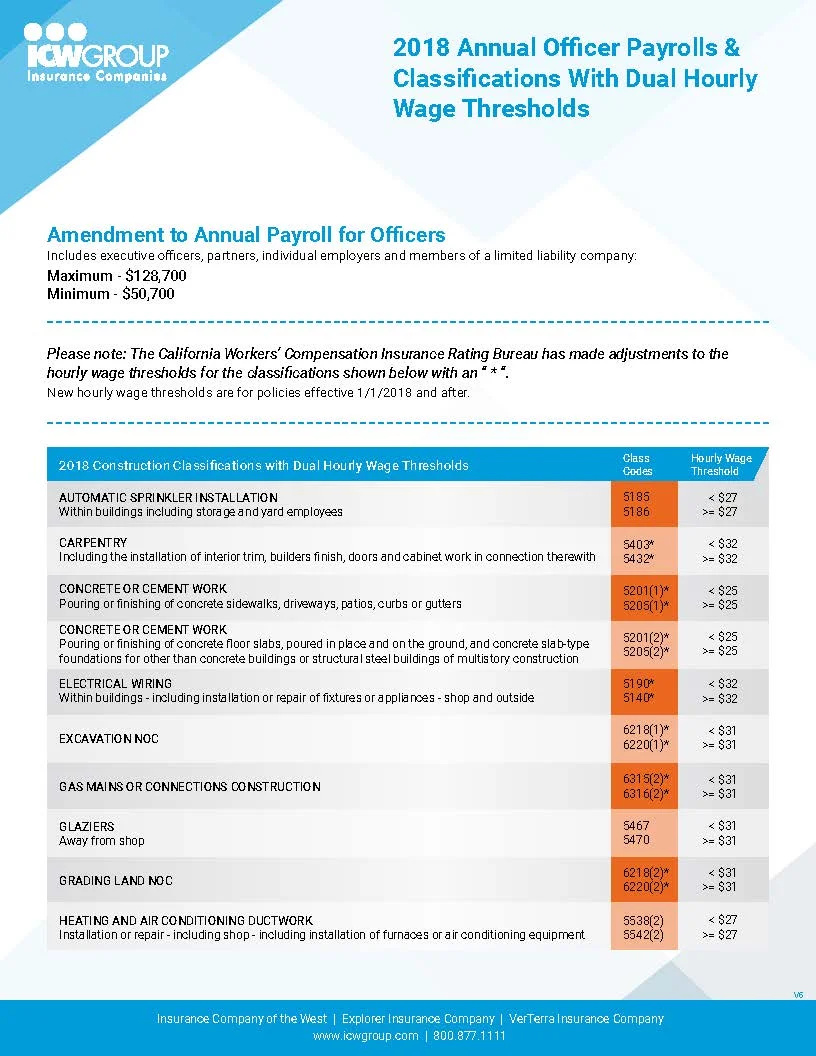
"2018 Annual Officer Payrolls, CA Assessemnt Rates & Duel Wage Threshold." Insurance Company of the West.
3 Steps to Developing Your 2018 Safety Training Calendar
Author, Alyssa Burley, Client Services Coordinator, Rancho Mesa Insurance Services, Inc.
The end of the year is the perfect time to evaluate your company’s overall safety program. One important element in a successful safety program is the weekly safety meetings (aka training shorts, tailgate talks, or toolbox talks).
Author, Alyssa Burley, Client Services Coordinator, Rancho Mesa Insurance Services, Inc.
Example of a construction training short calendar.
The end of the year is the perfect time to evaluate your company’s overall safety program. One important element in a successful safety program is the weekly safety meetings (aka training shorts, tailgate talks, or toolbox talks).
Rancho Mesa’s Risk Management Library provides the content employers need to educate their employees on how to be safe in the workplace.
The library includes hundreds of English and Spanish training shorts designed to educate employees on various safety topics in a quick and concise manner. Each training short typically includes 1-2 pages of easy to follow content and a sign-in sheet.
Rancho Mesa recommends choosing 52 topics that are relevant to your industry. This will serve as your training short calendar for 2018.
Step 1: Review the Training Shorts Library
To access the training shorts within the library, login to the Risk Management Center, click “Resources,” then click “Risk Management Library. Click on “Training Shorts,” then click “Safety.”
Review the list to determine which topics are appropriate for your industry.
Step 2: Save the Training Topics
It is recommended that you save your selected Training Shorts to your “My Content” folder. This will make it easily to find them later.
From the list of training shorts, check the box to the left of the title(s) you would like to save to the “My Content” folder. Then, click “Add to My Content” in the upper right corner. Choose the subfolder to save the training shorts. Now, you can refer back to the list of topics, later.
Step 3: Schedule the Trainings
Now, that you have picked your 52 training topics from the library, we recommend putting them on a calendar. Pick a day during the week when you’ll have your safety meeting and include the topic for each week. Training may also be scheduled within the Risk Management Center.
For recommendations for your training calendar, contact Rancho Mesa Insurance Services, Inc. at (619) 937-0164.
OSHA Pushes Back Electronic Reporting Deadline
Author, Alyssa Burley, Client Services Coordinator, Rancho Mesa Insurance Services, Inc.
In a recent news release from the U.S. Department of Labor (DOL), the Occupational Safety and Health Administration (OSHA) announced it has extended its electronic reporting deadline from December 1, 2017 to December 15, 2017.
Author, Alyssa Burley, Client Services Coordinator, Rancho Mesa Insurance Services, Inc.
In a recent news release from the U.S. Department of Labor (DOL), the Occupational Safety and Health Administration (OSHA) announced it has extended its electronic reporting deadline from December 1, 2017 to December 15, 2017.
The extension was made "to allow affected employers additional time to become familiar with the new electronic reporting system launched on August 1, 2017," according to the statement issed by the DOL's OSHA.
Employers in California, Maryland, Minnesota, South Carolina, Utah, Washington and Wyoming are currently not required to submit their OSHA reports electronically. However, it is likely it will be a requirement in the future.
Update: 5/3/18 For updated information on State requirements, read "Federal OSHA Asserts Electronic Data Reporting Requirement Applies to Employers across All States."
For additional information about the OSHA electronic reporting, read "Risk Management Center Streamlines Electronic OSHA Reporting," "DHS Alerts OSHA of Possible Electronic Reporting Security Breach," "OSHA Launched Electronic Reporting System."
Berkshire Hathaway Homestate Companies and Rancho Mesa Participate in Nationally Renowned LANDSCAPES 2017
Author, Drew Garcia, NALP Program Director, Rancho Mesa Insurance Services, Inc.
The Berkshire Hathaway Homestate Companies (BHHC) and Rancho Mesa Insurance Services (RMI) teamed up at the annual LANDSCAPES 2017 convention, the Green Industry & Equipment (GIE) Expo, and the Hardscape North America (HNA) Tradeshow, in Louisville, Kentucky, on October 17-20, 2017.
Author, Drew Garcia, NALP Program Director, Rancho Mesa Insurance Services, Inc.

Berkshire Hathaway Homestate Companies and Rancho Mesa Insurance Services NALP Program Team
The Berkshire Hathaway Homestate Companies (BHHC) and Rancho Mesa Insurance Services (RMI) teamed up at the annual LANDSCAPES 2017 convention, the Green Industry & Equipment (GIE) Expo, and the Hardscape North America (HNA) Tradeshow, in Louisville, Kentucky, on October 17-20, 2017.
The group consisted of Senior Vice President Margaret Hartmann, NALP Assistant Director of Underwriting Valerie Contreras, NALP Program Underwriter Davis Cooper, NALP Client Services Coordinator Emily Docuyanan, and NALP Senior Loss Control Specialist Steve Hamilton from BHHC, and agency Principal Dave Garcia and NALP Program Director Drew Garcia from RMI.

Davis Cooper, NALP Program Underwriter, Berkshire Hathaway Homestate Companies
The BHHC and RMI group participated in a multitude of event programs as speakers, ambassadors, and audience. BHHC and RMI championed four breakfast table topics, a breakout education session based on risk mitigation and cost savings, and took time to speak with association members about the program within National Association of Landscape Professionals' (NALP) booth at the expo.

NALP Program Board Presentation

Sam Steel, NALP Safety Advisor & Steve Hamilton, BHHC

Membership Meeting
“The event was a great success," said Dave Garcia. "It’s amazing to see so many like-minded people dedicated to improving themselves and their companies while building upon the professionalism this industry holds as standard. We are so proud to be a part of this amazing industry and look forward to a long lasting partnership with NALP for years to come.”

NALP Group

Davis Cooper and Drew Garcia at the booth

Davis Cooper speaking with attendees at the booth
I really enjoyed connecting with NALP members and learning about their individual companies. LANDSCAPES provides an environment for motivated industry professionals to share ideas, learn, and form long lasting relationships. The overwhelming commonality is this identified desire for industry veterans to give back to the community that helped them succeed. It’s easy to build off that energy and puts into perspective that our Work Comp Program is providing the level of specialized attention this industry deserves. I'm excited to keep the momentum going while constantly looking for ways to improve our product so that we can provide more to lawn and landscape professionals.
For more information about the NALP Workers' Compensation Program, contact Rancho Mesa Insurance Services, Inc. at (619) 937-0164.
OSHA Begins Enforcement of New Silica Rule
Author, Alyssa Burley, Client Services Coordinator, Rancho Mesa Insurance Services, Inc.
After an initial delay and a 30-day grace period, the Occupational Safety and Health Administration‘s (OSHA) revised Crystalline Silica Rule is now in full effect. The rule became effective September 23, 2017 and OSHA allowed for a 30-day grace period for issuing fines and citations for companies who were making a good-faith effort towards meeting the new requirements.
Author, Alyssa Burley, Client Services Coordinator, Rancho Mesa Insurance Services, Inc.
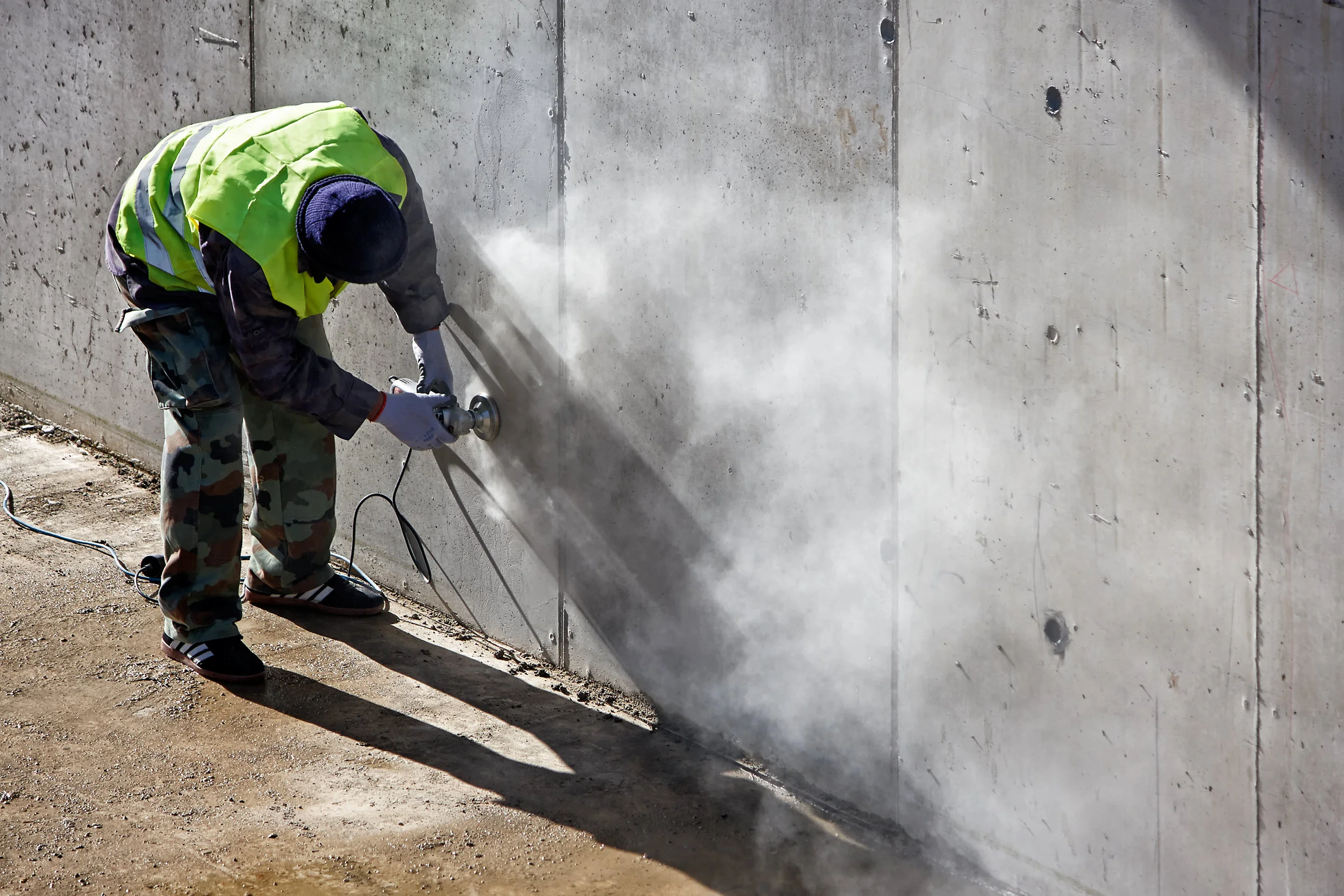
After an initial delay and a 30-day grace period, the Occupational Safety and Health Administration‘s (OSHA) revised Crystalline Silica Rule is now in full effect. The rule became effective September 23, 2017 and OSHA allowed for a 30-day grace period for issuing fines and citations for companies who were making a good-faith effort towards meeting the new requirements.
“The new silica rule lowers the permissible exposure limit from the current standard of 250 micrograms per cubic meter of air to 50 micrograms per cubic meter of air, averaged over an eight hour day, and an action level of 25 micrograms per cubic meter of air,” wrote Sam Clayton, Vice President of Rancho Mesa Insurance Services’ Construction Group.
OSHA has made available Interim Enforcement Guidelines and a Fact Sheet to assist companies in complying with the new requirements.
To learn more about the Crystalline Silica rule, read “Is your company prepared for OSHA’s new Silica Rule?” by Sam Clayton.
Contact Rancho Mesa Insurance Services at (619) 937-0164 for more information.
7 Tips for Managing Risk at Nonprofit Special Events
Author, Sam Brown, Vice President, Human Services, Rancho Mesa Insurance Services, Inc.
Nonprofit organizations often conduct special events throughout the year. These events can successfully increase awareness of the nonprofit’s mission, generate important unrestricted revenue, and offer all stakeholders a nice opportunity to have fun. Unfortunately, important risk management steps are often overlooked before the day of the event. Let’s look at a few that can limit exposure to risk.
Author, Sam Brown, Vice President, Human Services, Rancho Mesa Insurance Services, Inc.
Nonprofit organizations often conduct special events throughout the year. These events can successfully increase awareness of the nonprofit’s mission, generate important unrestricted revenue, and offer all stakeholders a nice opportunity to have fun. Unfortunately, important risk management steps are often overlooked before the day of the event. Let’s look at a few that can limit exposure to risk.

1. Documenting Risk Management Activities
In addition to helping train and supervise personnel, a written plan can help to ensure important actions take place. Documenting activities also helps an organization defend its actions if an accident occurs.
2. Safety Officer
Consider assigning risk management oversight specifically to one person. The “safety officer” should receive the proper training and resources to safeguard the event, the organization, the participants, and others.
3. Crisis Response Team
To prevent a crisis from draining valuable resources, develop a crisis response team of three to five people. This team should handle any emergency quickly and effectively while working with all stakeholders.
4. Pre-Event Inspections
This important step helps you identify and correct unsafe conditions before an event as well as identify pre-existing damage to the property. During the inspection, note any damages prior to the event and give a copy to the facility manager. It is also a good idea to inspect the premises during and after the event.
5. Emergency Plans
A host of things can go wrong at a special event, so an organization must know how to address these when they occur. Consider the following: evacuations, medical emergencies, crowd control, and limiting alcohol consumption.
6. Volunteers
Ensuring that your “day of” volunteers are properly trained and supervised is a very important risk management challenge. Without such precautions, great harm can come to the organization. Allow time to screen and select the best candidates.
7. Food and Beverages
Will your organization provide and serve food, or, is a vendor performing these functions? You can transfer risk to vendors in most situations, but if your organization is providing food and beverage then consider the following:
Facilities: Is there adequate preparation, storage, and refrigeration facilities for the type of food?
Health Regulations: Do you need a health department permit? What other health department regulations should you consider?
Food Spoilage and Contamination: Do your food handlers have the proper training for handling the food being served?
These are only a few of the very important risk management practices a nonprofit organization should consider before a special event. Ignoring these exposures in the planning phase can turn a fun day into a costly event. For a full risk assessment of your special event and other activities, please contact Rancho Mesa Insurance Services, Inc.s at (619) 937-1064.
Sources: The Nonprofit Risk Management Center’s “My Assessment“ module (www.nonprofitrisk.org).
Small Performance Bonds No Longer Require CPA Financial Statements
Author, Matt Gaynor, Director of Surety, Rancho Mesa Insurance Services, Inc.
In the past, many Surety Bond carriers required financial statements from a Certified Public Account (CPA), bank lines of credit, tax returns, etc. for contractor bond programs, whether the client required one bond a year or a large bond program. This is no longer the case.
Author, Matt Gaynor, Director of Surety, Rancho Mesa Insurance Services, Inc.

In the past, many Surety Bond carriers required financial statements from a Certified Public Account (CPA), bank lines of credit, tax returns, etc. for contractor bond programs, whether the client required one bond a year or a large bond program. This is no longer the case.
Several “A” rated carriers now provide “personal credit based scoring” to approve single bonds of $350,000 up to $500,000. There is no need for company financial statements. Instead, the contractor completes a “fast track” application, which requests personal financial information about the owner(s). The bond company will run the personal credit of the owner(s). If the owner(s) personal credit is decent, the bond will be approved. A response is provided within 48 hours of submission.
The program responds to requests for bid bonds, performance and payment bonds, and letters of bondability. Several carriers provide a “pre-qualification” feature so you can determine if you will qualify for the bond before you bid or negotiate a project that will require a bond. This pre-qualification feature is helpful for owners that are aware they have low credit scores.
So, if you are considering a project that requires a bond and you are not a big fan of collecting a lot of paperwork for one project – don’t fret. We may have a solution to help you win that job!
Contact Rancho Mesa Insurance Services, Inc. at (619) 937-0164.
NALP Announces 2017 Safety Award Recipients
Author, Drew Garcia, NALP Program Director, Rancho Mesa Insurance Services, Inc.
Rancho Mesa would like to congratulate all 263 National Association of Landscape Professionals (NALP) members who achieved recognition for their safety efforts in 2017.
Author, Drew Garcia, NALP Program Director, Rancho Mesa Insurance Services, Inc.
Rancho Mesa would like to congratulate all 263 National Association of Landscape Professionals (NALP) members who achieved recognition for their safety efforts in 2017.
"The National Association of Landscape Professionals Safety Recognition Awards Program is designed to reward landscape industry professionals who consistently demonstrate their commitment to safety, and reflects the dedication of these individuals and their companies to creating and maintaining safe work environments," according to the NALP website.
Companies are evaluated in the following categories:
- No vehicle accidents
- No injuries or illness
- No days away from work
We would like to encourage all professional lawn and landscape companies to partake in NALP’s safe company program because participation as a group will continue to evolve and strengthen safety within the industry as whole.
I’m looking forward to supporting the association and these individual achievements in Louisville on October 19th at the annual awards ceremony.
On behalf of Rancho Mesa, congratulations to the participants!
OSHA Announces Top 10 Cited Violations for FY 2017
Author, Sam Clayton, Vice President, Construction Group, Rancho Mesa Insurance Services, Inc.
The Occupational Safety and Health Administration (OSHA) released its preliminary top 10 citation list for fiscal year 2017 at the annual National Safety Council (NSC) Congress and Expo, held in late September 2017.
Author, Sam Clayton, Vice President, Construction Group, Rancho Mesa Insurance Services, Inc.

The Occupational Safety and Health Administration (OSHA) released its preliminary top 10 citation list for fiscal year 2017 at the annual National Safety Council (NSC) Congress and Expo, held in late September 2017.
“One thing I’ve said before in the past on this is, this list doesn’t change too much from year to year,” said Patrick Kapust, deputy director of OSHA’s Directorate of Enforcement and Programs, during the expo presentation. “These things are readily fixable. I encourage folks to use this list and look at your own workplace.”
OSHA compiled the list using data collected from incidents occurring from October 2016 through September 2017.
- Fall Protection in Construction: 6,072 violations.
Frequently violated requirements include unprotected edges and open sides in residential construction and failure to provide fall protection on low-slope roofs - Hazard Communication: 4,176 violations.
Not having a hazard communication program topped the violations, followed by not having or providing access to safety data sheets - Scaffolding: 3,288 violations.
Frequent violations include improper access to surfaces and lack of guardrails - Respiratory Protection: 3,097 violations.
Failure to establish a respiratory protections program topped these violations, followed by failure to provide medical evaluations - Lockout/Tagout: 2,877 violations.
Frequent violations were inadequate worker training and inspections not completed. - Ladders in Construction: 2,241 violations.
Frequent violations include improper use of ladders, damaged ladders and using the top step. - Powered Industrial Trucks: 2,162 violations.
Violations include inadequate worker training and refresher training. - Machine Guarding: 1,933 violations.
Exposure points of operation topped these violations. - Fall Protection-training requirements: 1,523 violations.
Common violations include failure to train workers in identifying fall hazards and proper use of fall protection equipment. - Electrical-wiring methods: 1,405 violations.
Violations of this standard were found in most general industry sectors, including food and beverage, retail and manufacturing
Training materials for each of the items on the OSHA list are available within the Risk Management Center. Contact Rancho Mesa Insurance Services, Inc. at (619) 937-0164, for more information.
3 Steps to Protect Your Employees from San Diego’s Recent Hepatitis A Outbreak
Author, Alyssa Burley, Client Services Coordinator, Rancho Mesa Insurance Services, Inc.
Whether you work in the human services sector like healthcare, community outreach, or schools, or you are in the construction industry working in areas like downtown San Diego, your employees may come in contact with the Hepatitis A virus.
Author, Alyssa Burley, Client Services Coordinator, Rancho Mesa Insurance Services, Inc.

Whether you work in the human services sector like healthcare, community outreach, or schools, or you are in the construction industry working in areas like downtown San Diego, your employees may come in contact with the Hepatitis A virus (HAV).
As cities throughout San Diego County actively work to stop the spread of the recent Hepatitis A outbreak, some employers are asking how they can protect their employees who may be exposed to the virus.
According to the Center for Disease Control (CDC), the Hepatitis A virus is spread by “person-to-person transmission through the fecal-oral route (i.e., ingestion of something that has been contaminated with the feces of an infected person) is the primary means of HAV transmission in the United States.”
While the local and national media have primarily focused on the concentration of homeless and drug users who have contracted the virus, about 20% of the recent reported cases are not included in that population, according to the “Hepatitis A Outbreak in San Diego, CA” interview by Dennis Stein, linked to on the County of San Diego’s website. However, about half of the 20%, can trace their infection back to working with at risk populations. Thus, the Hepatitis A outbreak should be everyone’s concern, not just those included in the homeless population and drug users.
The “Hepatitis A vaccination is the best way to prevent the disease,” wrote Wilma J. Wooten, Public Health Officer and Director for the County of San Diego Public Health Services, in a letter to emergency responders, businesses, homeless providers and substance abuse treatment providers. While vaccination is an option to prevent infection, good hygiene is also highly effective.
Follow the steps below to help prevent the spread of the Hepatitis A virus to your employees:
1. Wash Hands
First and foremost, instruct employees to frequently wash their hands with soap and warm water after using the restroom, before eating, and after touching handrails, door handles, tools, and other surfaces that are frequently used by others.
Handwashing is “integral to Hepatitis A prevention, given that the virus is transmitted through the fecal–oral route,” according to the CDC’s website.
2. Sanitize
It may be necessary to regularly sanitize your facility or equipment. “Maintain routine and consistent cleaning of bathrooms for employees and the public, using a chlorine-based disinfectant (bleach) with a ratio of 1 and 2/3 cup of bleach to one gallon of water. Due to the high bleach concentration of this mix, rinse surfaces with water after 1 minute of contact time and wear gloves while cleaning,” suggests Wooten.
3. Educate
Awareness and education about the Hepatitis A outbreak is key to preventing the spread of the virus. Based on knowing the facts about how the virus is spread, employees may decide to wear disposable gloves, wash hands more frequently, or change the way they perform their job duties to prevent exposure.
The Risk Management Center provides a variety of training materials to Rancho Mesa clients on Hepatitis A and other bloodborne pathogens. Through online courses, training shorts, videos and other training materials, help educate your employees before there is an infection.
The County of San Diego also provides Hepatitis A information in the form of guidelines, cards, posters, videos and more.
Contact Rancho Mesa Insurance Services at (619) 937-0164 for more information.
Is your Company Prepared for OSHA’s new Silica Rule?
Author, Sam Clayton, Vice President, Construction Group, Rancho Mesa Insurance Services, Inc.
On September 23rd 2017 the Occupational Safety and Health Administration’s (OSHA) new silica standard for construction will go into effect. This means contractors who engage in activities that create silica dust or are known in the industry as respirable crystalline silica, must meet a stricter standard for how much dust there workers inhale.
Author, Sam Clayton, Vice President, Construction Group, Rancho Mesa Insurance Services, Inc.

On September 23rd 2017 the Occupational Safety and Health Administration’s (OSHA) new silica standard for construction will go into effect. This means contractors who engage in activities that create silica dust or are known in the industry as respirable crystalline silica, must meet a stricter standard for how much dust their workers inhale.
What is Crystalline Silica?
Crystalline silica is a common mineral that is found in material that we see every day in roads, buildings and sidewalks. It is a common component of sand, stone, rock, concrete, brick, block and mortar.
What are the Effects?
Exposures to crystalline silica dust occur in common workplace operations involving cutting, sawing, drilling, and crushing of rock, and stone products such as construction tasks and operations using sand products like in glass manufacturing, foundries, sand blasting and hydraulic fracking. Inhaling silica dust can lead to silicosis, an incurable lung disease that can be fatal. Those with too much silica exposure can also develop lung cancer, kidney disease and chronic obstructive pulmonary disease.
What is the New Standard?
The new silica rule lowers the permissible exposure limit from the current standard of 250 micrograms per cubic meter of air to 50 micrograms per cubic meter of air, averaged over an eight hour day, and an action level of 25 micrograms per cubic meter of air.
How will the New Standard protect workers?
The rule significantly reduces the amount of silica dust that workers can be exposed to on the job. That means employers will have to implement controls and work practices that reduce workers exposures to silica dust. For most activities, that means employers will have to ensure the silica dust is wet or vacuumed up before workers can work in the area. Employers are required under the rule to provide training, respiratory protection when controls are not enough to limit exposure and written exposure control plans, measure controls in some cases limit access to high exposure areas. Employers are also required to offer medical exams to highly exposed workers.
How can your company protect itself from Silica Related Claims?
In addition to implementing the necessary controls to protect your employees, we would highly recommend you review your insurance policies to make sure that your company is protected from silica related claims.
Over the last few years, we’ve seen quite a few General Liability carriers putting Silica exclusions on there policies. This isn’t always the case and may be negotiated out depending on the carrier. Another alternative is to obtain a Contractors Pollution Policy that would provide the necessary coverage for this exposure.
Rancho Mesa also recommends taking advantage of the Silica Exposure Training materials available within the Risk Management Center. These materials include an online training course, PowerPoint presentation, training short and quiz in both English and Spanish. Should you have any questions, please contact Rancho Mesa Insurance Services at 619-937-0164.
Workers' Compensation Dual Wage Thresholds Increases for Construction Classes in 2018
Author David J. Garcia, C.R.I.S., A.A.I., President Rancho Mesa Insurance Services, Inc.
In an effort to keep you informed, so that you can begin to plan your 2018 budget, we wanted to let you know of a potential change in the dual wage classes, for many but not all, the dual wage construction class codes.
Author David J. Garcia, C.R.I.S., A.A.I., President Rancho Mesa Insurance Services, Inc.
Updated September 15, 2017 The Workers’ Compensation Insurance Rating Bureau has confirmed the following increases for the 2018 dual wage construction classifications. |

Originally published on May 12, 2017.
In an effort to keep you informed, so that you can begin to plan your 2018 budget, we wanted to let you know of a potential change in the dual wage classes, for many but not all, the dual wage construction class codes.
The Workers’ Compensation Insurance Rating Bureau is proposing increases in the wage threshold for ten different construction industry dual wage classifications and is likely to recommend an increase in an eleventh, by the time it releases its 2018 regulatory filing, next month. The proposed increases range from $1.00 to $2.00 per hour, to keep the thresholds in line with wage inflation. See the chart below for the actual changes.
Dual Wage Thresholds
| Classification | Current Threshold | Recommended Threshold | Threshold Difference | Last Changed |
|---|---|---|---|---|
| 5027/5028 Masonry | $27 | $27 | $0 | 2013 |
| 5190/5140 Electrical Wiring | $30 | $32 | $2 | 2014 |
| 5183/5187 Plumbing | $26 | $26 | $0 | 2014 |
| 5185-5186 Automatic Sprinkler Installation | $27 | $27 | $0 | 2009 |
| 5201-5205 Concrete or Cement Work | $24 | $25 | $1 | 2009 |
| 5403/5432 Carpentry | $30 | $32 | $2 | 2016 |
| 5446/5447 Wallboard Application | $33 | $34 | $1 | 2016 |
| 5467/5470 Glaizers | $31 | $31/further study | $1 | 2016 |
| 5474/5482 Painting/Waterproofing | $24 | $26 | $2 | 2009 |
| 5484/5485 Plastering or Stucco Work | $27 | $29 | $2 | 2014 |
| 5538/5542 Sheet Metal Work | $27 | $27 | $2 | 2009 |
| 5552/5553 Roofing | $23 | $25 | $2 | 2009 |
| 5632/5633 Steel Framing | $30 | $31 | $1 | 2016 |
| 6218/6220 Excavation/Grading/Land Leveling | $30 | $31 | $1 | 2014 |
| 6307/6308 Sewer Construction | $30 | $31 | $2 | 2014 |
| 6315/6316 Water/Gas Mains | $30 | $31 | $2 | 2014 |
Rancho Mesa will keep you informed should the proposed 2018 change go into effect. If you have any questions, please give us a call at (619) 937-0164.
Your Rancho Mesa Team - RM365 Advantage
3 Topics to Discuss with Vendors, Independent Contractors, and Partner Agencies Prior to Working Together
Author, Chase Hixson, Account Executive, Human Services, Rancho Mesa Insurance Services, Inc.
Recently, a non-profit client of mine asked the question: What are the steps I should take with vendors, contracted professionals and partner agencies to make sure my organization is protected should a claim arise as a result of their work? This is a common exposure to many of our clients, and there are several steps that can be taken to protect your business.

Recently, a non-profit client of mine asked the question: What are the steps I should take with vendors, contracted professionals and partner agencies to make sure my organization is protected should a claim arise as a result of their work? This is a common exposure to many of our clients, and there are several steps that can be taken to protect your business.
1. Verify the Proper Insurance is in Place
Any person/organization that you consider working with should be fully insured and able to provide you with a Certificate of Insurance, which lists the coverages, carriers and limits of insurance they have in place. Without their own insurance in place, your company is now assuming full responsibility for anything that may occur as a result of their negligence. Depending on the nature and scope of the work being performed, different types of insurance will be required. An insurance professional can help you determine the specific coverage needed.
Example: A charter school has hired a local animal shelter to bring animals to their students and teach about conservation. One of the animals bites a student. If the animal shelter does not have the proper insurance, the charter school’s insurance will be liable for any action taken against the school.
2. Name Your Business as Additional Insured
In addition to verifying that the correct coverages and limits are in place, you should also require they name your company as an additional insured on their policy. By doing this, your organization will now be indemnified under their policy for claims arising as a result of their work, in which you are named.
Example: In the example where a charter school has hired a local animal shelter to bring animals to their students and one of the animals bites a student, by requiring the animal shelter to name the charter school as an additional insured, the school is covered under the animal shelter’s insurance.
3. Provide a Waiver of Subrogation
A waiver of subrogation means an insured (and their insurance company) are waiving their right to subrogate against another party, should their employee suffer an injury on your premises. Most independent contractors aren’t required to carry insurance, so this wouldn’t apply to them. However, if employees of another company are performing work on your premises, it is wise to have them waive their right to subrogate against your workers’ compensation carrier.
Example: A charter school has hired a local animal shelter to bring animals to their students and teach about conservation. While presenting, an employee of the shelter trips and injures their knee. A waiver of subrogation would void the animal shelter’s workers’ compensation provider from seeking subrogation against the charter school’s workers’ compensation policy. The employee will still be treated, but you won’t suffer the penalty for it.
I strongly recommend reviewing your processes regarding vendor, independent contractors and partner agencies to see what is currently in place. Far too often steps are skipped and businesses are unaware of the liability they are assuming. If you have any question about a specific circumstance, please don’t hesitate to give Rancho Mesa a call at (619) 937-0164, we are happy to assist.
5 Steps to Avoiding Workers’ Compensation Claim Litigation
Author, Jeremy Hoolihan, CRIS, Janitorial Group Leader, Rancho Mesa Insurance Services, Inc.
Workers’ Compensation claims can cost a company time, money, employee productivity, and morale. Litigation is one of the most costly results of a workers’ compensation claim. Once an employee hires an attorney, the time and money it takes for the claim to close drastically increases.
Author, Jeremy Hoolihan, CRIS, Janitorial Group Leader, Rancho Mesa Insurance Services, Inc.

Workers’ Compensation claims can cost a company time, money, employee productivity, and morale. Litigation is one of the most costly results of a workers’ compensation claim. Once an employee hires an attorney, the time and money it takes for the claim to close drastically increases.
There are several reasons why an employee will find the need to hire an attorney. Practicing a sound Risk Management Program can dramatically reduce the likelihood of litigation. Here are some ways you can prevent most workers’ compensation claims from ever reaching that point:
- Acknowledge why employees hire attorneys. The employee/employer relationship is a critical factor in determining if a workers’ compensation claim results in litigation. Employees who feel threatened in some way are more likely to hire an attorney. A few key reasons are:
a. The employee is concerned they will be fired because of the injury and/or ownership or management doesn’t truly feel the injury was work related.
b. The employee feels they will face retaliation for reporting the claim.
c. There is a lack of understanding of the workers’ compensation claim process. For those employees that are faced with a workers’ compensation injury, it can be a very stressful time.
d. There is a fear the claim will be denied or they will be treated unfairly. Attorneys can prey on vulnerable injured employees. Radio and television ads imply injured employees need their assistance in order to get proper treatment and/or a huge settlement they deserve.
- Keep lines of communication open with your employee. Reassure the employee that he or she will have a job when they are able to return to work. In addition, show some compassion and stay in regular contact with the individual. An employee is far more likely to hire an attorney if they are concerned about losing their job or no longer of value to the company.
- Consider the ramifications before firing an injured employee. Termination of an employee after they have been injured on the job can put the company at risk of a lawsuit (Section 132 claim). In addition, terminating an injured worker could cost the company more in wage loss benefits; an injured employee will continue to draw from the workers’ compensation policy if they are unable to return to work, regardless if the company continues to employ them or not. Often, employees are released to modified duty (Return To Work Program). If an employer can accommodate the work restrictions, the employee’s temporary benefits are reduced or eliminated. This can significantly reduce the total cost of the claim.
- Act before a problem employee becomes injured. Once an injury has been reported, it becomes extremely risky to discipline or terminate a problem employee. Address and deal with the employee immediately and be consistent with your documentation.
- Train your supervisors!!!! It is vital that supervisors are trained in reporting and handling claims. They are your first line of defense in preventing claim litigation. Businesses should have a formalized Accident Investigation Program in place. Rancho Mesa provides a Supervisor’s Report of Accident or Near Miss form and a Witness’ Accident Statement form to assist in the investigation process. In addition to all the formal documentation, there are other key strategies a supervisor can use:
a. Do not accuse the injured employee of fraud, even if you know fraud is involved. Supervisors should simply document the facts. If there is suspicion of fraud, make sure you document any supporting evidence in the report and inform the adjuster.
b. Do not negotiate the injured worker’s treatment or return to work schedule. Leave that determination to the claims adjuster.
c. Keep in touch. Instruct the supervisor to check on the injured worker from time to time. Show some compassion and build trust. Assure the employee that their job is secure.
While there is no surefire way to eliminate litigated claims, by following these five steps you should see results. With the average litigated claim costing 30% more than a non-litigated claim, the savings over time could be significant. To discuss implementing this strategy within your company’s Risk Management Program, please contact Rancho Mesa Insurance Services, Inc. at (619) 937-0164.
Assembly Bill 72 Passes to Limit Unexpected Medical Costs to Californians
Effective July 1, 2017, Assembly Bill 72 (Bonta) went into effect by protecting Californians from unexpected medical bills when visiting in-network facilities (i.e., hospitals, labs, and imaging centers). No longer can providers who aren’t contracted with a patient’s health plan step into the operating room, for instance, and charge the patient more than the patient would have expected to pay an in-network provider. Furthermore, the patient can only be billed for his or her in-network cost-share, meaning in-network benefits apply to all providers seen, and services rendered, in an in-network facility.

Effective July 1, 2017, Assembly Bill 72 (Bonta) went into effect by protecting Californians from unexpected medical bills when visiting in-network facilities (i.e., hospitals, labs, and imaging centers). No longer can providers who aren’t contracted with a patient’s health plan step into the operating room, for instance, and charge the patient more than the patient would have expected to pay an in-network provider. Furthermore, the patient can only be billed for his or her in-network cost-share, meaning in-network benefits apply to all providers seen, and services rendered, in an in-network facility.
Over the course of my career, I’ve had to help many clients understand and appeal surprise charges from out-of-network doctors, anesthesiologists, etc., who’ve charged patients separately from the in-network facility, and I have experienced this myself when receiving care. With many/most Preferred Provider Organization (PPO) plans, there is a separate deductible that a member has to satisfy for care received from out-of-network providers, after which, there is less coverage than in-network providers, and the member can be “balance-billed” between what the insurance company pays and what out-of-network providers charge. AB 72 goes a long way toward eliminating such surprise charges.
As always, it’s important to review the Explanations Of Benefits (EOB’s) you receive from your insurance company, to make sure that your benefits have been applied correctly, according to your plan. This is a smart piece of legislation that will help prevent unsuspecting patients in California from getting charged more from out-of-network providers, at least not without prior written consent.
For more information, contact Rancho Mesa at (619) 937-0164.
DHS Alerts OSHA of Possible Electronic Reporting Security Breach
Author, Alyssa Burley, Client Services Coordinator, Rancho Mesa Insurance Services, Inc.
On August 1, 2017, the Occupational Safety and Health Administration (OSHA) launched its online electronic data filing application. It was designed to collect and publish injury data on companies throughout the United States in order to comply with a new requirement.
Author, Alyssa Burley, Client Services Coordinator, Rancho Mesa Insurance Services, Inc.
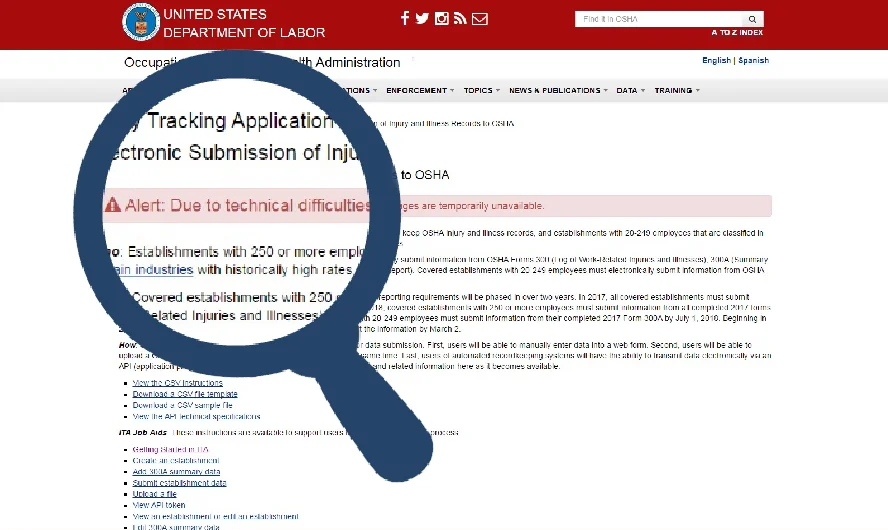
On August 1, 2017, the Occupational Safety and Health Administration (OSHA) launched its online electronic data filing application. It was designed to collect and publish injury data on companies throughout the United States in order to comply with a new requirement.
Within just a few weeks of its launch, according to an OSHA spokesperson, the United States Department of Homeland Security’s Computer Emergency Readiness Team alerted OSHA of a possible data breach within the newly launched Injury Tracking Application (ITA).
The warning indicated user information for the tracking application system could have been compromised and the affected company was notified about the apparent breach.
According to a Department of Labor official on August 14, 2017, “Access to the ITA has been temporarily suspended as OSHA works with the system developer to examine the issue to determine the extent of the problem.”
As of today, August 23, 2017, OSHA’s ITA webpage displays an “Alert: Due to technical difficulties with the website, some pages are temporarily unavailable,” preventing anyone from uploading their data.
In an article published by Business Insurance, legal experts were cited as advising companies to wait to file their reports. “I’m not advising anybody to file it before Dec. 1 because it might change,” said Mark Kittaka, a Columbus, Ohio-based partner with Barnes & Thornburg L.L.P. “I don’t know why you’d want to file it early. You may not have to file it all.”
However, Rancho Mesa Insurance Services advises its clients to continue to keep track of their incidents in the Risk Management Center, regardless of what happens with the OSHA electronic reporting requirement. Companies will still need to maintain current OSHA logs, even if the electronic system is unavailable or the electronic reporting requirement changes. If the December 1, 2017 deadline remains in effect, clients will be prepared to submit the data via the Risk Management Center, if the data has been maintained.
Contact Rancho Mesa Insurance Services at (619) 937-0164 if you have questions about how to track your incidents in the Risk Management Center and generate the required OSHA logs.
Surviving an Active Shooter Event: Recognize, React and Prevent Workplace Violence
Author, Sam Brown, Vice President of Human Services Group, Rancho Mesa Insurance Services, Inc.
In the ongoing effort to keep employees safe from workplace violence, it is very important to train workers how to recognize, react to and prevent active shooter events. In most cases, simply having a plan can mean the difference between life and death.
Author, Sam Brown, Vice President of Human Services Group, Rancho Mesa Insurance Services, Inc.

In the ongoing effort to keep employees safe from workplace violence, it is very important to train workers how to recognize, react to and prevent active shooter events. In most cases, simply having a plan can mean the difference between life and death.
PLAN FORMATION
When forming a workplace violence emergency plan, try to answer the following questions:
- How will first observers/responders communicate the threat and to whom?
- How will the threat be communicated to everyone in the facility? Through code words?
- Should the facility be locked down or evacuated?
- Has your security been trained in providing guidance to employees for this type of emergency?
- If your site does not have security, are your workers trained for this type of emergency? Do they know who to call if something happens?
- Do you have site-specific emergency plans in place?
- Do you have the capability to lock down your buildings remotely or deactivate card readers?
PREVENTION
Preventing workplace violence is your first line of defense. Try the following tips to defuse a situation:
- Don't pick fights. Loud and aggressive arguments can easily escalate into physical fights.
- Take verbal threats seriously. Do not aggravate the situation with a threatening response. Report all threats to your supervisor or the company's security department.
- Report any suspicious person or vehicle to security personnel, especially at night. The suspect could be casing the place for a break-in. Or, the person could be stalking an ex-spouse who works with you.
- Also, watch for unauthorized visitors who appear to have legitimate business at your plant. Crimes have been committed by people posing as employees, contractors and repair persons.
- Observe your company's rules prohibiting drugs and alcohol at work. Many violent incidents at work can be traced to the use of these substances.
- Be aware of the neighborhood in which you work and the areas you drive through on your commute. Gang activity and other violence does not always stop at the gate to your plant. Keep to well-traveled and well-lighted areas as you drive to and from work.
- If you drive on the job, don't pick up hitch-hikers. The most important reason for this rule is your personal safety.
- Keep your keys in a secure place so they cannot be stolen or copied. Notify plant security if you have lost your key to the premises.
- Learn how to contact help in an emergency. Speed-dialing numbers should be programmed into phones and emergency numbers should be listed at each phone.
- Some workplaces also have pre-determined code words so one employee can tell another about a dangerous customer or visitor without tipping off the suspect. Learn the distress signals used in your workplace.
- Follow lockup procedures. Wear your identification badge as you are instructed. Never lend your key or entry card to anyone. Keep your entry password a secret by memorizing it instead of writing it down.
TIPS TO SURVIVING A WORKPLACE SHOOTING
RUN: First and foremost, try to escape.
- If there is an escape path, attempt to evacuate.
- Evacuate whether others agree to or not.
- Leave your belongings behind.
- Help others escape if possible.
- Prevent others from entering the area.
- Call 911 when you are safe.
HIDE: If you cannot escape safely, find a place to hide.
- Lock and/or blockade the door.
- Silence your mobile phone.
- Hide behind large objects.
- Remain very quiet.
The hiding place should:
- Be out of the shooter’s view.
- Provide protection if shots are fired in your direction.
- Not trap or restrict your options for movement.
FIGHT: As a last resort, if your life is at risk, act with aggression.
- Attempt to incapacitate the shooter.
- Act with physical aggression.
- Improvise weapons.
- Commit to your actions.
The U.S. Department of Labor Occupational Safety and Health Administration (OSHA) also offers Guidelines for Preventing Workplace Violence for Healthcare and Social Service Workers to help employers prevent such incidents.
For additional resources on Workplace Violence and Active Shooter Preparedness, visit the Rancho Mesa Risk Management Center or contact us at (619) 937-0164.