

Industry News

Manage Your COVID-19 Risk With These Tools
Author, Alyssa Burley, Media Communications and Client Services Manager, Rancho Mesa Insurance Services, Inc.
While most of the country is under shelter-in-place orders, many of our clients work in essential industries that must continue to provide vital services to the community. Therefore, it is imperative that they have the tools they need to keep their employees safe.
Author, Alyssa Burley, Media Communications and Client Services Manager, Rancho Mesa Insurance Services, Inc.
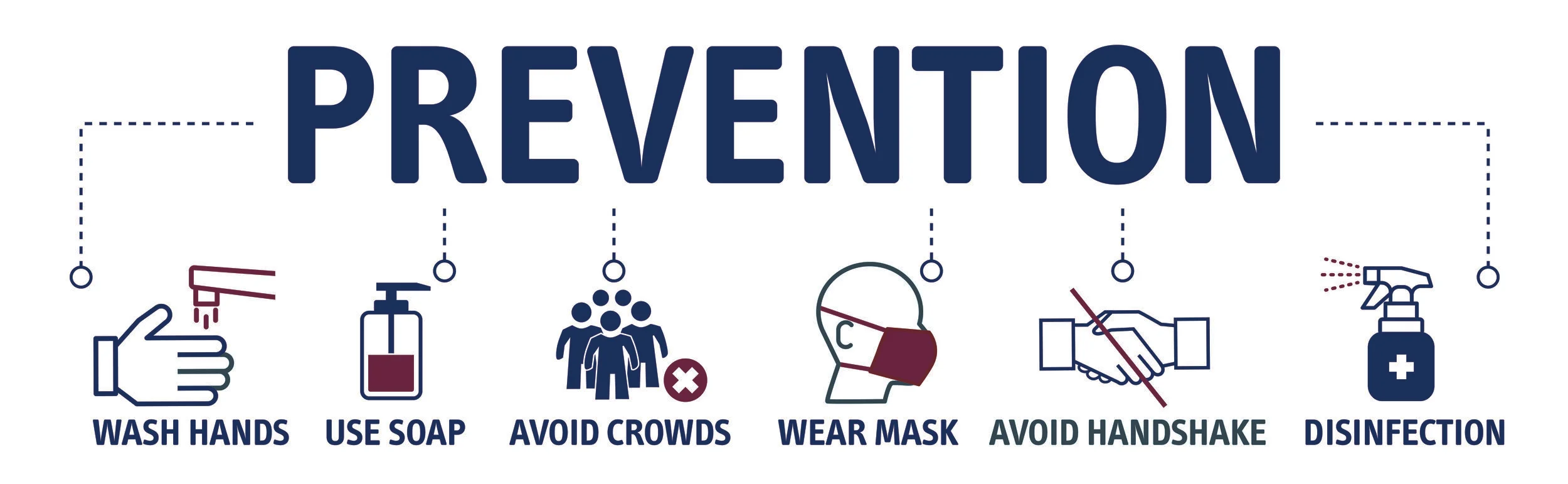
While most of the country is under shelter-in-place orders, many of our clients work in essential industries that must continue to provide vital services to the community. Therefore, it is imperative that they have the tools they need to keep their employees safe.
For those who must continue to operate, we’ve complied resources employers can use to implement COVID-19-specific written safety programs, provide employee training, and signage that can be posted in the workplace. Many of these resources are available in both English and Spanish.
Our goal is to provide the tools our clients’ needs to protect their employees.
Program Administration
Our risk management and safety partners have developed templates that employers can use, today.
COVID-19 Guide (English/Spanish)
This document should be reviewed by ownership and management for clarification on how to implement the COVID-19 Written Program.COVID-19 Guide Amendment A: Employee Has Tested Positive for COVID-19, Now What?
Amendment A provides instructions on what to do if your employee tests positive for the COVID-19 virus.
COVID-19 Health Screening Form (English/Spanish)
Each employee, should complete this form daily before performing any work. Foremen and supervisors should send these completed forms to management for record keeping purposes.COVID-19 Written Program (English/Spanish)
This program should be reviewed by all employees including ownership, management and workers in the field.COVID-19 Written Program Acknowledgement Form (English/Spanish)
All staff members must acknowledge they have read and understand the new program by signing the acknowledgement form.COVID-19 Checklist for Management (English/Spanish)
This checklist should be used daily for management to evaluate safety within the office for employees and identify any areas of concern.COVID-19 Checklist for Jobsites (English/Spanish)
This checklist should be used daily by foreman to evaluate the safety within the jobsite for employees and identify any areas of concern.COVID-19 Site-Specific Safety Plan
This site-specific safety plan may be required by a general contractor or site owner. It is a template employers can use to develop COVID-19 safety plans for specific jobsites where employees are working.
Training Staff
We have complied training that teach staff how to prevent the spread of the COVID-19 virus in the workplace through proper hygiene.
COVID-19 How to Prevent Catching & Spreading Coronavirus (English/Spanish)
Coronavirus and Workplace Hygiene (English/Spanish)
Safety Signage
In addition to proper training, signage is another way to remind employees of proper ways to prevent the spread of the COVID-19 virus within the workplace and among their co-workers.
CDC – Don’t’ Spread Germs at Work (English/Spanish)
CDC – Handwashing Sign (English/Spanish)
CDC – Handwashing: A Corporate Activity
COVID-19 – Do Not Enter If You Have Symptoms
COVID-19 – Eliminate the Spread Workday Flowchart
COVID-19 – How in infects and Spreads
COVID-19 – Prevention Practices – Why is soap better?
COVID-19 – Wash Hands Upon Entry Sign
To access these resources, login to the Risk Management Center and type in “COVID-19” or “Coronavirus” into the search box. If you already have an account but do not remember your login information, click the “Forgot Username or Password” link on the login screen.
We’ll continue to provide COVID-19 resources as they become available. Please visit www.ranchomesa.com/covid-19 for human resources content, insurance carrier statements and more.
3 Reasons Your Pre-Renewal Meeting Is the Key to Your Success
Author, Sam Brown, Vice President, Human Services, Rancho Mesa Insurance Services, Inc.
Business leaders across the country head into each year with questions regarding the upcoming business insurance renewal process. Owners and officers alike rely on their insurance broker to help them navigate these uncertainties. What should a best practice renewal process look like?
Author, Sam Brown, Vice President, Human Services, Rancho Mesa Insurance Services, Inc.

Business leaders across the country head into each year with questions regarding the upcoming business insurance renewal process. Owners and officers alike rely on their insurance broker to help them navigate these uncertainties. Why should owners and officers expect a pre-renewal meeting?
Discuss important changes to your business
Between 120 and 90 days prior to the insurance renewal, expect your broker to produce a renewal packet designed to facilitate a face-to-face conversation. This important exchange is the perfect setting to update insurance applications, discuss additional coverages and explore any changes to the business. Without this crucial meeting, changes within your business may not be reflected in the documentation presented to the insurance carrier. And, that can be costly.
“When I met with Rancho Mesa three months prior to our insurance renewal, we game-planned a strategy to address a changing market as well as potential new programs and exposures,” comments Florence Andres, Director of Human Resources for North County Lifeline. “I feel comfortable that our broker strives to understand our business and mission. Every year, important decisions are made and questions are answered.”
Create a target premium and renewal strategy
In addition to application updates, it’s important to discuss a detailed review of losses, the current carrier’s performance and changes in the marketplace that will affect the renewal terms. During this meeting, the two parties agree on a proactive plan to approach the marketplace, target the renewal pricing and agree to a meeting 3 to 4 weeks prior to the renewal date to insure no last minute surprises.
How is this possible? By using industry benchmarking like Rancho Mesa’s StatTrac™ program, we are able to compare our client’s performance to their industry peer group.
“Benchmarking a client’s claims performance over five years provides important insight,” reflects Dave Garcia, Rancho Mesa’s President. “In addition to helping us set aggressive renewal pricing objectives, it also assists us in discovering underlining trends and root causes that help us create the appropriate service plan moving forward to correct those areas of need.”
Prepare for the hardening market
As we enter into a hardening property and casualty insurance market with the potential for escalating premiums, the need for a formal renewal meeting, done well in advance of the policy expiration date, should be expected by all business owners and officers. With the marketplace leading to increasing rates, higher retentions, and lower limit options, leaving an underwriter’s interpretation to chance is not an option. Your broker must paint an accurate picture of your company for the underwriter in a way that justifies the appropriate pricing.
If you have questions about the hardening insurance market or wish to learn more about Rancho Mesa and our “Above and Beyond” approach to customer satisfaction, please call me at (619)937-0175 or sbrown@ranchomesa.com.
What Employers Need to Know Before a Serious Injury Occurs in the Workplace
Author, Jim Malone, Workers’ Compensation Claims Advocate, Rancho Mesa Insurance Services, Inc.
Timely reporting of an employee’s work-related serious injury, illness or death can pose a challenge to the employer. As of January 1, 2020, these incidents (including any hospitalizations, unless the injured worker is admitted for medical observation or diagnostic testing) must be reported immediately to Cal/OSHA. Immediately means as soon as practically possible but not longer than 8 hours after the employer knows or, with diligent inquiry, would have known of the serious injury, illness or death.
Author, Jim Malone, Workers’ Compensation Claims Advocate, Rancho Mesa Insurance Services, Inc.

Timely reporting of an employee’s work-related serious injury, illness or death can pose a challenge to the employer. As of January 1, 2020, these incidents (including any hospitalizations, unless the injured worker is admitted for medical observation or diagnostic testing) must be reported immediately to Cal/OSHA. Immediately means as soon as practically possible but not longer than 8 hours after the employer knows or, with diligent inquiry, would have known of the serious injury, illness or death.
Monitoring the employee’s status at a hospital can be difficult if the employer has not put in place procedures and policies that will authorize a healthcare provider to disclose information that is covered by the Health Insurance Portability and Accountability Act (HIPAA). For example, the employer must follow-up with the hospital providing care to the injured employee to determine if the incident must be reported to Cal/OSHA. The employer will need to know if the employee has been moved from the emergency room and admitted to the hospital for in-patient treatment.
Ensuring policies and procedures are developed and implemented to restrict the use and disclosure of protected health information (PHI), are important elements of HIPAA compliance. If health information is used for purposes not permitted by the HIPAA Privacy Rule, or is deliberately disclosed to individuals not authorized to receive the information, there are possible penalties for the covered entity or individual responsible.
HIPAA permits PHI to be used for healthcare operations, treatment purposes, and in connection with payment for healthcare services. It can be argued that employers need this information to comply with State and Federal OSHA laws. Information may be disclosed to third parties for said purposes, provided an appropriate relationship exists between the disclosing covered entity (i.e., the hospital) and the recipient’s covered entity or business associate (i.e., the employee or employer). A covered entity can only share PHI with another covered entity if the recipient had previously or currently has a treatment relationship with the patient. The PHI has to relate to that relationship. In the case of a disclosure to a business associate, a Business Associate Agreement must have been obtained. Disclosures must be restricted to the minimum necessary information that will allow the recipient to accomplish the intended purpose of use.
Prior to any use or disclosure of health information that is not expressly permitted by the HIPAA Privacy Rule, one of two steps must be taken:
A HIPAA authorization must be obtained from a patient, in writing, permitting the covered entity or business associate to use the data for a specific purpose not otherwise permitted under HIPAA.
The health information must be stripped of all information that allows a patient to be identified.
Employers may consider obtaining signed business associate agreements or HIPAA authorizations from their employees before any injury or accident occurs. This will ensure they are able to get the appropriate protected medical information from the hospitals so they can report “serious injury or illness” accurately and timely to Cal/OSHA.
Therefore, it is extremely important for employers to learn the existing laws and new changes to these laws and have a plan of action in place to address these concerns before the next serious injury, illness, or death occurs.
Currently, reporting to Cal/OSHA can be made by telephone or e-mail. With these reporting changes, Cal/OSHA has also been directed to establish an on-line mechanism for reporting these injuries. It is always important to document when these incidents are reported to Cal/OSHA. Until an online mechanism is established, use of e-mail would be such method for documentation. Monitoring of the Cal/OSHA website for implementation of the on-line mechanism of reporting is also suggested.
For more information on how to report serious injuries and illnesses to Cal/OSHA, please reference “Cal/OSHA Updates: AB 1804 Changes How Injuries and Illnesses Are Reported.”
For more information about what is considered a serious injury or illness under Cal/OSHA, please reference “Cal/OSHA Updates: AB 1805 Changes Definition of Serious Injury or Illness.”
Strategies Employers Can Use to Combat the Coronavirus
Author, Jeremy Hoolihan, Account Executive, Rancho Mesa Insurance Services, Inc.
According to the U.S. Center for Disease Control and Prevention (CDC), there is no evidence of widespread transmissions of COVID-19 (commonly known as Coronavirus) in the United States, at this time. But, business owners should ask themselves, would my company be prepared in the event of an outbreak? Employers should be ready to implement strategies to protect their workforce while ensuring some semblance of business operations. The CDC has recommended the following strategies that employers can use, today.
Author, Jeremy Hoolihan, Account Executive, Rancho Mesa Insurance Services, Inc.

According to the U.S. Center for Disease Control and Prevention (CDC) there is no evidence of widespread transmissions of COVID-19 (commonly known as Coronavirus) in the United States, at this time. For the general American public, such as workers in non-healthcare settings, where it is unlikely that work tasks create an increased risk of exposure to COVID-19, the immediate health risk from the virus is considered low. Business owners should ask themselves, would my company be prepared in the event of an outbreak? The CDC recommends creating an Infectious Disease Outbreak Response Plan.
Employers should be ready to implement strategies to protect their workforce in the event of an outbreak of COVID-19 while ensuring some semblance of business operations. The CDC has recommended the following strategies that employers can use, today.
Actively encourage sick employees to stay home.
Employees who have symptoms of acute respiratory illness are recommended to stay home and not come back to work until they are free of a fever (100.4° or greater) without the use of fever reducing medicines. Employees should notify their supervisor and stay home if they are sick.
Ensure that your sick leave policies are flexible and consistent with public health guidelines and that employees are aware of these policies.
If your business utilizes contract of temporary employees, make sure the company you work with implements the same strategies as your business and recommends sick employees stay home.
Separate sick employees:
The CDC recommends that employees who appear to have acute respiratory illness symptoms (i.e. cough, shortness of breath) upon arrival to work or become sick during the day should be separated from other employees and be sent home immediately. Sick employees should cover their noses and mouths with a tissue when coughing or sneezing.
Emphasize staying home when sick, respiratory etiquette and hand hygiene by all employees:
Place posters that encourage staying home when sick, cough and sneezing etiquette, and hand hygiene at the entrance to your workplace and in other workplace areas where they are likely seen.
Provide tissue and no-touch disposal receptacles for use by employees.
Provide and encourage the use of alcohol-based hand sanitizer that contains at least 60-95% alcohol, or wash hands with soap and water for at least 20 seconds.
Perform routine environmental cleaning:
Routinely clean all frequently touched surfaces in the workplace, such as workstations, countertops, and doorknobs.
Provide disposable wipes so that commonly used surfaces can be wiped down by employees before each use.
Advise employees before traveling to take certain precautions:
Check the CDC’s Traveler’s Health Notices for the latest guidelines and recommendations for each country to which you will travel.
Advise employees to check themselves for symptoms of acute respiratory illness before starting travel and notify their supervisor and stay home, if they are sick.
Ensure employees who become sick while traveling or on temporary assignment understand that they should notify their supervisor and promptly call a healthcare provider for advice, if needed.
Additional measures in response to currently occurring sporadic importations of the COVID-19:
Employees who are well but who have a sick family member at home with COVID-19 should notify their supervisor and refer to CDC guidance for how to conduct a risk assessment of their potential exposure.
If an employee is confirmed to have the COVID-19 infection, employers should notify fellow employees of their possible exposure to COVID-19 in the workplace but maintain confidentiality as required by the Americans with Disabilities Act (ADA). Employees exposed to a co-worker with confirmed COVID-19 should refer to CDC guidance for how to conduct a risk assessment of their potential exposure.
Engage state and local health departments to confirm channels of communication and methods for dissemination of local outbreak information.
It is extremely important for business owners to know what they can do to minimize the spread of an infectious disease. It is equally as important to be prepared for an outbreak (whether it’s COVID-19 or any other potential infectious disease). Having an Infectious Disease Outbreak Response Plan can guide a business during these trying times. Rancho Mesa Insurance’s RM365 HR Advantage™ online portal offers instructions on “How to Handle an Infectious Disease Outbreak.” If you have any questions relating to this subject matter please feel free to reach out to Rancho Mesa Insurance.
Don’t Trim Down Your Safety Procedures
Author, Rory Anderson, Account Executive, Landscape Group, Rancho Mesa Insurance Services, Inc.
Trees require regular maintenance to ensure their health and safety. Dead or diseased trees must be cut down in order to prevent injuries to people or damage to nearby structures. Maintaining trees through trimming is a dangerous task, even for experienced professionals. Unfortunately, accidents do occur. The three most common types of serious accidents experienced by tree trimmers are…
Author, Rory Anderson, Account Executive, Landscape Group, Rancho Mesa Insurance Services, Inc.
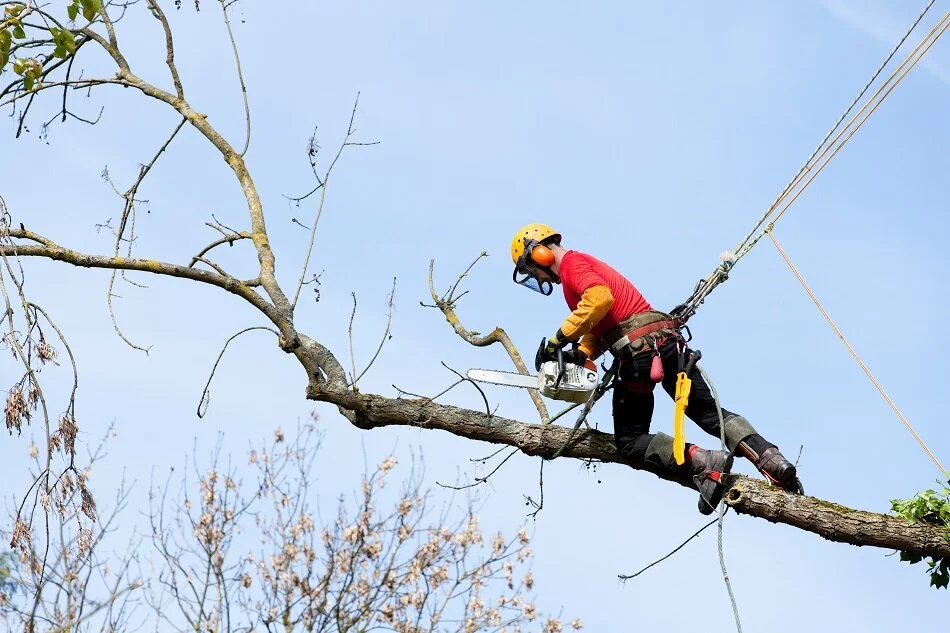
Trees require regular maintenance to ensure their health and safety. Dead or diseased trees must be cut down in order to prevent injuries to people or damage to nearby structures. Maintaining trees through trimming is a dangerous task, even for experienced professionals. Unfortunately, accidents do occur. The three most common types of serious accidents experienced by tree trimmers are falls, electrocution, and being struck by falling objects.
Falls
Falls are a common accident for tree trimmers. They can occur by slipping off of a ladder, falling from a roof, or falling out of a tree. The typical fall victim is unsecured or not properly secured. Using proper personal protective equipment is essential in preventing falls.
Electrocution
The risk of electrocution is very high when working around power lines. Some trees are planted near overhead power lines and there is a risk of electrocution to anyone trimming branches. The worker may accidentally touch the wires, or a falling branch could knock down the wires resulting in a tree trimmer touching the lines. The most common type of victim violates minimum approach distances and makes contact with the power lines through a conductive tool/object such as pruning shears. Training employees on minimum approach distances and proper trimming techniques when working around power lines can help prevent electrocution.
Falling Objects
According to the Centers for Disease Control, being struck by a falling object is the most reported tree trimming accident. A falling object is typically an entire tree or its branches/limbs, but it could also be loose equipment like a chain saw. Most victims are struck by a tree or tree limb after it falls in an unexpected direction; however, careless accidents do occur in specified drop zones. Communication between employees in the tree and on the ground is imperative to ensure the safety of all.
Tree trimming professionals face dangerous hazards on a daily basis and it is extremely important to take precautionary safety measures to make sure that they are doing everything they can to reduce risk. Safety training materials for tree trimmers are available through the Risk Management Center.
For information about Rancho Mesa's TreeOne™ program, contact Rory Anderson at (619) 937-0164.
Managing the Inherent Risks of Personal Vehicle Use Within Your Company
Author, Daniel Frazee, Executive Vice President, Rancho Mesa Insurance Services, Inc.
While costs associated with auto liability continue rising across the country, there are risks within existing fleet safety programs that often get overlooked. If your business allows employees to use personal vehicles to conduct business even just occasionally, you could be exposing your firm to considerably more risk.
Author, Daniel Frazee, Executive Vice President, Rancho Mesa Insurance Services, Inc.

While costs associated with auto liability continue rising across the country, there are risks within existing fleet safety programs that often get overlooked. If your business allows employees to use personal vehicles to conduct business, even just occasionally, you could be exposing your firm to considerably more risk. You can ignore this potential gap in coverage or closely examine the exposure while simultaneously developing a risk mitigation plan.
Review and Examine Liability Coverage
Before developing any guidelines, we encourage clients to identify those drivers that are using personal vehicles. Again, the pool here should include regular and non-regular drivers who are using personal vehicles. Once that list is finalized, request current declaration pages and/or certificates of insurance showing coverage periods and limits. As you examine this information, ensure that coverage is in force and pay close attention to the limits as many state minimum coverage requirements will be much lower than typical commercial auto policy limits (Example: $10,000 to $15,000 for bodily injury). Working to develop company standard minimum limits for personal use of vehicles is something you can establish with and through recommendations from your broker partner and carrier.
Hiring with Auto Exposure in Mind
Just as many managers do when hiring employees who will drive company vehicles, consider requiring the same guidelines for potential new hires who may use their own vehicles. These guidelines may include a current Motor Vehicle Report (MVR) which allows you to review accidents and track behavior. You may also enroll drivers in the Employer Pull Notice (EPN) Program which notifies businesses when employees have any type of driving activity in or out of the workplace. Lastly, be prepared with documented steps to take when your drivers exhibit unsafe driving behavior. This can include additional training, a suspension, or even termination depending on the frequency.
Written Expectations and Usage Guidelines for Drivers
Vehicle use agreements have become commonly used documents for employers. Depending on the layout, usage guidelines can help establish clear expectations and encourage real buy-in from the employee. As a reference point, Rancho Mesa offers an example of a usage guideline form available within the Risk Management Center.
Creating and Maintaining a Culture of Safety
Evaluating your respective safety programs is a process that takes time. Many employers are unfamiliar where to even start and perhaps which areas of their operation pose the greatest risk to their business’ financial health. With auto liability, in general, the potential for direct loss can impact balance sheets of all sizes. Part of our role as commercial insurance brokers is tying in years of experience seeing these gaps within programs, like personal vehicle use. We recommend first how to mitigate them and then tailor an insurance program that further reduces or eliminates the exposure. The points listed above represent only the start to your process in revamping your Fleet Safety Program. Call or email Rancho Mesa Insurance for a complete “all lines” safety review and coverage audit. Your company’s financial future could depend on it.
Have You Brushed Up on Your ABC’s?
Author, Emily Marasso, Media Communications Assistant, Rancho Mesa Insurance Services, Inc.
California Assembly Bill 5 (AB 5), better known as the “Gig Worker’s Bill” became law on January 1st 2020 and is designed to reclassify many independent contractors as employees for purposes of wages and benefits. What does this bill mean and how does it affect you?
Author, Emily Marasso, Media Communications Assistant, Rancho Mesa Insurance Services, Inc.

California Assembly Bill 5 (AB 5), better known as the “Gig Worker’s Bill” became law on January 1, 2020 and is designed to reclassify many independent contractors as employees for purposes of wages and benefits. What does this bill mean and how does it affect you??
Previously, employers used the “Borello test” to identify someone as either an independent contractor or employee. In most cases, AB 5 changes the standards to the new “ABC test,” which makes it much more challenging for a person to be classified as an independent contractor. Both the Borello test and the new ABC test assume that the worker is an employee and the employer must prove that the worker is actually an independent contractor.
According to the new law, “a person providing labor or services for remuneration shall be considered an employee rather than an independent contractor unless the hiring entity demonstrates that all of the following conditions are satisfied:
(A) The person is free from the control and direction of the hiring entity in connection with the performance of the work, both under the contract for the performance of the work and in fact.
(B) The person performs work that is outside the usual course of the hiring entity’s business.
(C) The person is customarily engaged in an independently established trade, occupation, or business of the same nature as that involved in the work performed.”
If you have hired an independent contractor who does not pass the ABC test, they likely will now be classified as an employee with minimum wage, unemployment insurance, sick leave, and income tax and social security withholdings. Independent contractors are not entitled to these benefits.
Doctors, lawyers, hair stylists, and insurance agents are just some of the more common independent contractor jobs that are not affected by AB 5. At this time, independent contractors such as architects and engineers are exempt from the ABC Test, but truck owner-operators, surveyors, and geologists are not exempt. In January 2022, contractors will not be able to hire owner-operators truck drivers. They will have to work with a company that has drivers who are employees.
AB 5 is intended to reduce the misclassification of workers and bring equality to the workplace. Although the bill has good intentions, it could negatively affect the way many companies operate. The ABC test has strict guidelines to be considered an independent contractor. With the reins tightening, it will be difficult for companies to enlist independent contractors to supplement their workforce when needed. Employers will be forced to hire actual employees or hold off on hiring employees all together.
For specific questions about AB 5 and how it will affect your business, contact our HR Experts via the RM365 HRAdvantage™ portal.
Skilled Labor Shortages Prompt Subcontractors to Provide Performance Guaranty
Author, Andy Roberts, Account Executive, Surety Division, Rancho Mesa Insurance Services, Inc.
The construction industry is currently booming. According to a survey conducted by the AGC of America, and a recent article written by Rancho Mesa’s Kevin Howard, the industry shows no signs of slowing down, as 80% of contractors predict growth in 2020. While that’s great news for the industry, we are starting to see some trends that can cause some issues for contractors.
Author, Andy Roberts, Account Executive, Surety Division, Rancho Mesa Insurance Services, Inc.

The construction industry is currently booming. According to a survey conducted by the AGC of America, and a recent article written by Rancho Mesa’s Kevin Howard, the industry shows no signs of slowing down, as 80% of contractors predict growth in 2020. While that’s great news for the industry, we are starting to see some trends that can cause some issues for contractors.
With an abundance of work, contractors are finding it more difficult to find the skilled labors required to complete a project on schedule. This is causing more and more general contractors, who historically didn’t require their subcontractors to provide a bond, to now require their subcontractors to bond back to them on contracts over a certain amount.
Bonding back is when a general contractor requires a subcontractor to obtain a performance and payment bond, even though the general contractor is already carrying a bond for the entire project. The bonds from the subcontractor operate in the same way as the bonds that the general contractor provided to the project owner, but now the general contractor has a performance guaranty from the subcontractor. This gives the general contractor an avenue to pursue recourse, should the subcontractor default or fail to perform up to the standards required by the contract, which is something that can happen if the subcontractor is having issues finding enough skilled labor.
Furthermore, this can present a problem for subcontractors who aren’t accustomed to bonding. They would need to get a bonding program put into place in order to work with a general contractor that they may have a long relationship with, who they previously never required a bond back. This makes it very important for subcontractors to have the discussion with the general contractor about potential bond requirements. An upfront conversation with the general contractor can help you avoid getting into a situation where you win a bid, but don’t have the ability to meet the bond requirement.
Fortunately, for contractors that are new to bonds or maybe don’t bond frequently, there are a variety of programs that the different sureties offer, whether it be credit-based, or a more traditional program. We can help navigate those programs and find the solution that works best for their company’s bonding needs.
If you have additional questions or would like to explore all the different options that each surety offers, please contact Andy Roberts at (619) 937-0166.
OSHA Penalties Increase in 2020
Author, Lauren Stumpf, Media Communications Coordinator, Rancho Mesa Insurance Services, Inc.
On January 15, 2020 the Federal Register published the Federal Civil Penalties Inflation Adjustment Act Annual Adjustments for 2020. This final rule increases civil penalties the Department of Labor assesses including those issued by the Occupational Safety and Health Administration (OSHA) based on workplace inspections and potential violations of safety and health standards. The rule is effective January 15, 2020. Beginning January 16, 2020 OSHA civil penalties will increase.
Author, Lauren Stumpf, Media Communications Coordinator, Rancho Mesa Insurance Services, Inc.

On January 15, 2020 the Federal Register published the Federal Civil Penalties Inflation Adjustment Act Annual Adjustments for 2020. This final rule increases civil penalties the Department of Labor assesses including those issued by the Occupational Safety and Health Administration (OSHA) based on workplace inspections and potential violations of safety and health standards. The rule is effective January 15, 2020. Beginning January 16, 2020 OSHA civil penalties will increase.
The new 2020 maximum OSHA penalties are as follows:
Serious violation: $13,494 (increased from $13,260)
Other-than-Serious violation: $13,494 (increased from $13,260)
Repeat violation: $134,937 (increased from $132,589)
Willful violation: $134,937 (increased from $132,589)
Each failure to correct the violation: $13,494 (increased from $13,260)
Each posting requirement violation: $13,494 (increased from $13,260)
For more information about the OSHA Penalties, visit https://www.osha.gov/penalties.
Cal/OSHA Updates: AB 1804 Changes How Injuries and Illnesses Are Reported
Author, Emily Marasso, Media Communications Assistant, Rancho Mesa Insurance Services, Inc.
As of January 1, 2020, California Assembly Bill 1804 (AB 1804) changed how an employer reports a serious employee injury or illness to Cal/OSHA. The bill removes the option to submit the report via email and replaces it with an “online mechanism,” according to Labor Code section 6409.1 (b). Reports may continue to be made via phone.
Author, Emily Marasso, Media Communications Assistant, Rancho Mesa Insurance Services, Inc.

As of January 1, 2020, California Assembly Bill 1804 (AB 1804) changed how an employer reports a serious employee injury or illness to Cal/OSHA. The bill removes the option to submit the report via email and replaces it with an “online mechanism,” according to Labor Code section 6409.1 (b). Reports may continue to be made via phone.
Until Cal/OSHA implements an online mechanism for collecting serious injury and illness reports like Fed/OSHA, emailed reports will be accepted. However, reports submitted by phone are always recommended over an emailed report. Reports submitted via phone or an online mechanism allows Cal/OSHA to ensure vital information is collected that is necessary to evaluate the seriousness of the injury or illness.
Cal/OSHA has not provided an estimated implementation date for the online report submission option.
As a reminder, California employers are required to report serious injury or illness of employees immediately. Serious injuries or illnesses must be reported as soon as practically possible. Deaths must be reported within 8 hours. All other injuries or illnesses must be reported once the employer learns of or should have known of the serious injury or illness.
Work Comp Unit Stat: The Meeting That Saves You Money
Author, Drew Garcia, Vice President, Landscape Group, Rancho Mesa Insurance Services, Inc.
California business owners are aware that their experience modifier (XMOD) is published annually, roughly three to four months before the expiration of their current workers compensation policy term. However, more often than not, companies are missing an incredible opportunity to make an impact on the calculation of their XMOD by strategically evaluating their work comp claims prior to the most critical month in the XMOD calendar known as Unit Stat.
Author, Drew Garcia, Vice President, Landscape Group, Rancho Mesa Insurance Services, Inc.

California business owners are aware that their experience modifier (XMOD) is published annually, roughly three to four months before the expiration of their current workers compensation policy term. However, more often than not, companies are missing an incredible opportunity to make an impact on the calculation of their XMOD by strategically evaluating their work comp claims prior to the most critical month in the XMOD calendar known as Unit Stat.
The Workers’ Compensation Insurance Rating Bureau (WCIRB) defines the process of receiving loss and payroll information by classification as the Unit Statistical Report. The information is reported to the WCIRB by insurance carriers at specific intervals based on your company’s policy effective date. The information is valued for the first time 18 months after the inception of your policy and every 12 months thereafter.
A policy that incepts in January 2020 will be valued for the first time in July of 2021 (18 month mark). This information will remain in your XMOD calculation for the valuations at 30 months and 42 months.
Once this information has been received by the WCIRB, from the respective carriers, it cannot be altered or changed until the following year’s unit stat. Thus, you may have a positive outcome on an existing open claim (reserve reduction or closure) but not see the benefit until the following year. Revisions to the XMOD once published are limited to a few circumstances; more information about revisions can be found here.
The loss information, sent to the WCIRB from the insurance carriers, will be evaluated at the paid (closed claim) or reserved (open claim) amounts. Typically, a claim that has been open for longer than 18 months signifies severity, litigation, lost time, permanent disability, or a combination of the group. For this reason it is absolutely critical that as a part of your risk management process you execute a
pre-unit stat meeting.
When should I schedule my Unit Stat meeting?
What should I do at this meeting?
Who needs to be involved?
How will this meeting save me money?
As a client of Rancho Mesa, we build this meeting into your annual service plan and take care of engaging the parties who need to be involved for the betterment of your XMOD.
Ready to learn more about Unit Stat? Join us for a complimentary 25-minute webinar where we will discuss the process in greater detail and take time for Q&A.
Still not sure if further learning is necessary, ask yourself these questions:
Have you ever been surprised by your XMOD being higher than you would have thought?
Have you ever had an XMOD above 1.00?
Has your XMOD ever caused your premium to increase?
The webinar can be viewed on-demand by clicking the link below.
It’s OSHA 300A Time
Author, Emily Marasso, Media Communications Assistant, Rancho Mesa Insurance Services, Inc.
The holidays have come and gone and here we are at the end of another great year. Year-end means calendar updates, process changes and document reviews, as well as time to prepare for filing your OSHA 300A form.
Author, Emily Marasso, Media Communications Assistant, Rancho Mesa Insurance Services, Inc.
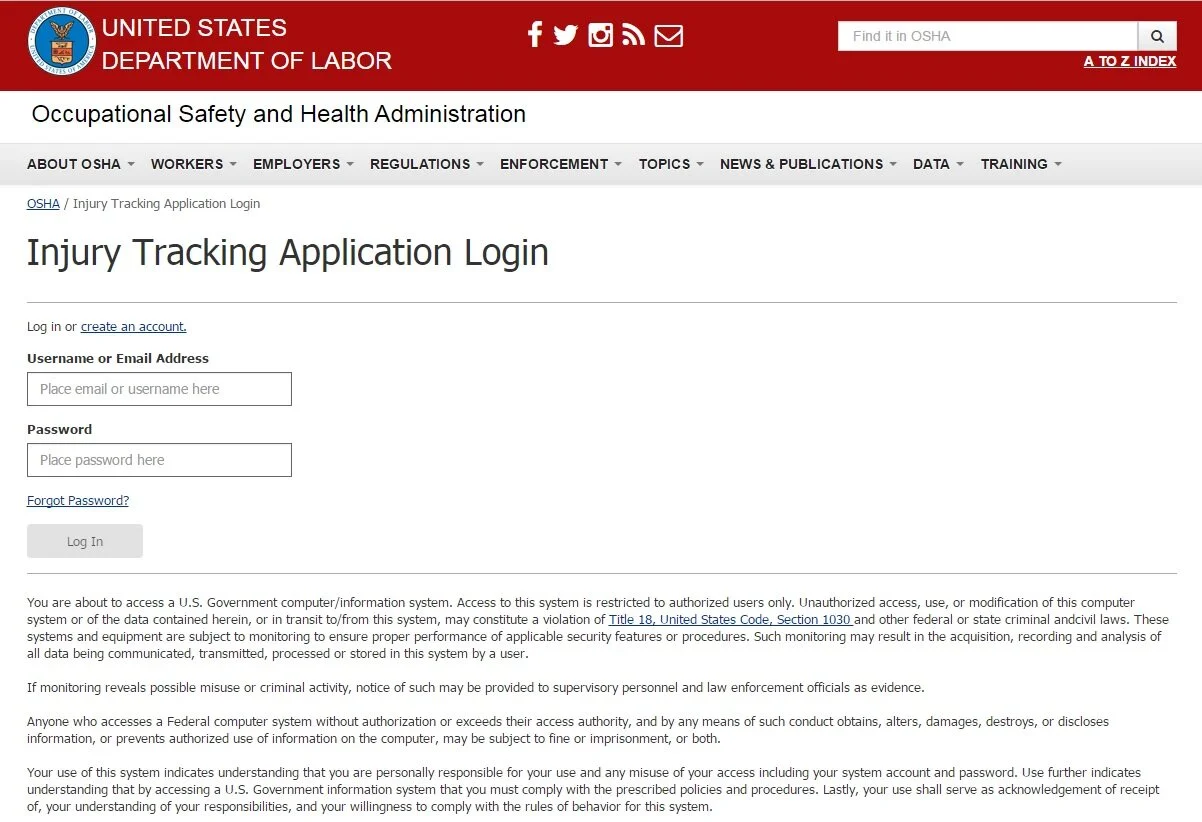
The holidays have come and gone and here we are at the end of another great year. Year-end means calendar updates, process changes and document reviews, as well as time to prepare for filing your OSHA 300A form.
The OSHA 300A form is a summary of injuries and illnesses which occurred on the job during the calendar year. The form must be filed electronically on the Injury Track Application (ITA) starting January 2, 2020. Deadline for 2019 data submissions is March 2, 2020. It must be displayed from February 1, 2020 to April 30, 2020.
Don’t forget, if you are a Rancho Mesa client and utilize the Risk Management Center Incident Track feature, you have access to generate the Cal/OSHA 300A form and export it to a CSV file. From there you can upload it to the OSHA website.
Rancho Mesa has put together a 5-minute tutorial video on how to generate the electronic 300A form data file from the Risk Management Center, that can be uploaded to the Injury Tracking Application website for reporting the data.
For questions about how to track the injury and illness data in the Risk Management Center, contact Alyssa Burley at (619) 438-6869.
Generating Your Employee Handbook Is Easier Than Keeping a New Years Resolution
Author, Casey Craig, Account Executive, Rancho Mesa Insurance Services, Inc.
When business owners are asked if their employee handbooks are up to date, they typically shrug and say “It’s something we have been meaning to tackle.” It is hard to blame them when it often feels as though a newly revised employee handbook quickly requires an update due to changes in employment laws! There is a significant need for an easy to use option where employers can have an up to date handbook throughout the year and, have it generated at no cost. Rancho Mesa provides that solution.
Author, Casey Craig, Account Executive, Rancho Mesa Insurance Services, Inc.
When business owners are asked if their employee handbooks are up to date, they typically shrug and say “It’s something we have been meaning to tackle.” It is hard to blame them when it often feels as though a newly revised employee handbook quickly requires an update due to changes in employment laws! There is a significant need for an easy to use option where employers can have an up to date handbook throughout the year and, have it generated at no cost. Rancho Mesa provides that solution.
As the California workplace climate changes, it is imperative that business owners have solutions before problems arise. Employee lawsuits against their employers are on the rise and Rancho Mesa clients must be prepared for the possible, if not inevitable. While updating an employee handbook can be one of the easiest obligations to neglect, skipping this task can have serious repercussions.
When laws and protocols change over time, it can be difficult making sure your employee handbook is up to date. Make sure it clearly communicates:
What is expected of your employees.
What are your company policies.
What rules are in place.
At Rancho Mesa, we have taken the time to understand our clients’ needs and if there is a solution available, we try to accommodate. We provide a free option for our clients, to help them compose a compliant handbook that is:
State and federal compliant.
Handbook is fully customizable with optional policy update alerts. If a law were to change right after completing your handbook, you would receive an email with the change and have the option to add it to your handbook.
Live HR support to assist with company specific question.
Please reach out to Alyssa Burley at aburley@ranchomesa.com with any questions you may have about the employee handbook builder option through the RM365 HRAdvantage™ portal. If you have any questions pertaining to your insurance needs, please call (619) 934-0164.
The Flu Isn’t the Only Bug You Need to Worry About
Author, Sam Clayton, Vice President, Construction Group, Rancho Mesa Insurance Services, Inc.
When we hear of a data breach, we typically think of large corporations or more recently municipalities that collect customers’ personal identification information or are using technology to manage physical locations (i.e. buildings), transit systems, and people. However, just about any large, medium or small organization that uses technology to operate their business faces a cyber-exposure.
Author, Sam Clayton, Vice President, Construction Group, Rancho Mesa Insurance Services, Inc.

Target, Capital One, and Equifax are all Fortune 500 Companies and household names we recognize. All have experienced a cyber liability breach in the last decade. When we hear of a data breach, we typically think of large corporations or more recently municipalities that collect customers’ personal identification information or are using technology to manage physical locations (i.e. buildings), transit systems, and people. However, just about any large, medium or small organization that uses technology to operate their business faces a cyber-exposure. And, as technology becomes more complex and sophisticated, so do the threats we face, which is why every business and organization needs to be prepared with both cyber liability insurance and an effective cyber security plan to manage and mitigate cyber risk. Below are two different cyber threats your company faces on a daily basis.
Ransomware is a type of malware that prevents users from accessing their system or personal files and demands a ransom payment, typically in the form of Bitcoin, in order to unlock and regain access to your data.
Social Engineering is the fraudulent attempt to obtain sensitive information such as usernames, passwords and credit card details by disguising oneself as a trustworthy entity via e-mail. This is typically accomplished by directing users to enter personal information at a fake website which matches the look and feel of the legitimate website.
A Cyber Liability Policy can help protect against data breaches and other evolving cyber exposures that are not covered by a standard property and general liability policy. These policies can respond in multiple ways such as credit card data remediation and notifications expense, network and information security liability, regulatory defense expense, crisis management expenses and computer program and electronic data restoration expenses.
In addition to the coverages above, many cyber insurers offer policyholders pre-breach services, employee training and IT forensics specialists. Some also provide data breach “coaches” who specialize in the unique legal and regulatory issues surrounding breaches, and will assist businesses with navigating the response process and ensure compliance with state and federal privacy laws.
Please contact Rancho Mesa to learn more about implementing a strong Cyber Prevention Plan.
New Law Changes Which Injuries Must Be Reported
Author, Daniel Frazee, Executive Vice President, Rancho Mesa Insurance Services, Inc.
A new California law, Assembly Bill 1805 (AB 1805), changes when employers are required to report serious workplace injuries to the California Division of Occupational Safety and Health (Cal/OSHA). The law now broadens the scope of what will be classified as a serious illness, injury or exposure. Many believe this change will increase the number of workplace accidents that will have to be reported in 2020.
Author, Daniel Frazee, Executive Vice President, Rancho Mesa Insurance Services, Inc.

A new California law, Assembly Bill 1805 (AB 1805), changes when employers are required to report serious workplace injuries to the California Division of Occupational Safety and Health (Cal/OSHA). The law now broadens the scope of what will be classified as a serious illness, injury or exposure. Many believe this change will increase the number of workplace accidents that will have to be reported in 2020.
The definition of “serious injury or illness” has, for many years, been defined as an injury or illness that requires inpatient hospitalization for more than 24 hours of treatment, or if any employee suffers a “loss of member” or serious disfigurement. The definition has excluded hospitalizations for medical observation. Regulations also excluded from reporting requirements any serious injury caused by a criminal assault and battery or a vehicle accident on a public road or highway.
AB 1805 aligns California’s rules more closely with Federal OSHA regulations for reporting. More specifically:
Rules
The following will need to be reported to Cal/OSHA:
Any inpatient hospitalization (even less than 24 hours),
An inpatient hospitalization is required for something “other than medical observation or diagnostic testing,”
Employers must report any “amputation” (even if the tip of a finger is cut off) to Cal/OSHA. This replaces the terminology “loss of member;”
The loss of an eye,
Serious injuries or deaths caused by a criminal assault and battery,
The exclusion for injuries from auto accidents on a public street or highway remains in effect. However, accidents that occur in a construction zone must now be reported.
Compliance (related directly to serious injuries and illnesses or fatalities)
In order to say in compliance:
The report must be made within 8 hours of the employer knowing, or with “diligent inquiry” should have known, about the serious injury/illness.
The report must be made by PHONE to the nearest Cal/OSHA district office.
For more details on how these changes may impact your company’s IIPP, please contact me at (619) 937-0172.
Autonomous Mowing – Are you Covered?
Author, Drew Garcia, Vice President, Landscape Group, Rancho Mesa Insurance Services, Inc.
Autonomous mowing is becoming more common in commercial and residential landscape management. As the market begins to adapt and utilize this technology it creates a very unfamiliar and unique exposure for you and your General Liability carrier.
Author, Drew Garcia, Vice President, Landscape Group, Rancho Mesa Insurance Services, Inc.

Autonomous lawn mowing is becoming more common in commercial and residential landscape management. As the market begins to adapt and utilize this technology it creates a very unfamiliar and unique exposure for you and your general liability carrier.
Commercial General Liability Policies should be written specific to your type of operations, including the coverages needed to protect your landscape company in the event of claim. The insurance marketplace has a general understanding of the common exposures that face a landscape contractor; from installation, to maintenance, and chemical application. Policies are written on the basis of annual sales or field payroll. When automated mowing is offered as a service from the contractor, the insurer would need to charge a premium to pick up the exposure. If the policy is written on a payroll basis then a direct premium will not be charged for the automated mowing operations, as there is no payroll associated with the mowers performance. The policy could also be written on a sales basis with clarification of estimated sales between autonomous mowing vs. the remainder of your operations to the insurance underwriter, so the appropriate rate can be charged. In either case, it is very important that the underwriting carrier has a clear understanding of your operations in order to determine the final pricing.
Whenever you have a change in your operations, such as the use of autonomous mowing, it is critical that you notify your insurer so they can properly assess the exposure and acknowledge that coverage would extend in the event of a claim.
Here are a few questions we use to help negotiate with the insurance marketplace when autonomous mowing is a part of the operations:
How quickly will the blades disengage if the unit was picked up while moving?
If the mower was to bump into someone/something will it divert the other way?
What is the set back of the blades from the perimeter of the mower?
How does it maintain its boundaries?
Will it be left on site?
What time of day will it run?
How is it powered?
Who has control of the mower while it is on?
How can the mower be turned off?
Do not let the carrier find out about your autonomous mowing operations at audit, or worse at the time of a claim.
Finally, consider coverage for the machine itself if it were to be stolen, damaged, or totaled. Adding the mower to your Commercial Inland Marine policy will provide coverage for the equipment. The valuation of this coverage would be detailed in the policy. Be sure to communicate where the mowers will be stored while not in use and the security functions installed on the device to protect against theft.
For more information or questions you might have about this topic or landscape insurance in general please contact the Drew Garcia at (619) 937-0200.
Ensure You’re Not Under Covered and Overpaying for Auto Insurance
Author, Casey Craig, Account Executive, Rancho Mesa Insurance Services, Inc.
Auto insurance prices are continuously rising. What is the reason for this and what can be done to cut back on the cost? There are many factors that lead to the carriers needing to increase their rates. We are going to discuss exactly what some of the reasons for the increases are; and more importantly, what business owners can do to offset price increase as much as possible while receiving adequate coverage.
Author, Casey Craig, Account Executive, Rancho Mesa Insurance Services, Inc.

Auto insurance prices are continuously rising. What is the reason for this and what can be done to cut back on the cost? There are many factors that lead to the carriers needing to increase their rates. We are going to discuss exactly what some of the reasons for the increases are; and more importantly, what business owners can do to offset price increase as much as possible while receiving adequate coverage.
Distracted drivers are causing more claims every year. Repairing a vehicle has become more costly as newer models have technology features such as sensors and back-up cameras. People using their cell phones while driving can cause them to have a diminished reaction time, which is leading to more severe high impact accidents. This is pushing medical costs up at a rapid rate, leading to an increase of claims dollars. Implementing a “No Phones While in a Vehicle” policy could reduce claims drastically and keep your employees safe.
There are many ways that carriers can get out of covering a loss, and employees driving their vehicles to and from job sites can really come back to haunt you if they do not have adequate coverage limits. Make sure that you have Hired and Non-Owned Coverage! Hired and Non-Owned is the coverage needed for the carrier to cover losses on vehicles that are not on the company’s policy, such as rented or employee owned vehicles. Employers need to make sure that employees have adequate personal auto insurance limits. The California minimum coverage limits of $15,000/$30,000/$5,000 can get exhausted very quickly in a serious accident, and lawyers are getting very good at finding grey areas to drag the employer in. You should consider reimbursing your employees to offset the increase in premium for them. Some carriers will apply subjective credits to your company auto premium if they know your employees need to have higher limits to drive for you.
One of the biggest gaps that brokers see when they audit policies for prospects is they are using the wrong symbols, thinking they are covered for a claim, and end up not having correct coverage. Most reputable carriers will offer Symbol 1 for your liability insurance and it is imperative that you use Symbol 1 vs. Symbol 7. Symbol 7 only covers vehicles described in the declaration and leaves limited coverage for vehicles acquired after your policy begins.
Rancho Mesa Insurance Services is a National Best Practices Agency 13 years in a row. We strive to make sure that our clients are without gaps in their coverage. Call (619) 934-0164 to ask about Rancho Mesa’s proprietary programs that help maintain clients’ safety and get them the lowest premiums possible. Register here for the free Fleet Safety webinar to learn how to increase vehicle safety, control vehicle accidents, safeguard long-term profitability, and ensure that your fleet safety & accident prevention programs are up-to-date.
California Wildfires Distress Insurance Market
Author, Chase Hixson, Account Executive, Human Services Group, Rancho Mesa Insurance Services, Inc.
2018 saw the most destructive wildfire season ever recorded in California. Over 1.8 million acres were burned; 22,751 buildings were destroyed and over 100 lives perished. As a result, insurance claims have exceeded $12 billion and are expected to rise.

2018 saw the most destructive wildfire season ever recorded in California. Over 1.8 million acres were burned; 22,751 buildings were destroyed and over 100 lives perished. As a result, insurance claims have exceeded $12 billion and are expected to rise.
Many in the industry expect we are on the verge of a crisis and from what I’ve seen so far, I’d have to agree. The marketplace is in frenzy as carriers aren’t sure what their overall financial hit will be. Furthermore, catastrophic losses like this affect the reinsurance marketplace, which causes pressure downstream to insurers.
Below is a look at what we are seeing in the marketplace.
Non-Renewals
Most carriers are non-renewing their entire books of business who are at risk of wildfires. Even if the client has been with the carrier many years with no losses, they are simply non-renewing properties on accounts in certain areas prone to wildfire. This is essentially leaving the marketplace with very few players.
Significant Premium Increases
Those carriers still willing to write property accounts are hiking up premiums significantly. We’ve heard of increases 5-10 times the previous year’s premiums. We recently spoke to an insured in the Riverside area whose insurance premium went from $85,000 to $500,000 a year.
Increased Deductibles for Wildfires
On top of the significant premium increases, most carriers are offering increased deductibles for wildfires. It’s not uncommon to now see $150,000, $250,000 and $500,000 deductibles depending on the value of the building(s).
What Can Business Owners Do?
Business owners need to act early and quickly. Speak with a broker to plan ahead because it looks like there will be a significant financial burden and risk (per increased deductible) moving forward. The marketplace is inundated with excessive submissions, so the need to submit as early as possible is imperative. There are alternative insurance programs that can act as a temporary solution while helping alleviate cost burdens. Some declinations can be avoided by proper abatement of brush and trees or installation of fire suppression systems. Regardless of when the insurance policy renews, I suggest getting started on this as soon as possible. The marketplace could take several years to stabilize.
For help understanding how wildfires can affect your organization’s insurance premium, contact Rancho Mesa Insurance Services at (619) 937-0164.
Senate Bill 778 Extends Employee Anti-Harassment Training Deadline
Author, Alyssa Burley, Media Communications and Client Services Manager, Rancho Mesa Insurance Services, Inc.
Newly passed Senate Bill 778 (SB 778) extends the deadline set in Senate Bill 1343 for California’s mandatory Anti-Harassment Training from January 1, 2020 to January 1, 2021. The bill also addresses concerns about supervisory employees and clarifies when temporary workers must be trained. California Governor Newsom signed the bill into law on August 30, 2019, which included an urgency clause that allows the bill to go into effect immediately.
Author, Alyssa Burley, Media Communications and Client Services Manager, Rancho Mesa Insurance Services, Inc.
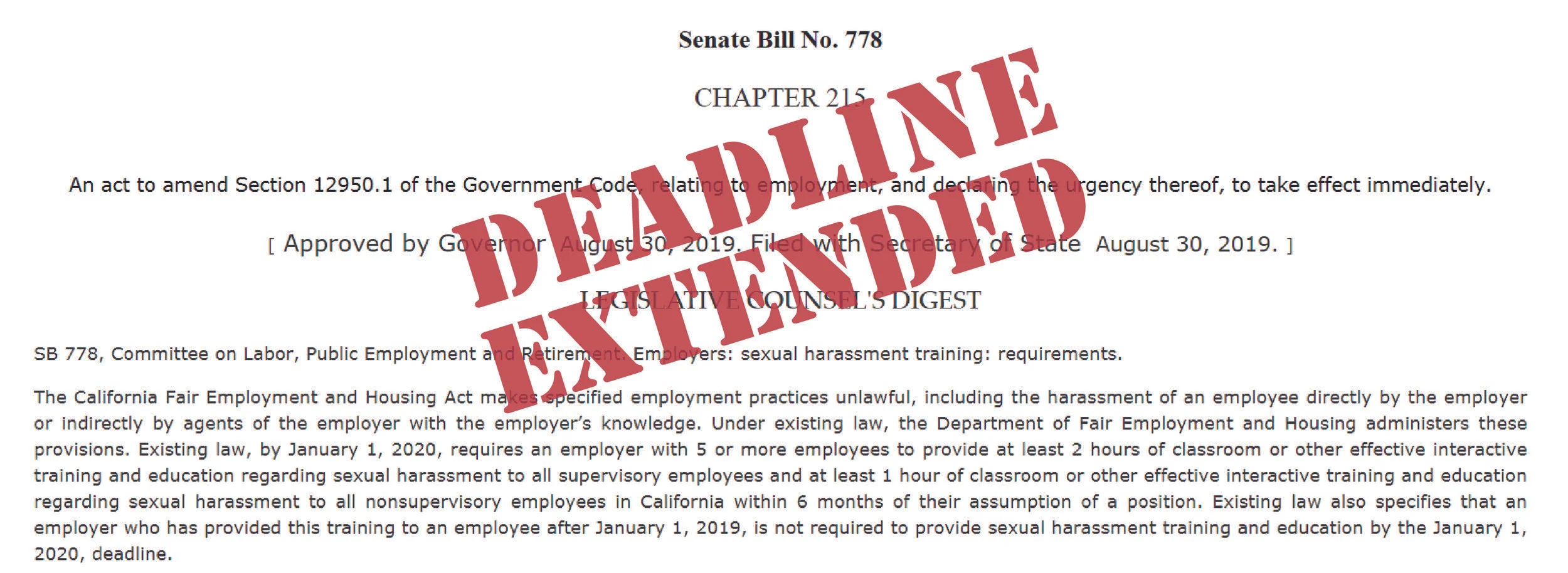
Newly passed Senate Bill 778 (SB 778) extends the deadline set in Senate Bill 1343 for California’s mandatory Anti-Harassment Training from January 1, 2020 to January 1, 2021. The bill also addresses concerns about supervisory employees and clarifies when temporary workers must be trained. California Governor Newsom signed the bill into law on August 30, 2019, which included an urgency clause that allows the bill to go into effect immediately.
What SB 778 Means to CA Employers
The changes made by SB 778 not only extends the deadline for non-supervisory employee Anti-Harassment training, but also allows supervisory employees to stay on their existing two-year training schedule. For example, if a supervisory employee completed Anti-Harassment training in 2018, their next training, with the SB 1343 compliant content, will be due in 2020 - two years from their last training date, which is before the new deadline. Likewise, if a supervisory employee was trained in 2019, their next training due date will be in 2021.
Non-supervisory employees will need to complete their initial 1-hour Anti-Harassment training by January 1, 2021. For those who have already taken the training in 2019, we recommend they maintain their two-year schedule, and complete the training again in 2021.
Both supervisory and non-supervisory employees must be trained within six months of hire. However, temporary or seasonal workers who are hired for less than six months must be trained within 30 days of hire.
For questions about this training requirement or to learn how to enroll your supervisors and employees, register for the “How to Enroll Supervisors and Employees in the Online Anti-Harassment Training” webinar or contact Rancho Mesa’s Client Services Department at (619) 438-6869.
3 Benefits to Working with an Insurance Specialist vs. Generalist
Author, Jeremy Hoolihan, Account Executive, Rancho Mesa Insurance Services, Inc.
Most insurance agencies welcome any and all types of businesses, paying little attention to the type of business the prospect is running. These accommodating professionals will commit to quote virtually any person or business looking for insurance coverage. With this type of approach, inevitably the buyer will be working with a jack of all trades, but a master of none.
Author, Jeremy Hoolihan, Account Executive, Rancho Mesa Insurance Services, Inc.

Most insurance agencies welcome any and all types of businesses, paying little attention to the type of business the prospect is running. These accommodating professionals will commit to quote virtually any person or business looking for insurance coverage. With this type of approach, inevitably the buyer will be working with a jack of all trades, but a master of none. Working at Rancho Mesa Insurance for nearly 16 years, I’ve learned the importance of focusing on a niche or vertical market, rather than attempting to write insurance for anything with a pulse. The two vertical markets I focus on are the janitorial and construction industries. Below are three reasons why I believe a business owner should consider working with a specialist rather than a generalist.
Avoid Gaps in Coverage:
Having a trusted advisor that is a specialist in your industry can truly minimize potential gaps in coverage that otherwise might get overlooked by someone dabbling in your industry. Some examples include:
Allowing an exclusion of coverage to a policy where the insured has exposure: Unfortunately I see this all too often when I audit a prospects policy. I once reviewed a residential general contractor’s (GC) insurance policy and found a subsidence exclusion. This posed a serious concern because the GC builds foundations. If they were ever served with a claim relating to a foundation sinking or failing, there would likely be no coverage. I’ve also seen residential GC’s who build new homes with a residential exclusion. It’s these types of errors that can put a business in tremendous jeopardy.
Missing key coverage’s to plug gaps in coverage: Most contractors are required to carry workers’ compensation and general liability insurances. However there are many exposures that a contractor has in their operations that would be excluded without additional coverage’s in place. One example is pollution liability. If a plumber installs a faucet that leaks over time, undetected, and causes mold or fungus to develop, you will likely run into a pollution liability claim for bodily injury and/or property damage. Most general liability policies have a pollution exclusion. Without the knowledge of placing a separate pollution liability policy in place, the plumbing contractor would be faced with a gap in coverage.
Knowledge of Specialty Coverage’s and Markets:
Brokers who understand the operations and challenges faced by a particular vertical market have an opportunity to position themselves as risk management and coverage expert in that field. Specialization can also lead to specialty markets seeking brokers out to work with. Specialty markets seek brokers with expertise in their specific niche because they know the marketplace, and proper coverages can provide a steady flow of business. These relationships often lead to a much more comprehensive policy at an aggressive price. In addition, these programs include coverages that you would normally purchase individually that come standard to the program.
In the janitorial industry, one example is 3rd party crime coverage. Many of your standard market package policies will include 1st party crime coverage for employee theft. While this coverage is very important against an employee stealing from an employer, it does not cover theft of a client’s property from an employee. In order to cover this exposure, a policy needs to have 3rd party crime coverage.
Industry Specific Resources:
Partnering with a broker and agency, like Rancho Mesa Insurance, will also provide industry specific resources that generalist agencies will not. Below are a few examples of what you should expect when working with a specialist like Rancho Mesa.
Industry Specific Workshops – such as OSHA 10 Certification, Mobility & Stretch, Heat Illness Prevention, Fleet Safety, Fighting Fraud in CA Workers’ Compensation, etc.
Industry Specific Training Materials – extensive training library of over 3,000 titles in both online and in-person formats, available in English and Spanish
A dedicated Workers’ Compensation Claims Advocate to aggressively work on a client’s existing claims.
HR Benefits – rely on a team of HR experts who can quickly answer complex human resource and compliance questions over the phone or via email.
Comprehensive Living Employee Handbook – create and maintain your customizable employee handbook plus receive suggested updates when laws change.
Client Services Advocacy – In house dedicated client services coordinator to assist with implementation of risk management services.
Rancho Mesa Insurance is dedicated to becoming a trusted advisor to their clients by providing a 365 day approach to Risk Management. Our laser focus on specific industries has allowed us to build comprehensive programs that our clients are able to benefit from. If anything in this article resonates with you, please feel free to reach out to Rancho Mesa Insurance at (619) 937-0164.