

Industry News

Six Reasons a Company’s Experience Modification Could be Recalculated
Author, Jeremy Hoolihan, Account Executive, Rancho Mesa Insurance Services, Inc.
Workers’ Compensation costs continue to be one of the most costly expenses for business owners in California. With recent reform, California has maintained steady rate decreases in the workers’ compensation marketplace. Unfortunately California still maintains some of the highest rates in the country, often times two to three times the nations average.
Author, Jeremy Hoolihan, Account Executive, Rancho Mesa Insurance Services, Inc.

Workers’ Compensation costs continue to be one of the most costly expenses for business owners in California. With recent reform, California has maintained steady rate decreases in the workers’ compensation marketplace. Unfortunately, California still maintains some of the highest rates in the country, often times two to three times the nations average.
Controlling insurance costs is vital to staying profitable and often times, staying in business. An important way business owners can control their insurance costs is by controlling their Experience Modification or X-MOD. An X-MOD is a benchmark of an individual employer against others in its industry, based on that employer's historical claim experience. This comparison is expressed as a percentage which is applied to an employer's workers' compensation premium.
The premium impact of a credit X-MOD (less than 1) vs a debit X-MOD (more than 1) can be significant. Business owners budget around their insurance costs. When there are unforeseen changes to their insurance costs it can have a dramatic effect. While it is rare, there are situations when an X-MOD can change in the middle of a policy term. Below are six circumstances when this could happen:
- If a claim that has been used in an X-MOD calculation is subsequently reported as closed mid policy term AND closed for less than 60% of the aggregate of the highest value, then the X-MOD is eligible for recalculation.
- In cases where loss values are included or excluded through mistake other than error of judgement. Basically, this rule takes into consideration the element of human error.
- Where a claim is determined non-compensable. Meaning the injury was determined to be non-work related.
- Where the insurance company has received a subrogation recovery or a portion of the claim cost is declared fraudulent.
- Where a closed death claim has been compromised over the sole issue of applicability of the workers’ compensation laws of California. Basically, if a person passes away at work but it was determined that the person had a pre-existing condition which caused the death, not work itself.
- Where a claim has been determined to be a joint coverage claim. This occurs mainly with cumulative trauma claims where there was no specific incident that caused an injury, but an injury that developed over time (i.e., wear and tear).
If any of the circumstances above have occurred, than a revised reporting shall be filed with the Workers’ Compensation Insurance Rating Bureau (WCIRB) and it shall be used to adjust the current and two immediately preceding experience ratings.
If you would like to discuss this topic in further detail, and learn how Rancho Mesa Insurance can audit your X-MOD worksheet for potential recalculations, please contact us at (619) 937-0164.
Seven Tactics to Reduce Slips and Falls when Landscaping a Slope
Author, Drew Garcia, Landscape Division Leader, Rancho Mesa Insurance Services, Inc.
Is your company taking the necessary precautions to avoid serious and costly slips and falls from slope work? Many maintenance jobs will require employees to mow, weed abate, or plant on hillside locations as a part of the properties serviceable needs. The injury exposures that come with slope related work typically result in severe injuries. Any injury of this magnitude can result in lost time away from work by that employee and possibly permanent disability.
Author, Drew Garcia, Landscape Division Leader, Rancho Mesa Insurance Services, Inc.
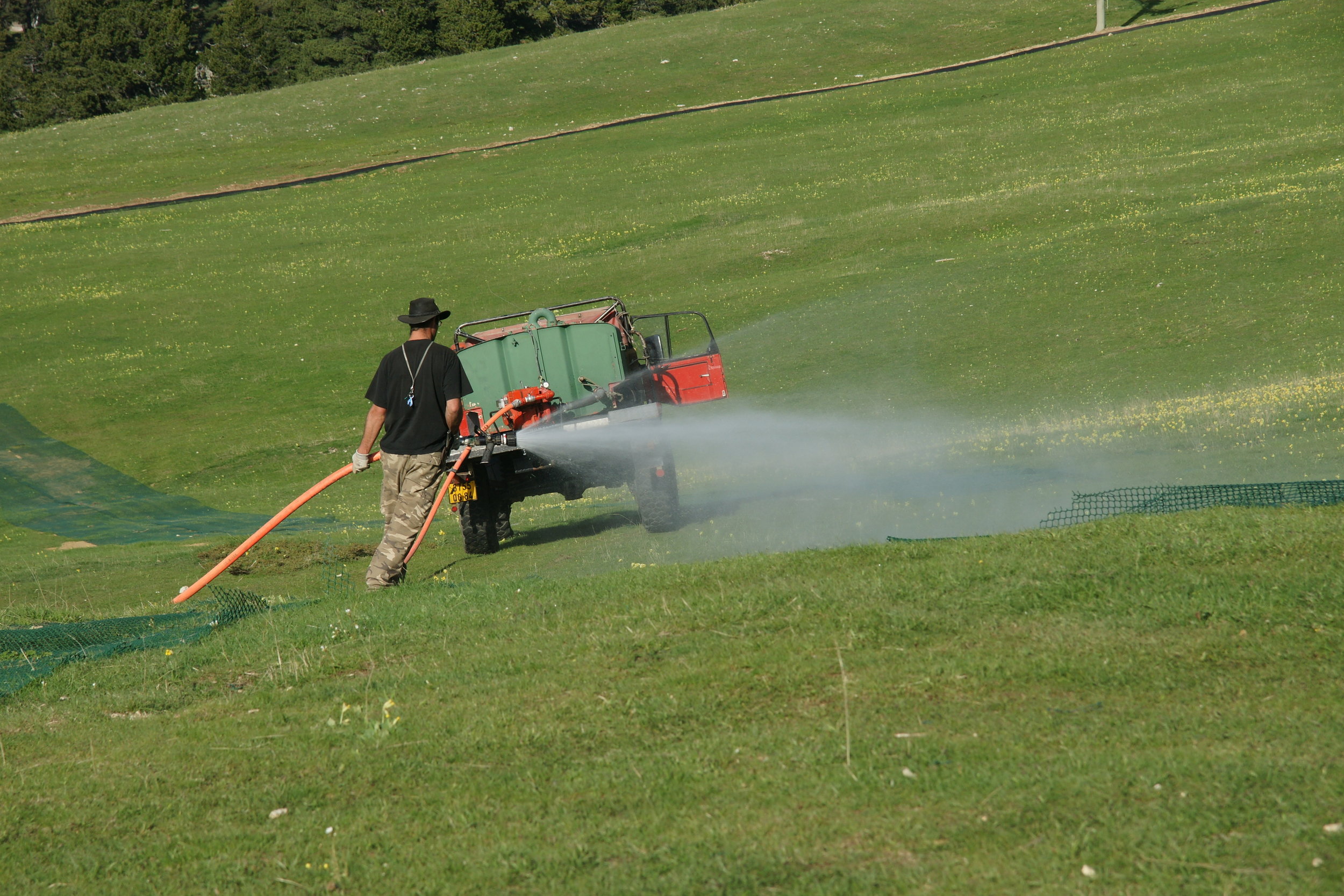
Is your company taking the necessary precautions to avoid serious and costly slips and falls from slope work? Many maintenance jobs will require employees to mow, weed abate, or plant on hillside locations as a part of the properties serviceable needs. The injury exposures that come with slope related work typically result in severe injuries. Any injury of this magnitude can result in lost time away from work by that employee and possibly permanent disability.
Take your slope work safety to the next level. Evaluate what percentage of your operations includes this exposure and then proactively manage the risk through tactical solutions. Perhaps when you consolidate your work, you will realize the percentage of the properties in your portfolio that require hillside management is a small representation of your total body of work. Here are a few examples of tactics taken to lower this exposure that we have seen in the past:
- Eliminate the exposure all together by avoiding contracts that require slope work to be performed.
- Consider creating an experienced “slope crew” and train these employees on slope related protocol to ensure they are properly educated. By having a specialized slope crew you’re ensuring this work will be done by properly trained employees.
- Evaluate the time of day slope work is performed. Morning dew can cause slick surfaces and result in an employee losing balance.
- Make sure employees are wearing proper footwear.
- Strategically plan your route up the slope or through the slope prior to engaging in the operation.
- Always complete a pre-job hazard assessment and communicate the information to the crew onsite. Identify loose soil and rock conditions before accessing dangerous areas of the slope.
- Work in horizontal lines across the slope. Dislodged materials can fall on workers below. Remain vigilant for rolling boulders and loose rocks.
Are you doing anything extra special with your slope work to prevent injury? We would enjoy hearing your strategies; please share!
Please contact Rancho Mesa Insurance Services, Inc, at (619) 937-0200 if you have questions about managing risk for the landscape industry.
Six Proactive Steps to Prevent Heat Illness During a Scorching Summer
Author, Dave Garcia, President, Rancho Mesa Insurance Services, Inc.
The National Weather Service has issued heat warnings for many parts of California starting today, and excessive heat warnings for some other areas. Temperatures are expected to rise to 110ºF in some parts of the Sacramento Valley, for instance. In the desert areas of Imperial and San Diego counties, they will soar as high as 114ºF.
Author, Dave Garcia, President, Rancho Mesa Insurance Services, Inc.

The National Weather Service has issued heat warnings for many parts of California starting today, and excessive heat warnings for some other areas. Temperatures are expected to rise to 110ºF in some parts of the Sacramento Valley, for instance. In the desert areas of Imperial and San Diego counties, they will soar as high as 114ºF.
Recommendation
If you have employees working outdoors, you should have an effective heat illness prevention plan in place and train your workers on it's content. Elements of the plan include:
- Making sure those toiling outside have plenty of fresh, cool water – workers need to drink at least a quart an hour. Just providing it isn’t enough, according to the heat illness prevention standard (General Industry Safety Orders section 3395). You must encourage employees to drink water.
- Providing shade when the temperature reaches 80ºF, or when employees request it.
- If an employee is in danger of developing heat illness, they must be allowed to take a rest in the shade until their symptoms disappear.
- Having emergency procedures, including effective communication with workers in remote areas.
- Designating employees at each work site to call emergency medical services if someone starts to develop heat illness.
- Keeping a close eye on workers who have been on the job for two weeks or less. They may not have the prior training to be aware of the early signs of heat illness.
In order to prepare our clients, Rancho Mesa recently conducted a Heat Illness Prevention Workshop. For those of you who were not able to attend, the training videos are available in the Risk Management Center or via the Workshop Video Request Form.
Should you have any questions or need further assistance, please contact a member of your Rancho Mesa team. Please be safe!!
Independent Contractor Classification Changes Expected to Impact Construction Industry
Author, David J. Garcia, AAI, CRIS, President, Rancho Mesa Insurance Services, Inc.
With the recent ruling by the California Supreme Court concerning how 1099 employees (independent contractors) are defined, the construction industry's approach to utilizing these workers has changed significantly. The Court adopted a new test to determine whether the worker should be classified as an employee or independent contractor. The previous test to determine if a worker was an employee or independent contractor was whether the employer had the right to direct the manner and means by which the worker performed the services.
Author, David J. Garcia, AAI, CRIS, President, Rancho Mesa Insurance Services, Inc.

With the recent ruling by the California Supreme Court concerning how 1099 employees (independent contractors) are defined, the construction industry's approach to utilizing these workers has changed significantly. The Court adopted a new test to determine whether the worker should be classified as an employee or independent contractor. The previous test to determine if a worker was an employee or independent contractor was whether the employer had the right to direct the manner and means by which the worker performed the services. Under the new test, a worker is considered to be an independent contractor only if all three of the following factors are present:
- The worker must be free from the control and direction of the hiring entity in connection with the performance of the work, both under the contract for the performance of the work and in fact;
- The worker must perform work that is outside the usual course of the hiring entities business;
- The worker must be customarily engaged in an independently established trade, occupation, or business of the same nature as that involved in the work performed.
These new factors have major implications for contractors, or any business for that matter, where previously they had classified a worker as an independent contractor and now have to classify them as an employee. This will impact several lines of insurance, but most critically workers' compensation, general liability and employee benefits.
Workers' Compensation
Currently, if an employee is classified as an independent contractor, they would not be subject to any workers' compensation premium nor workers' compensation benefits. If their status should change to employee, they now would be entitled to workers' compensation benefits and would have their payroll accounted for in the employer’s premium. In addition, based on the work being performed, this may change the employer’s risk profile, creating negative underwriting consequences in the workers' compensation carrier marketplace, resulting in coverage not being offered or higher premiums.
General Liability
The impact to general liability insurance is very similar to that of workers' compensation. Additional payroll or sales will need to be accounted for as the employer will become directly responsible for the work being performed without the benefit of any hold harmless agreement or other risk transfer methods. This could potentially change the risk profile of the employer’s operations, which could result in the employer needing to provide additional underwriting information.
Employee Benefits
Since 1099 contract workers are not employees and are considered self-employed, they do not show on the Quarterly Wage and Withholding Report (DE9 and DE9C) to the State of California. Because of this status, they typically cannot enroll in a group health insurance plan. Many workers who are now classified as independent contractors will be considered employees in the eyes of the state and will be eligible for group benefit offerings from their employer.
Employers may need to reevaluate their group size to ensure that they remain compliant with the Affordable Care Act (ACA). Employers with 50 or more full-time employees working a minimum of 30 hours per week, and/or full-time equivalents (FTEs) must offer health insurance that is affordable and provides minimum value to 95% of their full-time employees and their children up to age 26, or be subject to penalties.
While these changes are new and just beginning to take affect, we believe your best strategy moving forward is to consult with your trusted advisors in legal, accounting and risk management. This will have a significant impact to the construction industry throughout California and we intend to take a leadership role in helping those companies with concerns and questions. So, please reach out to our Rancho Mesa Team to help you navigate these changes. Contact Alyssa Burley at aburley@ranchomesa.com for assistance.
Key Steps to Take Before, During, and After an OSHA Inspection
Author, Sam Clayton, Vice President, Construction Group, Rancho Mesa Insurance Services, Inc.
An OSHA officer can show up to your facility or worksite for any number of reasons: employee complaints, accidents, programmed inspections, sweeps, follow-up or a drive-by observation. In order to ensure a smooth inspection, we suggest you prepare before OSHA appears at your door. Here are some key steps to take before, during and after an OSHA inspection.
Author, Sam Clayton, Vice President, Construction Group, Rancho Mesa Insurance Services, Inc.

An OSHA officer can show up to your facility or worksite for any number of reasons: employee complaints, accidents, programmed inspections, sweeps, follow-up or a drive-by observation. In order to ensure a smooth inspection, we suggest you prepare before OSHA appears at your door. Here are some key steps to take before, during and after an OSHA inspection.
Before the Inspection
Every company should have a formal plan in place detailing what should be done before, during and after an OSHA inspection. This procedure should be site specific and available to all supervisors. Site specific information should include company contacts for the project if OSHA arrives, location of documents like OSHA 300 logs and the Injury and Illness Prevention Program (IIPP).
Upon arrival of the OSHA inspection officer, the company should verify the officer’s credentials and try to determine why they are at the site. Before the opening conference begins, the employer should assign specific individuals to be the note taker and the photographer. It is also extremely important to remind everyone involved to be professional and treat the compliance officer with respect.
During the Inspection
Opening Conference: During the opening conference, you will want to establish the scope of the inspection, the reason for the inspection, and the protocol for any employee interviews or production of documents. If the inspection is triggered by an employee complaint, the employer may request a copy.
Physical Inspection: During the inspection, the OSHA compliance officer will conduct a tour of the worksite or facility in question to inspect for safety hazards. It is likely pictures will be taken by the compliance officer. Instruct your photographer to also take the same pictures and possibly additional pictures from different angels while the note taker should take detailed notes of the findings.
Closing Conference: At the closing conference, the OSHA compliance officer typically will explain any citations, the applicable OSHA standards and potential abatement actions and deadlines. It is important that during this process the company representative takes detailed notes and asks for explanations regarding any violations. If any of the alleged violations have been corrected, you will want to inform the OSHA compliance officer.
After the Inspection
If you are told no citations will be issued, contact the compliance officer and obtain a Notice of No Violation after Inspection (Cal/OSHA 1 AX). If you receive a citation, it is important to take immediate action because a company only has 15 working days after the inspection to notify the Appeals Board, if they choose to appeal the citation. Citations can be issued up to six months after the inspection, so it is important to watch your mail closely during this time.
For a proactive approach to OSHA inspections, contact the Consultation Services Branch for your state (i.e. Cal/OSHA) or Federal OSHA Consultation. They will be able to provide consultative assistance to you through on-site visits, phone support, educational materials and outreach, and partnership programs.
Register for the "How to Survive an OSHA Visit" webinar hosted by KPA on Monday, June 25, 2018 from 11:00 am - 12:00 pm PST to learn about what OSHA looks for during an inspection.
For additional information, please contact Rancho Mesa Insurance Services, Inc. at (619) 937-0164.
CIGA is “Back in Black” - Employers will receive 2% savings on 2019 workers' comp premium
Author, Sam Clayton, Vice President, Construction Group, Rancho Mesa Insurance Services, Inc.
For the first time in 20 years, the California Insurance Guarantee Association (CIGA) will not collect its annual assessment. As a result, California employers in the guaranteed cost workers' compensation insurance market will save 2% on their premium in 2019.
Author, Sam Clayton, Vice President, Construction Group, Rancho Mesa Insurance Services, Inc.
For the first time in 20 years, the California Insurance Guarantee Association (CIGA) will not collect its annual assessment. As a result, California employers in the guaranteed cost workers' compensation insurance market will save 2% on their premium in 2019.

The CIGA board of directors approved a zero assessment for 2019, as it moved into the black after collecting last year’s 2% assessment on workers' compensation premiums. At one point, CIGA had a workers, compensation deficit of $4 Billion. The 20 years of employer assessments, ranging from 1% to 2.6% of premium, paid off workers' compensation debt and in some years the debt payments on special bonds issued to pay claims from insurance company insolvencies.
Similar to the rest of the Industry, CIGA’s improved fortune results from positive reforms provided in SB 863, as well as the efforts of Department of Industrial Relations Director Christine Baker.
Three Question to Ask Before Enrolling in an OCIP/CCIP or Wrap Program
Author, Daniel Frazee, Executive Vice President, Rancho Mesa Insurance Services, Inc.
Subcontractors in California regularly enroll in OCIP/CCIP or wrap programs. These programs are insurance policies that cover many of the participants in a construction project, including the owner/developer, general contractor and subcontractors. As many contractors learn the hard way, they do not control the program or the coverage terms, leaving the possibility of significant gaps that can impact the contractor in the future.
Author, Daniel Frazee, Executive Vice President, Rancho Mesa Insurance Services, Inc.

Subcontractors in California regularly enroll in OCIP/CCIP or wrap programs. These programs are insurance policies that cover many of the participants in a construction project, including the owner/developer, general contractor and subcontractors. As many contractors learn the hard way, they do not control the program or the coverage terms, leaving the possibility of significant gaps that can impact the contractor in the future.
Prior to enrolling in a wrap insurance program, consider developing a list of key questions to regularly ask the plan sponsor. Before you begin that process, subcontractors need to know what information the plan sponsor is obligated to share about the project. And, that obligation varies greatly, depending on whether the project is public, private, or residential. Additionally, the statutory disclosure requirements are inconsistent in how they appear in the contract and bid documents. The following are a summary of those disclosures.
Residential Project Contract Documents
For residential projects, the contract documents must disclose, if and to the extent known, (Civil Code section 2782.95(a)):
- Policy limits
- Scope of policy coverage
- Policy term
- The basis upon which the deductible or occurrence is triggered by the insurance carrier
- Number of units, if the policy covers more than one work improvement indicated on the application for the insurance policy
- A good faith estimate of the amount of available limits remaining under the policy as of a date indicated in the disclosure obtained from the insurer.
Public and Commercial Project Contract Documents
For public and commercial projects, subcontractors are entitled to even less information, under (Civil Code section 2782.96):
- The policy limits
- Known exclusions
- The length of time the policy is intended to remain in effect.
In both cases above, the information that the plan sponsor is required to provide is far less than subcontractors need to truly make an informed decision on the coverage terms. Knowing now that enrollees have the right to ask for these insurance requirements before bidding the job, we will prioritize three important questions to begin the framework for your due diligence.
What are the Limits of Coverage?
Work inside OCIP/CCIP or wrap programs is commonly excluded on all contractor’s general liability policies. As a result, coverage is found almost entirely within the policy limits in place for the wrap program. That leaves key questions for your team to explore before stepping foot on a jobsite. What are the total costs of construction relative to policy limits? Are there any other projects being covered under the Wrap policy? Are the limits of insurance reinstated after a large loss? Do defense costs reduce the policy limits? While there are certainly more questions inside this vertical, knowing these initial answers and being familiar with what impact they may have on your business are a solid first step in your process.
What is Covered and What is Excluded?
Wrap programs, as many subcontractors know, can provide coverage for both general liability and workers' compensation. In the last few years, Wrap policies have focused more on general liability. Many can also include builder’s risk, professional and/or pollution liability. Each project, and therefore each wrap policy, is very unique. Be prepared to negotiate the removal of certain exclusions that often relate to some, but not all, subcontractors:
- Subsidence (earth movement)
- Professional Liability (also referred to as errors & omissions - typically a separate policy)
- Pollution Liability (typically a separate policy)
- Offsite work
What Deductible or Self-Insured Retention (SIR) is Required?
There are limited protections for wrap participants regarding the amount of self-insured retentions and/or deductibles, particularly with public or commercial projects. Subcontractors must identify, for example, the size of the deductible and whether that contribution is shared or individual. Deductibles within wrap policies can be as high as $25,000 - $50,000 per claim, which can represent significant impacts to a subcontractor’s balance sheet when unprepared.
Whenever you are considering a project that requires you to enroll within a OCIP/CCIP or wrap program, your due diligence in understanding the full scope of the insurance being offered is of the utmost importance. Discuss this in detail with your broker or reach out to one of us in our constructions group to help you navigate your way through the process.
Case Study: First-Time Bonding for Landscape Professional
Author, Matt Gaynor, Director of Surety, Rancho Mesa Insurance Services, Inc.
I recently had the opportunity to work with a new client who is a landscape professional. He wanted to bid on a maintenance project for a local municipality and wasn’t sure if he would qualify for the required performance bond.
Author, Matt Gaynor, Director of Surety, Rancho Mesa Insurance Services, Inc.

I recently had the opportunity to work with a new client who is a landscape professional. He wanted to bid on a maintenance project for a local municipality and wasn’t sure if he would qualify for the required performance bond.
After a brief discussion of how bonding differs from insurance, we decided to collect some basic information to determine if he would “pre-qualify” for the bond before putting together a full submission. The bond company ran the personal credit of the owner and determined that they would support single bonded projects up to $500,000.
After a careful review of the project specifications, the client decided not to bid on the project. We mutually decided he should provide additional information to the bond company in the event he wanted to bid on a larger project that was going to be released in the following month. The information requested by the bond company included:
a.) Completed contractor questionnaire
b.) Two year-end financial statements or tax returns for the company
c.) A personal financial statement for the owner(s)
Based on the additional information provided, we were able to negotiate a $1,000,000 single project / $3,000,000 aggregate bonding program for this particular landscape professional. The client executed the bond company general indemnity agreement and was off and running to bid the larger projects.
Make sure you work with a professional surety agent who can help assist with the bonding process if you are considering bidding on public works projects. It can save you a lot of time and effort.
Contact Rancho Mesa at (619) 937-0165 if you have any bonding questions.
Employers Beware! Ten Red Flags You May Have a Fraudulent Workers’ Comp Claim
Author, Jeremy Hoolihan, Account Executive, Rancho Mesa Insurance Services, Inc.
Workers’ Compensation is a form of insurance providing wage replacement and medical benefits to employees injured in the course of employment in exchange for mandatory relinquishment of the employee's right to sue their employer for the tort of negligence.
Author, Jeremy Hoolihan, Account Executive, Rancho Mesa Insurance Services, Inc.

Workers’ Compensation is a form of insurance providing wage replacement and medical benefits to employees injured in the course of employment in exchange for mandatory relinquishment of the employee's right to sue their employer for the tort of negligence.
While most people would agree with the idea of a workers' compensation system, unfortunately, there are people who try to defraud it in an effort to earn an extra buck. These individuals include both employers and employees. For this article, I will focus solely on the most common workers’ compensation fraud, claimant fraud (i.e., when an employee commits the fraud).
Claimant fraud includes false claims and exaggerated claims. These claims typically involve soft-tissue symptoms, such as headaches, whiplash, or muscle strain, which are all very difficult to disprove. In order to increase the value of the claim, claimants will also include multiple body parts. The most common types of claimant fraud includes reporting fake claims, injuries not received on the job, exaggerated injuries, and claimants working for another employer while collecting benefits from an injury claim.
Claimant fraud causes extreme frustration, animosity, and can lead business owners to question all claims, including those that are legitimate. Employers can feel helpless, especially when the system gives the benefit of the doubt to fraudsters. There are, however, red flags that both employers and insurance companies can pick up on to fight against these individuals seeking easy money.
Ten Red Flags
The top ten red flags employers can look for on a possible fraudulent claims are: When the claimant;
Hires an attorney the day of the alleged injury.
Has several other family members also receiving workers’ compensation benefits.
Exhibits a strong familiarity with the workers’ comp system.
Has been disciplined several times or is disgruntled and fears termination.
Was engaged in seasonal work that is about to end.
Continues to cancel or fails to keep medical appointments or refuses a diagnostic procedure to confirm an injury.
Changes doctors when the original suggests they return to work.
Is seen working at another job while collecting total temporary disability.
Is reluctant to return to work and shows very little improvement.
Has problems with workplace relationships.
Contact me to learn strategies for combating fraudulent claims before and after it is reported.
Risk Management Center Streamlines Electronic OSHA Reporting
Author, Alyssa Burley, Client Services Coordinator, Rancho Mesa Insurance Services, Inc.
The Occupational Health and Safety Administration (OSHA) now require certain employers to electronically submit their completed 2016 Form 300A. OSHA has created a website that allows employers to manually complete the information or upload a formatted CSV (comma-separated values) file
Author, Alyssa Burley, Client Services Coordinator, Rancho Mesa Insurance Services, Inc.
Editor's Note: This post was originally published on November 9, 2017 and has been updated to reflect the latest available information.
The Occupational Health and Safety Administration (OSHA) now requires certain employers to electronically submit their completed Form 300A. OSHA has created a website that allows employers to manually complete the information or upload a formatted CSV (comma-separated values) file. Users of Rancho Mesa’s Risk Management Center have the ability to track incidents and generate the export file, making the electronic reporting process quick and simple.
Check federal OSHA or your state's OSHA website for specific filing date deadlines.
Prepare and Submit
Once an incident occurs, Risk Management Center users track the details within the online system. All of the required information is stored and made available through reports and an export.
Request a Risk Management Center Account.
To export the OSHA 300A Report data, login to the Risk Management Center. Then, navigate to the Applications list and click on Incident Track®.
From this screen, click on the Reports menu and click the Export Data option.
Choose the report, “OSHA 300A Report” and select the export type a CSV. Choose the year and either all your sites or just one. Click the Export button and enter your email address.
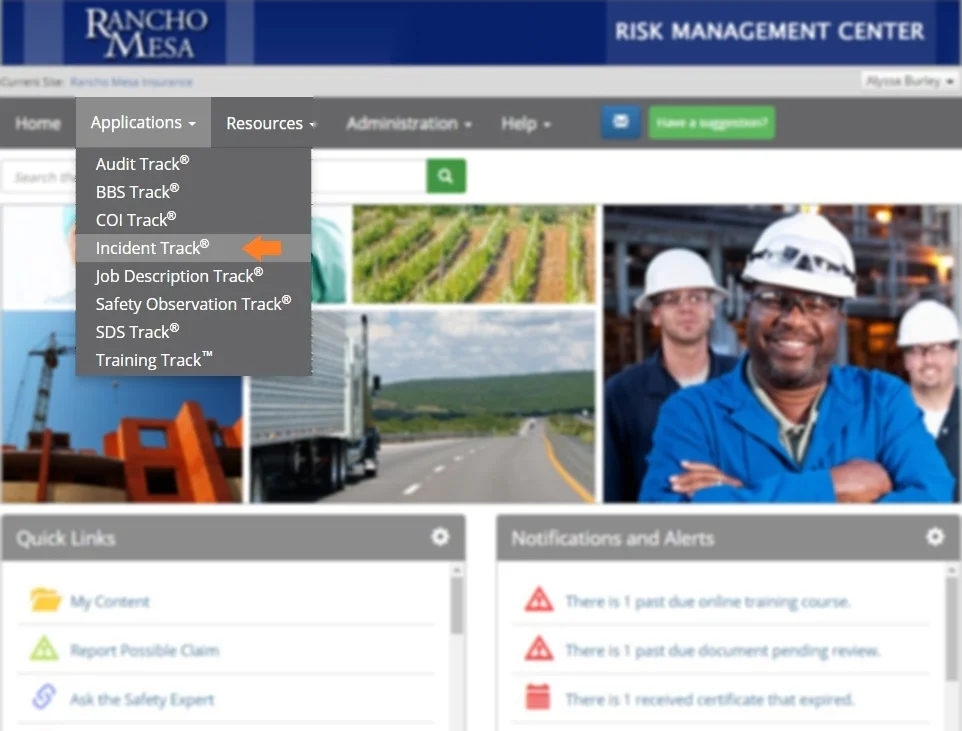

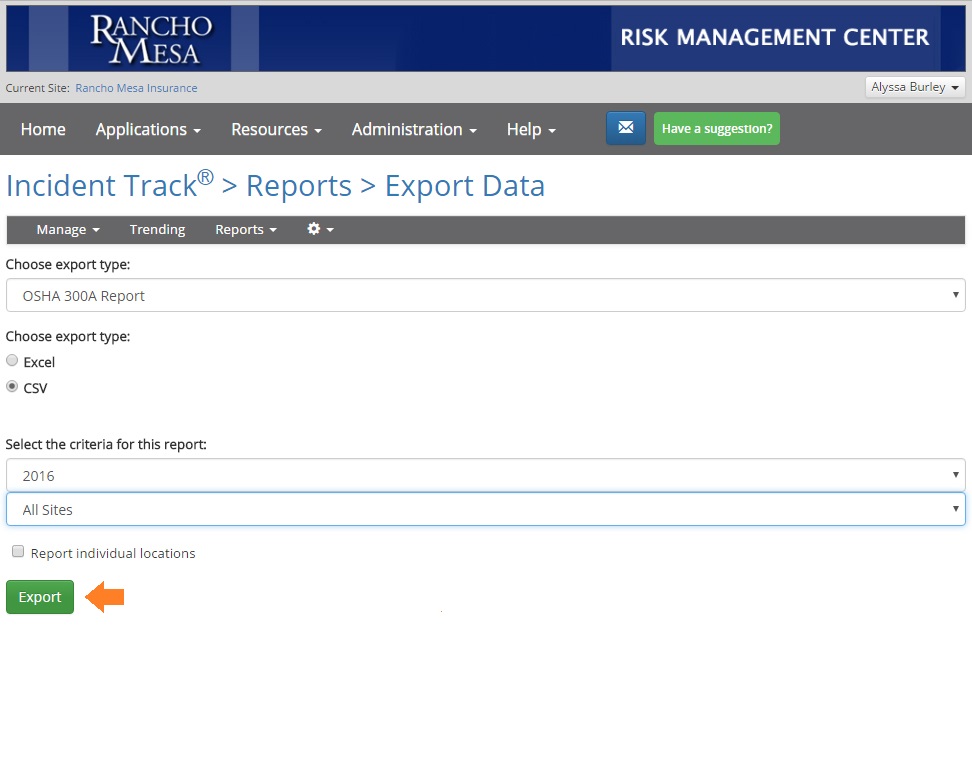
The .CSV file will be generated and emailed to you. Save the file on your computer so it can be uploaded to OSHA’s Injury Tracking Application (ITA).
To upload the .CSV file, login to OSHA’s ITA and follow the instructions on the screen.
Who is Required to Submit?
According to OSHA, “establishments with 250 or more employees are currently required to keep OSHA injury and illness records and establishments that are classified in certain industries with historically high rates of occupational injuries and illnesses.” Some of those industries include construction, manufacturing, health and residential care facilities, and building services.
On April 30, 2018, OSHA announced State Plans have been informed “that for Calendar Year 2017 all employers covered by State Plans will be expected to comply. An employer covered by a State Plan that has not completed adoption of a state rule must provide Form 300A data for Calendar Year 2017. Employers are required to submit their data by July 1, 2018. There will be no retroactive requirement for employers covered by State Plans that have not completed adoption of their own state rule.
Cal/OSHA released a statement explaining that "even though California has not yet adopted its own state rule, employers are advised to comply with federal OSHA's directive to provide Form 300A data covering calendar year 2017." In addition, other states like Maryland, Minnesota, South Carolina, Utah, Washington and Wyoming may follow California's lead.
For questions about tracking and exporting OSHA reports with the Risk Management Center, contact Rancho Mesa at (619) 937-0164
Federal OSHA Asserts Electronic Data Reporting Requirement Applies to Employers Across All States
Author, Alyssa Burley, Client Services Coordinator, Rancho Mesa Insurance Services, Inc.
The federal Occupational Safety and Health Administration (OSHA) announced Monday, April 30, 2018 it has “taken action to correct an error that was made with regard to implementing the final rule” which required some employers to electronically submit their injuring and illness reports via the Injury Tracking Application (ITA) online.
Author, Alyssa Burley, Client Services Coordinator, Rancho Mesa Insurance Services, Inc.

The federal Occupational Safety and Health Administration (OSHA) announced Monday, April 30, 2018 it has “taken action to correct an error that was made with regard to implementing the final rule” which required some employers to electronically submit their injuring and illness reports via the Injury Tracking Application (ITA) online.
Federal OSHA has determined that Section 18(c)(7) of the Occupational Safety and Health Act requires employers in State-administered OSHA plans “to make reports to the Secretary in the same manner and to the same extent as if the plan were not in effect.” Therefore, federal OSHA’s statement asserts “employers must submit injury and illness data in the Injury Tracking Application (ITA) online portal, even if the employer is covered by a State Plan that has not completed adoption of their own state rule.”
According to the announcement, State Plans have been informed “that for Calendar Year 2017 all employers covered by State Plans will be expected to comply. An employer covered by a State Plan that has not completed adoption of a state rule must provide Form 300A data for Calendar Year 2017. Employers are required to submit their data by July 1, 2018. There will be no retroactive requirement for employers covered by State Plans that have not completed adoption of their own state rule.”
“Even though California has not yet adopted its own state rule, employers are advised to comply with federal OSHA’s directive to provide Form 300A data covering calendar year 2017.”
This announcement comes on the heels of a March 2018 report by Bloomberg Environment that indicated federal OSHA anticipated more than 350,000 worksites to submit Form 300A reports via the online portal, yet nearly 200,000 weren’t submitted by the December 31, 2017 deadline. That means only 153,653 Form 300A reports were submitted and another 60,992 worksites submitted reports that were not required.
In May 2017, Cal/OSHA published a statement indicating “California employers are not required to follow the new requirements and will not be required to do so until ‘substantially similar’ regulations go through formal rulemaking, which would culminate in adoption by the Director of the Department of Industrial Relations and approval by the Office of Administrative Law." However, with the recent announcement from federal OSHA, Cal/OSHA released a statement explaining that "even though California has not yet adopted its own state rule, employers are advised to comply with federal OSHA's directive to provide Form 300A data covering calendar year 2017." In addition, other states like Maryland, Minnesota, South Carolina, Utah, Washington and Wyoming may follow California's lead.
Rancho Mesa’s Incident Track® is an effective way to manage incidents and maintain required OSHA logs. As just one of the many “tracks” inside the Agency’s “Risk Management Center,” Incident Track can also generate electronic report files that can be uploaded into the Federal OSHA’s ITA online portal.
Contact Alyssa Burley with follow up questions about these OSHA requirements and/or an interest in learning more about tracking incidents through our client based portal.
The Changing Definition of Employee: What you need to know about SB 189
Author, Yvonne Gallagher, Landscape Division Account Manager, Rancho Mesa Insurance Services, Inc.
California State Capital Building.
State Bill 189 (SB 189) (Bradford) was recently enacted by the California State Legislature. It is intended to correct issues resulting from the passage of Assembly Bill 2883 (AB 2883) (Daly et. al) in 2017, which changed the requirements for business owners to exclude themselves from workers' compensation coverage.
Author, Yvonne Gallagher, Landscape Division Account Manager, Rancho Mesa Insurance Services, Inc.

California State Capital Building.
State Bill 189 (SB 189) (Bradford) was recently enacted by the California State Legislature. It is intended to correct issues resulting from the passage of Assembly Bill 2883 (AB 2883) (Daly et. al) in 2017, which changed the requirements for business owners to exclude themselves from workers' compensation coverage.
SB 189 is written to expand:
The scope of the exception from the definition of an employee to apply to an officer or member of the board of directors of a quasi-public or private corporation, except as specified, who owns at least 10% of the issued and outstanding stock, or 1% of the issued and outstanding stock of the corporation if that officer’s or member’s parent, grandparent, sibling, spouse, or child owns at least 10% of the issued and outstanding stock of the corporation and that officer or member is covered by a health care service plan or a health insurance policy, and executes a written waiver, as described above. The bill would expand the scope of the exception to apply to an owner of a professional corporation, as defined, who is a practitioner rendering the professional services for which the professional corporation is organized, and who executes a document, in writing and under penalty of perjury, both waiving his or her rights under the laws governing workers’ compensation, and stating that he or she is covered by a health insurance policy or a health care service plan. The bill would expand the scope of the exception to include an officer or member of the board of directors of a cooperative corporation, as specified. The bill would also expand the definition of an employee to specifically include a person who holds the power to revoke a trust, with respect to shares of a private corporation held in trust or general partnership or limited liability company interests held in trust, and would authorize that person to also elect to be excluded from the requirement to obtain workers’ compensation coverage, as specified. The bill would provide that an insurance carrier, insurance agent, or insurance broker is not required to investigate, verify, or confirm the accuracy of the facts contained in the waiver. (Legislative Counsel, 2018)
Once a waiver is signed and on file with the insurance carrier it will remain in effect until there is a written withdrawal. When changing insurance carriers a new waiver must be signed with the new carrier.
Effective 1/1/18
- Carriers were able to accept waivers up until 12/31/17 for policies issued in 2017 that weren't turned in on time and the officer exclusion is being honored from the inception of the policy and is being applied at final audit.
Effective 7/1/18
- Trusts will be eligible for officer exclusion.
- To be excluded, the required ownership percentage will change from 15% to 10%.
- An officer with 1%-9% ownership that is related to an excluded officer that owns 10% or more may also be excluded as long as they have health insurance.
- Waivers currently are required at the policy effective date. SB 189 provides a 15-day grace period from the effective date to turn in the waiver. The waiver may only be backdated 15 days.
Examples: With a 1/1/18 effective date, if the waiver is turned in and accepted by 1/15/18, the officer exclusion will be effective 1/1/18. With a 1/1/18 effective date, if the waiver is turned in and accepted by 2/15/18, the officer exclusion will be effective 2/1/18.
For specific questions about your workers' compensation policy, contact Rancho Mesa Insurance Services, Inc. at (619) 937-0164.
Workplace Violence Insurance Surges in Aftermath of Shootings
Author, Sam Brown, Vice President, Human Services Group, Rancho Mesa Insurance Services, Inc.
In response to the hundreds of mass shootings taking place each year, the insurance marketplace has produced new workplace violence products to help employers and employees recover from a crisis.

Author, Sam Brown, Vice President, Human Services Group, Rancho Mesa Insurance Services, Inc.
In response to the hundreds of mass shootings taking place each year, the insurance marketplace has produced new workplace violence products to help employers and employees recover from a crisis.
U.S. employers have an obligation for duty of care for the safety, health, and security of employees (see Occupational Safety and Health Administration (OSHA) Act of 1970). Duty of care requires protection against workplace violence hazards.
A mass shooting is an attack resulting in 4 or more.
| Year | # of Incidents |
|---|---|
| 2017 | 327 |
| 2016 | 385 |
| 2015 | 333 |
It is the employer's obligation to protect its employees from violence. Homeland Security defines an active shooter as “an individual actively engaged in killing or attempting to kill people in a confined and populated area.” While OSHA describes workplace violence as “any act or threat of physical violence, harassment, intimidation, or other threatening disruptive behavior that occurs at the work site.” What is your organization doing to protect its people from these types of events?
Over the last three years, the United States recorded an average of 348 mass shootings per year.
| Description | Cost |
|---|---|
| Support for survivors and families of victims | $2.7 million |
| Cleanup, renovations, and other facility changes | $6.4 million |
| Settlement payments and other legal costs | $4.8 million |
Costs to Consider
As victims, families, and co-workers struggle to heal after losing friends and loved ones, the costs continue to mount.
Aside from treating survivors, consider some of the costs from the Virginia Tech University shooting: survivor support, cleanup, renovations, facility changes, settlement payouts and legal costs.
How would your organization absorb the cost of such an event?
Workplace Violence Policy Coverage
In addition to providing a consultant to guide businesses through an emergency event, a covered event will trigger legal liability coverage to address legal expenses. These expenses may be related to the following:
- Business interruption expense
- Defense and indemnity expenses
- Public relations counsel
- Psychiatric care
- Medical or dental care
- Employee counseling
- Temporary security measures
- Rehabilitation expenses
- Limits start at $1,000,000 with $0 deductible
Among other underwriting considerations, when pricing workplace violence policies, carriers factor in operations like exchanging money with the public, working with volatile or unstable people, providing services and care to the public, and working where alcohol is served. Take a look at your organization's operations to see if there is a risk.
Please contact Rancho Mesa Insurance Services to discuss whether this insurance is right for your organization.
Information sourced from McGowan Program Administrators.
The Rising Risk of Metal Theft from Jobsites
Author, Kevin Howard, Account Executive, Construction Group, Rancho Mesa Insurance Services, Inc.
Metal theft is one of the fastest growing crimes in the country. Copper, aluminum, nickel, stainless steel and scrap iron have become the desired target of thieves looking to make a quick buck.
Author, Kevin Howard, Account Executive, Construction Group, Rancho Mesa Insurance Services, Inc.

Metal theft is one of the fastest growing crimes in the country. Copper, aluminum, nickel, stainless steel and scrap iron have become the desired target of thieves looking to make a quick buck.
Of particular concern is copper, which is found in gutters, flashings, downspouts, water lines and electrical wiring – all of which can be quickly stripped from vacant buildings, industrial facilities, commercial buildings and construction sites. Air conditioning units are especially attractive, and are often tampered with or stolen for their copper coils and pipes that connect to HVAC systems. The metal is then sold to recycling companies and scrap yards for a tidy profit.
Common Targets
Subcontractors who store material on jobsites overnight are a common target for metal theft. Typically, subcontractors are designated specific areas on jobsites for their product waiting to be installed. And, it remains common for this material to be stored over multiple nights. Electricians often leave copper wiring; HVAC contractors can store duct work; and, plumbing contractors may store valuable fixtures. Exposure to theft can come from employees of other trade contractors on the site, as well as professionals who monitor the job, picking the right time and place to strike.
Preventing Metal Theft
To combat theft of materials, many states and municipalities have passed laws tightening the restrictions on scrap dealers. In some instances, purchases of scrap metal are required to be held in reserve for a week or more before being resold in case they have been stolen. In other instances, states require dealers to record the seller’s name, address and driver's license.
Another approach to prevent metal theft involves reducing exposure to risk at the jobsite. Examples can include:
Installing security cameras with video recordings that are maintained for sufficient periods of time.
Securing all equipment and scrap metals in locked buildings or in properly lit areas secured by fencing.
Posting "No Trespassing" placards or signs indicating the presence of a surveillance or security system.
Removing access to buildings and roofs, such as trees, ladders, scaffolding, dumpsters and accumulated materials such as pallet piles.
Securing your building access with deadbolts on doors and window locks.
Increasing exterior lighting and protecting fixtures (such as AC units) with locked metal cages.
Protecting Contractors’ Equipment on the Jobsite
Insurance for contractors that wish to transfer risk of theft at jobsites is commonly seen with Installation Floaters and Builder’s Risk policies.
Installation Floaters cover business personal property and materials that will be installed, fabricated or erected by a contractor while away from their premises. They extend coverage to the property until the installation work is accepted by the purchaser or when the insured's interest in the installed property ceases.
Builder’s Risk policies protect insurable interest in materials, fixtures and/or equipment being used in the construction or renovation of a building. While trade contractors can be held responsible for securing a Builder’s Risk policy, it is more typical that general contractors and/or building owners carry these policies during the course of construction. As a result, these policy terms fluctuate based on the length and scope of each project.
Rely on your insurance advisor to discuss these and other exposures to risk on jobsites. In advance, consider the amount of product stored at any jobsite at one time, the amount of product that can be at risk in transit, the value of product stored offsite (i.e., storage units) and the protections in place that secure your product. These will offer your broker, and ultimately the underwriter, key information in developing the right program for coverage.
For more information, contact Rancho Mesa at (619) 937-0164.
How To Lower Your Experience MOD by Understanding Your Primary Threshold
Author, Drew Garcia, NALP Program Director, Rancho Mesa Insurance Services, Inc.
The Experience Modifier (i.e., experience MOD, MOD, XMOD, experience modification rating, EMR) weighs heavy on the calculation of your workers' compensation premium. With a MOD rating of 1.00 signifying unity (i.e., the average for your industry), any MOD above 1.00 is considered adverse. Thus, any MOD below 1.00 is considered better than average. Higher MODs will debit the premium, resulting in higher workers' compensation premiums, while lower MODs will credit the premium, resulting in lower workers' compensation premiums.
Author, Drew Garcia, NALP Program Director, Rancho Mesa Insurance Services, Inc.

The Experience Modifier (i.e., experience MOD, MOD, XMOD, experience modification rating, EMR) weighs heavy on the calculation of your workers' compensation premium. With a MOD rating of 1.00 signifying unity (i.e., the average for your industry), any MOD above 1.00 is considered adverse. Thus, any MOD below 1.00 is considered better than average. Higher MODs will debit the premium, resulting in higher workers' compensation premiums, while lower MODs will credit the premium, resulting in lower workers' compensation premiums.
How do I decrease my MOD to lower my workers compensation premium?
A few factors can be addressed to reduce the workers' compensation premium. The most important is the primary threshold. Each individual employer has their own primary threshold that is determined by the class of business they operate and the amount of field payroll they accrue over a three year period. The primary threshold is the point at which any claim maximizes its negative impact on the MOD. You must be sensitive to this number because any open claim with paid amounts under the threshold, provides an opportunity to save points to the MOD. Once a claim exceeds paid amounts over your threshold, it no longer can negatively impact your MOD. However, you would still want to monitor and manage these claims to ensure your injured employee is being provided attentive care and to maintain knowledge of your loss experience.
Example
You’re a landscaping company and your primary threshold is $33,000. The most any claim can affect your MOD is $33,000 and the most points that any claim can add to your MOD is 13.
You have a claim open for $40,000 with paid amounts of $10,000 and reserved amounts of $30,000.
This claim will go into the calculation at $40,000 (Paid + Reserved) but because the total amount succeeds the primary threshold of $33,000, it will only show up on the rating sheet totaling $33,000 of primary loss and contribute 13 points to your MOD.
It would behoove you to analyze and monitor this open claim, because it has paid out amounts well below your primary threshold of $33,000.
If this same claim closes for a total paid amount of $22,000, the closed claim would go into your MOD at $22,000 with 8 points contributing to the MOD.
The difference between a $40,000 claim and a $22,000 claim is 5 points to your MOD, or, 5% to your premium!
Knowing your primary threshold is the most important piece of information when managing your XMOD. Fortunately, Rancho Mesa can help you manage your experience MOD by tracking your primary threshold and maintaining the other critical elements that go into establishing a sustainable low experience MOD.
For more information about lowering your experience MOD or a detailed analysis of your current MOD please reach out to Rancho Mesa.
Below is an example worksheet for Landscapers to determine the primary threshold.
| Annual Landscape Payroll | 2018 Primary Threshold | Max Points to MOD | Lowest MOD |
|---|---|---|---|
| $100,000 | $5,500 | 53 | .84 |
| $250,000 | $10,000 | 38 | .75 |
| $500,000 | $15,500 | 30 | .65 |
| $1,000,000 | $22,000 | 21 | .56 |
| $1,500,000 | $26,000 | 17 | .51 |
| $2,000,000 | $30,000 | 14 | .47 |
| $2,500,000 | $32,000 | 12 | .45 |
| $3,000,000 | $35,000 | 11 | .42 |
| $5,000,000 | $41,000 | 8 | .36 |
| $10,000,000 | $40,000 | 5 | .30 |
Why All Trade Contractors Must Consider Pollution Liability
Authors Sam Clayton, ARM, CRIS, Vice President, Construction Group and Daniel Frazee, ARM, CRIS, Executive Vice President, Rancho Mesa Insurance Services, Inc.
Contractor’s Pollution Liability (CPL), once viewed as expensive and unnecessary, has now become an integral part of every trade and environmental contractor’s insurance program. The industry is seeing requirements for this coverage from a combination of building owners, developers and general contractors for projects of all sizes.
Authors Sam Clayton, ARM, CRIS, Vice President, Construction Group and Daniel Frazee, ARM, CRIS, Executive Vice President, Rancho Mesa Insurance Services, Inc.
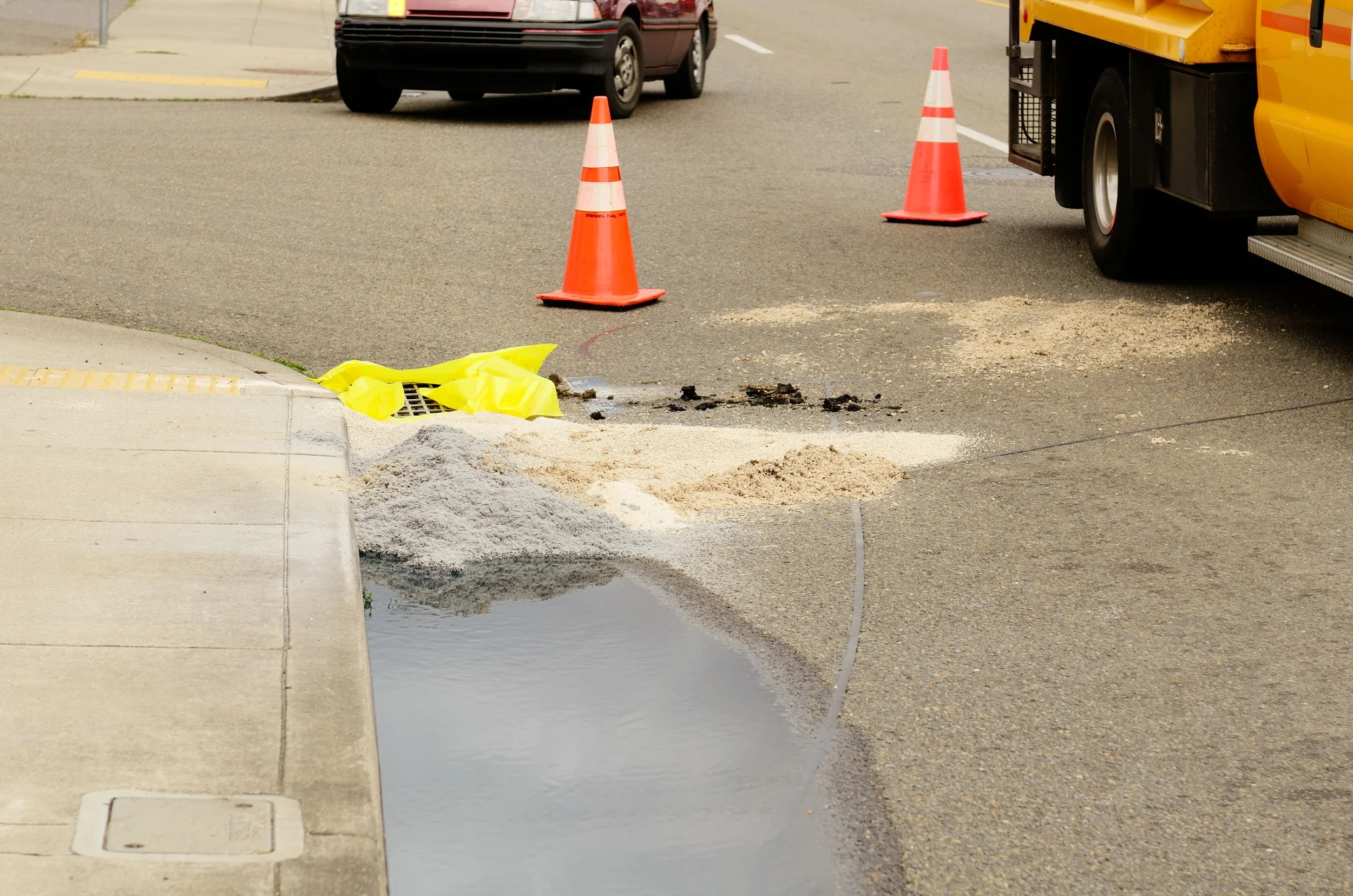
Contractor’s Pollution Liability (CPL), once viewed as expensive and unnecessary, has now become an integral part of every trade and environmental contractor’s insurance program. The industry is seeing requirements for this coverage from a combination of building owners, developers and general contractors for projects of all sizes.
Protecting contractors from pollution exposure by transferring this risk to a CPL policy supports a best practice approach. Contractors' pollution liability insurance provides coverage for third party bodily injury, property damage and pollution clean-up costs as a result of pollution conditions for which the contractor may be responsible. A pollution condition can include the discharge of pollutants brought to the job site, a release of pre-existing pollutants at the site or other pollution conditions due to the performance of the contractor’s or a lower tier subcontractor’s operations. In addition to the potential loss of reputation, often overlooked expenses that can negatively impact a profit & loss statement are the costs incurred to defend a company involved in a pollution claim.
Contractors who choose not to purchase Contractor’s Pollution Liability Insurance generally fall into two categories. Many believe that their operations do not have a pollution exposure. And countless others assume that their Commercial General Liability (CGL) policies offer protection in the event a pollution claim arises. Neither of these assumptions is accurate. Pollution coverage is not commonly found in CGL policies by virtue of the Total Pollution Exclusion. This form excludes pollution coverage for any bodily injury, property damage and/or the clean-up costs. Examples of pollution incidents apply to many different types of trade contractors, in addition to traditional environmental contractors. A handful of those are listed below:
- An HVAC system is installed improperly which, over time, causes moisture and ultimately mold to spread throughout a residential building, causing bodily injury and property damage
- A painting contractor accidentally disposes paint thinner through a public drain causing polluted water to a local community
- Dirt being excavated from one area of a job site to another is contaminated with arsenic and lead. The chemicals are then spread to a larger area which is later found by a soils expert
- Construction equipment on a project site has hydraulic fuel lines cut by vandals, causing fuel to leak out and contaminate the soil
- A contractor punctures an underground storage tank during excavation, causing the product to spill into the soil and groundwater.
- A gas line ruptures during excavation causing a gas leak into a neighboring building that leads to an explosion
The common thread seen above describes how contractors are causing some type of “contamination” on a job site. And, contamination is the operative word in all pollution exclusions. With such a broad definition extending to so many types of construction, beginning your search now for CPL options is just simply good business.
And, with a multitude of insurance companies aggressively pricing CPL policies, securing competitive quotes to compliment your current insurance program can fill significant gaps at more reasonable costs than you think.
Take time to consult with your broker and learn more about how pollution liability impacts your firm.
For more information, contact Sam Clayton at (619) 937-0167 or Daniel Frazee at (619) 937-0172.
3 Practical Reasons for Timely Claims Reporting
Author, Jim Malone, Claims Advocate, Rancho Mesa Insurance Services, Inc.
When a work-related accident occurs, as a business owner or manager, it is our nature to want to analyze the situation in order to learn how to avoid it in the future. However, the reporting of the incident is equally as important. With the recent requirement to report first aid claims, timely reporting for all claims is recognized as being critical for a number of reasons.
Author, Jim Malone, Claims Advocate, Rancho Mesa Insurance Services, Inc.

When a work-related accident occurs, as a business owner or manager, it is our nature to want to analyze the situation in order to learn how to avoid it in the future. However, the reporting of the incident is equally as important. With the recent requirement to report first aid claims, timely reporting for all claims is recognized as being critical for a number of reasons.
Employee Morale
First and foremost, timely reporting allows for immediate care of any injuries that may have occurred as a result of the incident. It promotes prompt referral for medical evaluation, documentation of the bodily areas affected, and provides recommendations for treatment.
Promptly reporting an injury shows the injured employee, and their coworkers, that the company cares about them. When an employee knows the employer cares, they are less likely to litigate the claim, which can significantly reduce the overall cost to the employer.
Elimination of Hazards
Timely reporting can trigger the immediate assessment of the scene and cause of the accident. The initial focus is to document the area and determine if there is still an injurious exposure or condition present that may need to be addressed to prevent further incidents or injuries. Timely reporting also allows for prompt investigation of the accident and the scene of the accident, identify witnesses, secure faulty tools or equipment for safety and subrogation purposes, and to convey a sense of responsibility and concern for the employee that their safety is of extreme importance.
Prompt investigations into the cause of a near miss, accidents, and injuries can lead to an understanding of the factors that lead up to the incident. Thus, the employer has the opportunity to make changes in processes and improvements in safety in order to prevent future near miss events or accidents from occurring.
Cost Savings
Timely reporting can directly affect the overall costs of a claim. Decreased medical costs are realized when injuries are promptly assessed, allowing for treatment to start immediately. Injured employees tend to recover quickly when treatment is provided right away. Swift recoveries usually result in shorter periods of temporary total and/or temporary partial disability, fewer diagnostic studies, physical therapy visits, injections, surgeries, permanent physical limitations, work restrictions or permanent disability percentages, and lower future medical care needs. This translates into lower financial resources allocated to these claims.
The timely reporting of a claim promotes positive morale among employees; helps remove potential future hazards from the workplace and can significantly reduce overall the cost of incidents.
For more information about claims reporting, contact Rancho Mesa Insurance Services, Inc. at (619) 937-0164.
Simple Steps to Developing a Personal Protective Equipment Program
Author, Jeremy Hoolihan, Account Executive, Rancho Mesa Insurance Services, Inc.
In the workplace, employees can be exposed to potentially harmful hazards. Identifying these hazards and using precautionary measures such as personal protective equipment (PPE) can mean the difference between a safe jobsite and an injury.
Author, Jeremy Hoolihan, Account Executive, Rancho Mesa Insurance Services, Inc.

In the workplace, employees can be exposed to potentially harmful hazards. Identifying these hazards and using precautionary measures such as personal protective equipment (PPE) can mean the difference between a safe jobsite and an injury.
PPE “is equipment worn to minimize exposure to a variety of hazards,” according to the Occupational Safety and Health Administration’s (OSHA) booklet on the subject. Examples of PPE include gloves, foot and eye protection, earplugs, hard hats, respirators and full body suites.
Implementing a PPE program can greatly reduce the chances of workplace injuries and increase a business’s productivity.
A PPE Program consists of three main components:
- An assessment of the workplace hazards and procedures, and determining what PPE will be used to protect employees.
- Employee training.
- Documentation of hazard assessment and employee training.
Conducting a Hazard Assessment
The OSHA Personal Protective Equipment Standard (29 CFR 1910.132-138) requires that employers ensure appropriate PPE is “provided, used, and maintained in a sanitary and reliable condition whenever it is necessary” to protect workers from hazards. Employers are required to assess the workplace to determine if hazards that require the use of personal protective equipment are present or are likely to be present. The following information will aid in the hazard assessment process:
- Develop a Hazard Assessment Checklist (a sample is available in the Risk Management Center) to identify exposures in the workplace that could injure a specific body part such as eyes, face, hand, arms, feet, legs, body, head, or hearing. Once you have identified the potential exposures, include the required PPE to minimize or eliminate the exposure.
- Conduct a walk-through survey of the workplace and complete the information on the Hazard Assessment Checklist. The purpose of the survey is to identify sources of hazards to workers such as chemical exposures, harmful dust, sharp objects, electrical hazards, etc.
- Select suitable PPE. Should an employer determine that PPE is necessary, they are then required to ensure that it is available and used. It is not enough to select PPE and witness its use, however. Employers must also make sure that the PPE is suitable for protection from the identified hazards, is properly fitted, and is not defective or damaged in any way.
Employee Training
Before doing work which requires PPE, employees must be trained to know the following:
- When PPE is necessary.
- The type of PPE that is necessary.
- How the PPE is properly worn.
- PPE's limitations.
- How to properly care, maintain, and disposal of the PPE.
Written Verification of Hazard Assessments and Employee Training
Employers are responsible for ensuring that employees are trained in the use of PPE and must provide written certification to that effect. Employers must also certify in writing that the employees understand the training. Also, in general, employers must provide required PPE at no cost to employees.
A large majority of workplace injuries are preventable through the implementation of a PPE Program. It is the employer’s responsibility to keep their employees adequately protected at all times. After all, it is certainly difficult to imagine a firefighter performing his or her duties without a helmet, boots, gloves and other necessary protective equipment.
Rancho Mesa Insurance Services has expertise in risk management for the construction industry. We can provide you with assistance in developing a PPE Program, as well as other risk management and insurance needs. Please contact me with any questions at (619) 937-0174 or jhoolihan@ranchomesa.com.
Berkshire Hathaway's Steve Hamilton Discusses Workplace Injury Trends for the Landscape Industry in Recent Webinar
Author, Drew Garcia, NALP Program Director, Rancho Mesa Insurance Services, Inc.
In this webinar, Steve Hamilton, Senior Loss Control Specialist from Berkshire Hathaway Homestate Companies, reviews workplace injury trends for the landscape industry, along with OSHA’s most cited regulatory violations.
Author, Drew Garcia, NALP Program Director, Rancho Mesa Insurance Services, Inc.

Steve Hamilton, Senior Loss Control Specialist from Berkshire Hathaway Homestate Companies, reviews workplace injury trends for the landscape industry, along with OSHA’s most cited regulatory violations, in his Landscape Industry Injury Trends for 2017 webinar.
This information will help landscapers focus their training efforts to improve compliance and reduce the risk potential for frequency and severity.
Start the year off right with a plan to address these common injury trends!
A National Association of Landscape Professionals (NALP) login is required to view the webinar.
Ask the Expert: Insurance Questions from the Lawn and Landscape Industry
Author, Drew Garcia, NALP National Program Director, Rancho Mesa Insurance Services, Inc.
Drew Garcia answers common insurance questions for the landscape industry.
Author, Drew Garcia, NALP National Program Director, Rancho Mesa Insurance Services, Inc.
How can I control and/or lower my experience rating?
Without getting into detail about the formula or governing insurance bodies, here are some key items to focus on in order to lower your experience rating (i.e., experience modification, MOD), no matter your jurisdiction.
Frequency vs. Severity (Proactively Track and Eliminate the Claim Before it Happens)
Analyze your work related injuries and near misses to search for trends that will help to prevent similar claims from occurring. Your rating will typically see more of a negative impact with multiple claims (frequency) as opposed to one large loss (severity). Frequency drives the probability for more claims to occur in the future which would make your company a higher risk to insurer.
Return to Work (Make it Mandatory)
All claims may potentially impact the experience rating in one way or another, with frequency having a large role in the mathematical formula. Another key part of managing claim costs is the focus on reducing indemnity expenses on every claim. By returning an employee to work you eliminate any claim cost that would have been allocated to temporary disability. The savings you will see on your experience MOD is remarkable. If you need help creating a return to work program, reach out to your workers compensation insurance carrier for guidance. If you decide to implement any of these strategies going forward, implement a mandatory Return to Work program.
Example:
An injured employee will earn $400 a week on temporary disability and is estimated to need three months of recovery. The claim closes three months later with a total incurred claim cost of $4,800 in indemnity (wages) and $2,000 in medical, equaling $6,800.
With a Return to Work program, the injured employee is right back to work on modified duty and earns no temporary disability. The claim closes for $2,000. Not only will the claim have less of an effect on your experience MOD, but you will also have constant communication with the injured employee, which keeps them feeling part of the team, boosts their morale, and perhaps expedites the length of the injury.
Carrier Analytics (Save a $1 Today That Will Cost You $5 in the Future)
Who is handling your insurance claims? When you purchase workers compensation insurance, you are buying a company’s ability to handle claims and how those claims are handled will determine your experience MOD, your cost, and your bottom line for years to come. Carrier benchmarking reports are becoming critical in helping to evaluate the impact each carrier will have on your claim experience. You should place your insurance with a carrier who has a history of writing policies for your specific industry and a proven track record of closing claims faster than the industry, and for less money, because that money is what drives your modifier through the roof.
What are your thoughts on a safety incentive program?
I would suggest safety recognition as opposed to safety incentive, here’s why. An incentive program might keep employees from reporting work related injuries in fear that they might “ruin” a streak of consecutive days without an injury. You do not want to make an employee fearful of reporting an injury. OSHA and the Department of Labor have started to enforce these “dis-incentive” programs in a more visible way.
Safety recognition would mean identifying an employee who has successfully executed your company’s standard safety requirements or has gone above and beyond to better the company’s safety culture. A type of recognition could be handing out raffle tickets to employees who have executed standard safety protocol and having a monthly drawing for prizes.
What is the key to having a safe company? We have all the safety programs; we do tailgates every week; and, we still have claims, routinely!
In one word, the companies that experience the best safety records all share this common trait, communication. You can have all the compliance based safety programs in place but without superior communication they will lack true execution. Proactively communicating with your team in the field, every day, is what it takes. Safety must become a common attribute employees think of when they talk about your company. It takes participation and “buy-in” on all levels from ownership to employee. Employees must understand the exposures and job hazards associated with their work, but, the culture you are trying to create within your company should generate excellent decision making, like employees who think:
- “I probably shouldn’t lift this alone.”
- “That slope looks wet."
- “I should pick this up before someone steps on it.”
You cannot buy a good safety company. Like anything in life, it is earned. With a concentrated effort, you can establish a solid safety program that becomes routine and everyone in your company will benefit from it.