

Industry News

The Final Chapter: Addressing Training, Access and Recordkeeping in the IIPP
Author, Jack Marrs, Associate Account Executive, Rancho Mesa Insurance Services, Inc.
In this third installment of exploring an Injury and Illness Prevention Program (IIPP), we will be taking a closer look at: Providing employee training and instruction, procedures to allow employee access to the program, and recordkeeping and documentation.
Author, Jack Marrs, Associate Account Executive, Rancho Mesa Insurance Services, Inc.

In this third installment of exploring an Injury and Illness Prevention Program (IIPP), we will be taking a closer look at: Providing employee training and instruction, procedures to allow employee access to the program, and recordkeeping and documentation.
Providing Employee Training and Instruction
Providing clear and effective training for both employees and supervisors is essential for the success of an IIPP. All employees are required to be fully aware of the workplace hazards they may face. Comprehensive and well-conducted trainings can help reduce the likelihood of work-related injuries and illnesses. An article from The State Fund suggests “If you are unable to conduct your own required trainings, you should reach out to an outside consultant, Cal/OSHA consultation, vendors, your insurance carrier, and/or broker for assistance.” The more knowledgeable and prepared employees are, the safer the work environment becomes.
Take a look at the training resources that are available to your organization. Rancho Mesa clients can access the online safety training courses in the SafetyOne™ platform.
Procedures to Access the IIPP
All employees are required to have access to the written IIPP. This will ensure that all employees are fully aware of the safety protocols and hazard prevention strategies used to minimize workplace accidents and illnesses and thus, maintain a safe workplace.
According to Cal/OSHA, employers can meet this requirement by:
1. Unobstructed access through a company server or website, which allows employees to review, print, or email a copy of the IIPP
2. When requested, provide a printed copy of the IIPP (unless the employee agrees to receive an electronic copy)
The IIPP can be made accessible to users of the SafetyOne mobile app. It allows organizations to upload digital files into a file cabinet that is available only to their users. For employees who aren’t SafetyOne app users, they could scan a QR code or complete a webform to request the IIPP from their administrator. However your organization decides to distribute the IIPP, it should be easy for employees to access or request.
Recordkeeping and Documentation
Recordkeeping and proper documentation are crucial components of the IIPP. By maintaining accurate records, employers can learn from past incidents and identify injury and illness trends. This knowledge allows for necessary corrections and improvements in future operations, which will improve overall workplace safety. There are 5 steps required by the OSHA for a compliant recordkeeping system:
Each employer (unless exempt by size or industry) must record each fatality, injury, or illness that is work-related, is a new case, or meets one or more of the general recording criteria specified in Title 8, Section 14300.
Record each injury or illness on the Cal/OSHA Log of Occupational Work Related Injuries and Illnesses (Form 300) according to its instructions.
Prepare an Injury and Illness Incident Report (Form 301), or equivalent.
Annually review and certify the Cal/OSHA Form 300 and post the Summary of Work-Related Injuries and Illnesses (Form 300A) no later than February 1 and keep it posted where employees can see it until April 30.
Maintain the last five years of these records in your files.
A simple way to collect the incident information required for the OSHA logs (Form 300, 300A and 301) can be obtained by utilizing SafetyOne’s mobile forms. Either through the mobile app or via a QR Code or web link, employees can complete accident investigation forms and witness statements digitally. Then, the person responsible for documenting and maintaining the OSHA logs, can review the reports that came in through the mobile app and document the OSHA logs in the RM365 HRAdvantage Portal.
Rancho Mesa will host several webinars in the coming months to assist clients with understanding the best practices for completing their OSHA logs using SafetyOne™ and the RM365 HRAdvantage Portal.
Cal/OSHA has a Guide to Developing Your Workplace Injury and Illness Prevention Program that is helpful for organizations that need some assistance with getting started.
Rancho Mesa also has a 6-page Sample Injury and Illness Prevention Overview for California Employers available through our RM365 HRAdvantage Portal.
Following these steps is a proactive approach to building a safer working environment for all employees. The bottom line, it’s all about mitigating accidents before they happen and building a safe work environment.
Please contact me with any questions regarding the IIPP at (619)-486-6569 or via email at jmarrs@ranchomesa.com.
Identifying Proper Procedures for the Injury and Illness Prevention Program
Author, Jack Marrs, Associate Account Executive, Rancho Mesa Insurance Services, Inc.
In this second installment of exploring an Injury and Illness Prevention Program (IIPP) we will be taking a closer look at the procedures for identifying and evaluating workplace hazards, investigating occupational injury or illnesses, and correcting unsafe or unhealthy conditions, work practices and procedures.
Author, Jack Marrs, Associate Account Executive, Rancho Mesa Insurance Services, Inc.

In this second installment of exploring an Injury and Illness Prevention Program (IIPP) we will be taking a closer look at the procedures for identifying and evaluating workplace hazards, investigating occupational injury or illnesses, and correcting unsafe or unhealthy conditions, work practices and procedures.
Identifying and Evaluating Workplace Hazards
Employers need to have proper measures in place to identify potential health and safety risks like unsafe conditions and practices within the workplace. These measures involve conducting regular inspections to identify any areas of the workplace that may be hazardous. Also, conducting interviews with employees is a great way to identify any potential workplace hazards. During this process it is important to document any identified hazards and create a plan of action to fix them.
According to California’s State Fund “Inspections should be conducted by personnel who, through experience or training, are able to identify actual and potential hazards and understand safe work practices. They should be knowledgeable in the Cal/OSHA safety orders that apply to your workplace to better help you identify potential hazards.”
Investigating Occupational Injuries or Illnesses
Referring now to the investigation that should take place after an accident or near miss has occurred. The investigation should be done by a trained employee who is able to identify the cause of the accident and understands what solutions need to be put in place to prevent a similar incident from happening in the future. When doing an investigation, it is crucial to fill out an investigation report containing the details about what happened. This information is used to not only identify root causes but much of the data that is collected will need to be documented on the OSHA logs. CAL/OSHA lists five important steps for proper recordkeeping:
Each employer (unless exempt by size or industry) must record each fatality, injury, or illness that is work-related, is a new case, or meets one or more of the general recording criteria specified by OSHA.
Record each injury or illness on the OSHA Form 300, according to its instructions.
Prepare an Injury and Illness Incident Report known as Form 301, or its equivalent.
Annually review and certify the OSHA Form 300 and post the Summary of Work-Related Injuries and Illnesses known as the Form 300A no later than February 1 and keep it posted where employees can see it until April 30.
Maintain the last five years of these records in your files.
Lastly, building an inventory of investigation reports can lead to a stronger ability to identify developing trends and root causes that could lead to additional incidents, if not corrected.
Correcting Unsafe or Unhealthy Conditions, Work Practices and Procedures
Once your safety team becomes aware of a hazard, it is imperative to take immediate action. If the hazard is not easily fixable, employees should vacate the work area until a solution is implemented. Once the solution is in place, only trained staff members should enter the hazardous area to address the issue. This approach ensures effective hazard management while minimizing the risks associated with its correction.
By implementing an effective Injury and Illness Prevention Program, workplaces will begin to fulfill their regulatory obligation of maintaining a safe workplace, but also create a culture of safety and accountability.
Our next installment will cover the last 3 critical components of the IIPP: providing employee training and instruction, procedures to allow employee access to the program, and recordkeeping and documentation.
Please contact me with any questions about managing your risk at (619) 486-6569 or via email at jmarrs@ranchomesa.com.
First Four Steps to Take Immediately After a Data Breach
Author, Sam Brown, Account Executive, Rancho Mesa Insurance Services, Inc.
On Friday, July 14th Rancho Mesa hosted a popular workshop titled “Cyber Liability Explained: Hacking Trends for 2023” with presenter Beau Bechelli of Evolve MGA. His 60-minute presentation educated the audience on the cost of cyber-attacks, the most common types of attacks, and practical ways to help reduce the threat of a breach.
Author, Sam Brown, Account Executive, Rancho Mesa Insurance Services, Inc.

On Friday, July 14th Rancho Mesa hosted a popular workshop titled “Cyber Liability Explained: Hacking Trends for 2023” with presenter Beau Bechelli of Evolve MGA. His 60-minute presentation educated the audience on the cost of cyber attacks, the most common types of attacks, and practical ways to help reduce the threat of a breach.
This article will cover recommended steps an organization should take immediately following a data breach.
Call Insurance Agent
Immediately call the business’ insurance agent or the cyber insurance policy’s claim reporting line to report details of the incident.
Secure Operations
According to the FTC.gov’s Data Breach Response Guide, an organization should first take steps to quickly secure its operations. This may require:
New locks and access codes to physical areas
Taking all affected equipment offline immediately
Remove improperly posted information from the organization’s website
Search for the organization’s exposed information on the web
FTC.gov also recommends interviewing individuals who discovered the breach and advises against destroying evidence.
Address Vulnerabilities
The organization should next address the system’s vulnerabilities compromised in the breach. Contact any service providers involved to assess the personal information to which the provider had access and determine if it’s necessary to change access privileges.
Work with the forensics team to understand if the breach is contained and determine the status of the network’s backup data. This process should also produce the number and types of records compromised. Begin corrective measures as soon as possible.
Notify Appropriate Parties
The guide instructs businesses to notify law enforcement, other affected businesses, and affected individuals. Work with the insurance company’s assigned legal counsel to ensure compliance with all state and federal notification requirements.
Please refer to the Federal Trade Commission’s Data Breach Response Guide for more detailed steps.
For those who are interested in learning more about how cyber-crimes affect real businesses, watch “Cyber Liability Explained: Hacking Trends for 2023.”
Contact me to discuss the merits of cyber liability insurance or a possible data breach at (619) 937-0175 or sbrown@ranchomesa.com.
Breaking Down the First Few Components of the IIPP
Author, Jack Marrs, Associate Account Executive, Rancho Mesa Insurance Services, Inc.
Building upon Sam Brown’s article “Guidance for Developing an Effective Injury and Illness Prevention Program” (IIPP), I would like to delve further into some of the key components of an IIPP. In this first installment, I will explore assigning the right person to create the IIPP, compliance with safety regulations, and effective communication.
Author, Jack Marrs, Associate Account Executive, Rancho Mesa Insurance Services, Inc.

Building upon Sam Brown’s article “Guidance for Developing an Effective Injury and Illness Prevention Program” (IIPP), I would like to delve further into some of the key components of an IIPP. In this first installment, I will explore assigning the right person to create the IIPP, compliance with safety regulations, and effective communication.
Person Responsible for Creating the IIPP
This person must understand the ins and outs of the organization. They must be familiar with the workplace hazards and understand what safety measures need to be put in place. They are also in charge of updating the program and improving it as the organization changes and grows. This individual must also be formally mentioned in the IIPP, clarifying the assigned responsibility for overseeing this aspect of safety by including their name in the document.
Compliance with Safety Regulations
The IIPP outlines the system for ensuring employees comply with safe and healthy work practices.
This entails effectively training and informing employees about their responsibilities and expectations. Employees need to understand the system that is put in place as well as the safety procedures and the requirements of the IIPP. Providing positive recognition and rewarding employees who are following the IIPP guidelines is crucial, while disciplinary measures should be put in place for those who fail to comply. This is how you begin to create a culture of safety and accountability. Also, to ensure your IIPP stays up to date, it is considered best practices to regularly review and update all rules and procedures as needed.
Effective Communication
The IIPP must include a system for communicating with employees in a form readily understandable by all affected.
It remains critical to effectively communicate with your employees on matters that relate to the IIPP. Clear communications can be learned through trainings. And, it is important that employees use language that can be easily interpreted. According to the State Fund, “your communication system should include provisions for encouraging employees to report potential hazards in the work environment without fear of reprisal. One way to do this is to have a notification system where employees report hazards anonymously.” This helps eliminate fear in the employee and allows them to feel comfortable holding their co-workers to the IIPP standard. Effective communication can help prevent injuries from happening in the first place.
By embracing these components, organizations can create a culture of safety and accountability.
The next IIPP article will cover the three critical components of the IIPP: identifying work place hazards, investigating occupational injury or illness, and work practices/procedures.
If you have any inquiries, feel free to reach out to me at (619) 486-6569 or via email at jmarrs@ranchomesa.com.
Guidance for Developing an Effective Injury and Illness Prevention Program
Author, Sam Brown, Account Executive, Rancho Mesa Insurance Services, Inc.
As some company leaders may recall, since 1991, all California employers are required to maintain a written Injury and Illness Prevention Program (IIPP). An IIPP is an understandable and accessible safety program tailored to a business’ operations. An effective IIPP will help an employer establish and maintain a safe workplace while setting expectations and protocols for all employees.
Author, Sam Brown, Account Executive, Rancho Mesa Insurance Services, Inc.
As some company leaders may recall, since 1991, all California employers are required to maintain a written Injury and Illness Prevention Program (IIPP). An IIPP is an understandable and accessible safety program tailored to a business’ operations. An effective IIPP will help an employer establish and maintain a safe workplace while setting expectations and protocols for all employees.
The information below outlines the necessary elements of a written and effective IIPP, while recommending a resource to use when creating or updating the plan.
Cal/OSHA requires all Injury and Illness Prevention Programs to contain nine critical components:
A person (or persons) with authority and responsibility for implementing the program is identified.
A system for ensuring employees comply with safe and health work practices.
A system for communicating with employees in a form readily understandable by all affected.
Procedures for identifying and evaluating work place hazards.
Procedures to investigate occupational injury or illness.
Procedures for correcting unsafe or unhealthy conditions, work practices and procedures.
Provide employee training and instruction.
Procedures to allow employee access to the Program.
Recordkeeping and documentation.
California employers looking for guidance on the Cal/OSHA required Injury & Illness Prevention Program can often feel overwhelmed when addressing all required elements, while also abiding by the best practices of updating the plan, annually. Fortunately, California’s State Compensation Insurance Fund offers a free IIPP builder to all employers.
The State Fund’s IIPP Builder will help an employer create an IIPP from scratch, but can also help improve an existing program to make it more effective and compliant. An employer is first asked to answer a series of questions about safety practices. The answers will help build a safety program and tailor it to the business. The IIPP builder will also guide an employer through the required elements of the written IIPP.
Once finished, an employer can save the IIPP to their computer and upload it into their SafetyOne™ mobile app. They can also print and keep a hard copy at all locations. Lastly, to make it a truly effective program, the employers should share details of the IIPP with their employees.
Rancho Mesa wants clients to feel comfortable and confident when creating, updating, and sharing details of their Injury and Illness Prevention Program. To learn more about an effective IIPP and the State Fund’s IIPP BuilderSM, please contact me at sbrown@ranchomesa.com or (619) 937-0175.
Plan Your SafetyOne™ App to Best Suit Your Organization’s Needs
Author, Megan Lockhart, Media Communications and Client Services Coordinator, Rancho Mesa Insurance Services, Inc.
Rancho Mesa aims to provide clients with tools that are flexible in order to best fit their individual needs, including our proprietary SafetyOne™ application. SafetyOne’s features are systemized based on “Projects.” However, projects are highly adaptable to the way each individual organization works.
Author, Megan Lockhart, Media Communications and Client Services Coordinator, Rancho Mesa Insurance Services, Inc.

Rancho Mesa aims to provide clients with tools that are flexible in order to best fit their individual needs, including our proprietary SafetyOne™ application. SafetyOne’s features are systemized based on “Projects.” However, projects are highly adaptable to the way each individual organization works.
Below are best practices for utilizing projects depending on your organization’s industry and structure.
Construction (Project or Job)
As the name suggests, construction companies will most likely assign their policies, mobile forms and users to their individual construction projects or job sites. Project managers and foremen can access job-specific content based on the projects they are assigned.
This system works well for both short-term and long-term projects that need to manage safety within unique worksites.
Landscape, Tree Care and Janitorial (Service Crew)
Many landscape, tree care and janitorial companies organize their employees in the SafetyOne application into crews. These crews are employees who stay grouped together from one worksite to the next. Companies can name their projects based on a crew number, truck, or team name and assign content, such as toolbox talks to individual crews.
This system works well for companies providing on-going services to multiple accounts that aren’t necessarily tied to one worksite.
Human Services (Client or Program)
Human services organizations like non-profits, home healthcare, and schools can use projects for their different office locations, facilities, programs, or campuses. These organizations may choose to make policies and forms available to employees based on their office, clients, facility, program or campus.
There may be different ways to utilize the projects organization structure in the SafetyOne application. Through the dynamicity of the platform, Rancho Mesa is happy to help clients best meet their organization’s risk management needs.
For more information about how to set up projects in SafetyOne™, please contact your client services coordinator or watch our Administrator Website Overview Training.
Directors & Officers Liability Series: Side A Defense Costs & Settlements
Author, Jack Marrs, Associate Account Executive, Rancho Mesa Insurance Services, Inc.
While an insurance agent must continually stay abreast of industry trends and market conditions, it’s equally important to educate clients on the enforce insurance policies. As a non-profit focused insurance agency, Rancho Mesa is accustomed to having important conversations with clients regarding Directors & Officers Liability insurance (D&O).
Author, Jack Marrs, Associate Account Executive, Rancho Mesa Insurance Services, Inc.

While an insurance agent must continually stay abreast of industry trends and market conditions, it’s equally as important to educate clients on the enforce insurance policies. As a non-profit focused insurance agency, Rancho Mesa is accustomed to having important conversations with clients regarding Directors & Officers Liability Insurance (D&O).
This article is the first installment in a 3-part series explaining the most common insurance agreements in a D&O policy: Side A, Side B, and Side C.
Side A addresses defense costs and settlements.
Why Organizations Have D&O Policies
Most non-profit board members understand they may be held personally liable for financial damages they cause while serving the organization.
This scenario might occur if a director or officer unintentionally misappropriates funds, isn’t transparent about a conflict of interest, or unknowingly violates workplace laws. As such, personal assets can be exposed without a D&O policy in place.
Fortunately, the D&O policy’s Side A insuring agreement addresses this concern and protects the personal assets of the organization’s directors.
Having a D&O policy allows organizations to attract qualified board members who do not want to risk their personal assets in order to serve on the organization’s board.
D&O Policy Coverage
Side A covers the cost of claims not indemnified by the organization.
A claim made against an officer during a bankruptcy is one such example. Without this coverage, the officer will be liable for defense costs.
Fortunately, Side A insuring agreements typically do not have a self-insured retention, which acts similar to a deductible.
Our next installment in this Directors & Officers liability series will address the Side B insuring agreement.
To learn more about D&O insurance or to address your organization’s risk, contact me at (619)486-6569 or jmarrs@ranchomesa.com.
Inflation Increases Cost of Workers’ Compensation Claims
Author, Sam Brown, Account Executive, Rancho Mesa Insurance Services, Inc.
As non-profits and leaders of human service organizations navigate important business decisions in the face of inflation, it’s important to consider measures that can reduce inflation’s impact to an organization’s operating budget. Today, we look at inflation’s effect on workers’ compensation insurance and strategies to reduce future costs.
Author, Sam Brown, Account Executive, Rancho Mesa Insurance Services, Inc.

As non-profits and leaders of human service organizations navigate important business decisions in the face of inflation, it’s important to consider measures that can reduce inflation’s impact to an organization’s operating budget. Today, we look at inflation’s effect on workers’ compensation insurance and strategies to reduce future costs.
In August 2022, the U.S. Bureau of Labor Statistics published data reflecting an 8.3% increase to the Consumer Price Index for All Urban Consumers over the previous 12 months. If medical costs are the largest expenditure in workers’ compensation claims, how is the recent inflationary trends affecting worker’s compensation medical and claim costs?
Medical costs per workers’ compensation claim increased almost 18% between 2012 and 2021 according to a study by the National Council on Compensation Insurance (NCCI). Moving forward, the Office of the Actuary at the Centers for Medicare and Medicaid Services projects an index closely related to medical costs in worker’s compensation will increase 2.5% to 3% beyond 2022. Inflation has impacted many segments of the economy, including workers’ compensation insurance.
Strategies to reduce inflation’s impact to workers’ compensation insurance premiums, include:
Offer modified duty to all injured workers.
Offering modified duty to employees with work restrictions is widely known to reduce the likelihood of workers’ compensation litigation and reduces the overall cost and duration of the claim. In addition, if an injured employee rejects the offer, then the individual can no longer receive temporary disability benefits. These positive outcomes may help explain why at least one insurance company offers a 10% rate discount to employers that offer modified duty to all injured workers.
Consider on-call medical technician and telephonic nurse triage services.
Rancho Mesa has published articles about the benefits of on-site medical evaluations and nurse-triage services, but they deserve a fresh look. Both services can advise the injured workers on proper self-care, thereby providing the employee with helpful treatment options while avoiding a costly workers’ compensation claim. The employer will also avoid paying the injured worker’s wages while they travel to and wait inside a medical provider’s office.
The nurse-triage service will continue to manage the injury and help the employee determine if further medical care is necessary. Of course, employers should always report the incident to the workers’ compensation carrier.
Consider an alternative workers’ compensation plan to gain more control over claim and insurance premiums.
It’s true that self-insured worker’s compensation plans are typically reserved for very large organizations, but options exist that replicate some of the most beneficial features. The available options depend on the size of the employer.
Small to medium sized employers can explore self-insured groups (SIG) to potentially split payroll between class codes and receive dividends. SIGs are very motivated to help members avoid workers’ compensation claims, but also closely manage open claims. A member vote is typically required after a review of an applicant’s safety plan, safety record, and operations.
Medium to large organizations may consider loss-sensitive plans. The policy will typically offer reduced annual premium if the employer can control claim frequency and claim costs. There may also be an opportunity to share in the underwriting profit following a plan year. Of course, the insured may also need to share in the claim costs in a poor performing year.
Another alternative, workers’ compensation deductible plans, can also offer a premium savings if the employer is willing to pay a deductible on each claim. Deductibles can range from $10,000 to $100,000 or more, depending on the employer’s risk tolerance.
Looking at alternative workers’ compensation strategies and plans can help employers navigate the current pattern of inflation. The information above can reduce claim frequency, claim cost, and also inform nonprofit and human service leaders about potential insurance premium savings available.
To discuss your organization’s options, contact me at (619) 937-0175 or sbrown@ranchomesa.com.
NIAC Reimbursing for Damage to Employees Personal Vehicles
Author, Jack Marrs, Associate Account Executive, Rancho Mesa Insurance Services, Inc.
Many employees of non-profit organizations use their personal vehicles while performing work-related duties. Following an auto accident, the employee’s personal auto insurance will respond to a third party liability claim. Only once those policy limits are exhausted will the organization’s non-owned auto liability coverage respond.
Author, Jack Marrs, Associate Account Executive, Rancho Mesa Insurance Services, Inc.

Many employees of non-profit organizations use their personal vehicles while performing work-related duties. Following an auto accident, the employee’s personal auto insurance will respond to a third party liability claim. Only once those policy limits are exhausted will the organization’s non-owned auto liability coverage respond.
But who is responsible for physical damage to the employee’s vehicle?
Below, we discuss the impact of California Labor Code 2802 and one insurer’s response.
If an employee’s vehicle is damaged while performing work-related duties, the responsibility of the repair cost falls to the other driver or the employee’s auto insurance. An issue arises, however, when a personal auto lines carrier adopts exclusions that eliminate coverage for an employee involved in a business-related activity.
Complicating matters, California Labor Code 2802 states that “an employer must indemnify an employee for all necessary expenditures or losses that the employee incurs in direct consequence of performing work-related duties.” Non-profit leaders must understand the organization’s obligation to reimburse the employee for the cost to repair a personal vehicle.
This unexpected expense can be challenging, especially for smaller organizations with employees driving personal vehicles to help fulfill the mission.
Fortunately, Nonprofit Insurance Alliance of California (NIAC), an insurance risk sharing pool for 501(c)3 organizations, has developed a useful coverage to address this issue. If coverage is elected, NIAC will reimburse the employer’s expense for physical damages to a California-based employee’s personal vehicle. Coverage offers $5,000 per claim with a $25,000 policy aggregate limit, thereby easing the financial burden created by Labor Code 2802.
Understanding these types of coverages and their exclusions are key for non-profit organizations. If you’re unsure how your policy would respond to this scenario, contact me at (619) 486-6569 jmarrs@ranchomesa.com for a policy audit to see if your organization is covered.
Retaining Non-Profit Employees in Vital Service Roles
Author, Jack Marrs, Associate Account Executive, Rancho Mesa Insurance Services, Inc.
Employees and volunteers are the heart of non-profits. Without them, non-profits would never have a chance to fulfill their missions. They are the organizations who communities rely on for support.
Author, Jack Marrs, Associate Account Executive, Rancho Mesa Insurance Services, Inc.

Employees and volunteers are the heart of non-profits. Without them, non-profits would never have a chance to fulfill their missions. They are the organizations who communities rely on for support.
Dating back to Spring of 2020, employee retention in the non-profit has become a crisis. Individuals and communities relying on non-profits are suffering because of low employee retention. Non-profits provide a large variety of different services anywhere from food banks to domestic violence shelters. They also provide hope, which gives those in need a fighting chance. According to the National Council of Nonprofits, “staffing shortages in direct-care services mean that families and individuals cannot access life-saving support. When a non-profit closes its doors, the ripple effects cannot be ignored: communities lose access to food, shelter, mental health care, and other vital services.”
Non-profits are not able to provide proper care for the same number of clients that they once could, which is creating a longer waitlist to get access to care.
According to the National Council of Non-Profits survey, “26% of responding organizations reported having a waiting list that is more than a month long, with some organizations highlighting that clients have to wait years to receive services. While 21% of respondents acknowledged that they do not have a wait list, they clarified that it is because they are no longer accepting new clients or referrals and have turned people away at some point.”
Non-profit leaders who are experiencing high employee turnover must take action and consider implementing new tactics that can help retain key employees. To start, employees like to feel valued and appreciate being checked in on and complimented for their hard work. It is important that organizational leaders are engaging with these employees, asking them for their opinion, giving them options, and making them feel heard and supported. This can lead to building an organization that others will want to join because you have created a healthy work environment with employees who regularly share these positive examples with their friends and loved ones.
Also, employees want to be able to grow within non-profit organizations. According to Chelsea Guffy, a graduate of the Master of Nonprofit Leadership and Management program at Arizona State University, who is the Marketing and Events Manager at Homeward Bound in Phoenix, “employees who value their work want the opportunity to grow and gain more experience in their career. Start the professional development in the onboarding process. Find out the training and skills incoming staff wish to learn, and take an interest in their personal career goals.”
With respect to income, Guffy goes on to suggest “When looking at the budget, offering other types of compensation, such as bonuses for exceptional performance; perhaps an implemented paid vacation time could provide incentive for greater work performance and raise appreciation toward the organization.”
Something as small as paid time off can go a long way. It will provide your employee with more of a balanced work-life as well as decrease likelihood of burnout.
Another great way for non-profit employers to retain their employees is to hold exit interviews. Ask the employee a series of questions of what you could improve in order to provide a better experience for the next candidate. Continue to keep track of these statements and you’ll begin to see a pattern. From there, it's up to the non-profit leader to put in the action to resolve those complaints.
Additional tips for retaining employees can be found is Rancho Mesa’s RM365 HRAdvantage™ portal, along with our downloadable “Guide to Improving Retention” and online courses designed for human resources professionals that address engaging your workforce, developing successful teams and a healthy work/life balance.
To discuss your risk management strategies or our HR portal, contact me at (619) 486-6569 or jmarrs@ranchomesa.com.
Four Factors Contributing to Employee Theft
Author, Sam Brown, Vice President of Human Services, Rancho Mesa Insurance Services, Inc.
Crime insurance policies act as one line of defense against financial loss to an employer. At times, guarding against theft can feel like an uphill battle with many factors outside of our control. One common form of crime insurance claims may be more preventable than ever with some quick education. We are talking about employee theft.
Author, Sam Brown, Vice President of Human Services, Rancho Mesa Insurance Services, Inc.

Crime insurance policies act as one line of defense against financial loss to an employer. At times, guarding against theft can feel like an uphill battle with many factors outside of our control. One common form of crime insurance claims may be more preventable than ever with some quick education. We are talking about employee theft.
Employee theft can come in the form of stolen petty cash, liberal use of gas cards, or payroll fraud. A review and understanding of the most common reasons why employees steal from their employer can help prevent such crimes.
1. Financial Need
Real or perceived, a financial crisis can drive an employee to steal. Examples include family illness, falling behind on bills, personal debts, or even the desire to have clothing or material possessions the employee cannot afford on their own.
2. Perceived Unfair Treatment
Employees justify stealing when they believe the employer has overworked and underpaid its employees. An employee may also blame management when job performance does not warrant a pay increase. Employees may feel the company owes them.
3. Opportunity
One theory suggests that even honest people will steal if there is ample opportunity. It would make sense then that the incidence of theft increases for employees near unsecured cash or valuable property. This is especially true for employees who understand the worth of company property.
4. Workplace Norms
Employees who see co-workers get away with stealing from the company are more likely to commit theft themselves. Conversely, a quick reminder to a new employee that theft of an any kind is not condoned can adequately communicate what is and what is not to be tolerated.
Understanding factors that drive an employee to steal from an employer can help organizational leaders identify suspicious behavior. This may also lead to management decisions made to influence company culture in a positive way.
Please contact Rancho Mesa Insurance if your private company or non-profit organization has questions about crime insurance and employee theft.
Preventing Stress Claims
Author, Jack Marrs, Associate Account Executive, Human Services Group, Rancho Mesa Insurance Services, Inc.
Specializing in non-profit insurance has opened my eyes to how difficult it is for some non-profit employees to deal with the stress related to their jobs. It’s the nature of the work. Helping people through difficult situations can be rewarding for an employee, but it can also be emotionally draining when they become invested in their clients to the point where it can lead to burnout.
Author, Jack Marrs, Associate Account Executive, Human Services Group, Rancho Mesa Insurance Services, Inc.

Specializing in non-profit insurance has opened my eyes to how difficult it is for some non-profit employees to deal with the stress related to their jobs. It’s the nature of the work. Helping people through difficult situations can be rewarding for an employee, but it can also be emotionally draining when they become invested in their clients to the point where it can lead to burnout.
Employees can suffer from emotional and mental illness as a result of their working environments, which can lead them to file workers’ compensation claims. Depending on the nature of the non-profit’s mission, employees may witness a variety of disturbing realities that the general public isn’t used to experiencing.
Since psychiatric injuries are based on an employees' personal experience, it’s much more difficult for physicians to verify these types of claims. Plus, these conditions can also develop from multiple stressors in an employee’s professional and personal life like when they are dealing with a death, going through a divorce, or filing for bankruptcy. So, it’s hard to determine what percentage of the claim is work-related and what percentage is caused by outside factors.
Workplace stress can trigger mental and physical illnesses and injuries, so identifying and correcting stressful situations early, can prevent costly health care costs and workers’ compensation claims.
Managers should periodically check in with their employees to see how they are doing with regards to their workload, relationships with clients, co-workers and vendors, etc., but also their personal lives. If there is an issue in the workplace, it can be addressed quickly before it causes extreme stress to the employee. If something is happening at home, it could be affecting their productivity and performance on the job. And, the employer may be able to refer their employee to resources to assist them as they deal with whatever stressors are in their personal lives. This also helps to establish if the stress felt by the employee is work-related or personal.
Employers can reduce workplace stress by ensuring effective communication from supervisors to employees. Whether the communication is about job duties and expectations, career growth within the organization, or a traumatic event and relevant resources to help employees cope, being transparent with employees can relieve some stress caused by not knowing what’s to come.
Stress claims take a tremendous toll on both employees working for non-profits and the organizations themselves. Rancho Mesa provides an extensive library of training offered through our Risk Management Center and the RM365 HRAdvantage™ Portal. These trainings can be easily accessed and allow for our non-profit clients to be proactive in mitigating the severe impact of stress claims.
Contact me at jmarrs@ranchomesa.com or (619) 486-6569 to learn more about these options.
Nonprofits Insurance Alliance® Discusses Their Mission
On February 8th, 2022 Sam Brown, Vice President of Human Services Group, welcomed Nonprofits Insurance Alliance® (NIA) founder, president, and CEO Pamela E. Davis to Rancho Mesa’s StudioOne® podcast. Pamela shared how she turned a graduate school project and a vision for insuring nonprofits into $250 million in written premium. Sam and Pamela discuss how a nonprofit specialist broker serves clients, and how NIA provides cost-saving tools tailored for nonprofit leaders and brokers.
On February 8th, 2022 Sam Brown, Vice President of Human Services Group, welcomed Nonprofits Insurance Alliance® (NIA) founder, president, and CEO Pamela E. Davis to Rancho Mesa’s StudioOne® podcast.
Pamela shared how she turned a graduate school project and a vision for insuring nonprofits into $250 million in written premium.
Sam and Pamela discuss how a nonprofit specialist broker serves clients, and how NIA provides cost-saving tools tailored for nonprofit leaders and brokers.
Listen to the full interview below.
OSHA Posting and Submitting Guide
Author, Alyssa Burley, Media Communications and Client Services Manager, Rancho Mesa Insurance Services, Inc.
Rancho Mesa Insurance Services, Inc. would like to remind its clients that February 1, 2022 marks the start of the OSHA Form 300A Summary posting period. The OSHA Form 300A is a summary of the company's annual work-related injuries and illnesses. It must be posted from February 1, 2022 to April 30, 2022.
Author, Alyssa Burley, Media Communications and Client Services Manager, Rancho Mesa Insurance Services, Inc.

Rancho Mesa Insurance Services, Inc. would like to remind its clients that February 1, 2022 marks the start of the OSHA Form 300A Summary posting period. The OSHA Form 300A is a summary of the company's annual work-related injuries and illnesses. It must be posted from February 1, 2022 to April 30, 2022.
To learn more about maintaining all the OSHA logs, listen to Rancho Mesa's StudioOne™ podcast episode 168 where Alyssa Burley and Megan Lockhart discuss the Forms 300, 300A and 301.

REQUIRED TO POST
According to Cal/OSHA, “If your company had more than ten (10) employees at any time during the last calendar year, you must keep Cal/OSHA injury and illness records unless your establishment is classified as a partially exempt industry under Section 14300.2.”
POST FORM 300A SUMMARY
The Form 300A Summary must be posted in a conspicuous place at each workplace, where notices to employees are usually displayed. Make sure that the posted annual summary is not altered, defaced, or covered by other material. Employers must send a copy of the summary to employees who do not report to the workplace on a regular weekly basis.
NO RECORDABLE INJURIES
Companies with no recordable injuries or illnesses in 2021 must post the OSHA Form 300A Summary with zeros on the “total” lines.
HOW TO GENERATE THE FORM 300A SUMMARY
Through Rancho Mesa's Risk Management Center, clients can generate the OSHA Form 300A Summary using the incident tracking feature. Individual employers are required to maintain the OSHA Forms 300, 300A and 301 throughout the year. So, when it is time to generate the Form 300A Summary, it can be printed from the Risk Management Center, as long as the employer has been documenting the information in the platform throughout the year.
To print the OSHA Form 300A Summary, login to the Risk Management Center and navigate to Incident Track. Ensure you have entered all your incident information, then go to the Reports section and choose the Form 300A Summary from the available list. You'll be able to choose the year and locations (Sites) that you want to print.
SUBMITTING THE FORM 300A SUMMARY TO FEDERAL OSHA
In addition to posting the Form 300A Summary in your workplace, the data must also be submitted to Federal OSHA by March 2, 2022. If you have entered your incident data into the Risk Management Center, you'll be able to generate the electronic .CSV file that is used to upload the data to the Federal OSHA website. Watch out short video on how to generate the electronic Form 300A Summary.
Data Entry and Generating the Electronic Form 300A Summary
There are some minor differences between Cal/OSHA and Federal OSHA requirements. Check with your state’s OSHA division for specific differences for your state.
Visit the California Recordkeeping Standard or Injury & Illness Recordkeeping Forms webpages for more information.
Risk Bow Tie Exercise
Author, Sam Brown, Vice President, Human Services Group, Rancho Mesa Insurance Services, Inc.
Rancho Mesa’s non-profit clients successfully serve their communities in changing economic and political climates. In part, their success is due to managing risk for an organization’s employees, clients, finances, and mission. Just as important, but less discussed than risk management, is risk analysis. This article offers one helpful tool non-profit leaders can use to facilitate risk analysis, the Risk Bow Tie Exercise.
Author, Sam Brown, Vice President, Human Services Group, Rancho Mesa Insurance Services, Inc.
Rancho Mesa’s non-profit clients successfully serve their communities in changing economic and political climates. In part, their success is due to managing risk for an organization’s employees, clients, finances, and mission. Just as important, but less discussed than risk management, is risk analysis. This article offers one helpful tool non-profit leaders can use to facilitate risk analysis, the Risk Bow Tie Exercise.
Introduced to Rancho Mesa by the Nonprofit Risk Management Center’s book World-Class Risk Management for Nonprofits, the Risk Bow Tie technique helps nonprofit leaders consider an event’s positive and negative consequences in a group setting. Following the exercise, participants may feel empowered to utilize the technique in multiple departments to analyze both expected and unexpected events.
The five steps of the bow tie exercise include:
Identify a potential event.
Identify some of the underlying conditions that make the event more or less likely, more or less impactful, and more or less urgent.
Identify some of the consequences or ripple effects, both positive and negative, should the risk materialize.
Identify preventative risk management steps or controls that could make the event less likely or less detrimental.
Identify risk management steps or controls that could be planned now, but implemented after the event has occurred, to reduce the potential negative consequences.
The image below, from page 152 of World-Class Risk Management for Nonprofits, is a sample Bow Tie Worksheet.
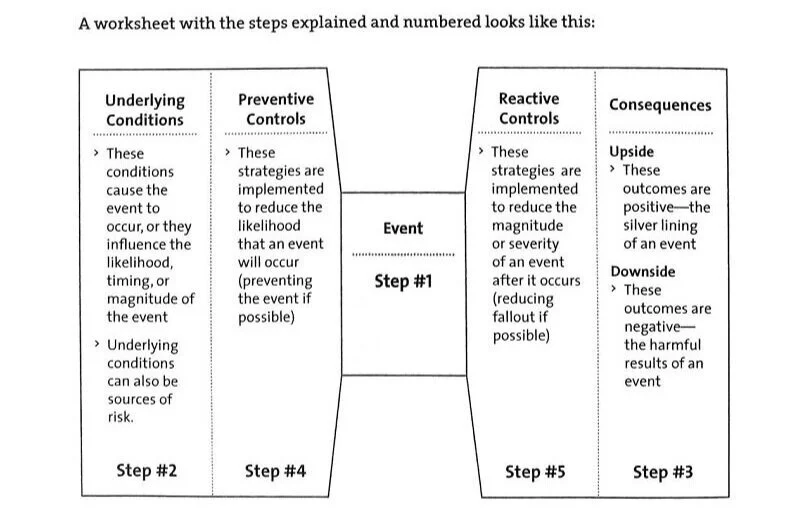
Risk Bow Ties Worksheet image provided by World-Class Risk Management for Nonprofits.
Performing the exercise in a workshop or group setting will usually provide one or more of the following insights:
The group uncovers details of an event that had not previously been discussed or observed.
Both positive and negative consequences can result from one event.
The exercise brings to light unique perspectives and experiences from multiple participants.
Identifying important underlying conditions and consequences better informs the creation of relevant controls.
Team members can perform a risk analysis in a fun, accessible and informal way.
Nonprofit leaders can use a diverse set of tools to analyze and manage risk. Rancho Mesa encourages clients to ask about various tools we have available to prepare for both the expected and unexpected.
To learn more about the Risk Bow Tie technique contact me at sbrown@ranchomesa.com or (619) 937-0175.
Cyber Attacks Threaten One-in-Six Firms’ Survival
Author, Sam Brown, Vice President of the Human Services Group, Rancho Mesa Insurance Services, Inc.
The dramatic increase in cyber-attacks since 2020 has resulted in employer pain and made headlines as the economic cost skyrockets. The recent Hiscox Cyber Readiness Report 2021 states that the number of firms attacked rose from 38% to 43%. Not surprisingly, more than 28% of those employers suffered multiple cyber-attacks.
Author, Sam Brown, Vice President of the Human Services Group, Rancho Mesa Insurance Services, Inc.

The dramatic increase in cyber-attacks since 2020 has resulted in employer pain and made headlines as the economic cost skyrockets. The recent Hiscox Cyber Readiness Report 2021 states that the number of firms attacked rose from 38% to 43%. Not surprisingly, more than 28% of those employers suffered multiple cyber-attacks.
Determining the cost of a breach can be difficult, but the report states that one-in-six firms’ survival was threatened. Over 58% of firms hit with a ransom paid the threat-actors to regain access to the computer system and vital information. In 2020, the standalone cyber loss ratio increased to 73%, its highest level since separate cyber data were included in financial reporting, six years ago.
The increase in cyber-attacks and claim payouts is causing alarm in both insurance companies and businesses. According to the Insurance Journal, insurance companies are quoting significant premium rate increases and tighter coverage terms to improve underwriting performance and profitability. The average cyber renewal premium rate increased 11%. Meanwhile, written premiums for standalone cyber coverage increased 29% in 2020, a sign of growing demand.
The shift to a remote workforce and an increase in phishing email has tested network security systems. Fortunately, many insurance carriers now offer a cyber readiness assessment to help policyholders address vulnerabilities and avoid cyber-attacks.
As cyber-attacks continue, it is important for all employers to learn more about the specific exposures that cyber insurance coverage can cover along with ways to improve cyber security.
We will be offering a Cyber Liability workshop in the coming weeks, so be sure to look for that information on our workshops and webinars webpage.
Please contact me at (619) 937-0175 or sbrown@ranchomesa.com to discuss our process of developing competitive quote options.
Experience Mod KPI Provides Trend Analysis, Opportunity Assessment, and Vital Management Tools
Author, Drew Garcia, Vice President, Landscape Group, Rancho Mesa Insurance Services, Inc.
In January 2021, we launched the Safety Key Performance Indicator (KPI) Dashboard to provide a tool for our customers to use as a bridge between their experience mod and safety performance.
Author, Drew Garcia, Vice President, Landscape Group, Rancho Mesa Insurance Services, Inc.

In January 2021, we launched the Safety Key Performance Indicator (KPI) Dashboard to provide a tool for our customers to use as a bridge between their experience mod and safety performance.
Our primary goals were to:
Eliminate surprises
Simplify concepts
Track performance
Highlight the positive and negative trends
Benchmark safety performance against industry competitors
An experience mod above 100 can limit a landscape company’s ability to be awarded jobs or maintain contracts, increase insurance premiums, and have other significant financial implications.
Our dashboard is a tool companies can use to strategically manage the underlying components that directly impact the experience mod and help project future experience mod deviations. Rancho Mesa can help interpret the results and provide insights to help improve your performance.
Not a Rancho Mesa client but interested in seeing what your dashboard looks like? Complete our new KPI Dashboard quick form, to see how your company measures up.
How to Choose a Workers’ Compensation Carrier Partner
Author, Dave Garcia, President, Rancho Mesa Insurance Services, Inc.
Many years ago, when I was a young producer, one workers’ compensation carrier legend pulled me aside and told me never to forget that a workers’ compensation decision is not a one-year decision, but at least a 4-year decision. Of course, policies are only written on a one-year basis but what he was teaching me was that the carrier you choose will handle all the claims you have through your Experience Modification cycle. So, evaluating and recommending a workers’ compensation partner for my clients just became a much more thorough analysis of many critical factors beyond just the premium.
Author, Dave Garcia, President, Rancho Mesa Insurance Services, Inc.

Many years ago, when I was a young producer, one workers’ compensation carrier legend pulled me aside and told me never to forget that a workers’ compensation decision is not a one-year decision, but at least a 4-year decision. Of course, policies are only written on a one-year basis but what he was teaching me was that the carrier you choose will handle all the claims you have through your Experience Modification cycle. So, evaluating and recommending a workers’ compensation partner for my clients just became a much more thorough analysis of many critical factors beyond just the premium.
I understand and want to acknowledge that competitive pricing is very important, yet other than price, most business owners are not sure what to look for when comparing carriers. All businesses should consider the following in their evaluation of a workers’ compensation carrier:
What is the A.M. Best rating of the carrier?
How long have they been in the State workers’ compensation marketplace?
What is their premium volume within the State?
What “in-house” services does the carrier provide? Two services for special consideration are:
The Claims Department
Loss Control Service
How does their medical cost containment numbers compare to the industry averages?
How does their claim closing rates compare to the industry average?
Are the following services available?
Telemedicine
Nurse Triage
For any businesses that pay above $250,000 in annual premium, should consider these additional questions:
Does the carrier offer a dedicated indemnity claims examiner for your business?
Does the carrier offer Claim Review Meetings?
Does the carrier offer a Client Services coordinator?
Does the carrier offer on-line claim status information?
What loss sensitive programs do they offer?
Further, for any businesses that are exploring loss sensitive programs (usually above $400,000 in annual premium) like deductible workers’ compensation, they should evaluate the following:
What are the terms of the letter of credit required?
Is there a Loss Conversion Factor (LCF)?
Is a Loss Fund required?
How are Allocated Loss Adjustment Expenses (ALAE) handled?
Is there a policy deductible aggregate?
Are there any claims handling charges?
Are there Medical Cost Containment charges?
Since many of the concepts and terms above require a deeper understanding and explanation, listen to my podcast episodes where I examine this topic in greater detail.
Also, consider attending one or both of my live webinars that cover this topic and afford you the opportunity to ask questions. Register for our Thursday April 1, 2021 webinar where I will focus on businesses with annual premiums below $400,000, and/or register for my Thursday April 8, 2021, webinar where I will deal specifically with deductible workers’ compensation. Both webinars will be 30 minutes in length.
If you would prefer to speak with me directly, I can be reached at (619) 937-0170 or email me at dgarcia@ranchomesa.com.
I wish you all a safe and profitable 2021.
A Hardening Employment Practices Marketplace Likely to Impact Many Businesses
Author, Jeremy Hoolihan, Account Executive, Rancho Mesa Insurance Services, Inc.
The Employment Practices Liability Insurance (EPLI) marketplace has faced a number of factors that are contributing to skyrocketing premiums and deductibles. Many insurance companies are facing the choice of whether to remain in the marketplace or exit altogether. Those willing to remain are then faced with having to consider the following changes…
Author, Jeremy Hoolihan, Account Executive, Rancho Mesa Insurance Services, Inc.

The Employment Practices Liability Insurance (EPLI) marketplace has faced a number of factors that are contributing to skyrocketing premiums and deductibles. Many insurance companies are facing the choice of whether to remain in the marketplace or exit altogether. Those willing to remain are then faced with having to consider the following changes:
Increase their premiums to offset increased claim activity
Increase their deductibles
Consider adding exclusions of previously covered exposures
Consider only renewing existing clients’ policies
Pulling out of certain business segments such as retail, hospitality, leisure, and transportation which is currently being impacted the most from COVID-19.
Below are some of the main factors causing the hardening EPLI marketplace. As you will see, they vary significantly but combined they have created a perfect storm.
COVID-19
These are unprecedented times with businesses being forced to shut down for months due to COVID-19, employees having to work remotely and our economy seemingly coming to a standstill. Couple this with a significant increase in layoffs, severance packages, furloughs, and unemployment, and we have seen a significant increase in claims filed. By January 2021, the plaintiff’s bar had filed over 1,200 COVID-19 related employment lawsuits. These types of lawsuits have continued to grow each month since the pandemic began.
We have also seen the unemployment rate spike from 3.5% in March of 2020 to 14.7% in April 2020. Currently the unemployment rate has settled to about 8% but this still represents a double digit increase from2019.
EPLI claims often follow large changes in workforce, including reductions, promotions and demotions. Three areas of particular growing concern include:
Sexual Harassment
Privacy
Retaliation
Sexual Harassment
The heightened awareness and increased public intolerance for harassment developed in part from the #MeToo movement has given a voice to people that are now not only speaking out but filing lawsuits against their employer for sexual harassment. This national attention has also altered the legal environment surrounding these types of claims, often leading to much higher settlements outcomes.. Industry wide, the total monetary benefits awarded to sexual harassment victims has increased 68% from 2016 to 2019 according to the U.S. Equal Employment Opportunity Commission.
Privacy
In addition to discrimination and sexual harassment claims, insurance carriers also anticipate privacy-related claims. As businesses begin to reopen, there are new policies and procedures in place that require a Human Resources department to question employees about their personal health, their health history, and their family’s health history. The nationwide Health Insurance Portability and Accountability Act (HIPAA) and other state-specific laws like the Illinois Biometric Information Privacy Act (BIPA) regulates how companies collect, store, use, and share biometric information. With temperature-taking requirements and a certification form filled out, there is a concern that some employees may feel their privacy has been invaded.
Retaliation
There is also a growing concern that there will be more retaliation type claims relating to an employee’s use of social media. With COVID-19 in mind, employees are already expressing their concerns via social media about their employers’ lack of safety measures or personal protective equipment (PPE). It’s reasonable to consider that if these employees are terminated that they may feel they were retaliated against because of their posts.
Retaliation could also be a result of employees exercising their rights under Family Medical Leave Act (FMLA) or other benefits such as workers compensation or paid sick leave.
US Supreme Court LGBTQ Decision
The Supreme Court ruled in June 2020 that Title VII of the 1964 Civil Rights Act protects employees from discrimination based on sexual orientation and gender identification.
Previously only 28 States awarded such protections. Now that these protections are law in all 50 states, we will likely see additional claims alleging employment discrimination based on gender identity and sexual orientation.
In conclusion, running a business remains a challenge under normal circumstances. Add in the many side effects of the pandemic and it can feel overwhelming. EPLI-related claims can result in catastrophic financial impacts to a company’s balance sheet. The cost of defending your business alone can potentially put a company out of business. While EPLI premiums continue to rise, so does your exposure to a myriad of claims that fall under this coverage umbrella. Having EPLI in place can mean the difference between absorbing fair and reasonable claim costs or forcing an uninsured business to close their doors. To learn more about EPLI coverage and ways to construct a policy that meets your needs, please reach out to me at 619-937-0174 or jhoolihan@ranchomesa.com.
Can Employers Mandate a COVID-19 Vaccination Policy?
Author, Sam Brown, Vice President of the Human Services Group, Rancho Mesa Insurance Services, Inc.
As COVID-19 vaccinations become more available and the positive results of our efforts are realized, employers may ask how this impacts the workforce and a full-scale return to the workplace. More specifically, they may ask if an employer can mandate a COVID-19 vaccination policy.
Author, Sam Brown, Vice President of the Human Services Group, Rancho Mesa Insurance Services, Inc.

As COVID-19 vaccinations become more available and the positive results of our efforts are realized, employers may ask how this impacts the workforce and a full-scale return to the workplace. More specifically, they may ask if an employer can mandate a COVID-19 vaccination policy.
The laws are complex, so please do not rely on this article as legal advice. Please consult your labor law attorney before deciding how to proceed.
The short answer is yes, employers can mandate a COVID-19 vaccination for employees, when it makes sense.
The 1905 court case Jacobson v. Massachusetts forms the U.S. Equal Employment Opportunity Commission’s (EEOC) basis for guidance. Following a deadly smallpox outbreak in New England in 1901, the Supreme Court ruled that the government may impose “reasonable regulations” to protect the “safety of the general public.” The EEOC makes clear that employers may implement similar demands.
According to the EEOC, an employer can implement a mandatory vaccination policy if there is a job-related need for it or if non-vaccination threatens the health of other employees, customers or themselves. The EEOC’s guidelines date back to the 2009 outbreak of H1N1, and was updated in March 2020.
A mandatory COVID-19 vaccination policy would commonly be used in a health care environment or in emergency services where the likelihood of exposure may be higher based on the nature of the work, opposed to the average office environment that is following the Centers for Disease Control COVID-19 guidelines along with implementing a COVID-19 Prevention Plan.
Employers should take caution when deciding whether or not to implement such a policy and whether it makes sense for their industry and organization. According to OSHA’s January 2021 Guidance on Mitigating and Preventing the Spread of COVID-19 in the Workplace, employers should not distinguish between workers who are vaccinated and those who are not. All employee should follow the same safety precautions regardless of vaccination status.
Essential workers in sectors like construction and landscaping, community-based organizations and financial services to name few, can operate under the provided guidance without requiring their employees to get the COVID-19 vaccine in order to resume normal business operations.
Some employers are waiting to impose a mandatory vaccination policy, choosing instead to offer employees incentives for getting vaccinated. These incentives may include a vacation day, a few hours of regular pay, or a cash bonus. To avoid discrimination, an employer may offer the incentive to all employees if the company’s work force meets a vaccination goal. Whatever path you decide, make sure to include the policy in your employee handbook or COVID-19 Prevention Plan.
Considering a recent Kaiser Family Foundation survey, 27% of Americans are “vaccine hesitant.” So, the employer will need to decide if a COVID-19 vaccination policy is right for their organization. Questions regarding mandatory vaccinations will continue to present a challenge to employers.
For specific questions about your company’s vaccine policy, consult our RM365 HRAdvantage™ portal’s live HR experts.