

Industry News

Managing the Inherent Risks of Personal Vehicle Use Within Your Company
Author, Daniel Frazee, Executive Vice President, Rancho Mesa Insurance Services, Inc.
While costs associated with auto liability continue rising across the country, there are risks within existing fleet safety programs that often get overlooked. If your business allows employees to use personal vehicles to conduct business even just occasionally, you could be exposing your firm to considerably more risk.
Author, Daniel Frazee, Executive Vice President, Rancho Mesa Insurance Services, Inc.

While costs associated with auto liability continue rising across the country, there are risks within existing fleet safety programs that often get overlooked. If your business allows employees to use personal vehicles to conduct business, even just occasionally, you could be exposing your firm to considerably more risk. You can ignore this potential gap in coverage or closely examine the exposure while simultaneously developing a risk mitigation plan.
Review and Examine Liability Coverage
Before developing any guidelines, we encourage clients to identify those drivers that are using personal vehicles. Again, the pool here should include regular and non-regular drivers who are using personal vehicles. Once that list is finalized, request current declaration pages and/or certificates of insurance showing coverage periods and limits. As you examine this information, ensure that coverage is in force and pay close attention to the limits as many state minimum coverage requirements will be much lower than typical commercial auto policy limits (Example: $10,000 to $15,000 for bodily injury). Working to develop company standard minimum limits for personal use of vehicles is something you can establish with and through recommendations from your broker partner and carrier.
Hiring with Auto Exposure in Mind
Just as many managers do when hiring employees who will drive company vehicles, consider requiring the same guidelines for potential new hires who may use their own vehicles. These guidelines may include a current Motor Vehicle Report (MVR) which allows you to review accidents and track behavior. You may also enroll drivers in the Employer Pull Notice (EPN) Program which notifies businesses when employees have any type of driving activity in or out of the workplace. Lastly, be prepared with documented steps to take when your drivers exhibit unsafe driving behavior. This can include additional training, a suspension, or even termination depending on the frequency.
Written Expectations and Usage Guidelines for Drivers
Vehicle use agreements have become commonly used documents for employers. Depending on the layout, usage guidelines can help establish clear expectations and encourage real buy-in from the employee. As a reference point, Rancho Mesa offers an example of a usage guideline form available within the Risk Management Center.
Creating and Maintaining a Culture of Safety
Evaluating your respective safety programs is a process that takes time. Many employers are unfamiliar where to even start and perhaps which areas of their operation pose the greatest risk to their business’ financial health. With auto liability, in general, the potential for direct loss can impact balance sheets of all sizes. Part of our role as commercial insurance brokers is tying in years of experience seeing these gaps within programs, like personal vehicle use. We recommend first how to mitigate them and then tailor an insurance program that further reduces or eliminates the exposure. The points listed above represent only the start to your process in revamping your Fleet Safety Program. Call or email Rancho Mesa Insurance for a complete “all lines” safety review and coverage audit. Your company’s financial future could depend on it.
Have You Brushed Up on Your ABC’s?
Author, Emily Marasso, Media Communications Assistant, Rancho Mesa Insurance Services, Inc.
California Assembly Bill 5 (AB 5), better known as the “Gig Worker’s Bill” became law on January 1st 2020 and is designed to reclassify many independent contractors as employees for purposes of wages and benefits. What does this bill mean and how does it affect you?
Author, Emily Marasso, Media Communications Assistant, Rancho Mesa Insurance Services, Inc.

California Assembly Bill 5 (AB 5), better known as the “Gig Worker’s Bill” became law on January 1, 2020 and is designed to reclassify many independent contractors as employees for purposes of wages and benefits. What does this bill mean and how does it affect you??
Previously, employers used the “Borello test” to identify someone as either an independent contractor or employee. In most cases, AB 5 changes the standards to the new “ABC test,” which makes it much more challenging for a person to be classified as an independent contractor. Both the Borello test and the new ABC test assume that the worker is an employee and the employer must prove that the worker is actually an independent contractor.
According to the new law, “a person providing labor or services for remuneration shall be considered an employee rather than an independent contractor unless the hiring entity demonstrates that all of the following conditions are satisfied:
(A) The person is free from the control and direction of the hiring entity in connection with the performance of the work, both under the contract for the performance of the work and in fact.
(B) The person performs work that is outside the usual course of the hiring entity’s business.
(C) The person is customarily engaged in an independently established trade, occupation, or business of the same nature as that involved in the work performed.”
If you have hired an independent contractor who does not pass the ABC test, they likely will now be classified as an employee with minimum wage, unemployment insurance, sick leave, and income tax and social security withholdings. Independent contractors are not entitled to these benefits.
Doctors, lawyers, hair stylists, and insurance agents are just some of the more common independent contractor jobs that are not affected by AB 5. At this time, independent contractors such as architects and engineers are exempt from the ABC Test, but truck owner-operators, surveyors, and geologists are not exempt. In January 2022, contractors will not be able to hire owner-operators truck drivers. They will have to work with a company that has drivers who are employees.
AB 5 is intended to reduce the misclassification of workers and bring equality to the workplace. Although the bill has good intentions, it could negatively affect the way many companies operate. The ABC test has strict guidelines to be considered an independent contractor. With the reins tightening, it will be difficult for companies to enlist independent contractors to supplement their workforce when needed. Employers will be forced to hire actual employees or hold off on hiring employees all together.
For specific questions about AB 5 and how it will affect your business, contact our HR Experts via the RM365 HRAdvantage™ portal.
Skilled Labor Shortages Prompt Subcontractors to Provide Performance Guaranty
Author, Andy Roberts, Account Executive, Surety Division, Rancho Mesa Insurance Services, Inc.
The construction industry is currently booming. According to a survey conducted by the AGC of America, and a recent article written by Rancho Mesa’s Kevin Howard, the industry shows no signs of slowing down, as 80% of contractors predict growth in 2020. While that’s great news for the industry, we are starting to see some trends that can cause some issues for contractors.
Author, Andy Roberts, Account Executive, Surety Division, Rancho Mesa Insurance Services, Inc.

The construction industry is currently booming. According to a survey conducted by the AGC of America, and a recent article written by Rancho Mesa’s Kevin Howard, the industry shows no signs of slowing down, as 80% of contractors predict growth in 2020. While that’s great news for the industry, we are starting to see some trends that can cause some issues for contractors.
With an abundance of work, contractors are finding it more difficult to find the skilled labors required to complete a project on schedule. This is causing more and more general contractors, who historically didn’t require their subcontractors to provide a bond, to now require their subcontractors to bond back to them on contracts over a certain amount.
Bonding back is when a general contractor requires a subcontractor to obtain a performance and payment bond, even though the general contractor is already carrying a bond for the entire project. The bonds from the subcontractor operate in the same way as the bonds that the general contractor provided to the project owner, but now the general contractor has a performance guaranty from the subcontractor. This gives the general contractor an avenue to pursue recourse, should the subcontractor default or fail to perform up to the standards required by the contract, which is something that can happen if the subcontractor is having issues finding enough skilled labor.
Furthermore, this can present a problem for subcontractors who aren’t accustomed to bonding. They would need to get a bonding program put into place in order to work with a general contractor that they may have a long relationship with, who they previously never required a bond back. This makes it very important for subcontractors to have the discussion with the general contractor about potential bond requirements. An upfront conversation with the general contractor can help you avoid getting into a situation where you win a bid, but don’t have the ability to meet the bond requirement.
Fortunately, for contractors that are new to bonds or maybe don’t bond frequently, there are a variety of programs that the different sureties offer, whether it be credit-based, or a more traditional program. We can help navigate those programs and find the solution that works best for their company’s bonding needs.
If you have additional questions or would like to explore all the different options that each surety offers, please contact Andy Roberts at (619) 937-0166.
OSHA Penalties Increase in 2020
Author, Lauren Stumpf, Media Communications Coordinator, Rancho Mesa Insurance Services, Inc.
On January 15, 2020 the Federal Register published the Federal Civil Penalties Inflation Adjustment Act Annual Adjustments for 2020. This final rule increases civil penalties the Department of Labor assesses including those issued by the Occupational Safety and Health Administration (OSHA) based on workplace inspections and potential violations of safety and health standards. The rule is effective January 15, 2020. Beginning January 16, 2020 OSHA civil penalties will increase.
Author, Lauren Stumpf, Media Communications Coordinator, Rancho Mesa Insurance Services, Inc.

On January 15, 2020 the Federal Register published the Federal Civil Penalties Inflation Adjustment Act Annual Adjustments for 2020. This final rule increases civil penalties the Department of Labor assesses including those issued by the Occupational Safety and Health Administration (OSHA) based on workplace inspections and potential violations of safety and health standards. The rule is effective January 15, 2020. Beginning January 16, 2020 OSHA civil penalties will increase.
The new 2020 maximum OSHA penalties are as follows:
Serious violation: $13,494 (increased from $13,260)
Other-than-Serious violation: $13,494 (increased from $13,260)
Repeat violation: $134,937 (increased from $132,589)
Willful violation: $134,937 (increased from $132,589)
Each failure to correct the violation: $13,494 (increased from $13,260)
Each posting requirement violation: $13,494 (increased from $13,260)
For more information about the OSHA Penalties, visit https://www.osha.gov/penalties.
Cal/OSHA Updates: AB 1804 Changes How Injuries and Illnesses Are Reported
Author, Emily Marasso, Media Communications Assistant, Rancho Mesa Insurance Services, Inc.
As of January 1, 2020, California Assembly Bill 1804 (AB 1804) changed how an employer reports a serious employee injury or illness to Cal/OSHA. The bill removes the option to submit the report via email and replaces it with an “online mechanism,” according to Labor Code section 6409.1 (b). Reports may continue to be made via phone.
Author, Emily Marasso, Media Communications Assistant, Rancho Mesa Insurance Services, Inc.

As of January 1, 2020, California Assembly Bill 1804 (AB 1804) changed how an employer reports a serious employee injury or illness to Cal/OSHA. The bill removes the option to submit the report via email and replaces it with an “online mechanism,” according to Labor Code section 6409.1 (b). Reports may continue to be made via phone.
Until Cal/OSHA implements an online mechanism for collecting serious injury and illness reports like Fed/OSHA, emailed reports will be accepted. However, reports submitted by phone are always recommended over an emailed report. Reports submitted via phone or an online mechanism allows Cal/OSHA to ensure vital information is collected that is necessary to evaluate the seriousness of the injury or illness.
Cal/OSHA has not provided an estimated implementation date for the online report submission option.
As a reminder, California employers are required to report serious injury or illness of employees immediately. Serious injuries or illnesses must be reported as soon as practically possible. Deaths must be reported within 8 hours. All other injuries or illnesses must be reported once the employer learns of or should have known of the serious injury or illness.
2020 Promises Growth for Contractors but With a Twist
Author, Kevin Howard, C.R.I.S., Account Executive, Rancho Mesa Insurance Services, Inc.
Based on a recently published survey from the Associated General Contractors of America, 80% of contractors predict growth in 2020…but there is a twist. There is a major labor shortage.
Author, Kevin Howard, C.R.I.S., Account Executive, Rancho Mesa Insurance Services, Inc.

Based on a recently published survey from the Associated General Contractors of America, 80% of contractors predict growth in 2020…but there is a twist. There is a major labor shortage.
The current California Unemployment Rate, is a staggeringly low 3.9% compared to an unbearable 12% during the 2008 recession. As Californians, this statistic is music to our ears. However, for construction owners, the demand to hire skilled workers from an extremely shallow workforce pool has created a need for Best Practices hiring strategies paired with enhanced methods of retaining employees.
As a 13-consecutive year Best Practices Agency, Rancho Mesa provides resources to equip our clients with strategies and methods to enhance human resources strategies. These efforts lead to broader protection from insurable risk.
We are excited to partner with Equal Parts Consulting on February 6, 2020 for a seminar that will equip businesses with the needed methods for this economic environment. Attendees can look forward to the following topics and discussions below:
Strategies and best practices to create an easy to implement hiring process that aligns with your company’s culture.
Effective ways to assess and evaluate talent to ensure they are aligned with your company purpose, values, and culture.
Uncover some of the most important things your business can do to attract and retain the right talent for your culture.
Our goal is to help our contractor clients map out a game plan that will help retain talent, search for needed key employees and create a successful 2020 and beyond. Please feel free to contact me with any questions, at (619) 438-6874.
Work Comp Unit Stat: The Meeting That Saves You Money
Author, Drew Garcia, Vice President, Landscape Group, Rancho Mesa Insurance Services, Inc.
California business owners are aware that their experience modifier (XMOD) is published annually, roughly three to four months before the expiration of their current workers compensation policy term. However, more often than not, companies are missing an incredible opportunity to make an impact on the calculation of their XMOD by strategically evaluating their work comp claims prior to the most critical month in the XMOD calendar known as Unit Stat.
Author, Drew Garcia, Vice President, Landscape Group, Rancho Mesa Insurance Services, Inc.

California business owners are aware that their experience modifier (XMOD) is published annually, roughly three to four months before the expiration of their current workers compensation policy term. However, more often than not, companies are missing an incredible opportunity to make an impact on the calculation of their XMOD by strategically evaluating their work comp claims prior to the most critical month in the XMOD calendar known as Unit Stat.
The Workers’ Compensation Insurance Rating Bureau (WCIRB) defines the process of receiving loss and payroll information by classification as the Unit Statistical Report. The information is reported to the WCIRB by insurance carriers at specific intervals based on your company’s policy effective date. The information is valued for the first time 18 months after the inception of your policy and every 12 months thereafter.
A policy that incepts in January 2020 will be valued for the first time in July of 2021 (18 month mark). This information will remain in your XMOD calculation for the valuations at 30 months and 42 months.
Once this information has been received by the WCIRB, from the respective carriers, it cannot be altered or changed until the following year’s unit stat. Thus, you may have a positive outcome on an existing open claim (reserve reduction or closure) but not see the benefit until the following year. Revisions to the XMOD once published are limited to a few circumstances; more information about revisions can be found here.
The loss information, sent to the WCIRB from the insurance carriers, will be evaluated at the paid (closed claim) or reserved (open claim) amounts. Typically, a claim that has been open for longer than 18 months signifies severity, litigation, lost time, permanent disability, or a combination of the group. For this reason it is absolutely critical that as a part of your risk management process you execute a
pre-unit stat meeting.
When should I schedule my Unit Stat meeting?
What should I do at this meeting?
Who needs to be involved?
How will this meeting save me money?
As a client of Rancho Mesa, we build this meeting into your annual service plan and take care of engaging the parties who need to be involved for the betterment of your XMOD.
Ready to learn more about Unit Stat? Join us for a complimentary 25-minute webinar where we will discuss the process in greater detail and take time for Q&A.
Still not sure if further learning is necessary, ask yourself these questions:
Have you ever been surprised by your XMOD being higher than you would have thought?
Have you ever had an XMOD above 1.00?
Has your XMOD ever caused your premium to increase?
The webinar can be viewed on-demand by clicking the link below.
It’s OSHA 300A Time
Author, Emily Marasso, Media Communications Assistant, Rancho Mesa Insurance Services, Inc.
The holidays have come and gone and here we are at the end of another great year. Year-end means calendar updates, process changes and document reviews, as well as time to prepare for filing your OSHA 300A form.
Author, Emily Marasso, Media Communications Assistant, Rancho Mesa Insurance Services, Inc.
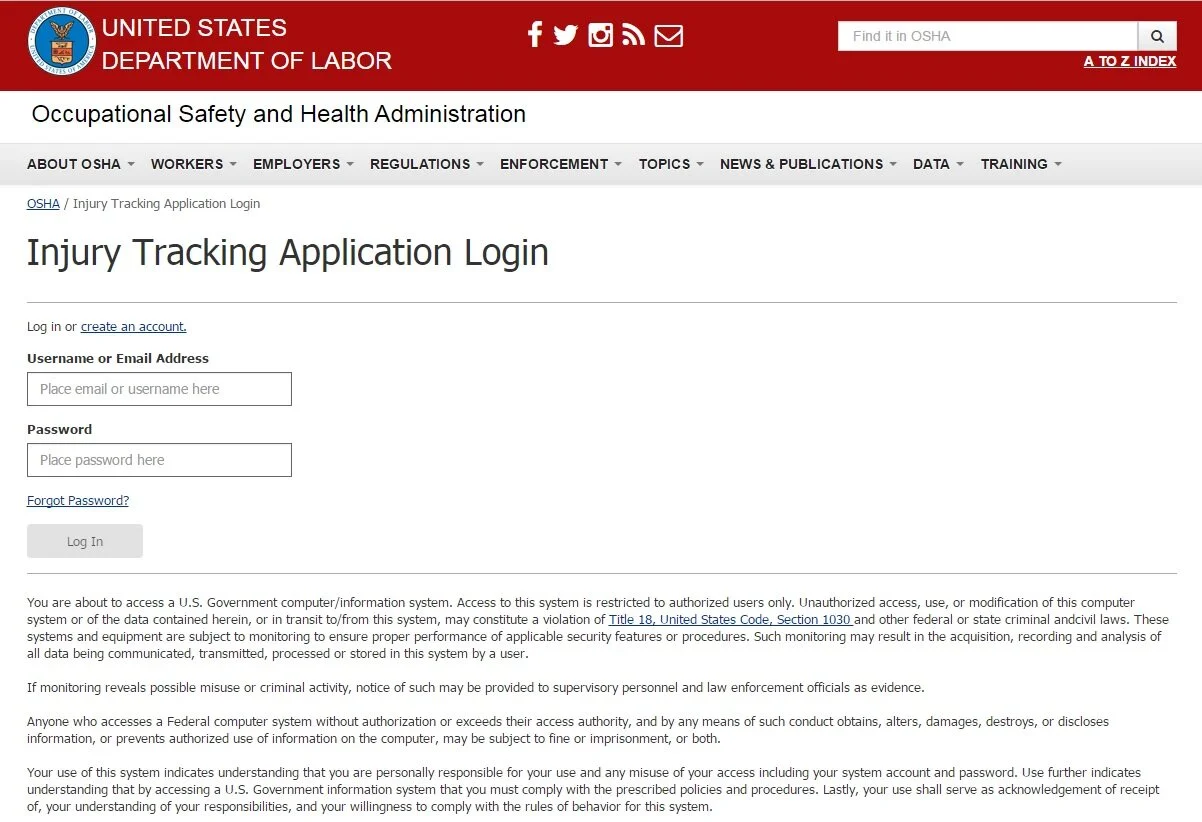
The holidays have come and gone and here we are at the end of another great year. Year-end means calendar updates, process changes and document reviews, as well as time to prepare for filing your OSHA 300A form.
The OSHA 300A form is a summary of injuries and illnesses which occurred on the job during the calendar year. The form must be filed electronically on the Injury Track Application (ITA) starting January 2, 2020. Deadline for 2019 data submissions is March 2, 2020. It must be displayed from February 1, 2020 to April 30, 2020.
Don’t forget, if you are a Rancho Mesa client and utilize the Risk Management Center Incident Track feature, you have access to generate the Cal/OSHA 300A form and export it to a CSV file. From there you can upload it to the OSHA website.
Rancho Mesa has put together a 5-minute tutorial video on how to generate the electronic 300A form data file from the Risk Management Center, that can be uploaded to the Injury Tracking Application website for reporting the data.
For questions about how to track the injury and illness data in the Risk Management Center, contact Alyssa Burley at (619) 438-6869.
Generating Your Employee Handbook Is Easier Than Keeping a New Years Resolution
Author, Casey Craig, Account Executive, Rancho Mesa Insurance Services, Inc.
When business owners are asked if their employee handbooks are up to date, they typically shrug and say “It’s something we have been meaning to tackle.” It is hard to blame them when it often feels as though a newly revised employee handbook quickly requires an update due to changes in employment laws! There is a significant need for an easy to use option where employers can have an up to date handbook throughout the year and, have it generated at no cost. Rancho Mesa provides that solution.
Author, Casey Craig, Account Executive, Rancho Mesa Insurance Services, Inc.
When business owners are asked if their employee handbooks are up to date, they typically shrug and say “It’s something we have been meaning to tackle.” It is hard to blame them when it often feels as though a newly revised employee handbook quickly requires an update due to changes in employment laws! There is a significant need for an easy to use option where employers can have an up to date handbook throughout the year and, have it generated at no cost. Rancho Mesa provides that solution.
As the California workplace climate changes, it is imperative that business owners have solutions before problems arise. Employee lawsuits against their employers are on the rise and Rancho Mesa clients must be prepared for the possible, if not inevitable. While updating an employee handbook can be one of the easiest obligations to neglect, skipping this task can have serious repercussions.
When laws and protocols change over time, it can be difficult making sure your employee handbook is up to date. Make sure it clearly communicates:
What is expected of your employees.
What are your company policies.
What rules are in place.
At Rancho Mesa, we have taken the time to understand our clients’ needs and if there is a solution available, we try to accommodate. We provide a free option for our clients, to help them compose a compliant handbook that is:
State and federal compliant.
Handbook is fully customizable with optional policy update alerts. If a law were to change right after completing your handbook, you would receive an email with the change and have the option to add it to your handbook.
Live HR support to assist with company specific question.
Please reach out to Alyssa Burley at aburley@ranchomesa.com with any questions you may have about the employee handbook builder option through the RM365 HRAdvantage™ portal. If you have any questions pertaining to your insurance needs, please call (619) 934-0164.
The Flu Isn’t the Only Bug You Need to Worry About
Author, Sam Clayton, Vice President, Construction Group, Rancho Mesa Insurance Services, Inc.
When we hear of a data breach, we typically think of large corporations or more recently municipalities that collect customers’ personal identification information or are using technology to manage physical locations (i.e. buildings), transit systems, and people. However, just about any large, medium or small organization that uses technology to operate their business faces a cyber-exposure.
Author, Sam Clayton, Vice President, Construction Group, Rancho Mesa Insurance Services, Inc.

Target, Capital One, and Equifax are all Fortune 500 Companies and household names we recognize. All have experienced a cyber liability breach in the last decade. When we hear of a data breach, we typically think of large corporations or more recently municipalities that collect customers’ personal identification information or are using technology to manage physical locations (i.e. buildings), transit systems, and people. However, just about any large, medium or small organization that uses technology to operate their business faces a cyber-exposure. And, as technology becomes more complex and sophisticated, so do the threats we face, which is why every business and organization needs to be prepared with both cyber liability insurance and an effective cyber security plan to manage and mitigate cyber risk. Below are two different cyber threats your company faces on a daily basis.
Ransomware is a type of malware that prevents users from accessing their system or personal files and demands a ransom payment, typically in the form of Bitcoin, in order to unlock and regain access to your data.
Social Engineering is the fraudulent attempt to obtain sensitive information such as usernames, passwords and credit card details by disguising oneself as a trustworthy entity via e-mail. This is typically accomplished by directing users to enter personal information at a fake website which matches the look and feel of the legitimate website.
A Cyber Liability Policy can help protect against data breaches and other evolving cyber exposures that are not covered by a standard property and general liability policy. These policies can respond in multiple ways such as credit card data remediation and notifications expense, network and information security liability, regulatory defense expense, crisis management expenses and computer program and electronic data restoration expenses.
In addition to the coverages above, many cyber insurers offer policyholders pre-breach services, employee training and IT forensics specialists. Some also provide data breach “coaches” who specialize in the unique legal and regulatory issues surrounding breaches, and will assist businesses with navigating the response process and ensure compliance with state and federal privacy laws.
Please contact Rancho Mesa to learn more about implementing a strong Cyber Prevention Plan.
New Law Changes Which Injuries Must Be Reported
Author, Daniel Frazee, Executive Vice President, Rancho Mesa Insurance Services, Inc.
A new California law, Assembly Bill 1805 (AB 1805), changes when employers are required to report serious workplace injuries to the California Division of Occupational Safety and Health (Cal/OSHA). The law now broadens the scope of what will be classified as a serious illness, injury or exposure. Many believe this change will increase the number of workplace accidents that will have to be reported in 2020.
Author, Daniel Frazee, Executive Vice President, Rancho Mesa Insurance Services, Inc.

A new California law, Assembly Bill 1805 (AB 1805), changes when employers are required to report serious workplace injuries to the California Division of Occupational Safety and Health (Cal/OSHA). The law now broadens the scope of what will be classified as a serious illness, injury or exposure. Many believe this change will increase the number of workplace accidents that will have to be reported in 2020.
The definition of “serious injury or illness” has, for many years, been defined as an injury or illness that requires inpatient hospitalization for more than 24 hours of treatment, or if any employee suffers a “loss of member” or serious disfigurement. The definition has excluded hospitalizations for medical observation. Regulations also excluded from reporting requirements any serious injury caused by a criminal assault and battery or a vehicle accident on a public road or highway.
AB 1805 aligns California’s rules more closely with Federal OSHA regulations for reporting. More specifically:
Rules
The following will need to be reported to Cal/OSHA:
Any inpatient hospitalization (even less than 24 hours),
An inpatient hospitalization is required for something “other than medical observation or diagnostic testing,”
Employers must report any “amputation” (even if the tip of a finger is cut off) to Cal/OSHA. This replaces the terminology “loss of member;”
The loss of an eye,
Serious injuries or deaths caused by a criminal assault and battery,
The exclusion for injuries from auto accidents on a public street or highway remains in effect. However, accidents that occur in a construction zone must now be reported.
Compliance (related directly to serious injuries and illnesses or fatalities)
In order to say in compliance:
The report must be made within 8 hours of the employer knowing, or with “diligent inquiry” should have known, about the serious injury/illness.
The report must be made by PHONE to the nearest Cal/OSHA district office.
For more details on how these changes may impact your company’s IIPP, please contact me at (619) 937-0172.
Employers Embrace Benefits of Telemedicine to Treat Work-Place Injuries
Author, Jeremy Hoolihan, Account Executive, Rancho Mesa Insurance Services, Inc.
Telemedicine is becoming prevalent in the workplace as a more efficient way to treat non-emergency type injuries. Employers, employees, and insurance companies alike are seeing the benefits of telemedicine from a convenience and efficiency standpoint.
Author, Jeremy Hoolihan, Account Executive, Rancho Mesa Insurance Services, Inc.

Telemedicine is becoming prevalent in the workplace as a more efficient way to treat non-emergency type injuries. Employers, employees, and insurance companies alike are seeing the benefits of telemedicine from a convenience and efficiency standpoint.
Telemedicine is defined as the practice of caring for patients remotely when the provider and patient are not physically present with each other. Modern technology has enabled doctors and nurses to consult patients by using HIPAA compliant audio and video conferencing tools.
Benefits of Telemedicine
Immediate access to medical professionals is provided to injured employees and their supervisors; 24 hours a day, seven days a week. This often eliminates the need for scheduling and attending an in-person appointment and waiting room delays.
The injured workers and supervisors avoid lost time from work driving to and from appointments.
Employees who work remotely can quickly gain access to medical assistance.
Minor injuries such as strains and sprains can respond favorably to appropriate on-site first aid. Often times, these types of injuries are referred to off-site clinics for care that is more expensive and more time consuming, but no more effective.
Sound clinical decisions can be made about when first aid is appropriate and when referrals are necessary.
When off-site referrals are necessary, doctors and nurses can direct the injured worker to pre-selected clinics within the insurance companies Medical Provider Network (MPN).
Many telemedicine providers work directly with the employer’s insurance company to provide the first report of injury and create the claim in their system. This eliminates the need for policyholders to report the claim. This also ensures that claims are reported immediately and without delay.
Telemedicine calls are typically recorded for future reference. The recordings are a useful tool in documenting the symptoms and injuries that are initially reported.
How Telemedicine Works
When a workplace injury occurs and the employee requests medical treatment, a call will be placed to the predetermined telemedicine company. The triage nurse that answers will typically speak with the supervisor first, then privately with the injured employee. During the call, the nurse will provide an initial assessment of the injured worker, determine the seriousness, and evaluate the type of medical care that is appropriate. If further medical care is deemed necessary, the nurse will refer the injured employee to a certified occupational physician who can conduct a virtual appointment online via a computer, tablet, or smartphone. If the telemedicine company is not able to conduct a virtual appointment, the injured employee will be directed to a clinic within the MPN.
Once the assessment is complete, the nurse will provide a treatment plan. If the injured employee can safety return to work, the nurse will provide first aid/self-care instructions. Self-care instructions are typically accessed online or faxed. The nurse typically completes the call by speaking once again with the supervisor to ensure they are aware of the treatment plan.
Telemedicine is recognized by many as an efficient way of treating non-emergency injuries in the workplace. In fact, many insurance companies have recently partnered with telemedicine companies to help prevent a minor injury from becoming more complicated, and help the injured employee focus on returning to wellness.
If you would like to have a discussion about telemedicine and how it could be implemented into your workers’ compensation program, please feel free to reach out to me, Jeremy Hoolihan, at (619) 937-0174.
What is an LLC Employee/Worker Bond?
Author, Andy Roberts, Account Executive, Surety Division, Rancho Mesa Insurance Services, Inc.
In California, when a contractor opts to organize their business as a Limited Liability Company (LLC) they are required to maintain an LLC Employee/Worker Bond in the amount of $100,000 in order to obtain their Contractors License, per the California Business and Professions Code, Section 7071.6.5. After our clients receive notice of this requirement, we are often asked why this bond is required and what does it protect against.
Author, Andy Roberts, Account Executive, Surety Division, Rancho Mesa Insurance Services, Inc.
In California, when a contractor opts to organize their business as a Limited Liability Company (LLC) they are required to maintain an LLC Employee/Worker Bond in the amount of $100,000 in order to obtain their Contractors License, per the California Business and Professions Code, Section 7071.6.5. After our clients receive notice of this requirement, we are often asked why this bond is required and what does it protect against.
LLCs are a very popular type of business structure, as they provide the owners, or members, a high level of protection from a liability standpoint because only the LLC, not the owners personally, will be held liable for the debts and liabilities incurred by the business. While this type of protection is good for the owners, California wants to ensure that the LLC’s employees/workers are protected from certain types of monetary damage they may suffer at the hands of the LLC, and they accomplish this by requiring the LLC to have this bond executed by an admitted surety company.
By issuing the bond, the surety company is providing the Contractors State License Board (CSLB) a guarantee that the workers employed by the LLC will receive payment of their wages, up to a limit of $100,000. Additionally, the bond covers interest on wages, fringe benefits, welfare fund contributions, and apprentice program contributions. Should an LLC fail to provide any of the guarantees listed above, a claim may be filed against the bond, which the surety company will pay in order to settle the claim. Once the claim has been settled, the surety will look to the LLC to reimburse them for any money paid out.
Please note, due to the high risk associated with these bonds, they aren’t written as easily or freely as the $15,000 Contractors License Bond, which a lot of sureties provide instant quotes on just based on the owners credit score. In order to qualify for an LLC Employee/Worker bond, sureties will require a completed commercial bond application, Indemnity Agreement executed by all owners and their spouses, company financials, and personal financial statements for all owners.
Should you have any questions regarding LLC Employee/Worker bonds or need one quoted or placed for your business, please give me a call at (619) 937-0166.
Contractors Brace for Impact of 2020 Expected Loss Rates
Author, Kevin Howard, CRIS, Account Executive, Rancho Mesa Insurance Services, Inc.
California contractors focused on their experience modification are paying close attention to the soon to be published 2020 Expected Loss Rates (ELRs).
Author, Kevin Howard, CRIS, Account Executive, Rancho Mesa Insurance Services, Inc.

California contractors focused on their experience modification are paying close attention to the soon to be published 2020 Expected Loss Rates (ELRs).
ELRs determine the expected claim cost per $100 in pay roll for each class code during an Experience Modification (Ex-Mod) period. These rates are updated annually. The 2020 rates were recently approved on September 5, 2019. Changes in each specific class code’s ELR can positively or negatively impact a contractor’s Ex-Mod calculation.
In a nutshell, if an expected loss rate drops from one year to another with no material changes to payroll or claims, Ex-Mod’s will increase. Additionally, if an expected loss rate increases, Ex-Mod’s will decrease using the same example.
Below is a breakdown of the 2020 ELRs per class code with notable double digit increases highlighted:
| Class Code | 2020 ELR | Increase/Decrease % |
|---|---|---|
| 3724 Solar/ Millwright | 1.74 | -4% |
| 5187 Plumbing > $28 | 1.18 | -8% |
| 5183 Plumbing < $28 | 2.6 | -5% |
| 5542 Sheet Metal > $27 | 1.40 | -4% |
| 5538 Sheet Metal < $27 | 2.30 | -12% |
| 6258 Foundation Prep | 2.65 | -3% |
| 0042 Landscape Gardening | 2.59 | -15% |
| 0106 Tree Pruning | 3.91 | -21% |
| 5140 Electrical Wiring > $23 | .81 | -6% |
| 5190 Electrical Wiring < $23 | 1.89 | +2% |
| 5470 Glaziers > $33 | 1.63 | +7% |
| 5467 Glaziers < $33 | 4.30 | -2% |
| 5028 Masonry > $28 | 2.17 | -9% |
| 5027 Masonry < $28 | 4.73 | -18% |
| 5482 Painting/ Waterproofing > $28 | 1.42 | -15% |
| 5474 Painting/ Waterproofing < $28 | 3.68 | -7% |
| 5186 Automatic Sprinkler Install > $29 | 1.11 | +5% |
| 5185 Automatic Sprinkler Install < $29 | 2.45 | -18% |
| 5205 Concrete/Cement work > $28 | 1.95 | -5% |
| 5201 Concrete/Cement work < $28 | 3.95 | -4% |
| 5432 Carpentry > $35 | 2.01 | -7% |
| 5403 Carpentry < $35 | 5.27 | -9% |
| 5447 Wallboard Application > $36 | 1.34 | -12% |
| 5446 Wallboard Application < $36 | 2.76 | -21% |
| 5485 Plastering or Stucco >$32 | 2.66 | -6% |
| 5484 Plastering or Stucco < $32 | 4.78 | -27% |
| 5443 Lathing | 2.37 | -18% |
| 5553 Roofing > $27 | 3.90 | -14% |
| 5552 Roofing < $27 | 9.85 | -4% |
| 6220 Excavation/Grading > $34 | 1.24 | -24% |
| 6218 Excavation/Grading < $34 | 2.34 | -5% |
The data above shows that a majority of class codes will be seeing a decrease in ELRs which will cause higher Ex-Mods in many cases. That reality creates a heightened need for loss control, claim management and post claim strategies. If you are seeking a partner with the tools to address these needs, please reach out to Rancho Mesa Insurance and our team of professionals at (619) 438-6874.
Ensure You’re Not Under Covered and Overpaying for Auto Insurance
Author, Casey Craig, Account Executive, Rancho Mesa Insurance Services, Inc.
Auto insurance prices are continuously rising. What is the reason for this and what can be done to cut back on the cost? There are many factors that lead to the carriers needing to increase their rates. We are going to discuss exactly what some of the reasons for the increases are; and more importantly, what business owners can do to offset price increase as much as possible while receiving adequate coverage.
Author, Casey Craig, Account Executive, Rancho Mesa Insurance Services, Inc.

Auto insurance prices are continuously rising. What is the reason for this and what can be done to cut back on the cost? There are many factors that lead to the carriers needing to increase their rates. We are going to discuss exactly what some of the reasons for the increases are; and more importantly, what business owners can do to offset price increase as much as possible while receiving adequate coverage.
Distracted drivers are causing more claims every year. Repairing a vehicle has become more costly as newer models have technology features such as sensors and back-up cameras. People using their cell phones while driving can cause them to have a diminished reaction time, which is leading to more severe high impact accidents. This is pushing medical costs up at a rapid rate, leading to an increase of claims dollars. Implementing a “No Phones While in a Vehicle” policy could reduce claims drastically and keep your employees safe.
There are many ways that carriers can get out of covering a loss, and employees driving their vehicles to and from job sites can really come back to haunt you if they do not have adequate coverage limits. Make sure that you have Hired and Non-Owned Coverage! Hired and Non-Owned is the coverage needed for the carrier to cover losses on vehicles that are not on the company’s policy, such as rented or employee owned vehicles. Employers need to make sure that employees have adequate personal auto insurance limits. The California minimum coverage limits of $15,000/$30,000/$5,000 can get exhausted very quickly in a serious accident, and lawyers are getting very good at finding grey areas to drag the employer in. You should consider reimbursing your employees to offset the increase in premium for them. Some carriers will apply subjective credits to your company auto premium if they know your employees need to have higher limits to drive for you.
One of the biggest gaps that brokers see when they audit policies for prospects is they are using the wrong symbols, thinking they are covered for a claim, and end up not having correct coverage. Most reputable carriers will offer Symbol 1 for your liability insurance and it is imperative that you use Symbol 1 vs. Symbol 7. Symbol 7 only covers vehicles described in the declaration and leaves limited coverage for vehicles acquired after your policy begins.
Rancho Mesa Insurance Services is a National Best Practices Agency 13 years in a row. We strive to make sure that our clients are without gaps in their coverage. Call (619) 934-0164 to ask about Rancho Mesa’s proprietary programs that help maintain clients’ safety and get them the lowest premiums possible. Register here for the free Fleet Safety webinar to learn how to increase vehicle safety, control vehicle accidents, safeguard long-term profitability, and ensure that your fleet safety & accident prevention programs are up-to-date.
California Wildfires Distress Insurance Market
Author, Chase Hixson, Account Executive, Human Services Group, Rancho Mesa Insurance Services, Inc.
2018 saw the most destructive wildfire season ever recorded in California. Over 1.8 million acres were burned; 22,751 buildings were destroyed and over 100 lives perished. As a result, insurance claims have exceeded $12 billion and are expected to rise.

2018 saw the most destructive wildfire season ever recorded in California. Over 1.8 million acres were burned; 22,751 buildings were destroyed and over 100 lives perished. As a result, insurance claims have exceeded $12 billion and are expected to rise.
Many in the industry expect we are on the verge of a crisis and from what I’ve seen so far, I’d have to agree. The marketplace is in frenzy as carriers aren’t sure what their overall financial hit will be. Furthermore, catastrophic losses like this affect the reinsurance marketplace, which causes pressure downstream to insurers.
Below is a look at what we are seeing in the marketplace.
Non-Renewals
Most carriers are non-renewing their entire books of business who are at risk of wildfires. Even if the client has been with the carrier many years with no losses, they are simply non-renewing properties on accounts in certain areas prone to wildfire. This is essentially leaving the marketplace with very few players.
Significant Premium Increases
Those carriers still willing to write property accounts are hiking up premiums significantly. We’ve heard of increases 5-10 times the previous year’s premiums. We recently spoke to an insured in the Riverside area whose insurance premium went from $85,000 to $500,000 a year.
Increased Deductibles for Wildfires
On top of the significant premium increases, most carriers are offering increased deductibles for wildfires. It’s not uncommon to now see $150,000, $250,000 and $500,000 deductibles depending on the value of the building(s).
What Can Business Owners Do?
Business owners need to act early and quickly. Speak with a broker to plan ahead because it looks like there will be a significant financial burden and risk (per increased deductible) moving forward. The marketplace is inundated with excessive submissions, so the need to submit as early as possible is imperative. There are alternative insurance programs that can act as a temporary solution while helping alleviate cost burdens. Some declinations can be avoided by proper abatement of brush and trees or installation of fire suppression systems. Regardless of when the insurance policy renews, I suggest getting started on this as soon as possible. The marketplace could take several years to stabilize.
For help understanding how wildfires can affect your organization’s insurance premium, contact Rancho Mesa Insurance Services at (619) 937-0164.
Workers’ Compensation Fraud Is Not a Victimless Crime
Author, Jim Malone, Workers’ Compensation Claims Advocate, Rancho Mesa Insurance Services, Inc.
Fraud can happen in every industry, including workers’ compensation. Within workers’ compensation claims, fraud is a term that can be overused by employers who may not agree with a claim, or a condition that has been considered work-related/work-aggravated. Many times, instead of fraud, there is simply a difference of opinion as to whether a specific work incident caused an injury.
Author, Jim Malone, Workers’ Compensation Claims Advocate, Rancho Mesa Insurance Services, Inc.

Fraud can happen in every industry, including workers’ compensation. According to standard definitions, “in law, fraud is intentional deception to secure unfair or unlawful gain, or to deprive a victim of a legal right. Fraud can violate civil law, a criminal law, or it may cause no loss of money, property or legal right but still be an element of another civil or criminal wrong. The purpose of fraud may be monetary gain or other benefits, for example by obtaining a passport, travel document, or driver's license, or mortgage fraud, where the perpetrator may attempt to qualify for a mortgage by way of false statements.”
Within workers’ compensation claims, fraud is a term that can be overused by employers who may not agree with a claim, or a condition that has been considered work-related/work-aggravated. Many times, instead of fraud, there is simply a difference of opinion as to whether a specific work incident caused an injury. For these disputes, it usually comes down to a medical opinion addressing whether something is work-related or work-aggravated.
Examples of Workers’ Compensation Fraud
A claim can become fraudulent when the employee lies about how the injury occurred or about their ability to work. The treating physician may be asked to provide their opinion as to whether the injured worker mislead them about how their injury occurred, and the significance of their complaints or physical capabilities. The doctor is provided records or sub rosa videotape contradicting information previously provided by the injured worker. Fraud can also occur when the injured worker lies under oath during a deposition, thus becoming a felony.
Workers’ compensation fraud is not limited to employees, but others within the system can also knowingly participate in the fraud. Physicians can be fraudulent in their billing for services not rendered, for accepting kick-backs, or realizing financial benefit for referrals to and from other physicians, vendors or other entities. Employers can commit insurance fraud by understating their number of employees, under-reporting payroll or misclassifying employees into cheaper job/class codes in order to secure cheaper insurance policy rates and premiums. Vendors can commit fraud by billing insurance carriers for products or services never provided. Attorneys can use illegal capping schemes to retain injured workers for clients.
Combating Workers’ Compensation Fraud
Each insurance company is now required to have a Special Investigative Unit (SIU) that provides ongoing monitoring and investigation of questionable activities related to claims. Fraud continues to cost tax-payers millions of dollars (some estimates are up to $80,000,000) per year. The money and resources the employers and insurance carriers are spending to combat fraud are also increasing each year.
In the event of a fraud conviction, fines or assessments, prison sentences, or restitution can be ordered. Workers’ compensation fraud is not a victimless crime; from the losses caused by fraudulent activities, to the money used to combat and prosecute fraud. The money lost to workers’ compensation fraud can never be replaced, but we are all responsible to do our part in remaining vigilant and reporting suspected fraud to the appropriate person or agency.
Senate Bill 778 Extends Employee Anti-Harassment Training Deadline
Author, Alyssa Burley, Media Communications and Client Services Manager, Rancho Mesa Insurance Services, Inc.
Newly passed Senate Bill 778 (SB 778) extends the deadline set in Senate Bill 1343 for California’s mandatory Anti-Harassment Training from January 1, 2020 to January 1, 2021. The bill also addresses concerns about supervisory employees and clarifies when temporary workers must be trained. California Governor Newsom signed the bill into law on August 30, 2019, which included an urgency clause that allows the bill to go into effect immediately.
Author, Alyssa Burley, Media Communications and Client Services Manager, Rancho Mesa Insurance Services, Inc.
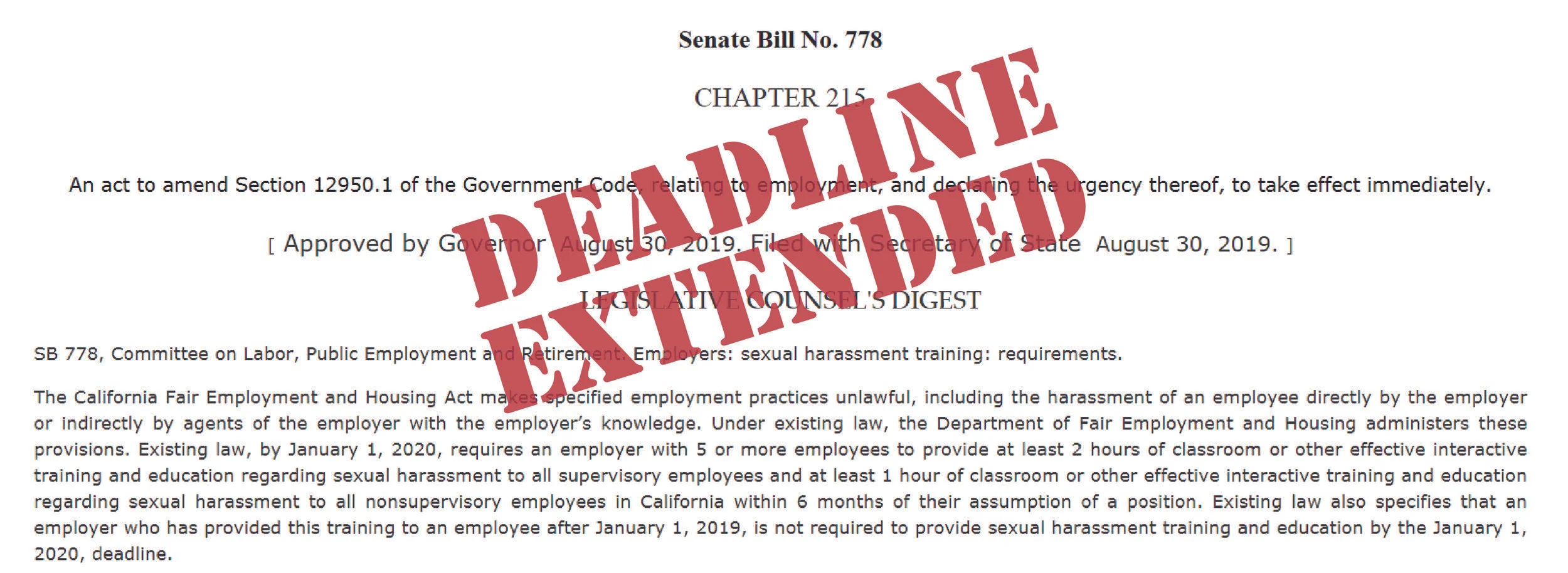
Newly passed Senate Bill 778 (SB 778) extends the deadline set in Senate Bill 1343 for California’s mandatory Anti-Harassment Training from January 1, 2020 to January 1, 2021. The bill also addresses concerns about supervisory employees and clarifies when temporary workers must be trained. California Governor Newsom signed the bill into law on August 30, 2019, which included an urgency clause that allows the bill to go into effect immediately.
What SB 778 Means to CA Employers
The changes made by SB 778 not only extends the deadline for non-supervisory employee Anti-Harassment training, but also allows supervisory employees to stay on their existing two-year training schedule. For example, if a supervisory employee completed Anti-Harassment training in 2018, their next training, with the SB 1343 compliant content, will be due in 2020 - two years from their last training date, which is before the new deadline. Likewise, if a supervisory employee was trained in 2019, their next training due date will be in 2021.
Non-supervisory employees will need to complete their initial 1-hour Anti-Harassment training by January 1, 2021. For those who have already taken the training in 2019, we recommend they maintain their two-year schedule, and complete the training again in 2021.
Both supervisory and non-supervisory employees must be trained within six months of hire. However, temporary or seasonal workers who are hired for less than six months must be trained within 30 days of hire.
For questions about this training requirement or to learn how to enroll your supervisors and employees, register for the “How to Enroll Supervisors and Employees in the Online Anti-Harassment Training” webinar or contact Rancho Mesa’s Client Services Department at (619) 438-6869.
California Workers’ Compensation Dual Wage Thresholds Increases Approved for Construction Classes in 2020 – Bottom Line Hit Hard
Author, Sam Clayton, Vice President, Construction Group, Rancho Mesa Insurance Services, Inc.
In an effort to keep you informed, so that you can begin to budget for 2020, we wanted to let you know of the approved changes in the dual wage classifications effective January 1, 2020.
Originally published May 23, 2019.
Updated September 19, 2019.
Author, Sam Clayton, Vice President, Construction Group, Rancho Mesa Insurance Services, Inc.

In an effort to keep you informed, so you can begin budgeting for 2020, we want to let you know of the approved changes in the dual wage classifications effective January 1, 2020.
The increases range from $1.00 to $3.00 per hour, to keep the thresholds in line with inflation. However these changes will have an immediate effect on your bottom line.
In the classes of business that are facing a $3 increase, this equates to a low of 9.3% to a high of 10.3%. See the chart below for the actual approved changes. Not only does this have an impact on wages, payroll taxes, and your bottom line, it may also have an impact on your workers compensation premiums. If you find yourself in a situation where the wage increase is not practical, this will push those employees into the under classification which will have a substantially higher workers compensation rate. In either case, proactive planning will be required so you’re not caught unprepared.
Following are the individual classes and approved changes:
Dual Wage Thresholds
| Classification | Current Threshold | 2020 Threshold | Threshold Difference | Last Changed |
|---|---|---|---|---|
| 5027/5028 Masonry | $27 | $28 | $1 | 2013 |
| 5190/5140 Electrical | $32 | $32 | $0 | 2018 |
| 5183/5187 Plumbing/Heating/Refrigeration | $26 | $28 | $2 | 2014 |
| 5185-5186 Fire Sprinkler | $27 | $29 | $2 | 2009 |
| 5201-5205 Concrete or Cement Work | $25 | $28 | $3 | 2018 |
| 5403/5432 Carpentry | $32 | $35 | $3 | 2018 |
| 5446/5447 Wallboard Application | $34 | $36 | $2 | 2018 |
| 5467/5470 Glaizers | $32 | $33 | $1 | 2019 |
| 5474/5482 Painting/Waterproofing | $26 | $28 | $2 | 2018 |
| 5484/5485 Plastering or Stucco Work | $29 | $32 | $3 | 2018 |
| 5538/5542 Sheet Metal Work | $27 | $27 | $0 | 2014 |
| 5552/5553 Roofing | $25 | $27 | $2 | 2018 |
| 5632/5633 Steel Framing | $32 | $35 | $3 | 2018 |
| 6218/6220 Excavation/Grading | $31 | $34 | $3 | 2018 |
| 6307/6308 Sewer Construction | $31 | $34 | $3 | 2018 |
| 6315/6316 Water/Gas Mains | $31 | $34 | $3 | 2018 |
In an effort to help control workers compensation costs, we have developed several proprietary programs including the RM365 Advantage Safety Star Program™ and RM365 StatTrac™ that can help control these increases. Please reach out to me at sclayton@ranchomesa.com to ask any questions about the above or to learn more about our proprietary programs.
3 Benefits to Working with an Insurance Specialist vs. Generalist
Author, Jeremy Hoolihan, Account Executive, Rancho Mesa Insurance Services, Inc.
Most insurance agencies welcome any and all types of businesses, paying little attention to the type of business the prospect is running. These accommodating professionals will commit to quote virtually any person or business looking for insurance coverage. With this type of approach, inevitably the buyer will be working with a jack of all trades, but a master of none.
Author, Jeremy Hoolihan, Account Executive, Rancho Mesa Insurance Services, Inc.

Most insurance agencies welcome any and all types of businesses, paying little attention to the type of business the prospect is running. These accommodating professionals will commit to quote virtually any person or business looking for insurance coverage. With this type of approach, inevitably the buyer will be working with a jack of all trades, but a master of none. Working at Rancho Mesa Insurance for nearly 16 years, I’ve learned the importance of focusing on a niche or vertical market, rather than attempting to write insurance for anything with a pulse. The two vertical markets I focus on are the janitorial and construction industries. Below are three reasons why I believe a business owner should consider working with a specialist rather than a generalist.
Avoid Gaps in Coverage:
Having a trusted advisor that is a specialist in your industry can truly minimize potential gaps in coverage that otherwise might get overlooked by someone dabbling in your industry. Some examples include:
Allowing an exclusion of coverage to a policy where the insured has exposure: Unfortunately I see this all too often when I audit a prospects policy. I once reviewed a residential general contractor’s (GC) insurance policy and found a subsidence exclusion. This posed a serious concern because the GC builds foundations. If they were ever served with a claim relating to a foundation sinking or failing, there would likely be no coverage. I’ve also seen residential GC’s who build new homes with a residential exclusion. It’s these types of errors that can put a business in tremendous jeopardy.
Missing key coverage’s to plug gaps in coverage: Most contractors are required to carry workers’ compensation and general liability insurances. However there are many exposures that a contractor has in their operations that would be excluded without additional coverage’s in place. One example is pollution liability. If a plumber installs a faucet that leaks over time, undetected, and causes mold or fungus to develop, you will likely run into a pollution liability claim for bodily injury and/or property damage. Most general liability policies have a pollution exclusion. Without the knowledge of placing a separate pollution liability policy in place, the plumbing contractor would be faced with a gap in coverage.
Knowledge of Specialty Coverage’s and Markets:
Brokers who understand the operations and challenges faced by a particular vertical market have an opportunity to position themselves as risk management and coverage expert in that field. Specialization can also lead to specialty markets seeking brokers out to work with. Specialty markets seek brokers with expertise in their specific niche because they know the marketplace, and proper coverages can provide a steady flow of business. These relationships often lead to a much more comprehensive policy at an aggressive price. In addition, these programs include coverages that you would normally purchase individually that come standard to the program.
In the janitorial industry, one example is 3rd party crime coverage. Many of your standard market package policies will include 1st party crime coverage for employee theft. While this coverage is very important against an employee stealing from an employer, it does not cover theft of a client’s property from an employee. In order to cover this exposure, a policy needs to have 3rd party crime coverage.
Industry Specific Resources:
Partnering with a broker and agency, like Rancho Mesa Insurance, will also provide industry specific resources that generalist agencies will not. Below are a few examples of what you should expect when working with a specialist like Rancho Mesa.
Industry Specific Workshops – such as OSHA 10 Certification, Mobility & Stretch, Heat Illness Prevention, Fleet Safety, Fighting Fraud in CA Workers’ Compensation, etc.
Industry Specific Training Materials – extensive training library of over 3,000 titles in both online and in-person formats, available in English and Spanish
A dedicated Workers’ Compensation Claims Advocate to aggressively work on a client’s existing claims.
HR Benefits – rely on a team of HR experts who can quickly answer complex human resource and compliance questions over the phone or via email.
Comprehensive Living Employee Handbook – create and maintain your customizable employee handbook plus receive suggested updates when laws change.
Client Services Advocacy – In house dedicated client services coordinator to assist with implementation of risk management services.
Rancho Mesa Insurance is dedicated to becoming a trusted advisor to their clients by providing a 365 day approach to Risk Management. Our laser focus on specific industries has allowed us to build comprehensive programs that our clients are able to benefit from. If anything in this article resonates with you, please feel free to reach out to Rancho Mesa Insurance at (619) 937-0164.