

Industry News

Update on California Workers’ Compensation Reform Efforts: APCIA Launches Public Awareness Campaign
As part of Rancho Mesa’s ongoing efforts to support meaningful reform around cumulative trauma claims, I want to share an important update on recent developments within the California workers’ compensation system.
Author, David Garcia, President & CEO, Rancho Mesa Insurance Services, Inc.

As part of Rancho Mesa’s ongoing efforts to support meaningful reform around cumulative trauma claims, I want to share an important update on recent developments within the California workers’ compensation system.
The American Property Casualty Insurance Association (APCIA), in collaboration with a broad coalition of business organizations, has launched a new public awareness campaign: “Fix CA Workers’ Comp Now.” This initiative includes a dedicated website, media outreach, and targeted digital advertising across social media, streaming services, and connected TV platforms.
What this means for California businesses:
The coalition is advocating for practical reforms aimed at improving the stability, fairness, and long-term sustainability of California’s workers’ compensation system.
The current campaign is focused on building awareness and support, and is not yet tied to a specific piece of legislation.
More detailed updates on potential legislative proposals and timelines will be shared as the effort progresses.
You can learn more and share the initiative at the Fix CA Workers' Comp Now website.
We will continue to closely monitor these developments and keep our clients informed as additional details emerge. If you have questions or would like to discuss how this may impact your organization, please reach out to Rancho Mesa at any time.
A Letter from RMI President to California Clients: Take Action On CT Claims Legislation
Rancho Mesa would like to provide you with an update on our efforts related to the growing cumulative trauma issue impacting the California workers’ compensation marketplace. As many of you have experienced firsthand, cumulative trauma claims continue to rise and are having a significant, negative effect on premiums and experience modification rates (EMRs) across all industries.
Rancho Mesa would like to provide you with an update on our efforts related to the growing cumulative trauma issue impacting the California workers’ compensation marketplace. As many of you have experienced firsthand, cumulative trauma claims continue to rise and are having a significant, negative effect on premiums and experience modification rates (EMRs) across all industries.
Over the past year, we’ve worked to better understand the root causes of this problem. We’ve hosted podcasts with industry experts and recently held a Cumulative Trauma workshop with a leading workers’ compensation carrier. From these conversations, one conclusion is clear, meaningful reform is needed.
To help advance that discussion, I’ve written letters to both the State Senator and Assembly Member who chair the committees responsible for potential legislative changes. While major action is unlikely during an election cycle, it’s important that our representatives understand the real-world impact this issue is having on California businesses.
Our intent is not to limit legitimate cumulative trauma claims, but rather to establish sensible guardrails that help prevent the growing abuse of the system. I’m attaching drafts of the letters I’ve submitted on behalf of Rancho Mesa. If you are inclined to join this effort, please feel free to use or modify them as you see fit.
Your voice matters, and collective engagement is often what drives meaningful change.
I hope you will consider joining me in supporting this much-needed reform.

David J. Garcia
President, Rancho Mesa Insurance Services Inc.
Send Letters to the Following
Senator Lola Smallwood-Cuevas
senator.smallwood-cuevas@senate.ca.gov
Assembly Member Lisa Calderon
assemblymember.calderon@assembly.ca.gov
2026 Legal Updates Reshaping California’s Private Construction Sector
Author, Josh Hill, Account Executive, Rancho Mesa Insurance Services, Inc.
California’s private construction industry has entered 2026 with two major legal changes that will significantly impact how contractors and subcontractors manage cash flow, negotiate contracts, and process change order work. Beginning January 1, 2026, California Senate Bill 61 Private works of improvement: retention payments (SB 61) and Senate Bill 440 Private Works Change Order Fair Payment Act (SB 440) took effect, reshaping longstanding practices around retention and change order payments. These laws apply only to new private works contracts signed on or after that date, leaving existing agreements untouched.
Author, Josh Hill, Account Executive, Rancho Mesa Insurance Services, Inc.

California’s private construction industry has entered 2026 with two major legal changes that will significantly impact how contractors and subcontractors manage cash flow, negotiate contracts, and process change order work. Beginning January 1, 2026, California Senate Bill 61 Private works of improvement: retention payments (SB 61) and Senate Bill 440 Private Works Change Order Fair Payment Act (SB 440) took effect, reshaping longstanding practices around retention and change order payments. These laws apply only to new private works contracts signed on or after that date, leaving existing agreements untouched.
These updates aim to correct chronic pain points for contractors who have long shouldered the financial burden of excessive retention and slow moving change order approvals.
A New Era for Retention: SB 61 Sets a 5% Cap
For decades, retention practices in California’s private works sector varied widely, with some upstream parties imposing retention rates higher than those seen in public projects. SB 61 changes that landscape by capping retention at 5%, aligning private contracting with the standards already established for public works.
This shift is intended to create more predictable cash flow throughout the contracting chain. Contractors and subcontractors may need to revise their contract templates and ensure that the new cap flows consistently through all tiers of subcontracts. The responsibility now falls on every party to verify that contract language mirrors the law, preventing scenarios where a subcontractor is held to a higher retention percentage simply because an outdated template was used.
The statute also carries financial consequences for disputes where a prevailing party seeking to enforce the retention cap may recover reasonable attorney’s fees.
There are, however, some exceptions to the new law. Purely residential projects of four stories or fewer are excluded unless it is part of a mixed use development. Additionally, if a higher tier contractor gives written notice before bidding that payment and performance bonds are required and the subcontractor chooses not to furnish them the retention cap does not apply.
SB 440: Bringing Fairness and Timeliness to Change Order Payments
Equally impactful is SB 440, which tackles one of the industry’s most persistent friction points, the slow approval and payment of extra work. Many contractors have grown accustomed to performing additional work promptly while waiting weeks or months for owners to process and compensate approved change orders.
SB 440 introduces firm deadlines designed to eliminate that delay. Once a contractor or subcontractor submits a change order claim via registered or certified mail, the project owner has 30 days to issue a written response identifying approved and disputed items. Any undisputed portion must be paid within 60 days of that response.
Failure to respond triggers a powerful remedy where the contractor or subcontractor may have the right to suspend work without penalty.
The intent behind SB 440 is straightforward accelerate reviews, encourage timely resolution of disagreements, reduce the financial strain created by float funding extra work, and ultimately keep projects on schedule. By establishing clear accountability, the law aims to ensure that contractors are no longer forced to operate as involuntary lenders on privately funded construction projects.
January 1st, 2026 and Beyond
Owners, contractors, and subcontractors should update their internal processes to comply with SB 41 and SB 61. Contract language, administrative workflows, and change order procedures should be reviewed to ensure they align with the new requirements. Subcontractors, in particular, should make it routine practice to obtain and review the prime contract to verify proper flow down provisions for both retention and change order rules. Understanding these new laws and adjusting practices accordingly will help protect your margins, avoid disputes, and ensure compliance as the industry transitions into this new regulatory landscape.
Rancho Mesa is happy to assist with any questions you may have regarding SB 41 and SB 61. Please direct your questions to me at jhill@ranchomesa.com or (619) 798-2819.
Navigating California Labor Laws: Key Compliance Challenges for Contractors
Jason Fischbein of Fisher Phillips sits down with Matt Gorham to discuss some of the primary labor and employment law issues currently impacting contractors, especially those within the HVAC and Plumbing industries.
Author, Matt Gorham, Account Executive, Rancho Mesa Insurance Services, Inc.
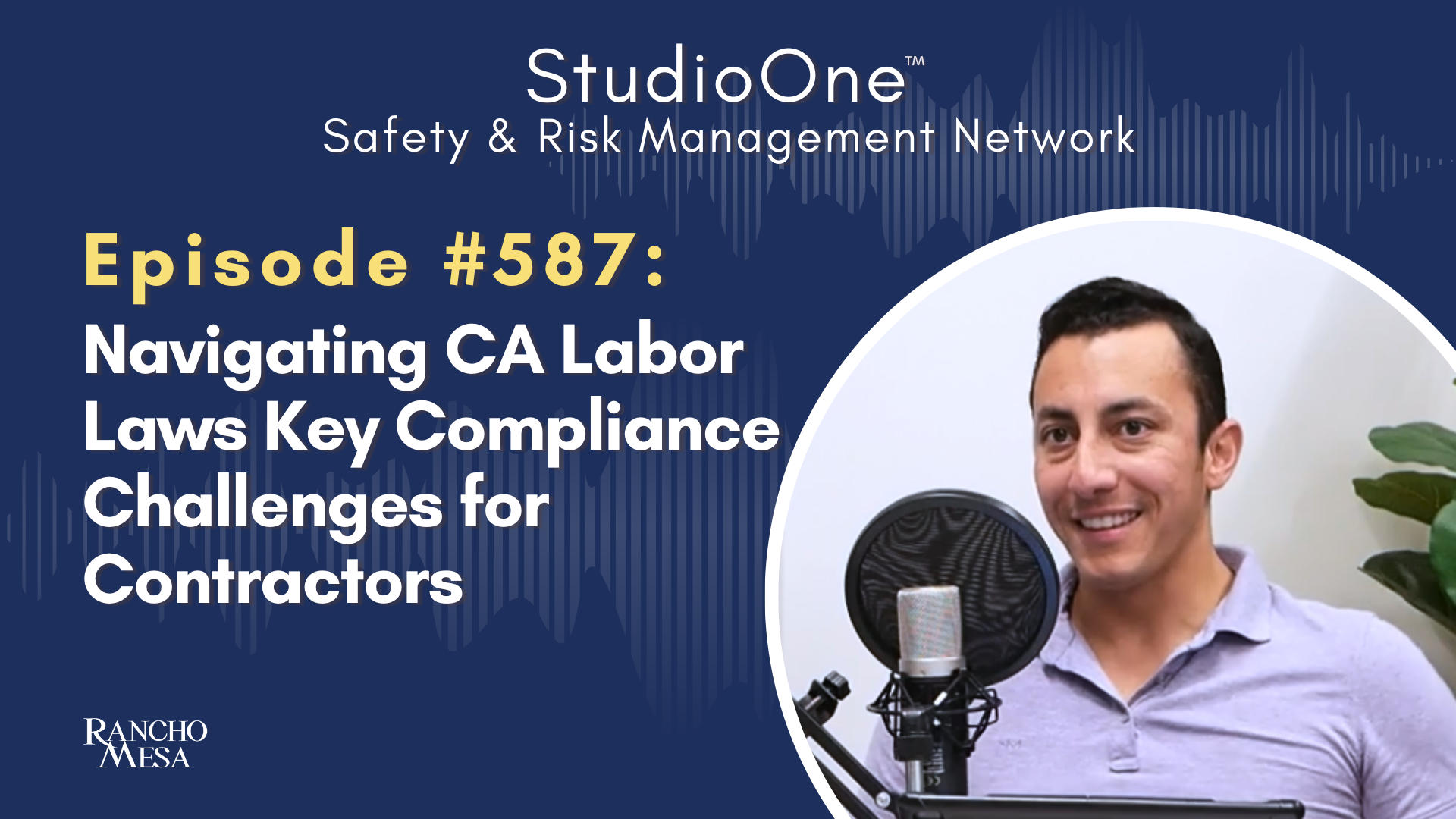
Jason Fischbein of Fisher Phillips sits down with Matt Gorham to discuss some of the primary labor and employment law issues currently impacting contractors, especially those within the HVAC and Plumbing industries.
Recognized by San Diego Business Journal as one of the 40 Next Business Leaders Under 40, Jason provides insights to the challenges of compliance with California’s highly technical labor code, specifically around meal breaks and rest periods, determining regular rates of pay, and the importance of the interactive process for employee accommodations.
Jason also discusses how wage and hour issues can develop into PAGA claims, and offers suggestions to avoid them.
Matt Gorham: You're listening to Rancho Mesa’s StudioOne™ podcast, where each week we break down complex insurance and safety topics to help your business thrive. I'm your host, Matt Gorham, and I'm joined by Jason Fischbein with Fisher Phillips, and I appreciate you being here. So, yeah, Jason, first and foremost, thanks for making the time to sit down with me.
Jason Fischbein: Thanks for having me, Matt. First ever podcast for me, so looking forward to it.
MG: I'm excited to hear how it goes. So let's jump in. I guess I want to start first because I know San Diego is a really close-knit market, a really interesting community here. And so you're from Chula Vista, so you're from the San Diego area. You've got a lot of personal experience here.
JF: Yep. San Diego, born and raised. I grew up in Chula Vista. Currently live in North Park and have been in San Diego my entire life, apart from three years of law school.
MG: Well, I understand you also went to UCSD, correct?
JF: Yes, UCSD for undergrad. I was a political science major at Roosevelt College and loved my time up there. Nothing beats going to college so close to the beach, right?
MG: I can relate to that. I mean, I fellow triton here. So, yeah, I'm sure we've got some stories that we can share offline. But you mentioned, of course, three years away from the San Diego area to go to school, and you went to Stanford.
JF: Yeah, Stanford for law school. Bay Area, of course, is not too different, but I was eager to come back to San Diego, all my family's here. And I always knew that right after law school, I'd come straight back and start my practice with a focus on employment law.
MG: That's fantastic. You know another personal connection for me. My dad's a Stanford alum, so obviously speaks to your qualification and your insights. I mean, you were recognized as 40 Next Business Leaders Under 40 by the San Diego Business Journal. Tell me about that.
JF: That was quite the honor. And that was bestowed on me last year. It's something that I'm proud of. and it's always rewarding to be recognized in my hometown community.
MG: Well, congratulations to you on that. And, you know, it's a testament to you and your work, your expertise, and the way that you serve your clients. So we'll jump into some questions here. And just to clarify the point, of course, that you focus specifically on labor and employment law. And so we're really going to offer some, I think, valuable insights on some of these areas here. With that focus, what are some of the most common challenges that contractors run into with respect to labor and employment law?
JF: Yeah, thanks, Matt. So you're exactly right. My practice is 100% employment law and focusing specifically on the management side, so representing businesses. And I would say that the biggest challenge that I'm seeing from plumbing, HVAC clients, but also clients in practically any industry, is how to comply with California's labor code, which is hyper-technical and also uncompromising.
The penalties for violating the labor code can be very severe and the consequences can be dire. So just one example off the top of my head. In the plumbing industry, for example, often the employees are compensated either on a commission basis or with bonus compensation. And depending on what type of compensation the plumber is receiving, the company needs to make sure that they're incorporating that type of incentive compensation in the rate that employees are earning for their meal break premiums, their rest break premiums, their overtime pay, their sick leave pay. So there's all sorts of factors to be aware of simply because an employee receives a non-discretionary bonus and now leads to all these other ramifications.
MG: Yeah, I really like the way that you use the word hyper-technical there. You know, it does seem like there are certain laws that almost contradict other laws and use some technical language here, of course, because it does depend on the specifics of the situation, and they don't always translate well to, you know, plain English, where I think it is really beneficial for people to work with you or someone like you because you can help them understand how do these hyper-technical terms really apply within the operations of their business?
And the fact that you work exclusively with the business side of management, you can help them to navigate the complexity of it and make decisions that set them up for success depending on what roles their employees are performing for them. Whether those are true salespeople, whether those are technicians, or whether there's a mixture of responsibilities for particular individuals that work for them.
JF: Yeah, absolutely. And you're exactly right. Whether they are exclusively focused on sales or whether they're at the client customer sites doing the hard technical work, it can drastically vary what rules of play are governing the compensation structure.
MG: Yeah. And so, you know, compliance, a lot of different ways that that can be interpreted or applied. But I'm curious to hear, because you mentioned that there are ramifications and consequences.
What would you say are the three, I guess, kind of main issues that plumbing/HVAC clients are coming to you for? Because I imagine most of them fall within compliance. But are those specific areas you mentioned meal breaks, rest breaks, commission structure. Can you speak a little bit more about some of those main issues?
JF: So I was going to start with meal and rest breaks. You hit the nail on the head there. It's very important in California that a meal break and a rest break be completely uninterrupted. So what we mean by uninterrupted is the employee cannot be receiving any work-related emails, any work-related calls, or fielding any work-related questions when they should be taking their meal break or the rest break. And if they do get a work-related call and they answer that call, they're going to either have to be paid a meal break premium for that interrupted meal break or, as soon as possible, reset things and go and take now a true proper uninterrupted 30-minute meal break. Right?
And practically speaking, it may not always be possible to reset that meal break. So now we have to be aware of, well, we need to pay this particular employee a premium because their break was interrupted. And then the question is, what hourly rate should that premium be paid at? And that entirely depends on their base rate of pay, as well as any non-discretionary bonuses they're receiving.
So for example, if they receive a bonus because they were able to refer a particular customer to an additional service that they're purchasing or that they're receiving from the company. Now potentially we have to incorporate the value of that compensation into the meal break premium rate. And it can get quite complicated. So we call this the regular rate of pay. Determining the regular rate of pay is always very tricky, especially in industries where the hourly employees are receiving all sorts of non-discretionary compensation, as is common in the plumbing industry in particular.
MG: Yeah, it's interesting you talk about, you know, the uninterrupted nature of these meal breaks, which is so difficult on both the construction side, you know, for guys that are at the job site of what conversation or what responsibilities, they're able to just completely shut down that aren't in some way able to be construed as work related. Or on the service side, you know, where guys are going from one job site to the next, you know, or one service call to the next. And so their breaks are more or less drive time. You know, is that really considered a break? I think most people would say no and yes at the same time, depending on how you interpret it. Obviously, the law is going to say no, but, you know, meal breaks in particular, you know, it’s common for people to just pick up food on the way from one call to the next. And so it's not really having uninterrupted time for a break, but it's kind of common practice. So it does seem like it's very difficult to provide those uninterrupted breaks.
JF: Right. And it's challenging just to track them, right? Because if you have an employee that's in the field, they're servicing one home on a plumbing issue, and then their next job is 20 minutes away, so they're driving to another customer's home. Making sure that the employee is tracking when their break time starts, when their break time ends, and ensuring that they're not performing any work-related activities during that time can be difficult in and of itself. So yeah, I completely agree with you. It can be tricky and most importantly we need to emphasize clear policies and practices. The employee needs to understand what is expected of them. And then we need to enforce those policies and practices, right? That's the logical next step. So if we have an employee that is not taking an uninterrupted break instead they are just eating and driving and going to the next client's site I would consider that to not be a truly uninterrupted break so my guidance to my clients all the time is to emphasize to the employees you need to take an uninterrupted break you should not be performing any work-related activity during that break and that would include driving to wherever the next job is, right? That counts as work-related activity, and that is not sufficient for a break. That break needs to be uninterrupted.
And, of course, if the break is interrupted, if the break is interrupted, the employee should be able to report that to the company, and the company then needs to be able to investigate, you know, what were the factors and circumstances at play that prompted this employee to say that they could not take an uninterrupted break. And if the company deems that break to have been interrupted, now the company should, in all likelihood, be paying a meal period premium. But there should be a process in place to basically allow the employee to report an interruption to the break and then allow the company to investigate and review the circumstances so that they can then make that decision as to what sort of premium needs to be paid.
MG: Yeah, it makes sense. So you mentioned that meal breaks and interest periods are kind of the top issue that clients are coming to you for. What's another area that you're seeing your clients have an issue with compliance?
JF: In the trade industries, right plumbing HVAC and similar industries tools and how to compensate for tools is always a big one that I'm seeing. So under the labor code if an employee is carrying their own tools they need to be earning at least twice the minimum wage and often in these industries we have an employee that is provided the tools by the employer but they might carry their own wrench because they like it, right? Or their own certain pocket knife or any other sort of tool that they personally own and that they deem to be reliable and they want to use their own tools, even though their employer provides them all the tools, right?
So, the way to solve this, in my view, is to have a clear tool usage policy that says, “this employee acknowledges and agrees that they have been provided all the tools they need for the job.”
Or, on the contrary, “this employee is providing their own tools.” We need to have clarity as to which situation is at play. Does this employee bring their own tools to the job? Or is this employee provided all of the tools they need for the job? And if it's the former, if they bring their own tools, the company needs to make sure that they're being paid at least twice the minimum wage.
MG: Yeah, which again gets into the complexity of when you've got these variable pays, you know, commissions and discretionary bonuses that can influence that calculation. Because, you know, I don't think I've met anyone in the field that doesn't have some preference for the tools that they're using.
And you're going to be hard pressed to find two guys in the field that agree exactly on what the best brand is or the best tools for the job. So it creates a bit of friction or conflict. So I appreciate you offering of suggestions too about, again, it seems like having clear policies in place, setting expectations and enforcing the policies.
And I know there's a few other challenges, some other issues that your clients are coming to you for, you know, talked about meal breaks and rest periods, compliance with employees providing their own tools and wages and how that comes into play. Is there another issue or kind of another topic that you're seeing a lot of questions around from your clients?
JF: Yeah, well, generally speaking, just to shift gears completely and kind of leave the wage and hour realm, because it's not only wage an hour that's difficult, right? Whenever there's a need for an interactive process discussion for an employee that may have medical restrictions, for example. That's always very challenging. And a couple of rules of thumb when I am helping clients navigate the interactive process and evaluating reasonable accommodation requests, I would say first and foremost, those types of discussions should be handled in conjunction with human resources. If there's a dedicated human resources department, my strong preference and guidance is to get human resources involved rather than having a supervisor try to handle that type of discussion because a supervisor typically doesn't have the training necessary to have that type of discussion and is also balancing hundreds of other items. So it's best to get human resources involved whenever we need to have an interactive process dialogue with an employee that is seeking medical restrictions or accommodations.
And secondly, it's important that the company is creative and open-minded rather than closed-minded. So if we have an employee that wants to continue working but they have some sort of medical restrictions, then companies should be approaching this from the perspective of, “We need to consider any and all possibilities to try to allow this employee to continue working, consistent with their medical restrictions, of course.”
And if the restrictions are unclear because the medical note is unclear, it is permissible to ask the employee to request an updated note. It's entirely contact-specific, so it's difficult to capture all the factors in a hypothetical scenario, but I would say this is why it's so important to get the assistance of human resources and legal counsel when dealing with the interactive process questions.
MG: Yeah, I really appreciate your point on the last part in particular, Jason, because there are so many different accommodations that might come up, and there are so many rules that govern what you can and can't ask, you know, at the hiring process or in the course of employment, yet there are expectations for accommodations around, you know, medical limitations.
And, I know, one of the areas that I've seen be addressed is clearly defining job descriptions so that there's a very well understood and clear idea and understanding of what an employee is expected of them within the course of their work and whether they can or cannot perform the duties of the job that they're being hired for or reassigned to. But your point about, you know, working with HR, working with legal counsel, everything that you've talked about really is proactive, or maybe not everything, but I think there's a strong emphasis that I'm picking up about kind of a proactive approach instead of just a reactive approach that once something has gone wrong, how do we address it? But more saying, how do we put the right systems in place? Again: policies, enforcement, clear communication and support to avoid the issues from really having the dire consequences that you've referred to.
JF: Absolutely. Yeah, I love to be proactive because it's much better to address an issue before it turns into litigation. And so I handle both, right? I handle plenty of litigation, but I also handle advising and counseling before there's a legal dispute. And the better job that our clients can do on the front end, the more likely it is they won't have a litigation down the line.
So I really enjoy advising and counseling my clients and solving issues before they turn into litigation. Not only does it save them time, money, and headaches, but it also ensures but it also ensures that the employees feel taken care of and are in good spirits as well.
MG: Yeah, which is a really good point that it's morale. It’s do the employees feel like they are a part of the team? Do they feel like they've got an interest in the success of the business or if they feel like they're being exploited, you know, or taken advantage of? Because that's where I think a lot of situations can arise in different forms that jeopardize the success of the business. And one of those wage and hour claims, you know, PAGA claims, you mind speaking to that a little bit? Because it a little, like, those can be retaliatory.
JF: Yeah, so PAGA claims are constant thorn in the side of almost any employer in California. And PAGA, it stands for the Private Attorney's General Act. This law has existed for over 20 years now in California. And these claims just become more and more prevalent in this state. And on a basic level, an employee who brings a PAGA claim is intending to stand in the shoes of the labor commissioner to enforce the labor code. So an employee basically can say that they want to represent not only themselves, but also other employees that have suffered the same type of labor code violation. And they can do that without having to exhaust all the formalities of a class action lawsuit.
So basically, PAGA claims are very worrisome and difficult to deal with in California because it allows for representative claims, claims made on behalf of dozens, potentially hundreds or thousands of employees, all in the interest of enforcing the labor code because the state of California doesn't have the resources to enforce every single labor code claim. That's the underlying rationale behind the law, but we've seen essentially just hundreds of these types of claims filed every single day.
And it could be the smallest violation of the labor code, but now you have an employee that tries to represent all other non-exempt employees for that same type of violation. So basically the reason that PAGA is such a powerful tool for employees is because it can turn one small issue into now a very large scale legal headache for the employer. So in my practice, I am helping clients with PAGA and class action types of wage and hour cases probably at least 50% of the time in my day-to-day practice. And having strong policies and practices is absolutely the first step to avoid that type of litigation before it can ever materialize.
MG: Yeah. So it seems like that, you know, wage an hour leads itself right into potential exposure for pocket claims.
JF: Right. Yeah, that's exactly right.
MG: Yeah. Jason, you mentioned that, you know, a lot of your advice includes bringing in legal counsel like yourself, as well as HR, and a lot of smaller companies maybe don't have access to those resources or don't invest in them yet. But I'm curious to hear your thoughts. You know, is there a certain size where a business becomes more vulnerable to these type of issues?
JF: Yeah, it's a really good question, Matt. And unfortunately, no matter how large or small the employer is in California, there's always going to be risk. And especially for labor code compliance, even the small companies have to comply with the labor code. And if there is a violation, especially a systemic violation that can impact all of the non-exempt employees, for example, that can turn into a PAGA lawsuit. It can turn into a class action depending on the circumstances. And the size of the company really has no bearing, right?
So of course, the bigger companies have more employees so there's more volume to go around and potentially bring a claim. But even the small companies need to ensure that they're complying with their labor code, that they're working with counsel if they can or at least have a dedicated person that is focused on those compliance efforts because simply being a small company isn't going to eliminate the litigation.
And in fact, it could mean that the litigation has the potential to threaten the viability of the business because it is a small company, right? So no matter what, my advice is to have a dedicated person at the company who is thinking about labor code compliance, working with trusted advisors as possible and as needed to ensure compliance, and also staying abreast with the latest changes in the laws because the labor code and other legislation in California changes on a yearly basis. And it's always kind of a moving target, just another reason why it's so difficult to do business in this state. And so something as simple as making sure your handbook is updated on a yearly basis can ensure that the company is taking the right steps to protect themselves.
MG: Again, just a number of really good points there. One of them is, it comes to mind for me, you know, big businesses now, they haven't always been big businesses. They started as a small business and they've been able to grow just through whatever circumstance they were able to navigate or persevere. And a lot of small businesses end up either staying small or end up unfortunately having to close their doors because of the threat of something like this if it should arise. So being proactive and having the right trusted advisors in place can make a huge difference for how to avoid or how to handle a situation like this should it arise.
You also talk about how quickly and how frequently the laws can change and how important is to stay in compliance. We're able to offer our clients a living handbook that's able to offer updates consistently as new laws go into effect. But I'm curious to hear your thoughts. Are there any new laws that went into effect January 1st that you took special interest in?
JF: Yeah, Matt, so one law that I wanted to point out for purposes of today's discussion is Senate Bill 642, which takes effect on January 1st, 2026. And this new law imposes significant changes to California's pay transparency requirements. Under this new law, employers will have to be more specific about the pay ranges that they provide in job posting. So what this really means is that an employer in a job posting should be providing a good faith estimate of the salary or hourly wage range that the employee could reasonably expect to be paid for that position. And that needs to include not only the base pay, but bonuses, commissions, other non-discretionary compensation, and it needs to be for the specific job position that that candidate would reasonably expect it to be offered rather than the position on a more broader scale.
So if this specific applicant would be expected to be paid, this base hourly pay, this type of bonus, and this type of other incentive compensation, that needs to be accounted for on the job posting. It also ensures that the statute of limitations for a fair pay type of claim is extended to three years. And the employee could potentially recover lost wages for a period of up to six years. So again, pretty significant consequences for noncompliance. And this is just another way that California is always reshaping the laws to make things more challenging for our clients in California.
MG: Yeah, which it's a good point, right? Because this stuff does evolve quickly. And from the insurance side of things, a lot of the conversations that we have is how to transfer that risk, what to retain as clients or as business owners, but also how to work with the right people to put the right controls in place and maintain and enforce the right policies and the right controls.
So, Jason, we've talked about a lot of different topics, and I'm sure that, you know, some of our listeners might have additional questions. If they want to reach out to you, how do they get in touch with you?
JF: Yeah, thanks, Matt. So the best way to reach me is at my law firm email address, jfischbein@fisherphillips.com. And they could also call me, and I'm available anytime. Always happy to assist, regardless of what the underlying need is, I'm available to chat. And I appreciate you giving me this opportunity to chat about these items with you today.
MG: Yeah, thank you so much for making the time, Jason. Again, it was great to have you. Thanks again for coming down and sit down with us.
JF: Yeah, thank you, Matt, very much.
MG: Thanks for tuning in to our latest episode produced by StudioOne. If you enjoyed what you heard, please share this episode and subscribe. For more insights like this, visit us at RanchoMesa.com and subscribe to our weekly newsletter.
California “Know Your Rights” Notice: Important Dates for Employers
Author, Jadyn Brandt, Client Communications Coordinator, Rancho Mesa Insurance Services, Inc.
Employers in California will soon be expected to adhere to new employee protections and emergency contact requirements. Although the law took effect on January 1, 2026, specific compliance dates are expected to be met in February and March.
Author, Jadyn Brandt, Client Communications Coordinator, Rancho Mesa Insurance Services, Inc.

Employers in California will soon be expected to adhere to new employee protections and emergency contact requirements. Although the law took effect on January 1, 2026, specific compliance dates are expected to be met in February and March.
Notice of Workplace Rights, February 1, 2026
By February 1, 2026, employers need to provide employees the required workplace rights notice. This notice will need to be shared with employees annually and must be updated to reflect any new legal developments.
The California Labor Commission provides notice templates in both English and Spanish and additional languages are expected to be made available, soon. If a template is unavailable in an employee’s preferred language, employers can provide a notice in English.
Employers can distribute the notice through personal delivery, email, text message, or any method normally used to communicate employment information.
Employees hired after February 1, 2026, should receive the notice when hired.
Employers need to keep records of having provided the notice for three years. These records must also include the date each notice was provided.
Emergency Contact, March 30, 2026
By March 30, 2026, employers must give employees the opportunity to name an emergency contact and designate if that person should be notified if the employee is arrested or detained while at work.
If any employee indicates they want their employer to reach out to their emergency contact in the case of an arrest or detention, the employer will be obligated to notify the emergency contact. Employees can update their emergency contact information, and their choice to notify at any time.
California employers who may need to add new requirements to their handbook can use Rancho Mesa’s RM365 HRAdvantage™ portal to make the necessary updates. To learn more about additional law updates at the federal and state level, visit the Law Alerts page in the HR portal.