

Industry News

Navigating California Labor Laws: Key Compliance Challenges for Contractors
Jason Fischbein of Fisher Phillips sits down with Matt Gorham to discuss some of the primary labor and employment law issues currently impacting contractors, especially those within the HVAC and Plumbing industries.
Author, Matt Gorham, Account Executive, Rancho Mesa Insurance Services, Inc.
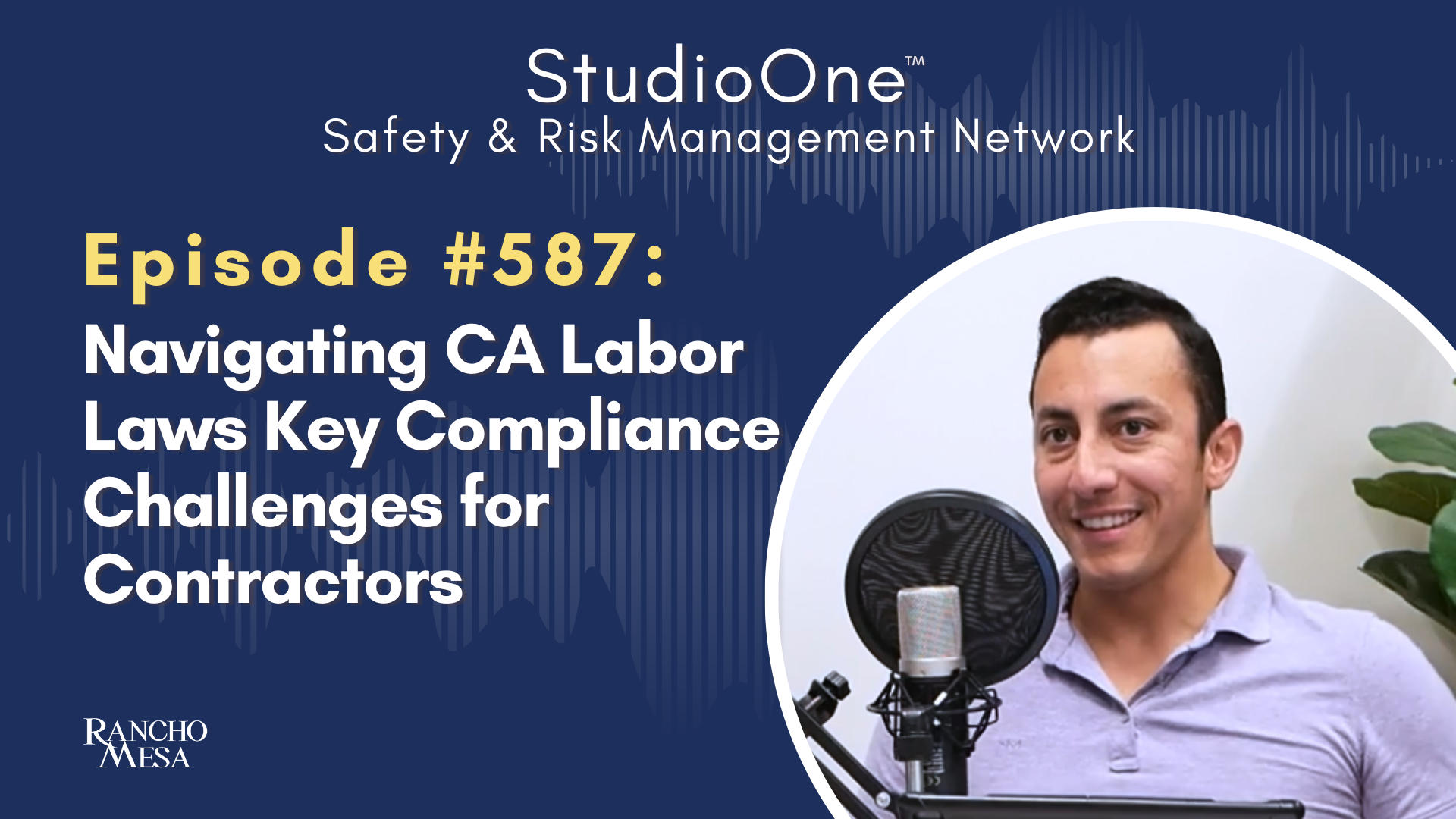
Jason Fischbein of Fisher Phillips sits down with Matt Gorham to discuss some of the primary labor and employment law issues currently impacting contractors, especially those within the HVAC and Plumbing industries.
Recognized by San Diego Business Journal as one of the 40 Next Business Leaders Under 40, Jason provides insights to the challenges of compliance with California’s highly technical labor code, specifically around meal breaks and rest periods, determining regular rates of pay, and the importance of the interactive process for employee accommodations.
Jason also discusses how wage and hour issues can develop into PAGA claims, and offers suggestions to avoid them.
Matt Gorham: You're listening to Rancho Mesa’s StudioOne™ podcast, where each week we break down complex insurance and safety topics to help your business thrive. I'm your host, Matt Gorham, and I'm joined by Jason Fischbein with Fisher Phillips, and I appreciate you being here. So, yeah, Jason, first and foremost, thanks for making the time to sit down with me.
Jason Fischbein: Thanks for having me, Matt. First ever podcast for me, so looking forward to it.
MG: I'm excited to hear how it goes. So let's jump in. I guess I want to start first because I know San Diego is a really close-knit market, a really interesting community here. And so you're from Chula Vista, so you're from the San Diego area. You've got a lot of personal experience here.
JF: Yep. San Diego, born and raised. I grew up in Chula Vista. Currently live in North Park and have been in San Diego my entire life, apart from three years of law school.
MG: Well, I understand you also went to UCSD, correct?
JF: Yes, UCSD for undergrad. I was a political science major at Roosevelt College and loved my time up there. Nothing beats going to college so close to the beach, right?
MG: I can relate to that. I mean, I fellow triton here. So, yeah, I'm sure we've got some stories that we can share offline. But you mentioned, of course, three years away from the San Diego area to go to school, and you went to Stanford.
JF: Yeah, Stanford for law school. Bay Area, of course, is not too different, but I was eager to come back to San Diego, all my family's here. And I always knew that right after law school, I'd come straight back and start my practice with a focus on employment law.
MG: That's fantastic. You know another personal connection for me. My dad's a Stanford alum, so obviously speaks to your qualification and your insights. I mean, you were recognized as 40 Next Business Leaders Under 40 by the San Diego Business Journal. Tell me about that.
JF: That was quite the honor. And that was bestowed on me last year. It's something that I'm proud of. and it's always rewarding to be recognized in my hometown community.
MG: Well, congratulations to you on that. And, you know, it's a testament to you and your work, your expertise, and the way that you serve your clients. So we'll jump into some questions here. And just to clarify the point, of course, that you focus specifically on labor and employment law. And so we're really going to offer some, I think, valuable insights on some of these areas here. With that focus, what are some of the most common challenges that contractors run into with respect to labor and employment law?
JF: Yeah, thanks, Matt. So you're exactly right. My practice is 100% employment law and focusing specifically on the management side, so representing businesses. And I would say that the biggest challenge that I'm seeing from plumbing, HVAC clients, but also clients in practically any industry, is how to comply with California's labor code, which is hyper-technical and also uncompromising.
The penalties for violating the labor code can be very severe and the consequences can be dire. So just one example off the top of my head. In the plumbing industry, for example, often the employees are compensated either on a commission basis or with bonus compensation. And depending on what type of compensation the plumber is receiving, the company needs to make sure that they're incorporating that type of incentive compensation in the rate that employees are earning for their meal break premiums, their rest break premiums, their overtime pay, their sick leave pay. So there's all sorts of factors to be aware of simply because an employee receives a non-discretionary bonus and now leads to all these other ramifications.
MG: Yeah, I really like the way that you use the word hyper-technical there. You know, it does seem like there are certain laws that almost contradict other laws and use some technical language here, of course, because it does depend on the specifics of the situation, and they don't always translate well to, you know, plain English, where I think it is really beneficial for people to work with you or someone like you because you can help them understand how do these hyper-technical terms really apply within the operations of their business?
And the fact that you work exclusively with the business side of management, you can help them to navigate the complexity of it and make decisions that set them up for success depending on what roles their employees are performing for them. Whether those are true salespeople, whether those are technicians, or whether there's a mixture of responsibilities for particular individuals that work for them.
JF: Yeah, absolutely. And you're exactly right. Whether they are exclusively focused on sales or whether they're at the client customer sites doing the hard technical work, it can drastically vary what rules of play are governing the compensation structure.
MG: Yeah. And so, you know, compliance, a lot of different ways that that can be interpreted or applied. But I'm curious to hear, because you mentioned that there are ramifications and consequences.
What would you say are the three, I guess, kind of main issues that plumbing/HVAC clients are coming to you for? Because I imagine most of them fall within compliance. But are those specific areas you mentioned meal breaks, rest breaks, commission structure. Can you speak a little bit more about some of those main issues?
JF: So I was going to start with meal and rest breaks. You hit the nail on the head there. It's very important in California that a meal break and a rest break be completely uninterrupted. So what we mean by uninterrupted is the employee cannot be receiving any work-related emails, any work-related calls, or fielding any work-related questions when they should be taking their meal break or the rest break. And if they do get a work-related call and they answer that call, they're going to either have to be paid a meal break premium for that interrupted meal break or, as soon as possible, reset things and go and take now a true proper uninterrupted 30-minute meal break. Right?
And practically speaking, it may not always be possible to reset that meal break. So now we have to be aware of, well, we need to pay this particular employee a premium because their break was interrupted. And then the question is, what hourly rate should that premium be paid at? And that entirely depends on their base rate of pay, as well as any non-discretionary bonuses they're receiving.
So for example, if they receive a bonus because they were able to refer a particular customer to an additional service that they're purchasing or that they're receiving from the company. Now potentially we have to incorporate the value of that compensation into the meal break premium rate. And it can get quite complicated. So we call this the regular rate of pay. Determining the regular rate of pay is always very tricky, especially in industries where the hourly employees are receiving all sorts of non-discretionary compensation, as is common in the plumbing industry in particular.
MG: Yeah, it's interesting you talk about, you know, the uninterrupted nature of these meal breaks, which is so difficult on both the construction side, you know, for guys that are at the job site of what conversation or what responsibilities, they're able to just completely shut down that aren't in some way able to be construed as work related. Or on the service side, you know, where guys are going from one job site to the next, you know, or one service call to the next. And so their breaks are more or less drive time. You know, is that really considered a break? I think most people would say no and yes at the same time, depending on how you interpret it. Obviously, the law is going to say no, but, you know, meal breaks in particular, you know, it’s common for people to just pick up food on the way from one call to the next. And so it's not really having uninterrupted time for a break, but it's kind of common practice. So it does seem like it's very difficult to provide those uninterrupted breaks.
JF: Right. And it's challenging just to track them, right? Because if you have an employee that's in the field, they're servicing one home on a plumbing issue, and then their next job is 20 minutes away, so they're driving to another customer's home. Making sure that the employee is tracking when their break time starts, when their break time ends, and ensuring that they're not performing any work-related activities during that time can be difficult in and of itself. So yeah, I completely agree with you. It can be tricky and most importantly we need to emphasize clear policies and practices. The employee needs to understand what is expected of them. And then we need to enforce those policies and practices, right? That's the logical next step. So if we have an employee that is not taking an uninterrupted break instead they are just eating and driving and going to the next client's site I would consider that to not be a truly uninterrupted break so my guidance to my clients all the time is to emphasize to the employees you need to take an uninterrupted break you should not be performing any work-related activity during that break and that would include driving to wherever the next job is, right? That counts as work-related activity, and that is not sufficient for a break. That break needs to be uninterrupted.
And, of course, if the break is interrupted, if the break is interrupted, the employee should be able to report that to the company, and the company then needs to be able to investigate, you know, what were the factors and circumstances at play that prompted this employee to say that they could not take an uninterrupted break. And if the company deems that break to have been interrupted, now the company should, in all likelihood, be paying a meal period premium. But there should be a process in place to basically allow the employee to report an interruption to the break and then allow the company to investigate and review the circumstances so that they can then make that decision as to what sort of premium needs to be paid.
MG: Yeah, it makes sense. So you mentioned that meal breaks and interest periods are kind of the top issue that clients are coming to you for. What's another area that you're seeing your clients have an issue with compliance?
JF: In the trade industries, right plumbing HVAC and similar industries tools and how to compensate for tools is always a big one that I'm seeing. So under the labor code if an employee is carrying their own tools they need to be earning at least twice the minimum wage and often in these industries we have an employee that is provided the tools by the employer but they might carry their own wrench because they like it, right? Or their own certain pocket knife or any other sort of tool that they personally own and that they deem to be reliable and they want to use their own tools, even though their employer provides them all the tools, right?
So, the way to solve this, in my view, is to have a clear tool usage policy that says, “this employee acknowledges and agrees that they have been provided all the tools they need for the job.”
Or, on the contrary, “this employee is providing their own tools.” We need to have clarity as to which situation is at play. Does this employee bring their own tools to the job? Or is this employee provided all of the tools they need for the job? And if it's the former, if they bring their own tools, the company needs to make sure that they're being paid at least twice the minimum wage.
MG: Yeah, which again gets into the complexity of when you've got these variable pays, you know, commissions and discretionary bonuses that can influence that calculation. Because, you know, I don't think I've met anyone in the field that doesn't have some preference for the tools that they're using.
And you're going to be hard pressed to find two guys in the field that agree exactly on what the best brand is or the best tools for the job. So it creates a bit of friction or conflict. So I appreciate you offering of suggestions too about, again, it seems like having clear policies in place, setting expectations and enforcing the policies.
And I know there's a few other challenges, some other issues that your clients are coming to you for, you know, talked about meal breaks and rest periods, compliance with employees providing their own tools and wages and how that comes into play. Is there another issue or kind of another topic that you're seeing a lot of questions around from your clients?
JF: Yeah, well, generally speaking, just to shift gears completely and kind of leave the wage and hour realm, because it's not only wage an hour that's difficult, right? Whenever there's a need for an interactive process discussion for an employee that may have medical restrictions, for example. That's always very challenging. And a couple of rules of thumb when I am helping clients navigate the interactive process and evaluating reasonable accommodation requests, I would say first and foremost, those types of discussions should be handled in conjunction with human resources. If there's a dedicated human resources department, my strong preference and guidance is to get human resources involved rather than having a supervisor try to handle that type of discussion because a supervisor typically doesn't have the training necessary to have that type of discussion and is also balancing hundreds of other items. So it's best to get human resources involved whenever we need to have an interactive process dialogue with an employee that is seeking medical restrictions or accommodations.
And secondly, it's important that the company is creative and open-minded rather than closed-minded. So if we have an employee that wants to continue working but they have some sort of medical restrictions, then companies should be approaching this from the perspective of, “We need to consider any and all possibilities to try to allow this employee to continue working, consistent with their medical restrictions, of course.”
And if the restrictions are unclear because the medical note is unclear, it is permissible to ask the employee to request an updated note. It's entirely contact-specific, so it's difficult to capture all the factors in a hypothetical scenario, but I would say this is why it's so important to get the assistance of human resources and legal counsel when dealing with the interactive process questions.
MG: Yeah, I really appreciate your point on the last part in particular, Jason, because there are so many different accommodations that might come up, and there are so many rules that govern what you can and can't ask, you know, at the hiring process or in the course of employment, yet there are expectations for accommodations around, you know, medical limitations.
And, I know, one of the areas that I've seen be addressed is clearly defining job descriptions so that there's a very well understood and clear idea and understanding of what an employee is expected of them within the course of their work and whether they can or cannot perform the duties of the job that they're being hired for or reassigned to. But your point about, you know, working with HR, working with legal counsel, everything that you've talked about really is proactive, or maybe not everything, but I think there's a strong emphasis that I'm picking up about kind of a proactive approach instead of just a reactive approach that once something has gone wrong, how do we address it? But more saying, how do we put the right systems in place? Again: policies, enforcement, clear communication and support to avoid the issues from really having the dire consequences that you've referred to.
JF: Absolutely. Yeah, I love to be proactive because it's much better to address an issue before it turns into litigation. And so I handle both, right? I handle plenty of litigation, but I also handle advising and counseling before there's a legal dispute. And the better job that our clients can do on the front end, the more likely it is they won't have a litigation down the line.
So I really enjoy advising and counseling my clients and solving issues before they turn into litigation. Not only does it save them time, money, and headaches, but it also ensures but it also ensures that the employees feel taken care of and are in good spirits as well.
MG: Yeah, which is a really good point that it's morale. It’s do the employees feel like they are a part of the team? Do they feel like they've got an interest in the success of the business or if they feel like they're being exploited, you know, or taken advantage of? Because that's where I think a lot of situations can arise in different forms that jeopardize the success of the business. And one of those wage and hour claims, you know, PAGA claims, you mind speaking to that a little bit? Because it a little, like, those can be retaliatory.
JF: Yeah, so PAGA claims are constant thorn in the side of almost any employer in California. And PAGA, it stands for the Private Attorney's General Act. This law has existed for over 20 years now in California. And these claims just become more and more prevalent in this state. And on a basic level, an employee who brings a PAGA claim is intending to stand in the shoes of the labor commissioner to enforce the labor code. So an employee basically can say that they want to represent not only themselves, but also other employees that have suffered the same type of labor code violation. And they can do that without having to exhaust all the formalities of a class action lawsuit.
So basically, PAGA claims are very worrisome and difficult to deal with in California because it allows for representative claims, claims made on behalf of dozens, potentially hundreds or thousands of employees, all in the interest of enforcing the labor code because the state of California doesn't have the resources to enforce every single labor code claim. That's the underlying rationale behind the law, but we've seen essentially just hundreds of these types of claims filed every single day.
And it could be the smallest violation of the labor code, but now you have an employee that tries to represent all other non-exempt employees for that same type of violation. So basically the reason that PAGA is such a powerful tool for employees is because it can turn one small issue into now a very large scale legal headache for the employer. So in my practice, I am helping clients with PAGA and class action types of wage and hour cases probably at least 50% of the time in my day-to-day practice. And having strong policies and practices is absolutely the first step to avoid that type of litigation before it can ever materialize.
MG: Yeah. So it seems like that, you know, wage an hour leads itself right into potential exposure for pocket claims.
JF: Right. Yeah, that's exactly right.
MG: Yeah. Jason, you mentioned that, you know, a lot of your advice includes bringing in legal counsel like yourself, as well as HR, and a lot of smaller companies maybe don't have access to those resources or don't invest in them yet. But I'm curious to hear your thoughts. You know, is there a certain size where a business becomes more vulnerable to these type of issues?
JF: Yeah, it's a really good question, Matt. And unfortunately, no matter how large or small the employer is in California, there's always going to be risk. And especially for labor code compliance, even the small companies have to comply with the labor code. And if there is a violation, especially a systemic violation that can impact all of the non-exempt employees, for example, that can turn into a PAGA lawsuit. It can turn into a class action depending on the circumstances. And the size of the company really has no bearing, right?
So of course, the bigger companies have more employees so there's more volume to go around and potentially bring a claim. But even the small companies need to ensure that they're complying with their labor code, that they're working with counsel if they can or at least have a dedicated person that is focused on those compliance efforts because simply being a small company isn't going to eliminate the litigation.
And in fact, it could mean that the litigation has the potential to threaten the viability of the business because it is a small company, right? So no matter what, my advice is to have a dedicated person at the company who is thinking about labor code compliance, working with trusted advisors as possible and as needed to ensure compliance, and also staying abreast with the latest changes in the laws because the labor code and other legislation in California changes on a yearly basis. And it's always kind of a moving target, just another reason why it's so difficult to do business in this state. And so something as simple as making sure your handbook is updated on a yearly basis can ensure that the company is taking the right steps to protect themselves.
MG: Again, just a number of really good points there. One of them is, it comes to mind for me, you know, big businesses now, they haven't always been big businesses. They started as a small business and they've been able to grow just through whatever circumstance they were able to navigate or persevere. And a lot of small businesses end up either staying small or end up unfortunately having to close their doors because of the threat of something like this if it should arise. So being proactive and having the right trusted advisors in place can make a huge difference for how to avoid or how to handle a situation like this should it arise.
You also talk about how quickly and how frequently the laws can change and how important is to stay in compliance. We're able to offer our clients a living handbook that's able to offer updates consistently as new laws go into effect. But I'm curious to hear your thoughts. Are there any new laws that went into effect January 1st that you took special interest in?
JF: Yeah, Matt, so one law that I wanted to point out for purposes of today's discussion is Senate Bill 642, which takes effect on January 1st, 2026. And this new law imposes significant changes to California's pay transparency requirements. Under this new law, employers will have to be more specific about the pay ranges that they provide in job posting. So what this really means is that an employer in a job posting should be providing a good faith estimate of the salary or hourly wage range that the employee could reasonably expect to be paid for that position. And that needs to include not only the base pay, but bonuses, commissions, other non-discretionary compensation, and it needs to be for the specific job position that that candidate would reasonably expect it to be offered rather than the position on a more broader scale.
So if this specific applicant would be expected to be paid, this base hourly pay, this type of bonus, and this type of other incentive compensation, that needs to be accounted for on the job posting. It also ensures that the statute of limitations for a fair pay type of claim is extended to three years. And the employee could potentially recover lost wages for a period of up to six years. So again, pretty significant consequences for noncompliance. And this is just another way that California is always reshaping the laws to make things more challenging for our clients in California.
MG: Yeah, which it's a good point, right? Because this stuff does evolve quickly. And from the insurance side of things, a lot of the conversations that we have is how to transfer that risk, what to retain as clients or as business owners, but also how to work with the right people to put the right controls in place and maintain and enforce the right policies and the right controls.
So, Jason, we've talked about a lot of different topics, and I'm sure that, you know, some of our listeners might have additional questions. If they want to reach out to you, how do they get in touch with you?
JF: Yeah, thanks, Matt. So the best way to reach me is at my law firm email address, jfischbein@fisherphillips.com. And they could also call me, and I'm available anytime. Always happy to assist, regardless of what the underlying need is, I'm available to chat. And I appreciate you giving me this opportunity to chat about these items with you today.
MG: Yeah, thank you so much for making the time, Jason. Again, it was great to have you. Thanks again for coming down and sit down with us.
JF: Yeah, thank you, Matt, very much.
MG: Thanks for tuning in to our latest episode produced by StudioOne. If you enjoyed what you heard, please share this episode and subscribe. For more insights like this, visit us at RanchoMesa.com and subscribe to our weekly newsletter.
New AI Regulations for California Employers
Author, Jadyn Brandt, Client Communications Coordinator, Rancho Mesa Insurance Services, Inc.
On October 1, 2025 California employers with five or more employees will be required to follow new Artificial Intelligence (AI) regulations. The amended regulations address the use of automated-decision systems (ADSs) in employee or prospective-hire evaluations, applying existing antidiscrimination laws to new AI technologies.
Author, Jadyn Brandt, Client Communications Coordinator, Rancho Mesa Insurance Services, Inc.

On October 1, 2025 California employers with five or more employees will be required to follow new Artificial Intelligence (AI) regulations.
The amended regulations address the use of automated-decision systems (ADSs) in employee or prospective-hire evaluations, applying existing antidiscrimination laws to new AI technologies.
Automated-Decision Systems
Employers will be required to comply with the state’s existing antidiscrimination laws when using an ADS. For work-related purposes, an ADS is defined as any computational process that makes or supports employment decision-making, including hiring, promotion, or termination. An ADS may use artificial intelligence, algorithms, or other types of data processing to:
Screen, evaluate, or make predictive assessments about applicants or employees, including their skills, abilities, personality or cultural fit.
Share job advertisements or recruiting materials to certain groups.
Screen resumes for key terms.
Analyze observable traits from online interviews, including facial expressions, word choice, or tone of voice.
Analyze third party data.
Accommodations
Improper use of ADS can lead to discrimination based on disability or religious creed. Individuals with disabilities could be placed at an unfair disadvantage if an ADS evaluates physical abilities or cognitive traits. An applicant’s or employee’s religious beliefs or practice could also conflict with the screening process used by an ADS. Employers should consider whether reasonable accommodations are required in either case before making a decision based on an ADS.
Recordkeeping
Data collected from an automated-decision system must be retained by employers for four years from the date the record was created or the date of the action taken as a result of the ADS, whichever is later.
To ensure your business is compliant with the new regulations, there are a few steps you can take.
Retain ADS data for at least four years.
Ensure HR and managers are aware of what accommodations for a disability or religious beliefs might be required, when using an ADS in employment decisions.
Resources for staying up-to-date with state and federal laws can be accessed through Rancho Mesa’s RM365 HRAdvantage™ portal. Rancho Mesa’s HR experts are also available for clients to answer specific questions about the new regulations and how they could impact your business through the HR portal.
Staying Compliant: Updating Your Human Resources Policies
Author, Jadyn Brandt, Client Communications Coordinator, Rancho Mesa Insurance Services, Inc.
In today’s rapidly changing legal landscape, it is more important than ever to ensure your company’s policies and procedures are kept up-to-date. Updating your employee handbook is a vital step in ensuring employees are aware of new policies and understand what is expected of them.
Author, Jadyn Brandt, Client Communications Coordinator, Rancho Mesa Insurance Services, Inc.

In today’s rapidly changing legal landscape, it is more important than ever to ensure your company’s policies and procedures are kept up-to-date.
Updating your employee handbook is a vital step in ensuring employees are aware of new policies and understand what is expected of them.
A yearly review of your company handbook is recommended, in order to prevent a lapse in compliance. In order to streamline this process, Rancho Mesa’s RM365 HRAdvantage™ portal provides important law updates at both the state and federal level. Additionally, if you choose to build your company handbook through the HR Portal, updates to your policies will be automatically be suggested to reflect any new laws or requirements.
If you are actively reviewing your company policies or simply want to get a head start on next year’s policy changes, login to the HR portal to get your state-specific requirements. Below are a few notable California law updates:
1. California Minimum Wage Increases for 2026
On January 1, 2026 the standard state minimum wage will increase to $16.90 per hour. The minimum salary threshold for exempt employees will also increase to $70,304 per year.
Employers who fall under local or industry-specific minimum wages that are higher must comply with those rates.
2. California Publishes Required Victim Leave Notice
A new notice requirement took effect July 1, 2025 as part of California’s expanded victim protection leave law. The California Civil Rights Department (CRD) released a model notice which employers need to provide:
To new employees upon hire
To all employees annually
At any time upon request
Any time an employee informs the employer that they or their family member is a victim
Employers can also choose to create their own notice provided it meets the requirements of the law.
3. Updated California Regulations Addressing Automated Decision Systems
The California Civil Rights Department (CRD) has updated the Fair Employment and Housing Act (FEHA) regulations on FEHA to employers’ use of an automated decision system (ADS) such as an AI applicant screening tool.
The updated regulations prohibit any discrimination that results from an employer’s use of an ADS or selection criteria—even when performed by a third party system.
The amended regulations apply to employers with five or more employees and will take effect on October 1, 2025.
For questions about how to update your employee handbook in the HR portal, contact your Client Services representative.
4 Steps to Ensure I-9 Compliance and Prepare for an Audit
Author, Jadyn Brandt, Client Communications Coordinator, Rancho Mesa Insurance Services, Inc.
The Trump administration has placed a strong emphasis on immigration policy. Significant changes to employment-based immigration and work authorization are anticipated to take effect within the next four years. For employers, this means I-9 compliance should be a top priority in order to avoid costly fines.
Author, Jadyn Brandt, Client Communications Coordinator, Rancho Mesa Insurance Services, Inc.

The Trump administration has placed a strong emphasis on immigration policy. Significant changes to employment-based immigration and work authorization are anticipated to take effect within the next four years. For employers, this means I-9 compliance should be a top priority in order to avoid costly fines.
All employers in the United States are required to complete and maintain Form I-9 for each employee as proof of work authorization status. Businesses can be audited for I-9 compliance at any time. If your business is selected for an audit, you will have three days to provide documentation to U.S. Immigration and Customs Enforcement (ICE) inspectors.
Implement these four steps to ensure your business is in compliance before an audit takes place:
1. Complete I-9 forms for all employees
Documentation is required from both employees and employers. Employees should provide employers with proper documentation and proof of work authorization. Section 1 of Form I-9 will need to be completed by the employee. Employers will need to verify the validity of those documents and enter necessary information into the employer’s own records, in Section 2 and Supplement B of Form I-9.
Rancho Mesa clients can access additional guidance for completing the Form I-9 in the RM365 HRAdvantage™ portal to ensure record-keeping compliance.
2. Conduct an internal audit
Conducting an internal audit can help catch any errors before a formal audit occurs. Depending on the size of your business, you may want to audit all employee I-9 records, or for really large companies, just audit a portion of your records. Check for any errors or omissions in I-9 forms, ensure all forms are compliant with current Form I-9 requirements, and dispose of any expired I-9 forms. Regular internal audits can help ensure your business is prepared in the event of an official audit.
3. Correct any I-9 errors
If you do find any errors through an internal audit, be sure to correct them right away. To correct Form I-9 in accordance with U.S. Citizenship and Immigration Services (USCIS) guidelines simply:
Draw a line through the incorrect information
Enter the correct information
Initial and date the correction
Errors made in Section 1 must be corrected by the employee, and errors made in Section 2 or Subsection B will need to be corrected by the employer.
4. Store I-9 forms and related documents in a secure location
I-9 forms contain sensitive information and should be kept in a safe and secure location. USCIS requires I-9 forms for each employee must be kept by an employer “for three years after the date of hire, or one year after the date employment ends, whichever is later.”
If an audit conducted by ICE does find your business to be in violation of I-9 requirements an employer could face fines worth tens of thousands of dollars. Repeat violations could also lead to criminal charges.
For questions about keeping your business in compliance with Form I-9 requirements, use the RM365 HRAdvantage™ portal to contact an HR expert.
SB 428: Expanding California’s Workplace Violence Restraining Order Law to Protect Against Harassment
Author, Jadyn Brandt, Client Communications Coordinator, Rancho Mesa Insurance Services, Inc.
A new California law expands the state’s protections around workplace violence restraining orders. Beginning January 1, 2025, employers were given the right to seek a temporary restraining order on behalf of an employee who has suffered harassment in the workplace. California State Senate Bill 428 (SB 428) was authored by Senator Catherine Blakespear and signed into law by Governor Gavin Newsom.
Author, Jadyn Brandt, Client Communications Coordinator, Rancho Mesa Insurance Services, Inc.

A new California law expands the state’s protections around workplace violence restraining orders.
Beginning January 1, 2025, employers were given the right to seek a temporary restraining order on behalf of an employee who has suffered harassment in the workplace. California State Senate Bill 428 (SB 428) was authored by Senator Catherine Blakespear and signed into law by Governor Gavin Newsom.
Existing state law allows employers to seek a temporary restraining order against a person who has perpetrated acts of violence in the workplace or has made credible threats of workplace violence. SB 428 expands those protections to allow employers to seek a temporary restraining order against a person who has harassed their employee(s), before harassment escalates to violence or threats of violence.
Individuals can also seek a restraining order against harassment for themselves.
The text of the bill defines harassment as, “a series of acts over a period of time, however short, evidencing a continuity of purpose, including following or stalking an employee to or from the place of work; entering the workplace; following an employee during hours of employment; making telephone calls to an employee; or sending correspondence to an employee by any means, including, but not limited to, the use of the public or private mails, interoffice mail, facsimile, or computer email.”
If an employer does request a temporary restraining order, and that order is granted by a judge, SB 428 states that the order will remain in effect for up to 21 days.
If the perpetrator of the harassment—otherwise known as the “respondent”—is also an employee of the same company that is requesting the temporary restraining order, a hearing will be held, “concerning the employers’ decision to retain, terminate, or otherwise discipline the respondent.”
If the respondent is determined to have been engaged in unlawful harassment, a restraining order may be issued with a duration of up to three years and the employer can request a renewal, “any time within the three months before the expiration of the order.”
However, the law does not allow employers to seek temporary restraining orders for any behavior or speech that is “constitutionally protected, or otherwise protected by Section 527.3 or any other provision of law.”
Rancho Mesa has a number of resources that can help protect your company and employees from workplace violence. Harassment prevention training, workplace violence training, and workplace violence policies can be found on the RM365 HRAdvantage™ portal.
Updates to California Sick Pay and PTO in 2025
Author, Jadyn Brandt, Client Communications Coordinator, Rancho Mesa Insurance Services, Inc.
Beginning on January 1, 2025, changes to California paid sick leave and paid family leave took effect in California. To ensure your business is in compliance with these new requirements, update your paid sick leave policy to include these new uses. Employers should also update family leave policies to remove any requirement that employees must use accrued vacation time before receiving PFL benefits on or after January 1.
Author, Jadyn Brandt, Client Communications Coordinator, Rancho Mesa Insurance Services, Inc.

Beginning on January 1, 2025, changes to California paid sick leave and paid family leave took effect in California.
Use of Paid Sick Leave Expanded
The use of paid sick leave has been expanded to cover additional reasons for absence including:
Jury duty
Appearance in court under a court order as a witness in a judicial proceeding
Any reason covered under the victim leave law, if the employee or their family member is a victim of any qualifying act of violence (QAOV)
Additionally, agricultural workers whose job description requires them to work outside may use paid sick leave to avoid unsafe smoke, heat, or flooding conditions.
To ensure your business is in compliance with these new requirements, update your paid sick leave policy to include these new uses.
Use of Paid Family Leave Requirements Changed
The requirements for an employee to use paid family leave have also been updated. Employers can no longer require employees to use up to two weeks of accrued, unused vacation time before they are able to receive Paid Family Leave (PFL) from the state.
Employers should update family leave policies to remove any requirement that employees must use accrued vacation time before receiving PFL benefits on or after January 1.
Changes to paid sick leave and Paid Family Leave policies can be made through Rancho Mesa’s RM365 HRAdvantage™ portal by utilizing the Company Policies/Handbooks feature.
For more information on other important changes to California employment law, register for Rancho Mesa’s 2025 Employment Law Update webinar.
Cal/OSHA’s COVID-19 Prevention Non-Emergency Standards End, Employers Still Required to Document COVID-19 Cases
Author, Jadyn Brandt, Client Communications Coordinator, Rancho Mesa Insurance Services, Inc.
February 3, 2025 marked the end of the California Division of Occupational Safety and Health (Cal/OSHA) COVID-19 Prevention Non-Emergency Standards. However, while California employers are no longer required to follow any regulatory requirements, COVID-19 reporting and recordkeeping requirements (Title 8 Subsection 3205(j)) remain effect until February 3, 2026.
Author, Jadyn Brandt, Client Communications Coordinator, Rancho Mesa Insurance Services, Inc.

February 3, 2025 marked the end of the California Division of Occupational Safety and Health (Cal/OSHA) COVID-19 Prevention Non-Emergency Standards.
However, while California employers are no longer required to follow any regulatory requirements, COVID-19 reporting and recordkeeping requirements (Title 8 Subsection 3205(j)) remain effect until February 3, 2026. The requirements specify that the employer must:
Keep a record of all employee COVID-19 cases.
These records should include the employee’s name, contact information, occupation, location where the employee worked, the date of the last day at the workplace, and the date of the positive COVID-19 test and/or COVID-19 diagnosis
These records must be kept for two years “beyond the period in which the record is necessary to meet the requirements of this section.”
Provide information on COVID-19 cases to all health and safety governing bodies when requested.
These records must be provided to the local health department that holds jurisdiction over the location of the workplace, the California Department of Public Health (CDPH), Cal/OSHA, and the National Institute for Occupational Safety and Health (NIOSH) immediately upon request and when required by law.
Although employers are no longer required to enforce a specific set of COVID-19 regulatory requirements, California employers must still adhere to state health and safety guidelines. These guidelines include:
Maintaining a “safe and healthful” place of employment for all employees as required by Labor Code section 6400.
Establishing, implementing, and maintaining an effective Injury and Illness Prevention Program (IIPP) as required by Title 8, California Code of Regulations, section 3203.
Identifying, evaluating, and correcting any and all unsafe or unhealthy conditions, practices, or procedures associated with COVID-19 if COVID-19 is identified as a workplace hazard.
A COVID Resources Toolkit is available through Rancho Mesa’s RM365 HRAdvantage™ portal.
More information can be found on Cal/OSHA’s COVID-19 Guidance and Resources webpage.
New California Employment Laws for 2025
Author, Jadyn Brandt, Client Communications Coordinator, Rancho Mesa Insurance Services, Inc.
Starting January 1, 2025, a number of new laws will be on the books for employers in California. Here’s a look at two of the changes business owners need to be aware of at the start of the new year.
Author, Jadyn Brandt, Client Communications Coordinator, Rancho Mesa Insurance Services, Inc.

Starting January 1, 2025, a number of new laws will be on the books for employers in California. Here’s a look at two of the changes business owners need to be aware of at the start of the new year.
First, Senate Bill 1100 (SB 1100)bars employers from requiring a driver’s license for a job, unless that job satisfies a two-part test. Employers will only be able to include a driver’s license requirement in a job posting if they “reasonably expect driving to be one of the job functions for the position,” and “reasonably believes […] using an alternative form of transportation (including ride hailing, carpooling, walking or biking) would not be comparable in travel time or cost,” according to the law.
Another new law worth noting requires multiple updates to workers’ compensation and whistleblower posters in the workplace. Assembly Bill 1870 (AB 1870) requires employers to add new information to the informational poster titled “Workers’ Compensation Notice to Employees — Injuries Caused by Work.” Starting January 1, 2025, the poster must alert employees that they may take council from a licensed attorney for advice on their legal rights.
Additionally, employers will also need to display a whistleblower notice that discloses an employee’s rights and responsibilities under the state’s whistleblower laws.
It is important that employers across the state of California understand how to implement these new laws within their business, in order to avoid legal penalties and foster a fair and informed workplace. Managers should work with their human resources department to ensure their business is in compliance with these new laws.
Rancho Mesa’s RM365 HRAdvantage™ is a great resource for employers looking to make certain they are up to date with these changes.
These are just a few key laws California employers should keep in mind for the upcoming year.
For a full breakdown of the changing legal landscape, be sure to attend Rancho Mesa’s 2025 Employment Law Workshop, happening Friday, November 22, 2024 from 10:30 A.M. to 11:30 A.M. at the Mission Valley Library.